
What is linear regression?
Linear regression analysis is used to predict the value of a variable based on the value of another variable. The variable you want to predict is called the dependent variable. The variable you are using to predict the other variable’s value is called the independent variable. (IBM)
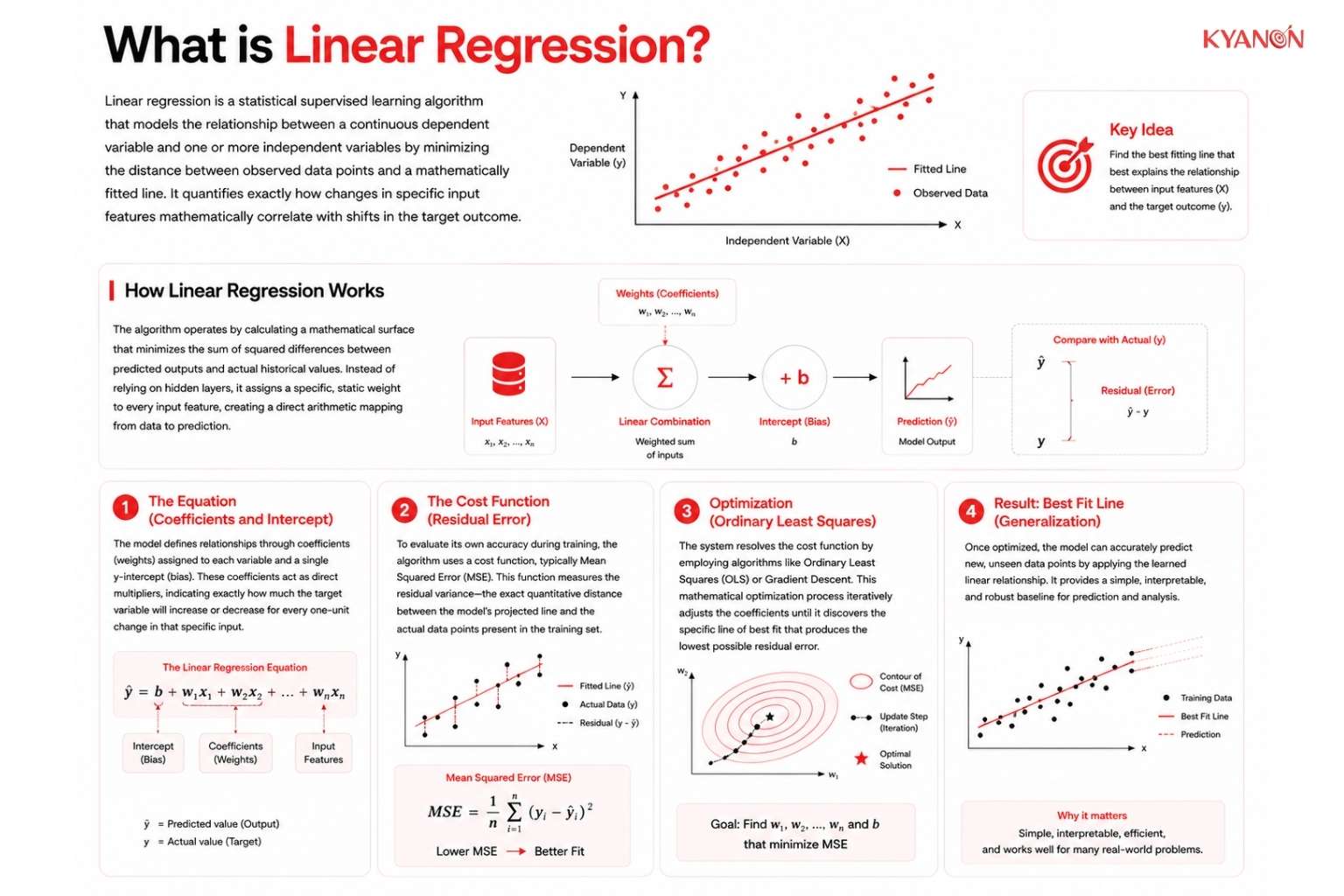
How linear regression works
The algorithm operates by calculating a mathematical surface that minimizes the sum of squared differences between predicted outputs and actual historical values. Instead of relying on hidden layers, it assigns a specific, static weight to every input feature, creating a direct arithmetic mapping from data to prediction.
The Equation (Coefficients and Intercept)
The model defines relationships through coefficients (weights) assigned to each variable and a single y-intercept (bias). These coefficients act as direct multipliers, indicating exactly how much the target variable will increase or decrease for every one-unit change in that specific input.
The Cost Function (Residual Error)
To evaluate its own accuracy during training, the algorithm uses a cost function, typically Mean Squared Error (MSE). This function measures the residual variance, the exact quantitative distance between the model’s projected line and the actual data points present in the training set.
Optimization (Ordinary Least Squares)
The system resolves the cost function by employing algorithms like Ordinary Least Squares (OLS) or Gradient Descent. This mathematical optimization process iteratively adjusts the coefficients until it discovers the specific line of best fit that produces the lowest possible residual error.

Linear Regression vs Deep Neural Networks
Both approaches generate mathematical predictions, but they optimize for entirely different operational priorities in production environments.
Dimension | Linear Regression | Deep Neural Networks |
| Interpretability | Complete mathematical transparency | Black box |
Compute requirements | Minimal (Microseconds) | High (Requires GPUs) |
| Risk of overfitting | Low | High without regularization |
Non-linear data handling | Requires manual feature engineering | Native automated extraction |
| Best for | Financial forecasting, pricing elasticity | Image recognition, NLP |
When to consider linear regression
Consider linear regression if:
- Your organization operates under strict regulatory requirements where AI models must provide explicit mathematical proof explaining how a decision or forecast was calculated.
- Your finance or pricing team requires exact quantification of how individual business levers, such as a 5% discount rate, impact overall sales volume.
- You are operating with limited historical datasets where highly complex models would immediately overfit to noise rather than identifying underlying business patterns.
It may not be the right priority if:
- Your primary predictive task involves extracting intent from unstructured data sources, such as parsing sentiment from raw customer service audio logs.
Real-world applications of linear regression
Sales forecasting and trend analysis
Linear regression can help organizations identify patterns and predict future outcomes based on historical data. For example, businesses can estimate a salesperson’s annual revenue by analyzing factors such as experience level, educational background, and age. By quantifying the relationship between these variables and sales performance, companies can make more informed planning and resource allocation decisions.
Understanding price sensitivity
Businesses frequently use linear regression to measure how price changes influence customer demand. By examining the relationship between product pricing and purchasing behavior, organizations can determine whether demand decreases as prices rise, identify acceptable pricing thresholds, and uncover the point at which customers begin reducing purchases. These insights support more effective pricing strategies and revenue optimization.
Insurance risk assessment
Insurance providers can apply linear regression models to estimate potential claim costs and evaluate risk exposure. For instance, by analyzing historical claims data, insurers can predict the likely financial impact of homeowners’ insurance claims. These forecasts enable decision-makers to allocate investigative resources more efficiently and make better-informed underwriting and risk management decisions.
Why linear regression matters for enterprise data systems
Linear regression matters for enterprise data systems because it serves as the foundational mathematical layer for cost-efficient, high-speed predictive analytics directly within cloud databases.
While modern generative AI captures public attention, enterprises still run their core financial, supply chain, and operational forecasting on structural table data. Linear regression provides a mathematically clear, legally compliant, and resource-light way to turn raw database rows into immediate predictive insights.
Common misconceptions
High correlation equals causation
The Reality: The model only proves that two events change at the same time (correlation). It cannot prove why. Often, a hidden third factor is driving both events.
It can only model “straight lines”
The Reality: You can absolutely capture curved trends with this tool. “Linear” refers to the way the math treats the internal weights, not the physical shape of the data. By transforming your inputs (like squaring the numbers before feeding them to the model), you can create smooth, curved lines.
It yields absolute, precise predictions
The Reality: Linear Regression does not predict exact, isolated outcomes. Instead, it estimates the average expected outcome for a specific group. A prediction of \(\$500,000\) means that on average, homes with those exact features sell for that much, though individual results will fluctuate.
How Kyanon Digital applies linear regression
Kyanon Digital integrates linear regression into demand forecasting, pricing elasticity models, and financial projection tools for enterprise clients across Southeast Asia and the US. Our engineering teams prioritize these transparent mathematical models for high-stakes implementations where cross-functional stakeholders require strict algorithmic interpretability alongside high-throughput, low-latency predictive execution.
Explore our Cloud and ML services:

 Create project brief with AI