
What is Predictive Analytics?
Predictive analytics is an advanced branch of data science that uses historical data, statistical modeling, and machine learning to answer the question, “What might happen next?” As organizations transition toward becoming autonomous data to AI platforms, predictive analytics has become the foundation for automating the entire data lifecycle, from ingestion to actionable insights. By leveraging serverless architectures and enterprise-grade scalability, modern predictive analytics allows data scientists and engineers to process broader pools of data faster than ever before. (Google Cloud)
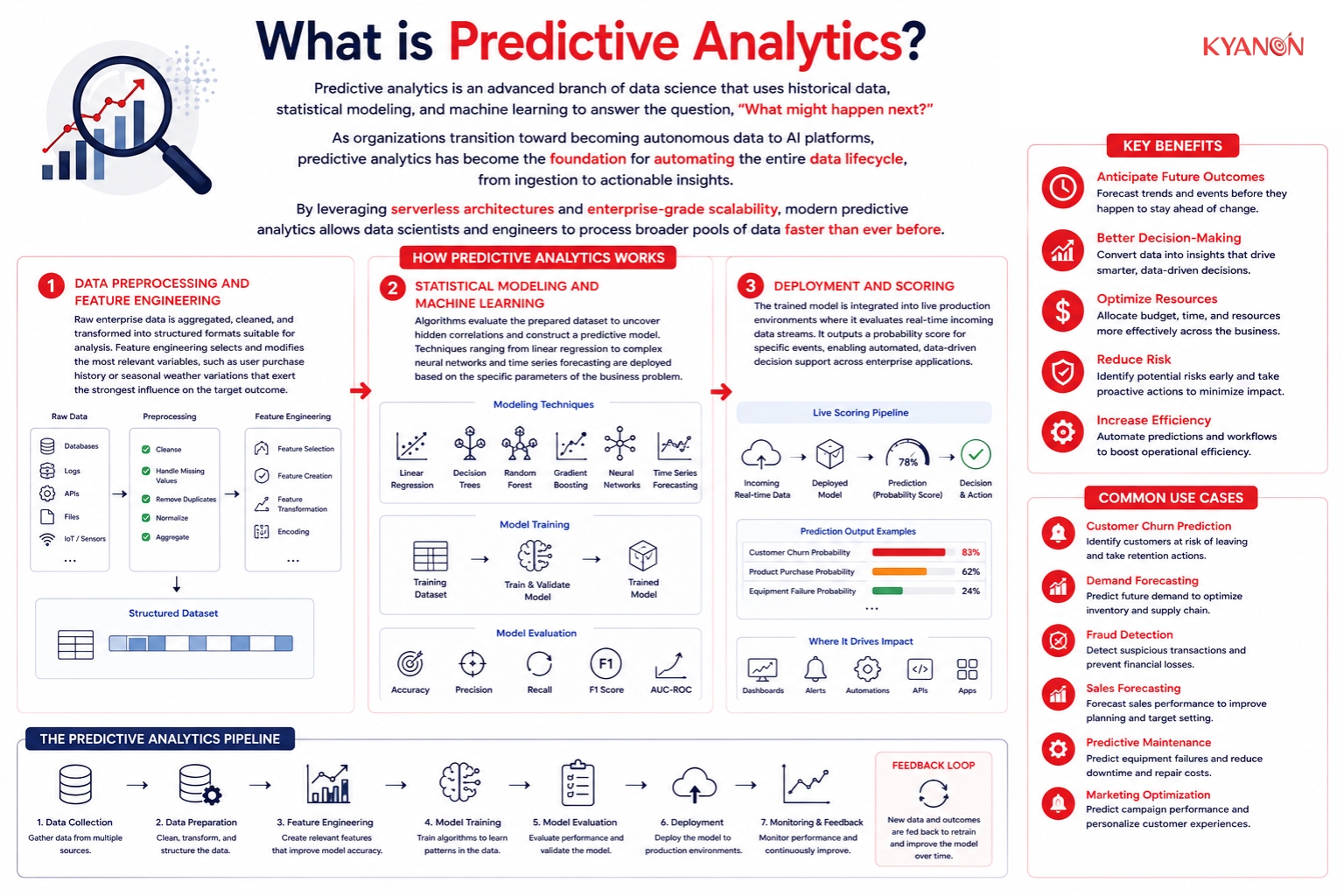
How predictive analytics works
The core mechanism of predictive analytics relies on extracting actionable signals from historical datasets to build mathematical models capable of scoring new, unseen data. Instead of merely reporting what happened in the past, the system continuously refines its algorithmic weights to project future scenarios with high statistical confidence.
Data Preprocessing and Feature Engineering
Raw enterprise data is aggregated, cleaned, and transformed into structured formats suitable for analysis. Feature engineering selects and modifies the most relevant variables, such as user purchase history or seasonal weather variations that exert the strongest influence on the target outcome.
Statistical Modeling and Machine Learning
Algorithms evaluate the prepared dataset to uncover hidden correlations and construct a predictive model. Techniques ranging from linear regression to complex neural networks and time series forecasting are deployed based on the specific parameters of the business problem.
Deployment and Scoring
The trained model is integrated into live production environments where it evaluates real-time incoming data streams. It outputs a probability score for specific events, enabling automated, data-driven decision support across enterprise applications.

Real-world applications across industries of Predictive Analytics
- Banking & Finance: Detecting fraudulent transactions instantly by scoring how much a current purchase pattern deviates from a customer’s historical spending behavior.
- Retail & E-commerce: Forecasting inventory demand down to specific store locations, allowing businesses to optimize supply chains and minimize stockouts.
- Healthcare: Predicting patient readmission risks by analyzing clinical histories, helping hospitals allocate staff resources and improve patient care plans.
Predictive Analytics vs Prescriptive Analytics
Both disciplines provide advanced decision support, but they answer fundamentally different questions within the business intelligence pipeline.
Dimension | Predictive Analytics | Prescriptive Analytics |
| Core Question | What is likely to happen next? | What action should we take about it? |
Primary Output | Probability scores and forecasts | Actionable recommendations |
| System Complexity | High (Statistical & ML modeling) | Very High (Optimization & simulation algorithms) |
Human Intervention | Requires a human to decide the next steps | Can automate the execution of the final decision |
| Enterprise Example | “There is an 85% chance this machine will fail.” | “Automatically order a part and schedule maintenance.” |
When to consider predictive analytics
Consider Predictive Analytics if:
- Your supply chain experiences frequent stockouts or overstock situations due to volatile, unpredictable consumer demand.
- You need to proactively identify high-value enterprise customers who are at imminent risk of churn to deploy targeted retention campaigns.
- Your financial or e-commerce operations require real-time, automated fraud detection to minimize false positives and protect legitimate transactions.
It may not be the right priority if:
- Your organization lacks centralized, high-quality historical data, and your current priority is establishing foundational descriptive reporting and data pipelines.
Why predictive analytics matters for enterprises
Predictive analytics helps organizations use historical and real-time data to anticipate future outcomes, enabling better decision-making and business performance. It is widely used to detect fraud and cybersecurity threats, optimize marketing campaigns and customer retention, improve operational efficiency through demand and resource forecasting, and reduce financial risk by assessing factors such as creditworthiness, insurance claims, and potential defaults. By identifying patterns before events occur, predictive analytics allows businesses to act proactively rather than reactively. (SAS)
Common misconceptions
Business leaders and engineering directors often misinterpret how predictive algorithms handle data volume, accuracy decay, and causal relationships.
More historical data always equals a more accurate prediction
Reality: The relevance and quality of data matter far more than the raw volume. If an enterprise feeds a predictive model ten years of historical data, but a massive market shift or regulatory change occurred last year, the old data becomes toxic noise. The model will overfit to outdated historical patterns and fail to accurately predict tomorrow’s reality.
A highly accurate predictive model will stay accurate forever
Reality: Predictive models suffer from model drift the moment they are deployed into production. Human behavior, economic conditions, and competitor strategies constantly evolve. If a retail model predicted consumer spending patterns perfectly before an inflation spike, it will quickly decay and output wildly incorrect forecasts unless it is continuously monitored and retrained on fresh data streams.
Predictive analytics automatically uncovers the ‘why’ behind a trend
Reality: Predictive analytics uncovers correlation, not causation. A model can successfully find a tight statistical link between two variables, like a spike in ice cream sales perfectly correlating with an increase in sunburn cases, but it does not understand that hot weather is driving both. Relying blindly on correlation without human domain expertise can lead to deeply flawed business strategies.
How Kyanon Digital applies predictive analytics
Kyanon Digital implements predictive analytics systems for enterprise clients across the retail, banking, and logistics sectors in Vietnam, Singapore, and ANZ. Our deep implementation expertise focuses on deploying robust machine learning models and automated data pipelines that provide highly accurate decision support at scale. We prioritize mitigating model drift and optimizing data quality, ensuring our clients achieve measurable outcomes such as accelerated time-to-market, maximized conversion rates, and optimized TCO across their technical infrastructure.
Explore our ML & AI services:

 Create project brief with AI