
What is mobile commerce (mCommerce)?
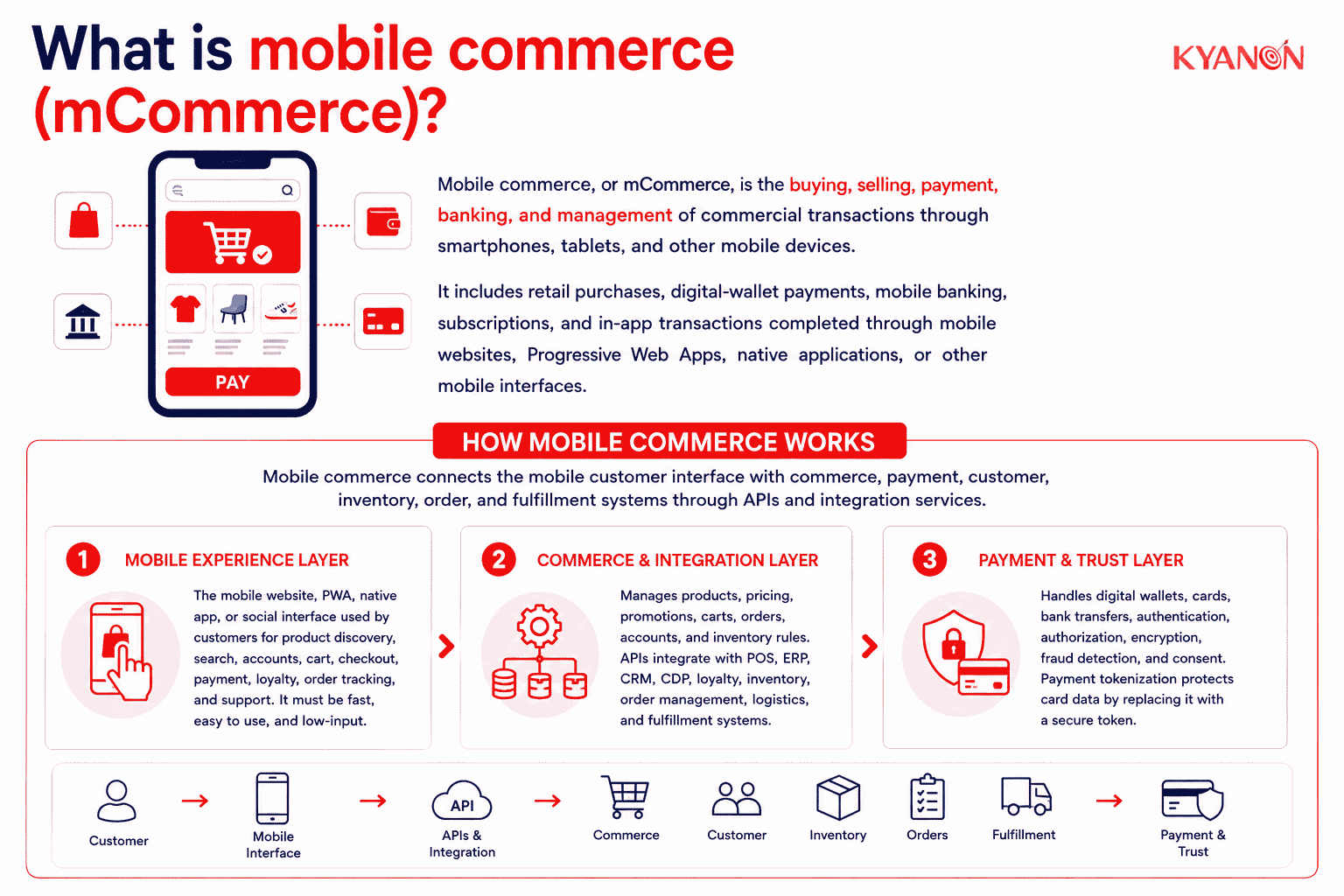
Mobile commerce, or mCommerce, is the buying, selling, payment, banking, and management of commercial transactions through smartphones, tablets, and other mobile devices.
It includes retail purchases, digital-wallet payments, mobile banking, subscriptions, and in-app transactions completed through mobile websites, Progressive Web Apps, native applications, or other mobile interfaces.
How mobile commerce works
Mobile commerce works by connecting a mobile customer interface with commerce, payment, customer, inventory, order, and fulfillment systems through APIs and integration services.
Its effectiveness depends on more than adapting an e-commerce page to a smaller screen. The experience must account for touch interaction, short sessions, limited screen space, variable network conditions, mobile authentication, and customers moving between digital and physical channels.
Mobile experience layer
The experience layer is the mobile website, PWA, native application, social interface, or embedded shopping environment used by the customer.
It controls product discovery, search, account access, cart management, checkout, payment, loyalty interactions, order tracking, and customer support. The interface must prioritise fast loading, readable content, clear navigation, and low-input transactions.
Commerce and integration layer
The commerce layer manages products, pricing, promotions, carts, orders, customer accounts, inventory rules, and checkout logic.
APIs and middleware connect these functions with POS, ERP, CRM, CDP, loyalty, inventory, order management, logistics, and fulfillment systems. This prevents the mobile channel from maintaining isolated versions of customer, pricing, stock, or order data.
Payment and trust layer
The payment and trust layer manages digital wallets, stored cards, bank transfers, authentication, transaction authorization, encryption, fraud detection, and customer consent.
Payment tokenization replaces valuable card information with a payment token, reducing the usefulness of exposed account data during mobile and e-commerce transactions.

Types and channels of mobile commerce
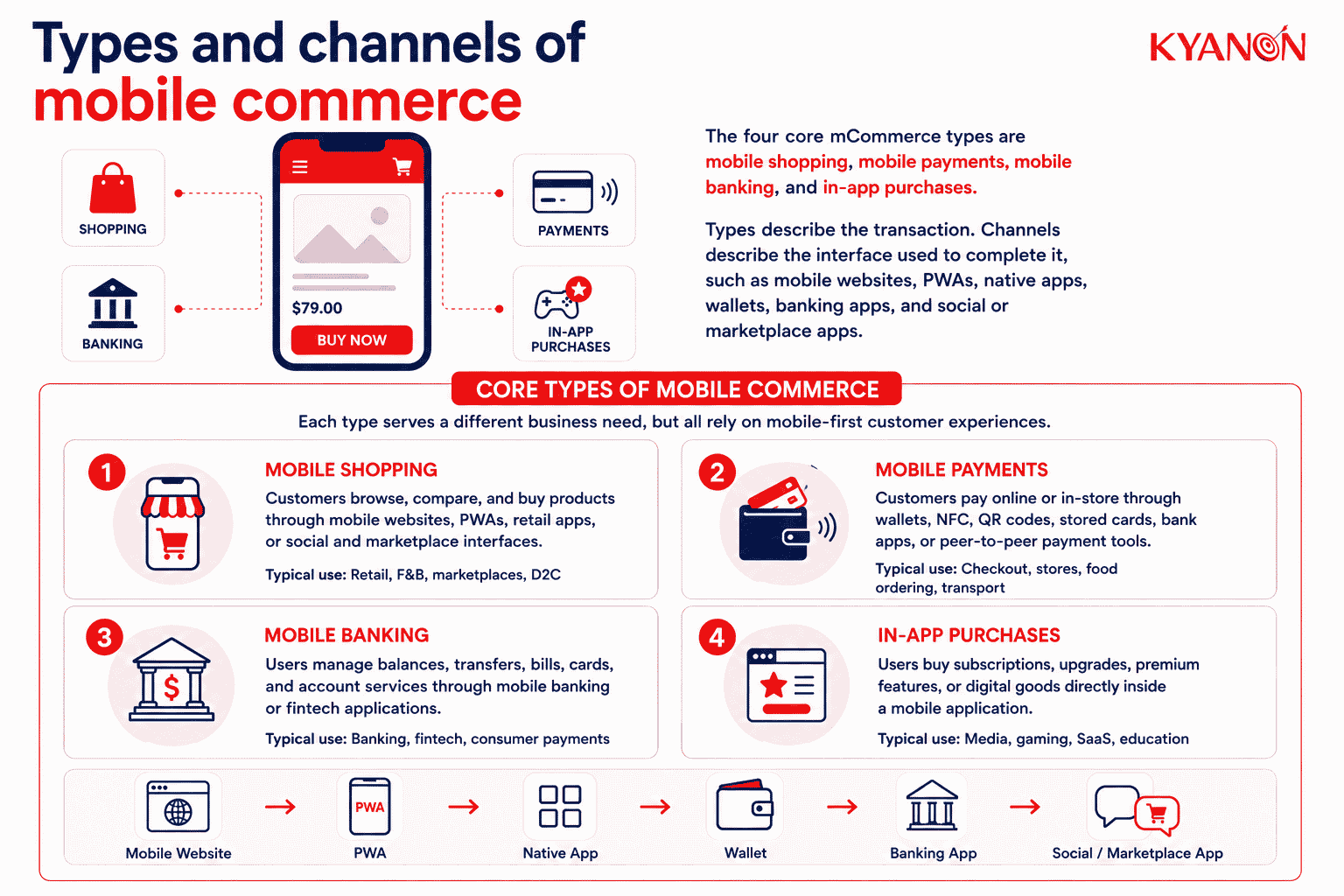
The four principal types of mobile commerce are mobile shopping, mobile payments, mobile banking, and in-app purchases.
These categories describe the transaction being completed, while mobile websites, PWAs, native apps, wallets, and financial applications describe the interfaces through which the transaction occurs.
| Type | What it includes | Typical business context |
Mobile shopping | Browsing, comparing, ordering, and purchasing physical or digital products through mobile websites, PWAs, retail apps, or social interfaces | Retail, F&B, marketplaces, direct-to-consumer commerce |
| Mobile payments | Paying online or in-store through digital wallets, contactless NFC, QR codes, stored credentials, or peer-to-peer payment applications | Ecommerce checkout, physical retail, food ordering, transportation |
Mobile banking | Checking balances, transferring funds, paying bills, depositing checks, and managing financial accounts through mobile applications | Banking, financial services, fintech, consumer payments |
| In-app purchases | Buying subscriptions, digital content, virtual goods, upgrades, or additional application features | Media, gaming, SaaS, education, entertainment |
Mobile shopping
Mobile shopping allows customers to browse and purchase products through mobile-optimized websites, PWAs, native retail applications, social platforms, or marketplace apps.
For retailers and F&B businesses, this category may include mobile ordering, click-and-collect, delivery selection, digital loyalty, personalized offers, and order tracking.
Mobile payments
Mobile payments allow customers to pay through digital wallets such as Apple Pay or Google Pay, contactless NFC, QR codes, stored payment credentials, bank applications, or peer-to-peer payment services.
The commercial value comes from reducing checkout input while connecting payment authorization with fraud controls, customer identity, order processing, and reconciliation.
Mobile banking
Mobile banking covers financial activities such as checking balances, transferring money, paying bills, managing cards, and depositing checks through mobile financial applications.
Mobile banking is commonly included within the broader definition of mCommerce, although it operates outside the retail-focused commerce scope of many e-commerce platforms.
In-app purchases
In-app purchases are transactions completed inside a mobile application to access digital goods, premium features, subscriptions, upgrades, or additional services.
Unlike mobile shopping for physical products, in-app commerce often requires integration with application-store billing rules, subscription management, entitlement systems, and digital-content delivery.
Why mobile commerce is popular
Mobile commerce is popular because it reduces the distance between customer intent and transaction completion by making shopping, payment, and account access available through a device customers already carry.
Its adoption is primarily driven by convenience, transaction speed, and context-aware personalization.
Convenience
Mobile commerce allows customers to search, compare, purchase, pay, and manage orders without being tied to a desktop computer or physical store.
For businesses, this extends the transaction window beyond store operating hours and enables purchases during short, intent-driven moments such as commuting, traveling, or waiting for service.
Speed
Digital wallets, saved addresses, biometric authentication, stored preferences, and one-tap reordering can reduce the number of steps required to complete a transaction.
Speed creates business value only when the entire journey is coordinated. A fast payment button cannot compensate for inaccurate stock, slow page loading, unclear delivery options, or repeated form entry.
Personalization
Mobile applications can use customer profiles, behavioral data, purchase history, location permissions, and real-time context to determine which products, offers, or messages are most relevant.
Location-based promotions and personalized alerts should be permission-based, transparent, and governed by applicable privacy and consent requirements.
Mobile commerce vs. omnichannel commerce
Mobile commerce is a transaction channel centered on mobile devices, whereas omnichannel commerce is an operating model that coordinates mobile, web, marketplace, contact-center, and physical-store journeys through connected data and systems.
A business can operate mobile commerce without being omnichannel, but mobile becomes part of an omnichannel model when customer, inventory, loyalty, payment, order, and fulfillment data remain consistent across channels.
| Dimension | Mobile commerce | Omnichannel commerce |
Primary scope | Commercial activity through mobile devices | Coordinated commerce across multiple channels |
| Main objective | Improve mobile discovery, conversion, payment, and engagement | Maintain journey and operational continuity between channels |
Customer touchpoints | Mobile websites, PWAs, native apps, wallets, and social interfaces | Mobile, desktop, marketplace, store, POS, contact centre, and other channels |
| Customer data | May be limited to mobile activity | Connected customer identity and history across channels |
Inventory model | Mobile access to product availability | Shared inventory visibility across stores, warehouses, and digital channels |
| Order management | Orders initiated through a mobile interface | Orders can be initiated, modified, fulfilled, or returned across channels |
Primary metrics | Mobile conversion, checkout completion, retention, and revenue per mobile user | Cross-channel conversion, fulfilment performance, retention, and customer lifetime value |
| Best suited for | Businesses with significant mobile demand or repeat mobile use cases | Businesses whose customers move regularly between digital and physical channels |
Main implementation risk | Treating mobile as a reduced desktop experience | Connecting interfaces without integrating operational systems |
When to consider mobile commerce
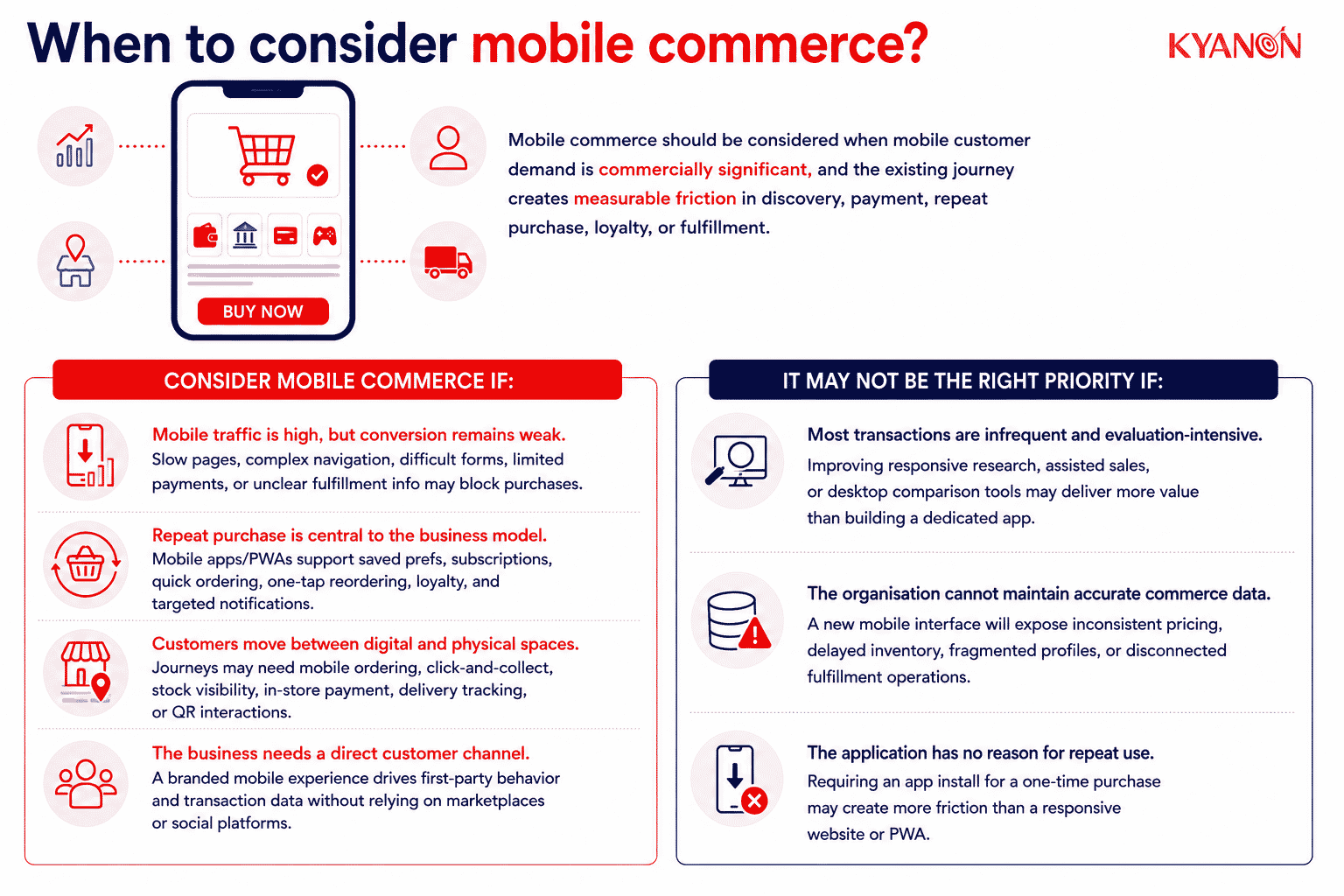
Mobile commerce should be considered when mobile customer demand is commercially significant, and the existing journey creates measurable friction in discovery, payment, repeat purchase, loyalty, or fulfillment.
Consider mobile commerce if:
- Mobile traffic is high, but conversion remains weak. Slow pages, dense navigation, difficult forms, limited payment methods, or unclear fulfillment information may be preventing customers from completing purchases.
- Repeat purchase is central to the business model. Mobile apps and PWAs can support saved preferences, subscriptions, quick ordering, one-tap reordering, digital loyalty, and targeted notifications.
- Customers transact while moving between digital and physical environments. Retail and F&B journeys may require mobile ordering, click-and-collect, digital membership, stock visibility, in-store payment, delivery tracking, or QR-based interactions.
- The business requires a direct customer channel. A branded mobile experience can generate first-party behavioral and transaction data without relying entirely on marketplaces or social platforms.
It may not be the right priority if:
- Most transactions are infrequent, complex, and evaluation-intensive. Improving responsive product research, assisted sales, or desktop comparison tools may create more value than building a dedicated app.
- The organisation cannot maintain accurate commerce data. A new mobile interface will expose rather than resolve inconsistent pricing, delayed inventory updates, fragmented profiles, or disconnected fulfillment operations.
- The application has no reason for repeat use. Requiring customers to install an app for a one-time purchase may create more friction than a responsive website or PWA.
Critical mobile commerce challenges
The main mobile commerce challenges are protecting customer and payment data, reducing small-screen friction, maintaining performance under unstable connectivity, and integrating the mobile channel with core operational systems.
These are business risks because they directly affect conversion, customer trust, fulfilment accuracy, operating cost, and total cost of ownership.
Security and privacy risks
Mobile commerce risks can arise from compromised devices, phishing, insecure public networks, weak session controls, excessive permissions, exposed APIs, and mishandled customer data.
Mobile transactions are not inherently unsafe. Tokenization, encryption, biometric authentication, secure APIs, risk-based verification, fraud monitoring, and consent management can reduce exposure when implemented within the architecture. EMVCo states that payment tokenization replaces valuable card data with tokens to increase the security of mobile and e-commerce transactions.
Small-screen user experience
Small screens create less space for navigation, product comparison, form entry, error recovery, and checkout information.
Mobile UX must therefore prioritize clear product information, readable content, appropriate touch targets, relevant mobile keyboards, persistent cart data, and minimal checkout input. A responsive layout alone does not guarantee a usable mobile transaction.
Connectivity and performance
Mobile commerce depends on cellular or internet connectivity, but customers may transact through slow, unstable, or interrupted networks.
Performance strategies may include caching, lightweight assets, progressive loading, resilient session handling, and recovery after interrupted transactions. PWAs can support installability and selected offline capabilities, although feature availability differs across browsers and operating systems.
System and data integration
A mobile interface can display incorrect prices, stock, loyalty balances, or delivery options when backend systems do not exchange data consistently.
Commerce, POS, ERP, CRM, inventory, order, payment, and fulfillment integration are therefore operating requirements, not secondary technical enhancements. Kyanon Digital’s omnichannel e-commerce model uses custom middleware to connect e-commerce environments with POS, ERP, CRM, and inventory systems.
Why mobile commerce matters for retail and F&B
Mobile commerce matters for retail and F&B because it turns a customer’s personal device into a channel for product discovery, ordering, payment, loyalty, fulfillment updates, and post-purchase service.
Its business value comes from connecting frequent mobile interactions with product availability, customer profiles, promotions, store operations, payments, loyalty rules, and order fulfillment.
Adobe Analytics reported in January 2026 that smartphones accounted for 56.4% of U.S. online transactions during the 2025 holiday shopping season, increasing from 54.5% in 2024. The analysis covered more than one trillion visits to U.S. retail sites, 100 million SKUs, and 18 product categories.
This evidence shows that mobile is not only a product-research channel during major retail periods. It is a primary transaction environment that requires the same performance, security, integration, and measurement discipline as desktop commerce.
High mobile use does not automatically produce completed orders. Baymard Institute’s current checkout research places the average e-commerce cart abandonment rate at approximately 70%, although this is an overall e-commerce benchmark rather than a mobile-only abandonment rate.
In one Kyanon Digital implementation, a leading Vietnamese coffee chain introduced an iOS and Android mobile application covering mobile ordering, payments, loyalty, CRM, and personalized offers. The project demonstrates how mCommerce can combine transactions and customer engagement within a single high-frequency F&B experience.
Read more: Loyalty & E-Commerce Mobile App for the leading Coffee Chain in Vietnam
Common misconceptions
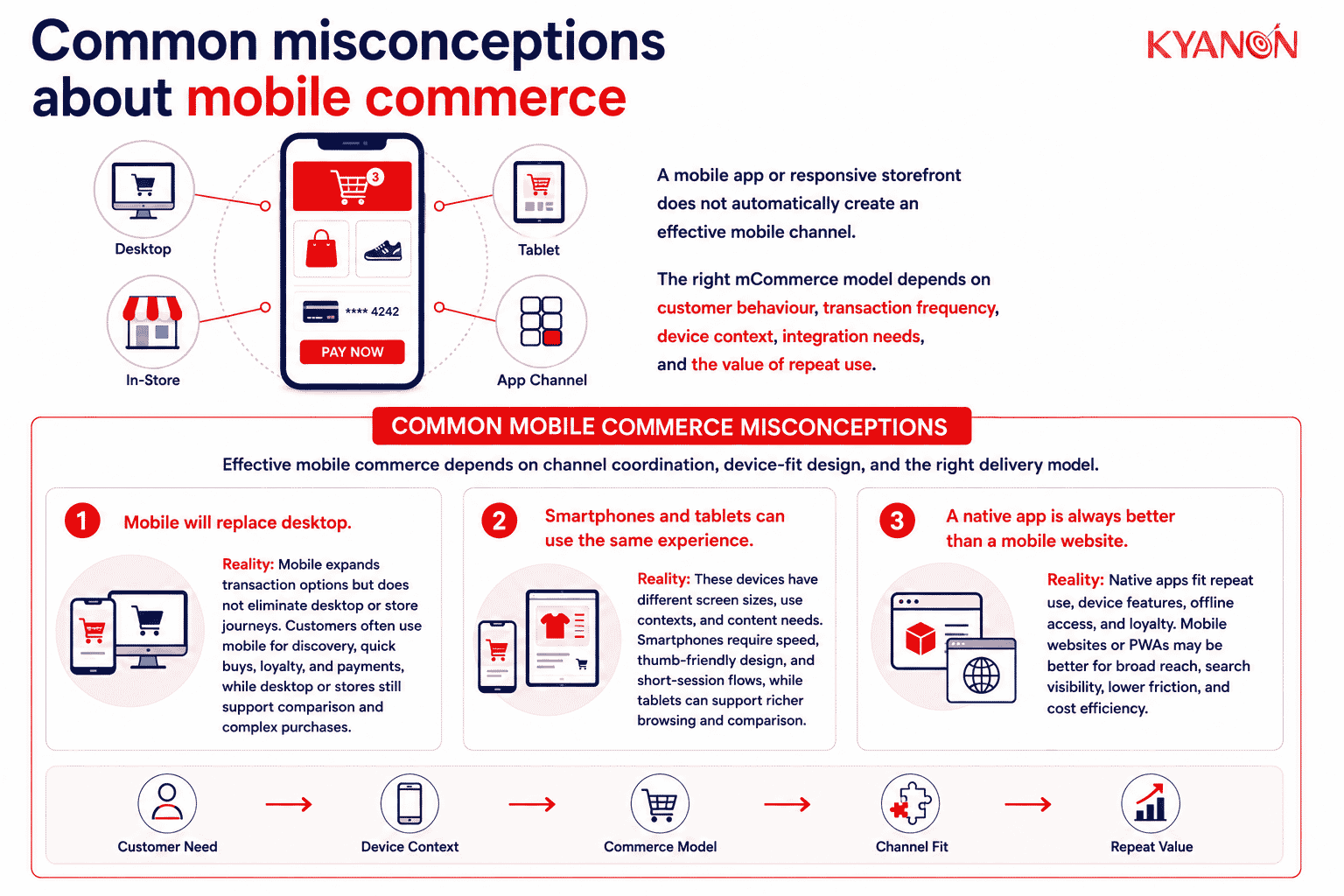
The central misconception about mobile commerce is that launching an app or responsive storefront automatically creates a commercially effective mobile channel.
The appropriate mCommerce model depends on customer behaviour, transaction frequency, device context, integration requirements, and the value customers receive from returning to the mobile experience.
“Mobile commerce will make desktop shopping obsolete.”
Reality: Mobile commerce expands the available transaction channels; it does not eliminate desktop or physical-store journeys.
Customers may use smartphones for discovery, price checks, loyalty, quick purchases, and payments while using desktop or physical stores for detailed comparison, assisted evaluation, or complex purchases. The business objective should be channel coordination rather than mobile-only replacement.
“Smartphones and tablets can use the same experience.”
Reality: Smartphones and tablets use different screen sizes, interaction patterns, customer contexts, and content densities.
Smartphone journeys generally require stronger prioritization of thumb reach, speed, compact content, and short-session completion. Tablets can support more detailed browsing and comparison, but they still require device-specific testing rather than a reduced desktop layout.
“A native app is always better than a mobile website.”
Reality: A native application is appropriate when repeat usage, device integration, offline functions, performance requirements, or loyalty engagement justify its acquisition and maintenance costs.
A responsive website or PWA may be more suitable when broad reach, search discoverability, low entry friction, and a shared web codebase are higher priorities. Kyanon Digital frames the choice as native for deeper performance and device access, PWA for reach and cost efficiency, and hybrid approaches for selected scaling requirements.
How Kyanon Digital applies mobile commerce
Kyanon Digital applies mobile commerce by selecting the mobile delivery model and integration architecture according to customer frequency, required device capabilities, operational systems, release priorities, conversion objectives, and total cost of ownership.
For retail and F&B use cases, this may involve mobile-first responsive storefronts, PWAs, native iOS and Android applications, or cross-platform applications. The customer interface is then connected with e-commerce platforms, catalogs, POS, CRM/CDP, loyalty, payments, inventory, order management, analytics, logistics, and fulfillment services.
Native commerce applications may use technologies such as Swift and Kotlin, where deeper operating-system access is required, while cross-platform and PWA approaches may be selected to balance delivery speed, platform coverage, and maintenance cost. Kyanon Digital’s published mobile capabilities include native application development, cross-platform technologies, PWAs, API integration, testing, DevOps, and long-term product enhancement.
The implementation focus is not simply delivering a mobile frontend. It is ensuring that the mobile channel uses reliable customer, product, pricing, inventory, payment, loyalty, and fulfillment data while remaining measurable against conversion, repeat purchase, time-to-market, and TCO objectives.
→ Explore Kyanon Digital’s mobile app development services

 Create project brief with AI