
What is Multi-Modal AI?
Multi-modal AI is an artificial intelligence system that can understand, process, and generate outputs from multiple types of data simultaneously, including text, images, audio, video, and other data formats. (McKinsey)
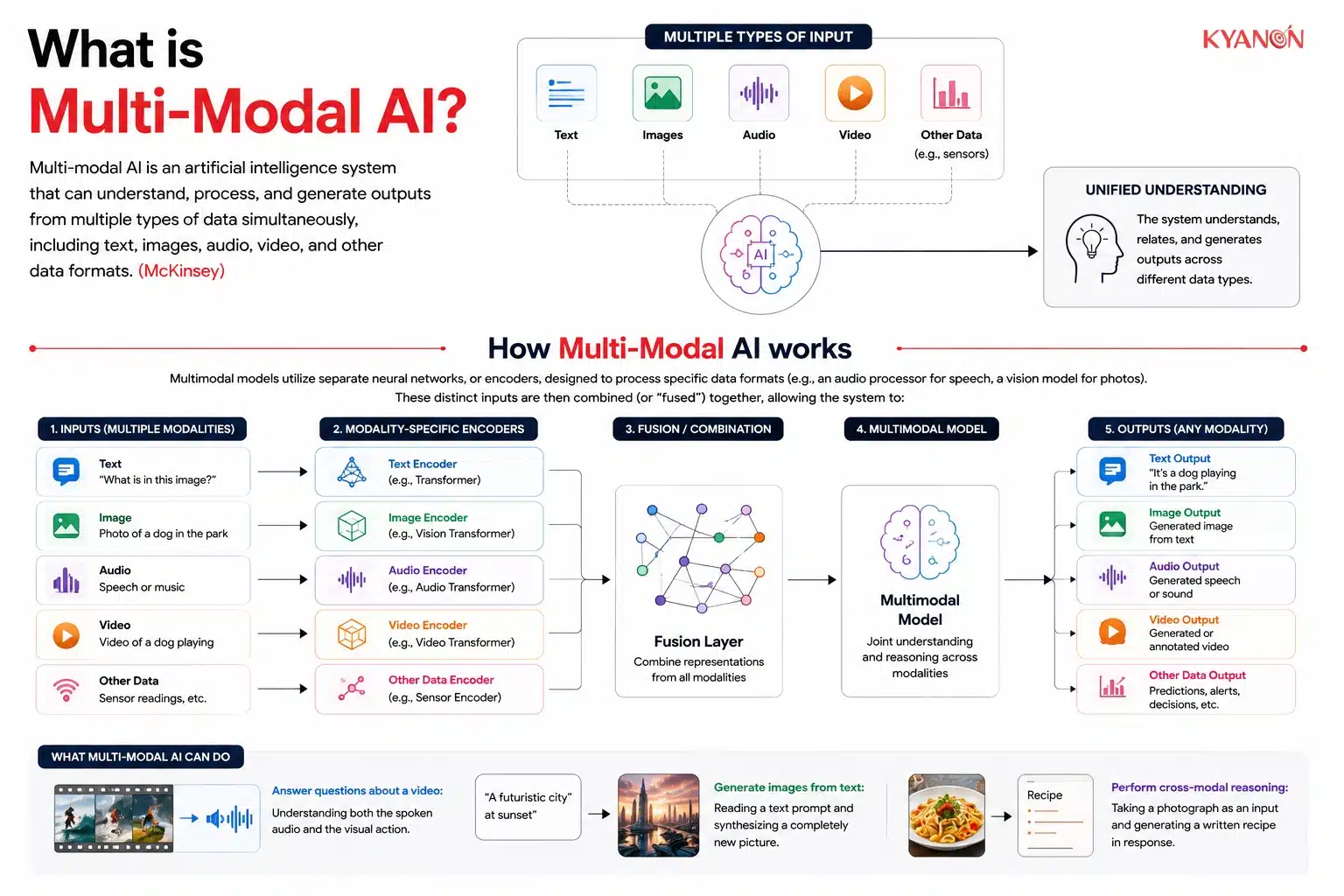
How Multi-Modal AI works
Multimodal models utilize separate neural networks, or encoders, designed to process specific data formats (e.g., an audio processor for speech, a vision model for photos). These distinct inputs are then combined (or “fused”) together, allowing the system to:
- Answer questions about a video: Understanding both the spoken audio and the visual action.
- Generate images from text: Reading a text prompt and synthesizing a completely new picture.
- Perform cross-modal reasoning: Taking a photograph as an input and generating a written recipe in response.

Real-World Applications
By fusing different data types, multimodal models are transforming various industries.
Healthcare
Doctors can utilize AI to analyze clinical notes (text), X-rays (images), and patient audio symptoms at the same time to better diagnose conditions or predict personalized treatment paths.
Customer Service
Virtual assistants can “listen” to a customer’s voice, transcribe the context, understand the visual products they are looking at, and provide instant, conversational support.
Autonomous Vehicles
Self-driving cars rely on multimodal systems to process video feeds (cameras), depth mapping (Lidar), and spatial audio to make split-second driving decisions.
Insurance
Automated systems can cross-reference customer statements, transaction logs, and attached photos/videos to streamline legitimate claims and flag fraudulent ones.
Multi-Modal AI vs Single-Modal Text Models
Both architectures process enterprise data, but they differ fundamentally in how they handle layout-dependent and sensory inputs.
Dimension | Multi-Modal AI | Single-Modal Text Models |
| Context extraction | Spatial, sensory, and semantic | Strictly semantic |
Token consumption rate | Extremely high | Low |
| Architectural complexity | High (requires modality adapters) | Standard (single encoder/decoder) |
Best for | Document parsing, structural invoices | Standard text classification and NLP |
| Hallucination trigger | Visual misinterpretation or axis misreading | Semantic ambiguity or factual gaps |
When to consider Multi-Modal AI
Consider Multi-Modal AI if:
- Your enterprise data is trapped in layout-dependent formats like PDFs, structural invoices, or blueprints where text-only OCR models lose critical spatial context.
- Your quality assurance workflows require automated visual inspections cross-referenced against technical text specifications simultaneously.
- You need to extract non-verbal context or nuanced spatial relationships from charts and graphs that cannot be flattened into a raw text dump without data loss.
It may not be the right priority if:
- Your core workflows rely entirely on structured database queries or flat text logs where API latency and high visual token computing costs would destroy your return on investment.
Why Multi-Modal AI matters for enterprise operations
Multimodal AI transforms enterprise operations by breaking down data silos, allowing businesses to automate highly complex tasks that previously required human intuition.
According to Gartner, Multimodal AI enhances enterprise operations by consolidating unstructured data, enabling end-to-end automation, and improving accuracy, with projections suggesting that 80% of enterprise software will be multimodal by 2030. These systems drive faster time-to-value by allowing for more accurate, automated workflows that handle multiple data inputs simultaneously.
Common misconceptions
We have to translate our images to text first before the model can process them
Reality: Modern architectures do not use multi-step translations; they process different sensory inputs natively using shared mathematical vectors. The model evaluates a pixel and a word as related concepts simultaneously, capturing non-verbal context that cannot be fully translated into a raw text description.
It is overkill for our traditional, text-heavy enterprise workflows
Reality: A massive amount of standard corporate data exists in layout-dependent formats like PDFs and structural invoices, where a text-only OCR dump loses all spatial context. A multi-modal model visually analyzes the document layout, instantly mapping where data sits spatially to eliminate structural extraction errors.
Adding vision or audio capabilities eliminates AI hallucinations
Reality: Cross-referencing multiple data modalities does not make an AI inherently factual, as they remain probabilistic token-prediction engines. A model can easily look at a line graph, visually misread the axis scaling, and confidently hallucinate an entirely incorrect financial trend that does not match the input data.
We need to train a completely new base model from scratch to add new senses
Reality: Engineers routinely graft new modalities onto highly mature, frozen text models using projection layers or cross-attention modules. By training a small mathematical bridge between a pre-trained vision encoder (like CLIP) and a language model, the system interprets visual embeddings without rewriting the core network weights.
Token costs and system latencies are the same as standard text processing
Reality: Image and video inputs consume massive token budgets and severely degrade processing speed. Uploading a single high-resolution image forces the architecture to break it into a massive grid of patches processed as hundreds of individual visual tokens, dramatically inflating API compute costs compared to standard text generation.
How Kyanon Digital applies Multi-Modal AI
Kyanon Digital builds multi-modal ai solutions for enterprise clients across Southeast Asia and the US needing to process diverse data types concurrently. Our engineering teams integrate native projection layers and advanced vision encoders to automate complex corporate workflows, such as combined document and image analysis in retail quality inspection, ensuring our clients achieve measurable reductions in manual processing time and total cost of ownership (TCO).
Explore our AI services:

 Create project brief with AI