
What Is Time Series Forecasting?
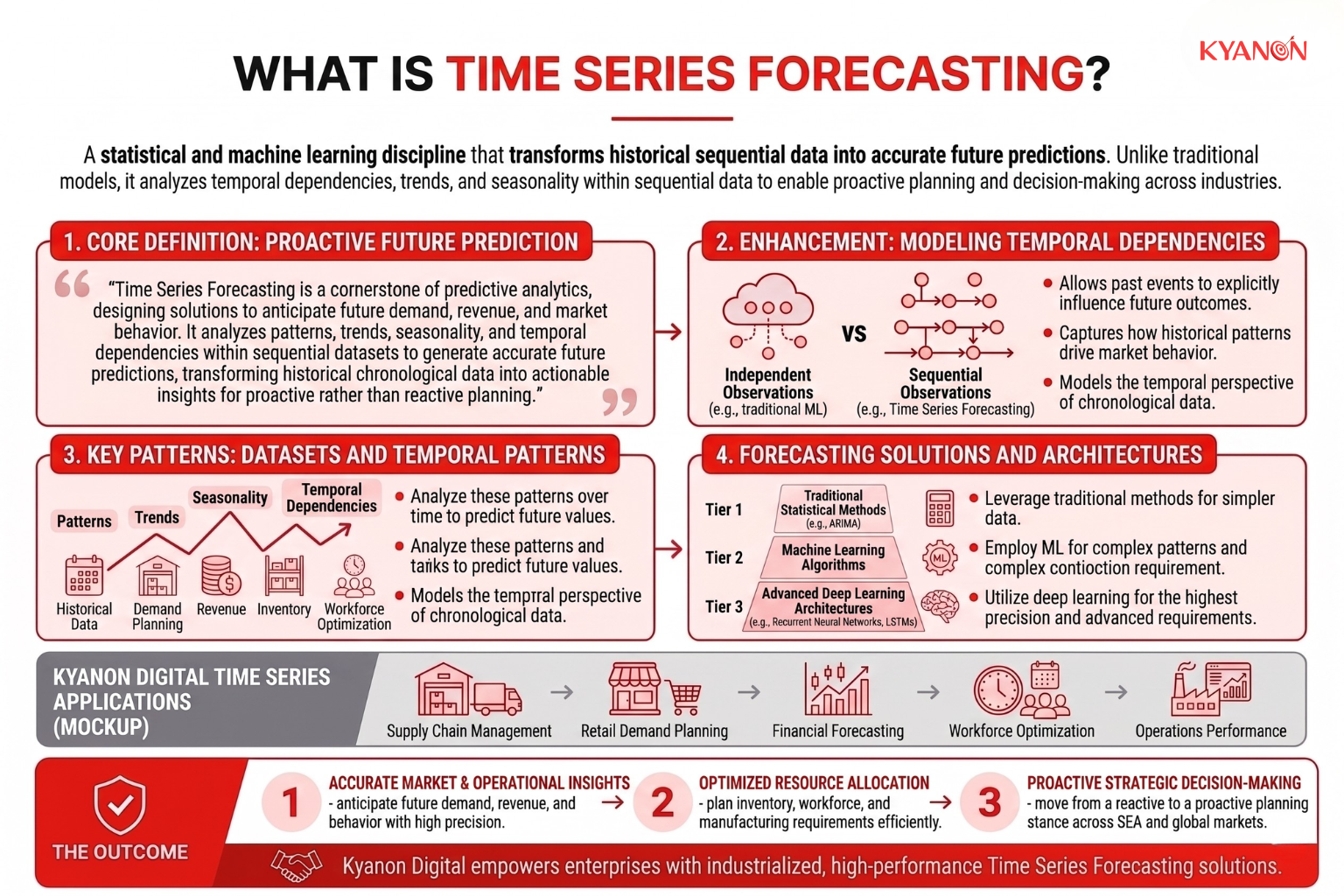
Time Series Forecasting is a statistical and machine learning discipline that predicts future values by analyzing patterns, trends, seasonality, and temporal dependencies within historical data. It is designed specifically for sequential datasets in which observations are recorded over time and the order of events carries critical information.
Unlike traditional machine learning tasks that treat observations as independent records, Time Series Forecasting explicitly models how past events influence future outcomes. This temporal perspective enables organizations to anticipate future demand, revenue, inventory requirements, operational performance, and market behavior based on historical patterns.
As a cornerstone of predictive analytics, Time Series Forecasting supports decision-making across industries, including supply chain management, retail demand planning, financial forecasting, manufacturing operations, and workforce optimization. Depending on the complexity of the data and business requirements, forecasting solutions may leverage traditional statistical methods, machine learning algorithms, or advanced deep learning architectures to generate accurate future predictions.
At its core, Time Series Forecasting transforms historical chronological data into actionable insights, helping organizations proactively plan for future events rather than simply react to them.
How Time Series Forecasting Works
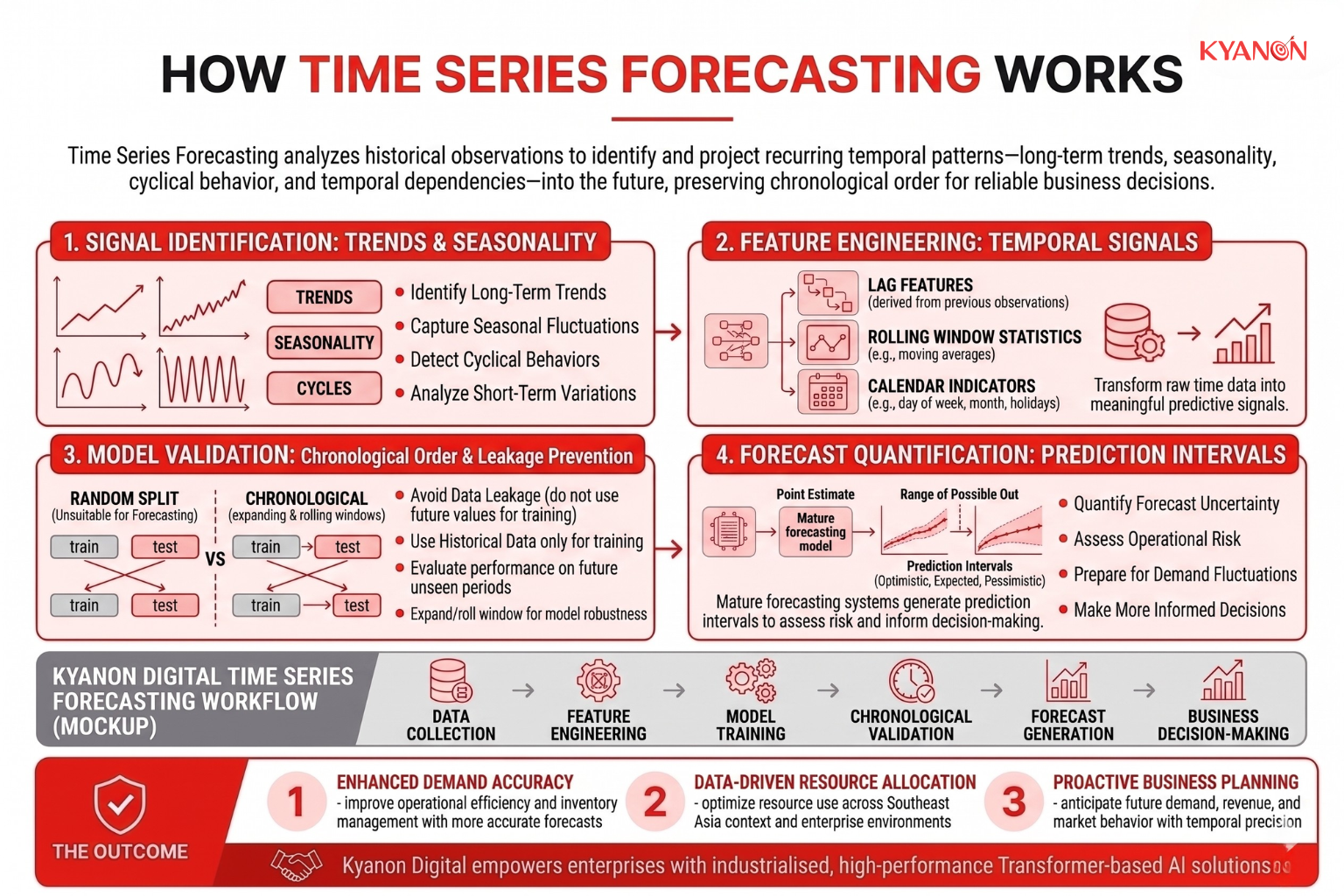
Time Series Forecasting analyzes historical observations, identifies recurring temporal patterns, and projects those patterns into future periods. Rather than treating data points as independent records, forecasting models learn how values evolve over time by capturing trends, seasonality, cyclical behavior, and temporal dependencies within the historical sequence.
A typical forecasting workflow begins with collecting historical data, followed by feature engineering, model training, chronological validation, forecast generation, and business decision-making. Throughout this process, the chronological order of observations must be preserved to ensure predictions reflect real-world conditions.
Historical Signal Analysis
Historical data serves as the foundation for forecasting. The objective is not to memorize past values but to identify patterns that are likely to persist into the future. These patterns may include long-term trends, seasonal fluctuations, cyclical behaviors, and short-term variations.
To make temporal patterns easier for forecasting models to learn, practitioners often create additional features from the historical series. Common examples include lag features derived from previous observations, rolling-window statistics such as moving averages, and calendar-based variables such as day of week, month, or holiday indicators. These features help transform raw time-based data into meaningful predictive signals.
Time-Based Validation
Forecasting models require chronological validation rather than random train-test splitting. Unlike traditional machine learning tasks, future observations cannot be used during training because doing so introduces data leakage and produces unrealistic performance metrics.
Instead, models are trained on historical periods and evaluated on future periods that were unavailable during training. Many forecasting teams use expanding-window or rolling-window validation approaches, which simulate real production environments by repeatedly training on past data and testing on the next unseen time period. This provides a more reliable measure of forecasting performance and model robustness.
Forecast Uncertainty
Every forecast contains uncertainty because future events cannot be observed directly. As a result, mature forecasting systems typically generate prediction intervals rather than relying solely on a single point estimate.
These intervals provide a range of possible outcomes, including optimistic, expected, and pessimistic scenarios. By quantifying uncertainty, organizations can better assess risk, prepare for demand fluctuations, allocate resources, and make more informed operational decisions. In practice, understanding the range of potential outcomes is often as valuable as the forecast itself.

Time Series Forecasting vs Predictive Analytics
Both approaches support future-oriented decision-making, but they differ in how they handle time and data relationships.
Dimension | Time Series Forecasting | Predictive Analytics |
| Primary objective | Predict future values over time | Predict future outcomes or behaviors |
Data structure | Chronological observations | Structured or unstructured datasets |
| Time dependency | Core requirement | Optional |
Validation approach | Time-based split | Random or stratified split |
| Typical outputs | Sales, demand, inventory forecasts | Churn, conversion, risk predictions |
Key business use case | Planning and resource allocation | Decision optimization |
| Forecast uncertainty | Explicitly modeled | Often secondary |
When to Consider Time Series Forecasting
Consider Time Series Forecasting if:
- Your organization needs more accurate demand planning, inventory management, workforce allocation, or revenue forecasting over the next 6–24 months.
- Business decisions depend on seasonal patterns, recurring cycles, or predictable customer behavior trends.
- Planning errors create measurable financial consequences such as stockouts, excess inventory, missed revenue targets, or inefficient staffing.
It may not be the right priority if:
- Your historical data is limited, highly inconsistent, or influenced primarily by one-time events that do not repeat over time.
Why Time Series Forecasting Matters for Enterprise Operations
Time Series Forecasting enables organizations to make forward-looking decisions based on historical evidence rather than assumptions. By anticipating future demand, revenue, inventory requirements, resource utilization, and operational workloads, businesses can allocate capital more effectively, reduce uncertainty, and improve planning across the enterprise.
The business value of forecasting is particularly significant in supply chain and inventory management, where small improvements in forecast accuracy can generate substantial operational and financial benefits. Accurate forecasts help organizations balance product availability with inventory costs, reducing both stockouts and excess inventory while improving customer service levels.
Research from McKinsey highlights the impact of advanced forecasting and predictive analytics on supply chain performance. Organizations that apply advanced demand forecasting techniques can reduce forecasting errors by 30% to 50%, enabling more accurate planning and inventory decisions. McKinsey also reports that optimized planning systems can reduce inventory levels by 10% to 20% while maintaining required service levels, freeing working capital and lowering inventory-related costs.
Beyond inventory management, forecasting supports a wide range of enterprise functions, including workforce planning, financial budgeting, production scheduling, procurement, logistics optimization, and capacity planning. By understanding likely future outcomes and associated uncertainty, organizations can proactively prepare for changing business conditions instead of reacting after disruptions occur.

For retailers, manufacturers, distributors, and consumer goods companies, forecasting accuracy directly influences inventory carrying costs, product availability, cash flow efficiency, and overall operational resilience. As supply chains become more complex and customer expectations continue to rise, Time Series Forecasting has evolved from a reporting tool into a critical capability for enterprise decision-making and competitive advantage.
Common Misconceptions
The more historical data we collect, the more accurate the forecast becomes
Older data is not always useful. Changes in customer behavior, economic conditions, pricing strategies, or market dynamics can make historical patterns less relevant than recent observations.
If forecast accuracy is high, business outcomes will automatically improve
Forecast accuracy and business value are not identical. A forecast must align with operational realities such as lead times, inventory policies, and capacity constraints to create measurable impact.
We can validate forecasting models the same way we validate other machine learning models
Random train-test splitting creates data leakage in time series forecasting. Models must be evaluated using future periods that were unavailable during training.
Deep learning models always outperform traditional forecasting methods
Simpler approaches such as ARIMA, Exponential Smoothing, or seasonal baseline models often outperform complex neural networks in business forecasting scenarios with limited data.
A forecast should provide one exact number
A single number hides uncertainty. Effective forecasting includes confidence intervals or probability ranges that help decision-makers prepare for multiple scenarios.
How Kyanon Digital Applies Time Series Forecasting
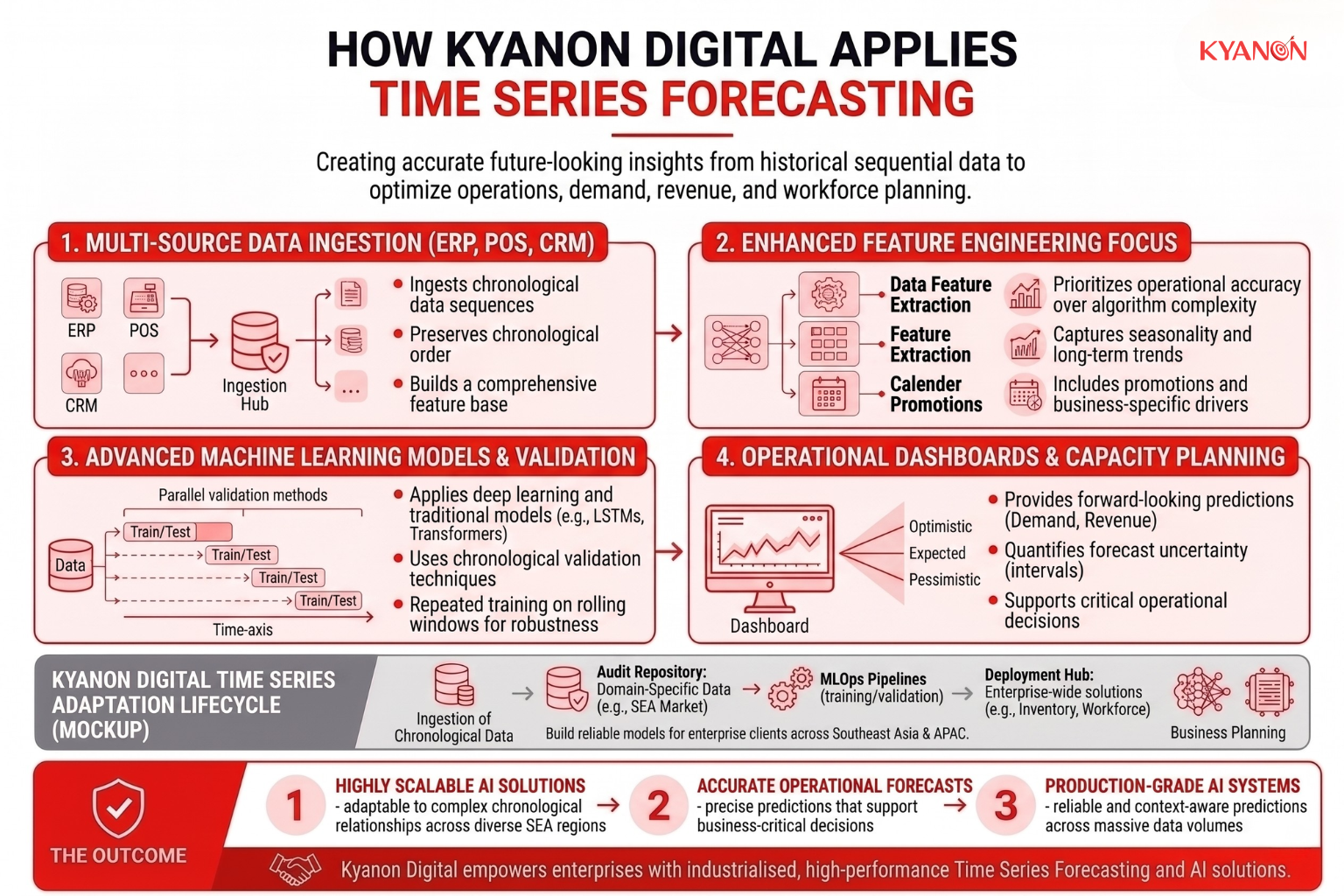
Kyanon Digital applies Time Series Forecasting in machine learning engagements involving demand forecasting, revenue prediction, inventory optimization, workforce planning, and operational capacity management. Across enterprise projects in Southeast Asia, ANZ, North America, and Europe, forecasting initiatives typically combine machine learning models with extensive feature engineering to capture seasonality, promotions, economic signals, and business-specific drivers.
In practice, feature engineering often contributes more to forecasting accuracy than selecting a more complex algorithm. This is particularly true when organizations need forecasts that support operational decisions rather than academic benchmarks.
→ Explore our Machine Learning Development services.

 Create project brief with AI