
What is Prompt Engineering?
Prompt engineering is the practice of designing and refining instructions that guide generative AI models to produce accurate, relevant, and useful outputs. Because AI systems rely heavily on the quality and clarity of user inputs, prompt engineers carefully craft prompts using specific wording, structures, and contextual cues to influence the model’s responses. Through experimentation and iterative testing, they optimize prompts to improve the performance, consistency, and effectiveness of AI-powered applications. (AWS)
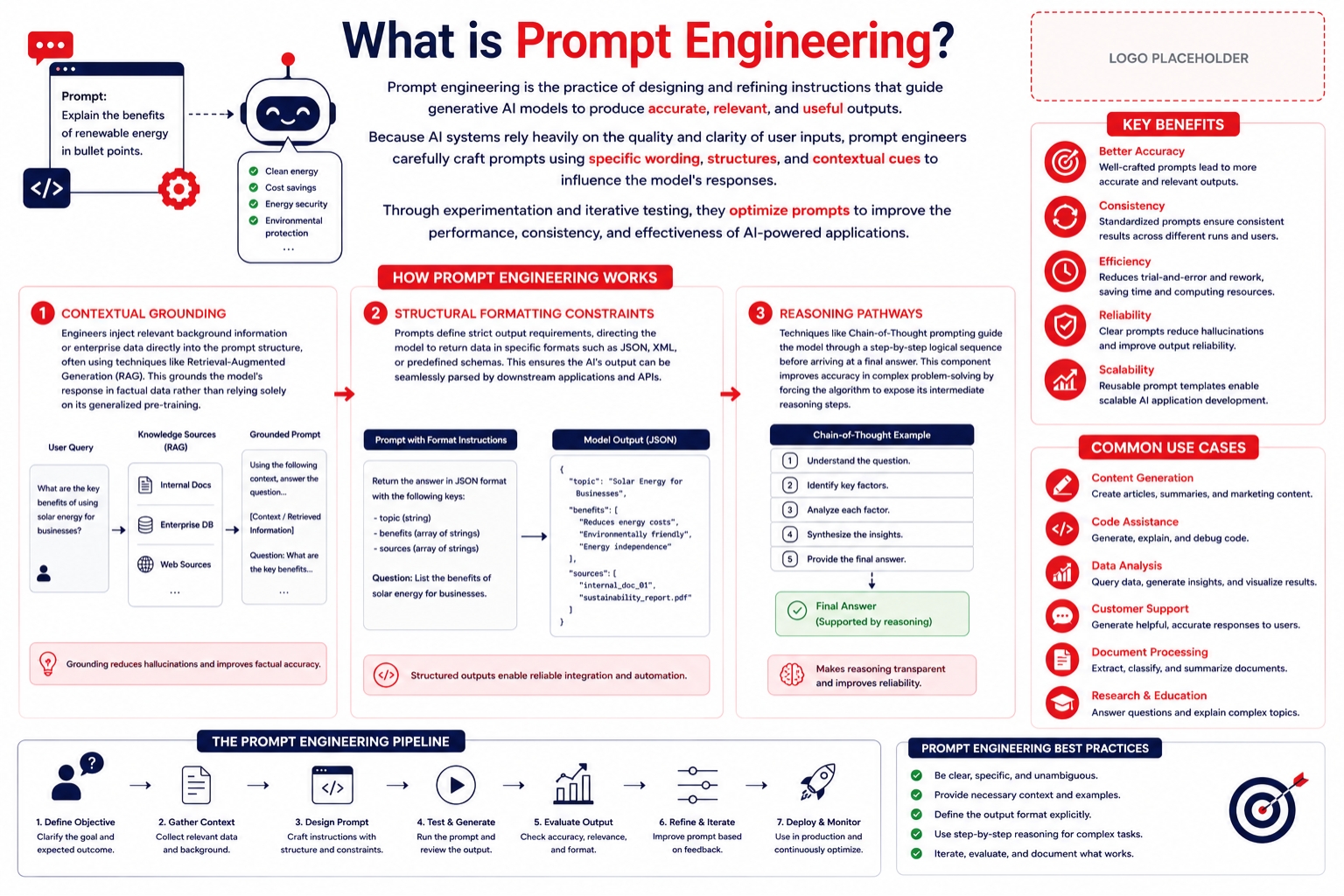
How prompt engineering works
Prompt engineering controls model behavior by establishing clear boundaries, providing necessary context, and defining output formats before the algorithm begins generation. Effective programmatic prompting utilizes frameworks to manage variables and conversational history, transforming raw queries into highly structured directives that guide the AI’s reasoning process.
Contextual Grounding
Engineers inject relevant background information or enterprise data directly into the prompt structure, often using techniques like Retrieval-Augmented Generation (RAG). This grounds the model’s response in factual data rather than relying solely on its generalized pre-training.
Structural Formatting Constraints
Prompts define strict output requirements, directing the model to return data in specific formats such as JSON, XML, or predefined schemas. This ensures the AI’s output can be seamlessly parsed by downstream applications and APIs.
Reasoning Pathways
Techniques like Chain-of-Thought prompting guide the model through a step-by-step logical sequence before arriving at a final answer. This component improves accuracy in complex problem-solving by forcing the algorithm to expose its intermediate reasoning steps.

Prompt Engineering vs Fine-Tuning
Both methods improve AI model performance, but they operate on fundamentally different levels of the algorithmic architecture.
Dimension | Prompt Engineering | Fine-Tuning |
| Modification Target | Input context and instructions | Internal model weights and parameters |
Compute Requirements | Low (Inference only) | High (Requires GPU training clusters) |
| Implementation Speed | Fast (Immediate iterations) | Slow (Requires data prep and training cycles) |
Primary Use Case | Formatting, tone, general reasoning | Deep domain knowledge, proprietary vocabulary |
| Data Requirements | Minimal (Few-shot examples) | High (Curated training datasets) |
When to consider prompt engineering
Consider Prompt Engineering if:
- You are integrating an LLM to generate customer-facing content and need to strictly enforce corporate brand voice and structural formatting.
- Your application relies on extracting structured data from unstructured text documents using APIs that require rigid JSON payloads.
- You need to rapidly prototype and iterate on an AI feature without committing to the heavy compute costs and long timelines of model fine-tuning.
It may not be the right priority if:
- Your AI system must possess deep, intrinsic knowledge of a highly specialized, proprietary domain (like custom medical coding or niche legal frameworks) that exceeds the capacity of a standard context window.
Why prompt engineering matters for enterprise IT
According to IBM, Prompt engineering plays a vital role in maximizing the effectiveness of generative AI by shaping the quality, accuracy, and relevance of its responses. Well-designed prompts provide clear context and direction, helping AI models better interpret user intent and generate more useful outcomes with less need for manual refinement. As organizations increasingly adopt generative AI across business functions, prompt engineering serves as a crucial practice for transforming broad user requests into reliable, actionable, and business-ready results.
Common misconceptions
Business leaders often mistake prompt engineering for a basic communication skill rather than a rigorous architectural practice, leading to fragile and unscalable AI deployments.
Prompt engineering is a rigid science with permanent ‘magic phrases’
Reality: Prompts are fragile, highly volatile, and tied to specific model versions. Adding hacks like “Take a deep breath” or “I will tip you $200” might temporarily improve results on a specific model build. However, the moment the AI vendor pushes a minor update or releases a new model architecture, those exact phrases can degrade performance or become entirely useless.
It is just typing clever text into a basic chat box
Reality: Enterprise-grade prompt engineering is software architecture, not creative writing. Programmatic prompting requires building dynamic templates inside application code using frameworks like LangChain or Semantic Kernel. It involves controlling variables, managing structural constraints to force strict JSON or XML outputs, handling conversational history arrays, and running automated evaluation tests on thousands of test cases.
Long, hyper-detailed prompts are always more effective
Reality: Bloated prompts trigger context dilution and dramatically increase cloud costs. Models can lose track of instructions tucked into the middle of massive prompts, the “lost-in-the-middle” phenomenon. Furthermore, every single word in a prompt consumes computational tokens; shorter, cleanly structured prompts using clear XML tags perform more reliably and cost significantly less to run at enterprise scale.
How Kyanon Digital applies prompt engineering
Kyanon Digital offers prompt engineering as a core professional service for enterprise clients adopting generative AI across Southeast Asia, ANZ, and Nordic Europe. Our implementation teams design programmatic prompt architectures using advanced frameworks to ensure AI outputs consistently meet strict business quality, tone, and accuracy standards. We focus on developing dynamic, scalable templates that optimize token usage and enforce rigorous structural constraints, driving measurable improvements in operational efficiency and ensuring seamless integration with existing corporate APIs.
Explore our Generative AI Development Services.

 Create project brief with AI