
What is Query Understanding (AI)?
Query understanding is the process of inferring the intent of a search engine user by extracting semantic meaning from the searcher’s keywords. Query understanding methods generally take place before the search engine retrieves and ranks results. It is related to natural language processing but specifically focused on the understanding of search queries.
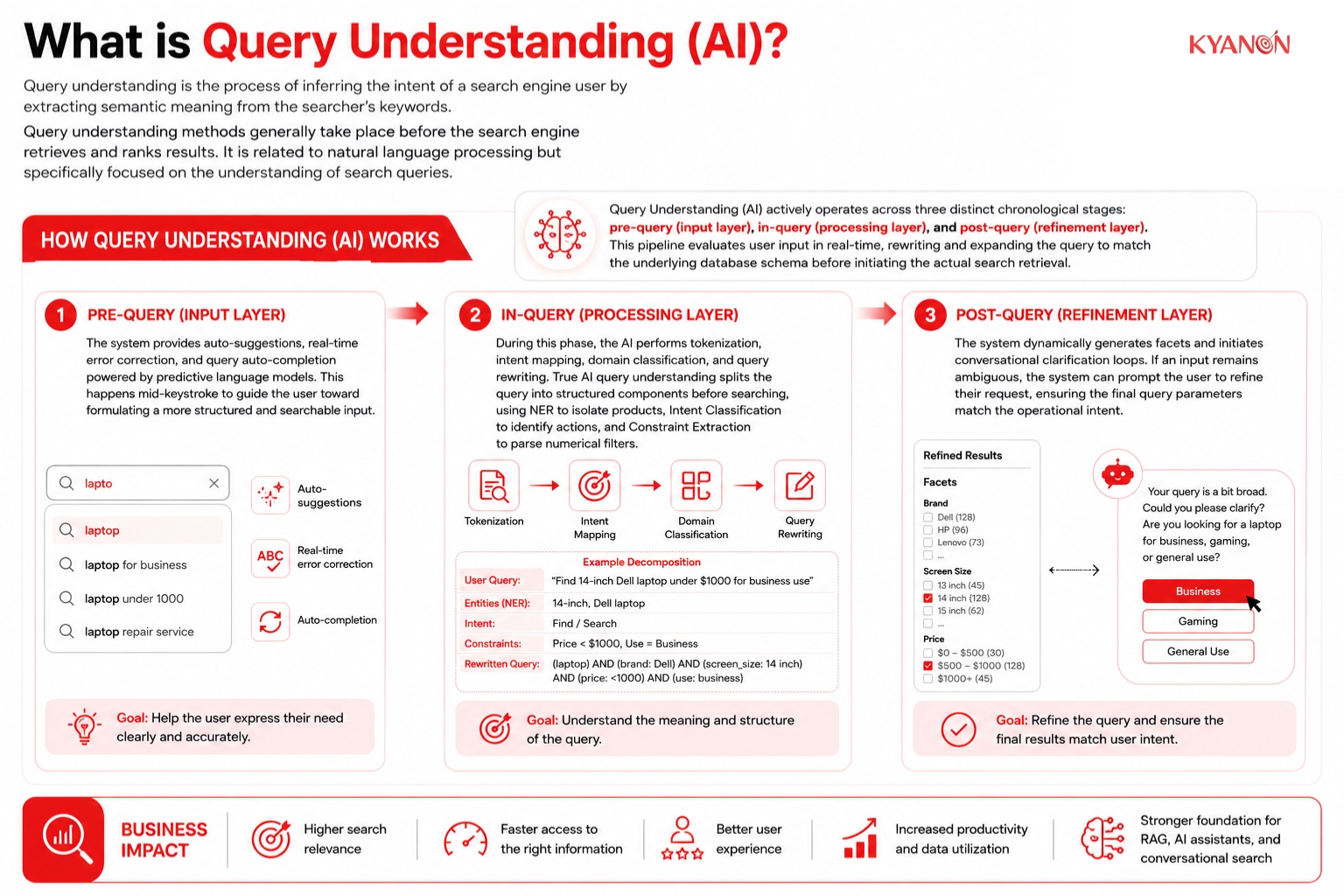
How Query Understanding (AI) Works
Query Understanding (AI) actively operates across three distinct chronological stages: pre-query (input layer), in-query (processing layer), and post-query (refinement layer). This pipeline evaluates user input in real-time, rewriting and expanding the query to match the underlying database schema before initiating the actual search retrieval.
Pre-Query (Input Layer)
The system provides auto-suggestions, real-time error correction, and query auto-completion powered by predictive language models. This happens mid-keystroke to guide the user toward formulating a more structured and searchable input.
In-Query (Processing Layer)
During this phase, the AI performs tokenization, intent mapping, domain classification, and query rewriting. True AI query understanding splits the query into structured components before searching, using Named Entity Recognition (NER) to isolate products, Intent Classification to identify actions, and Constraint Extraction to parse numerical filters.
Post-Query (Refinement Layer)
The system dynamically generates facets and initiates conversational clarification loops. If an input remains ambiguous, the system can prompt the user to refine their request, ensuring the final query parameters match the operational intent.

Real-World Applications of Query Understanding (AI)
- E-Commerce: Powering search bars so that typing “cheap summer dress” filters products by price, season, and category automatically.
- Search Engines: Allowing Google to answer complex questions directly rather than just pointing to websites.
- Customer Support Chatbots: Routing a user to the correct refund department even if they use slang or emotional language.
Query Understanding vs Raw Vector Search
While vector search focuses on broad semantic similarity, Query Understanding extracts precise, deterministic rules from the input to prevent irrelevant results.
Dimension | Query Understanding (AI) | Raw Vector Search (Dense Retrieval) |
| Search Mechanism | Extracts intent, entities, and constraints | Calculates global semantic similarity |
Handling of Constraints | Parses strict rules (e.g., “Under $100”) | Often ignores specific numerical boundaries |
| Query Processing | Actively rewrites and structures input | Directly embeds raw text as a vector |
Best For | Complex e-commerce filtering, operational queries | Open-ended research, knowledge discovery |
| Computational Overhead | High (Requires NLP parsing models) | Moderate (Relies on embedding generation) |
When to consider Query Understanding (AI)
Consider Query Understanding (AI) if:
- Your e-commerce platform struggles to return relevant products when users input long-tail, conversational queries with multiple constraints.
- Your enterprise chatbot frequently misinterprets localized slang or industry-specific jargon, leading to high escalation rates to human agents.
- Your internal document retrieval system returns thousands of loosely related files instead of isolating the specific report requested by the user.
It may not be the right priority if:
- Your user interface relies entirely on strict, pre-defined dropdown menus and faceted navigation, eliminating the need to parse open-ended text inputs.
Why Query Understanding (AI) matters for enterprise search
Query understanding is critical because it enables enterprise search systems to interpret the intent, context, and meaning behind a user’s question rather than relying solely on keyword matching. By understanding what employees are actually looking for, AI-powered search can return more relevant, context-aware, and permission-compliant results across knowledge bases, documents, CRM systems, and other enterprise data sources. This improves information discovery, reduces time spent searching, increases productivity, and serves as the foundation for advanced capabilities such as semantic search, RAG, AI assistants, and conversational enterprise search. (IBM)
Common misconceptions
Engineering teams often misjudge the architectural requirements of processing search inputs, incorrectly assuming that deploying massive, generalized models solves all localization and latency challenges.
It relies solely on a robust vector database (Dense Retrieval)
Reality: Pure vector search (semantic embeddings) without explicit query processing frequently fails on precise enterprise requests. If a user searches for “iPhone 15 screen replacement under $100,” a raw vector database looks at the global semantic “vibe” and might surface general iPhone 15 promotional articles or $90 phone cases. The correction requires splitting the query into structured components (NER, Intent Classification, Constraint Extraction) before searching.
A smarter Large Language Model (LLM) removes the need for a dedicated query pipeline
Reality: Passing raw user queries directly into an expensive LLM is slow, cost-prohibitive, and operationally fragile. Running a 70-billion parameter model to parse every single simple e-commerce or internal search query introduces massive latency spikes and astronomical token costs. Enterprise architectures utilize smaller, hyper-specialized, local intent-classification classifiers to handle query understanding in milliseconds, invoking heavy LLMs only for complex, multi-turn conversational reasoning.
Query understanding is completely language-agnostic out-of-the-box
Reality: Semantic intent rules change drastically based on localization, cultural contexts, and slang. While deep learning models learn universal cross-lingual spaces, true query intent is deeply tied to user behavior. For example, a user in Vietnam typing “ship hỏa tốc” requires an immediate, high-priority express delivery filter, whereas a translation model might look at the literal words (“fire speed ship”) and fail to map the operational intent. Localized intent classification tuning is always mandatory.
How Kyanon Digital applies Query Understanding (AI)
Kyanon Digital builds query understanding layers into enterprise search, chatbot, and document retrieval systems for clients handling ambiguous or complex user inputs across Southeast Asia, ANZ, and the US. Our data engineers deploy localized NLP pipelines that combine Named Entity Recognition, Intent Classification, and dynamic query rewriting to process user inputs in milliseconds. By utilizing specialized, lightweight classifiers rather than relying solely on raw LLM calls, we ensure measurable improvements in search accuracy and conversion rates while maintaining strict control over application latency and TCO.
Explore our Generative AI Development Services.

 Create project brief with AI