
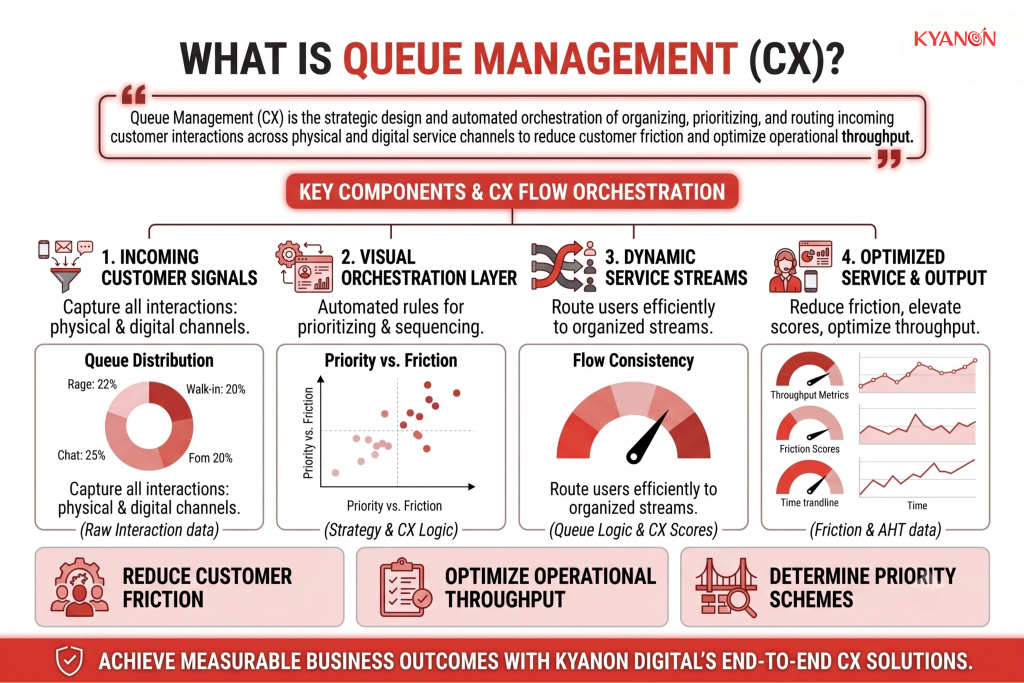
What is Queue Management (CX)?
Queue Management (CX) is the strategic design and automated orchestration of organizing, prioritizing, and routing incoming customer interactions across physical and digital service channels to reduce customer friction and optimize operational throughput.
How Queue Management (CX) Works
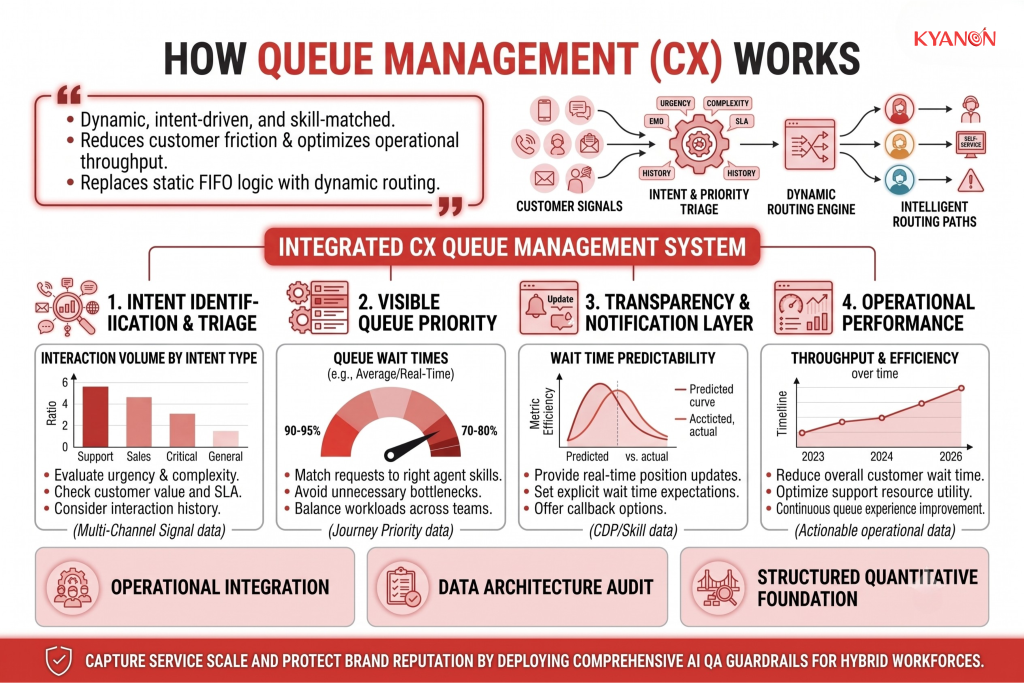
Modern queue management uses intelligent routing to decide how incoming customer requests should be handled based on customer needs, issue complexity, urgency, and available support capacity.
Instead of treating every customer request as first-come, first-served, the system evaluates each request and directs it to the most appropriate resolution path. This helps businesses reduce unnecessary waiting while making better use of available support resources.
Intent Identification and Triage
Intent identification and triage determine what the customer needs and how the request should be prioritized.
When a customer starts a conversation through voice, chat, or another channel, the system can evaluate:
- Technical urgency: Whether the issue involves a critical service disruption or requires immediate attention
- Resolution complexity: How much effort or specialized knowledge may be required
- Customer value and SLA: Whether the account has specific service commitments or priority support requirements
- Customer history: Previous interactions or unresolved issues that may affect how the request should be handled
In business terms, triage helps support teams answer a key question early: which customers need attention first, and what level of support do they need?
Dynamic Routing Engine
The dynamic routing engine matches each request with the most appropriate resolution path based on issue type, agent skills, and current team capacity.
For example:
- Simple questions can be directed to self-service or automated workflows
- Specialized issues can be assigned to agents with the right expertise
- High-priority cases can be escalated to senior or specialized teams
- Incoming demand can be distributed across available teams to avoid unnecessary bottlenecks
This goes beyond simply putting customers into a queue. The goal is to get each request to the right resource as efficiently as possible while balancing workload across support teams.
Transparency and Notification Layer
The transparency and notification layer keeps customers informed while they are waiting for assistance.
Instead of leaving customers with no visibility into what is happening, the system can provide:
- Current queue position
- Estimated wait time
- Callback options
- Status updates through SMS, mobile apps, or web interfaces
For CX teams, this creates a more predictable waiting experience. Even when an immediate response is not possible, customers have clearer expectations about when and how they will receive support.
Improving the Overall Queue Experience
Effective queue management is not only about reducing wait time. It connects customer demand with support capacity so that businesses can provide a more predictable and efficient service experience.
By combining intelligent triage, dynamic routing, and proactive notifications, businesses can:
- Reduce unnecessary waiting
- Route issues to the right team faster
- Balance workload across support resources
- Prioritize customers based on business and service needs
- Improve visibility throughout the support journey
The result is a queue experience that feels more responsive to customers while helping support teams operate more efficiently.

Comparative Analysis: Queue Management (CX) vs. Traditional FIFO Queuing
Dimension | Queue Management (CX) | Traditional FIFO Queuing |
| Routing Logic | Dynamic, intent-driven, and skill-matched | Static, chronological order of arrival |
Wait Transparency | Real-time position tracking and explicit ETA updates | Minimal or generic static time announcements |
| Resource Allocation | Automated triage based on query complexity | Fixed staffing distribution regardless of demand spikes |
Capacity Management | Integrated self-service offloading and express lanes | Linear processing causing operational bottlenecks |
| Cost Efficiency | Optimized agent utility and lower handle times | Higher TCO driven by overstaffing during peak loads |
Why Queue Management (CX) Matters
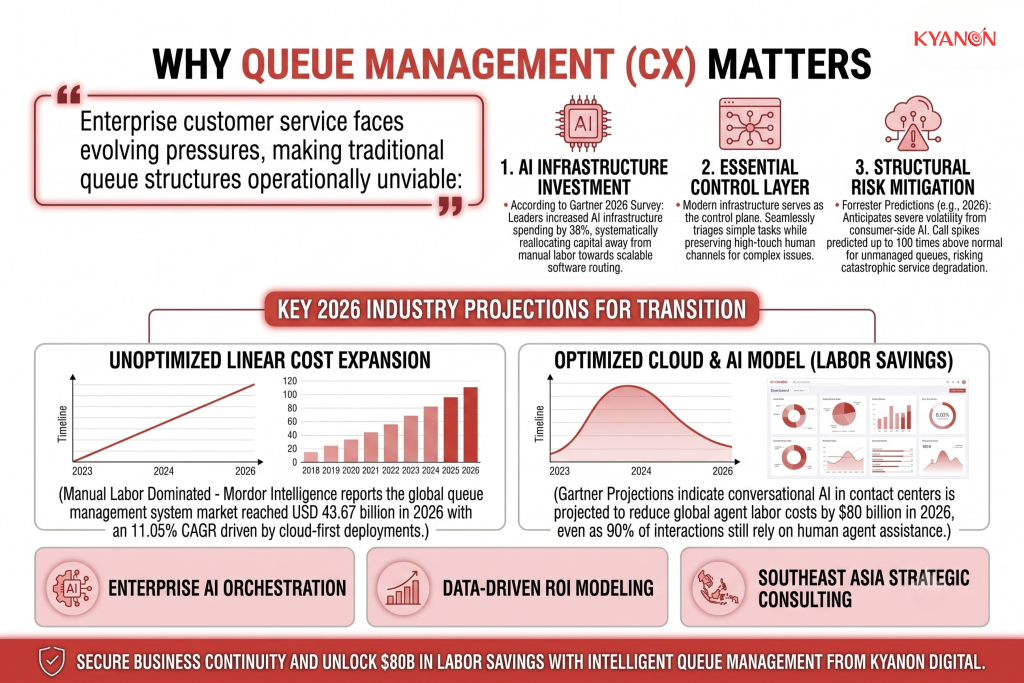
Enterprise customer service organizations face evolving demand pressures that make traditional queue structures operationally unviable:
- AI Infrastructure Investment: According to the Gartner 2026 Customer Service Technology Survey, customer service leaders increased spending on AI infrastructure by 38% in 2026, systematically reallocating capital away from manual labor toward scalable software routing.
- Essential Control Layer: Modern queue management infrastructure serves as the control plane that triages simple tasks seamlessly while preserving high-touch human channels for complex issues.
Unmanaged service queues pose substantial structural risks to business continuity during demand shocks. Research from Forrester’s Customer Service Predictions anticipates severe volatility driven by consumer-side AI tools, predicting that at least three major enterprise brands will experience call spikes 100 times above normal. Without intelligent prioritization engines to throttle inbound volume and identify bot-driven traffic, unmanaged queues risk catastrophic service degradation.
Key industry projections highlighting this transition include:
- Market Expansion: Mordor Intelligence reports the global queue management system market reached USD 43.67 billion in 2026 with an 11.05% CAGR driven by cloud-first deployments.
- Labor Savings: Gartner’s Conversational AI Projections indicate that conversational AI in contact centers is projected to reduce global agent labor costs by $80 billion in 2026, even as 90% of interactions still rely on human agent assistance.
Common Misconceptions
The goal is to make the wait time zero
A completely empty line usually indicates overstaffed operations and unnecessary labor spend. Leaders often focus on eliminating wait times entirely, but maintaining instant access for every contact requires unsustainable overhead. Focusing on occupied, predictable waiting time yields far better business efficiency; customers accept short waits when given precise queue positions, operational transparency, and explicit handling time expectations.
If customers are waiting quietly, they are perfectly fine
Passive waiting frequently masks building dissatisfaction rather than customer contentment. Silent digital or physical waiting gives users immediate downtime to explore alternative providers, write negative feedback, or drop out of purchasing journeys entirely. Proactive engagement through dynamic progress bars or brief updates mitigates psychological friction and preserves customer goodwill before frustration leads to attrition.
Digital queues completely solve the frustration of waiting
Shifting a line to a mobile screen simply makes the wait invisible rather than eliminating anxiety. Transitioning customers from physical spaces to QR codes or mobile apps without real-time feedback creates a “black box” experience that heightens uncertainty. Taking away physical line visibility requires replacing it with granular, real-time status updates, such as precise queue position numbers and dynamic time-to-service calculations.
First come, first served is always the fairest way to do it
Treating every incoming inquiry identically causes significant service bottlenecks across high-volume touchpoints. Processing basic, 10-second inquiries chronologically behind intricate 20-minute support issues degrades overall throughput and frustrates both customer segments. Segmenting queues by intent creates express pathways for routine interactions while matching complex inquiries directly with specialized handling teams.
How Kyanon Digital Applies Queue Management (CX)
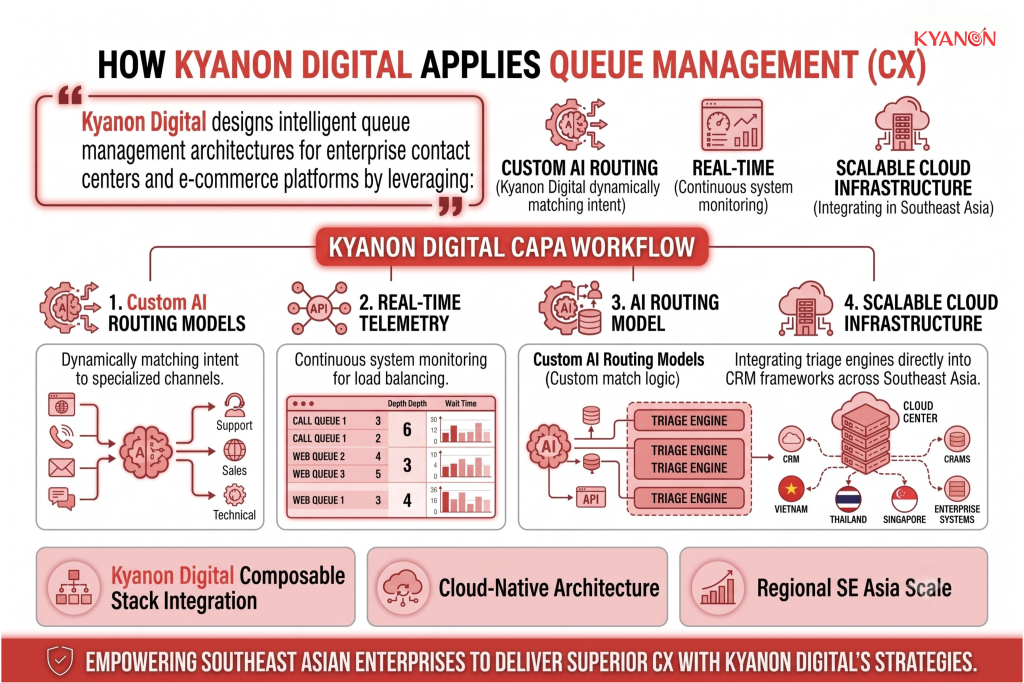
Kyanon Digital designs intelligent queue management architectures for enterprise contact centers and e-commerce platforms by leveraging:
- Custom AI Routing Models: Dynamically matching intent to specialized channels.
- Real-Time Telemetry: Continuous system monitoring for load balancing.
- Scalable Cloud Infrastructure: Integrating triage engines directly into CRM frameworks across Southeast Asia.
Explore our services:

 Create project brief with AI