
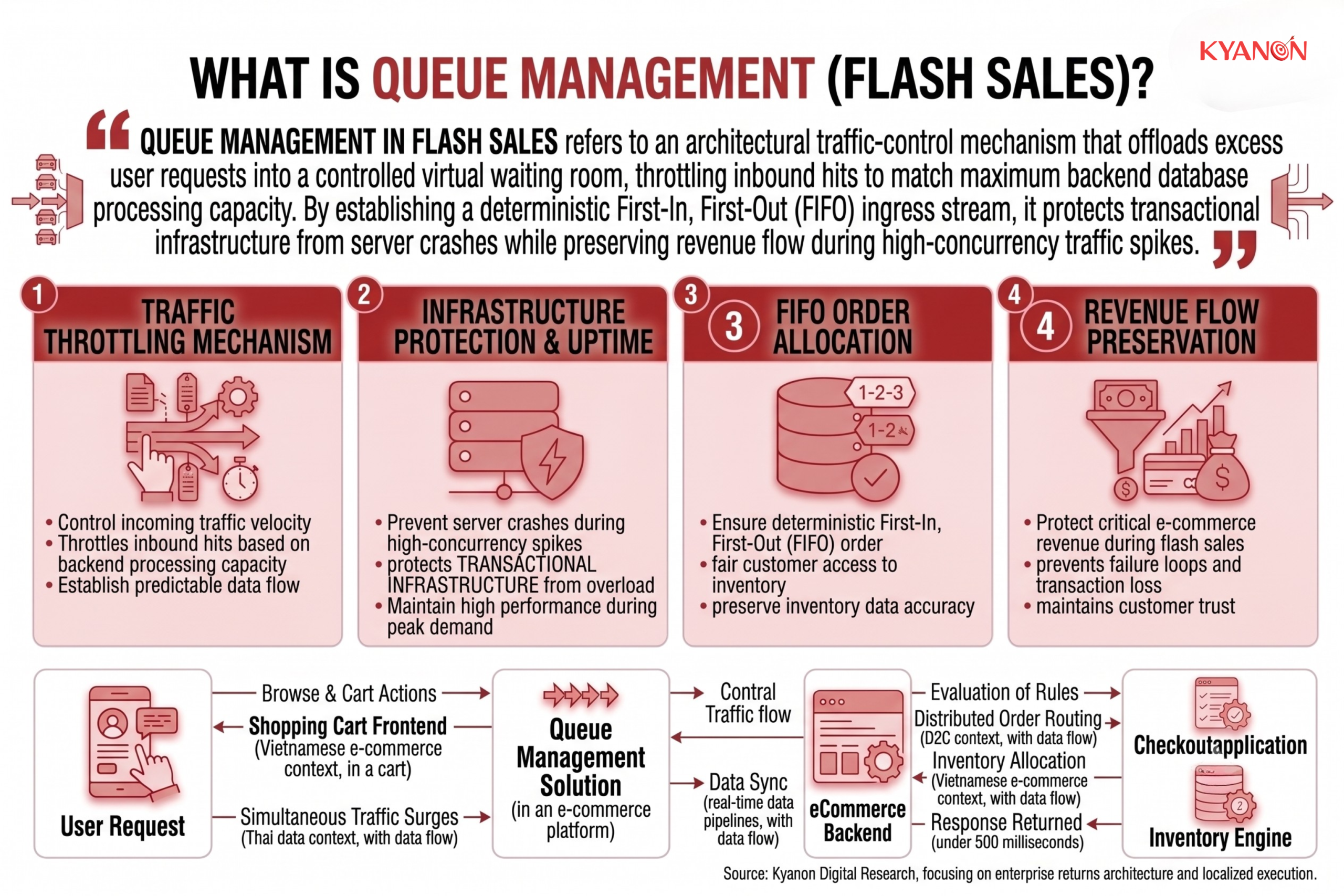
What is Queue Management (Flash Sales)?
Queue management in flash sales refers to an architectural traffic-control mechanism that offloads excess user requests into a controlled virtual waiting room, throttling inbound hits to match maximum backend database processing capacity. By establishing a deterministic First-In, First-Out (FIFO) ingress stream, it protects transactional infrastructure from server crashes while preserving revenue flow during high-concurrency traffic spikes.
How Queue Management (Flash Sales) Works
When high-demand drops occur, inbound traffic typically spikes beyond standard autoscaling operational limits within milliseconds. Queue management intercepts traffic at the network edge before it reaches application servers or transactional databases, holding excess connections in a managed virtual holding area and releasing users to checkout at a controlled rate.
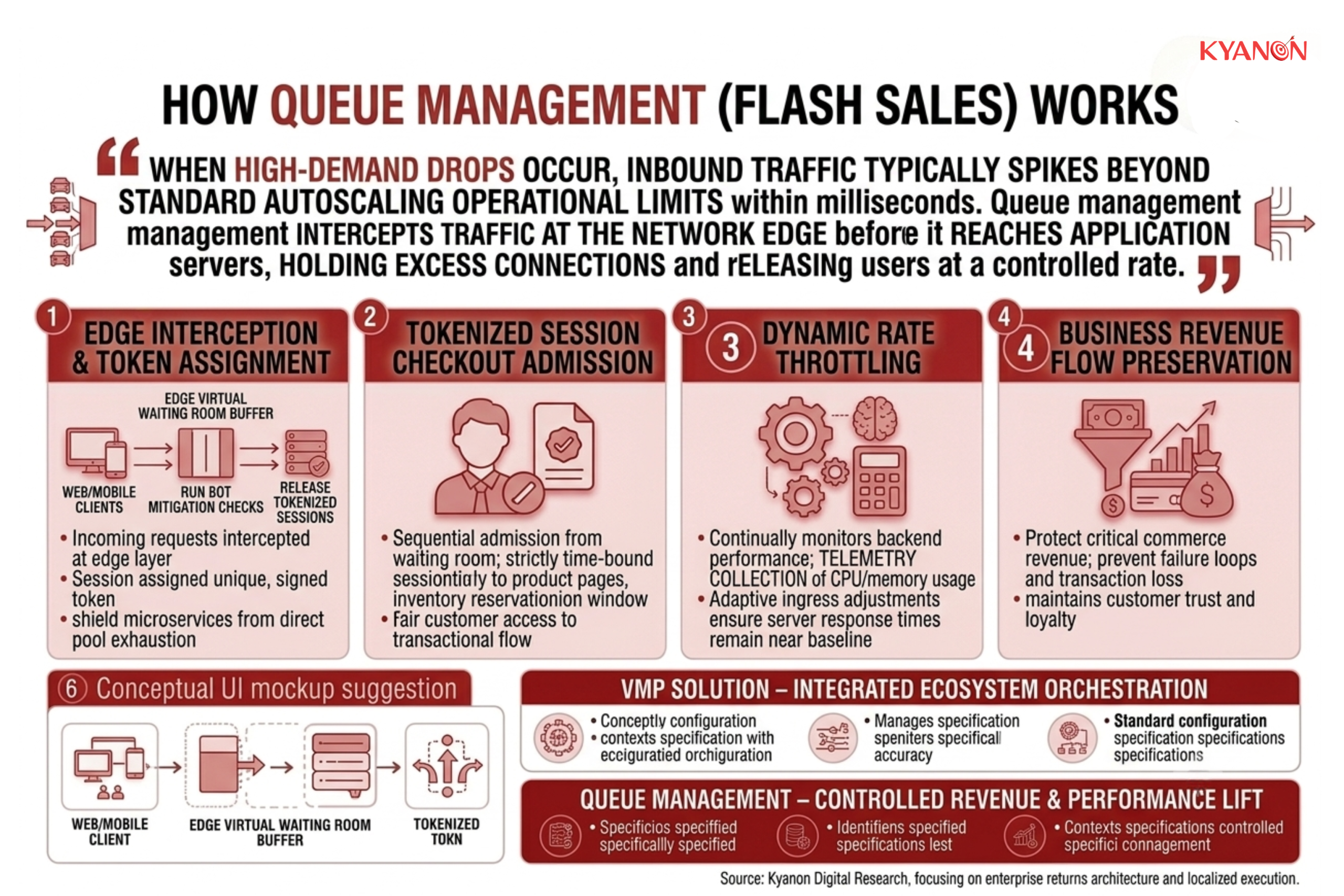
Edge Interception and Token Assignment
Incoming HTTP requests are intercepted at the edge network layer using edge workers or specialized virtual waiting room engines.
- Token Issuance: Instead of allowing raw traffic to hit application servers directly, the system assigns incoming user sessions a unique, cryptographically signed token.
- Off-Stack Queuing: Unvalidated requests are held in an off-stack holding queue, shielding microservices from direct connection pool exhaustion.
Dynamic Rate Throttling
The queuing engine continuously monitors key backend performance metrics, including database CPU utilization, memory consumption, inventory lock contention, and API response latencies.
- Telemetry Collection: Real-time health signals are gathered from checkout endpoints and inventory databases.
- Adaptive Ingress Adjustments: Based on these signals, the engine dynamically adjusts outflow rates (e.g., admitting 500 validated users every 10 seconds), ensuring server response times remain near baseline operational levels.
Tokenized Session Checkout Admission
When a user reaches the front of the virtual line, the system grants them access to proceed to the checkout flow with their signed session token. This token allows the user to navigate product pages, reserve inventory, and complete payment processing within a strict, time-bound window before expiring.

Comparative Analysis: Queue Management (Flash Sales) vs. Unmanaged Auto-Scaling
Operational Dimension | Unmanaged Auto-Scaling | Queue Management (Flash Sales) |
| System Stability | Vulnerable to database lockups during micro-burst traffic spikes. | Maintains 100% server uptime by capping active backend concurrency. |
User Experience | High frequency of 504 Gateway Timeouts and infinite page reloads. | Transparent wait times, clear queue position indicators, and line status. |
| Infrastructure Cost | High temporary cloud spend due to over-provisioned backend instances. | Low resource consumption by shifting queue state management to edge workers. |
Database Protection | Risk of deadlocks, unhandled race conditions, and overbooking inventory. | Controlled transactional throughput protecting inventory reservation APIs. |
| Bot & Fraud Control | Vulnerable to automated checkout scripts and scraping bots. | Integrated token validation and challenge-response bot filtering before checkout. |
Why Queue Management (Flash Sales) Matters
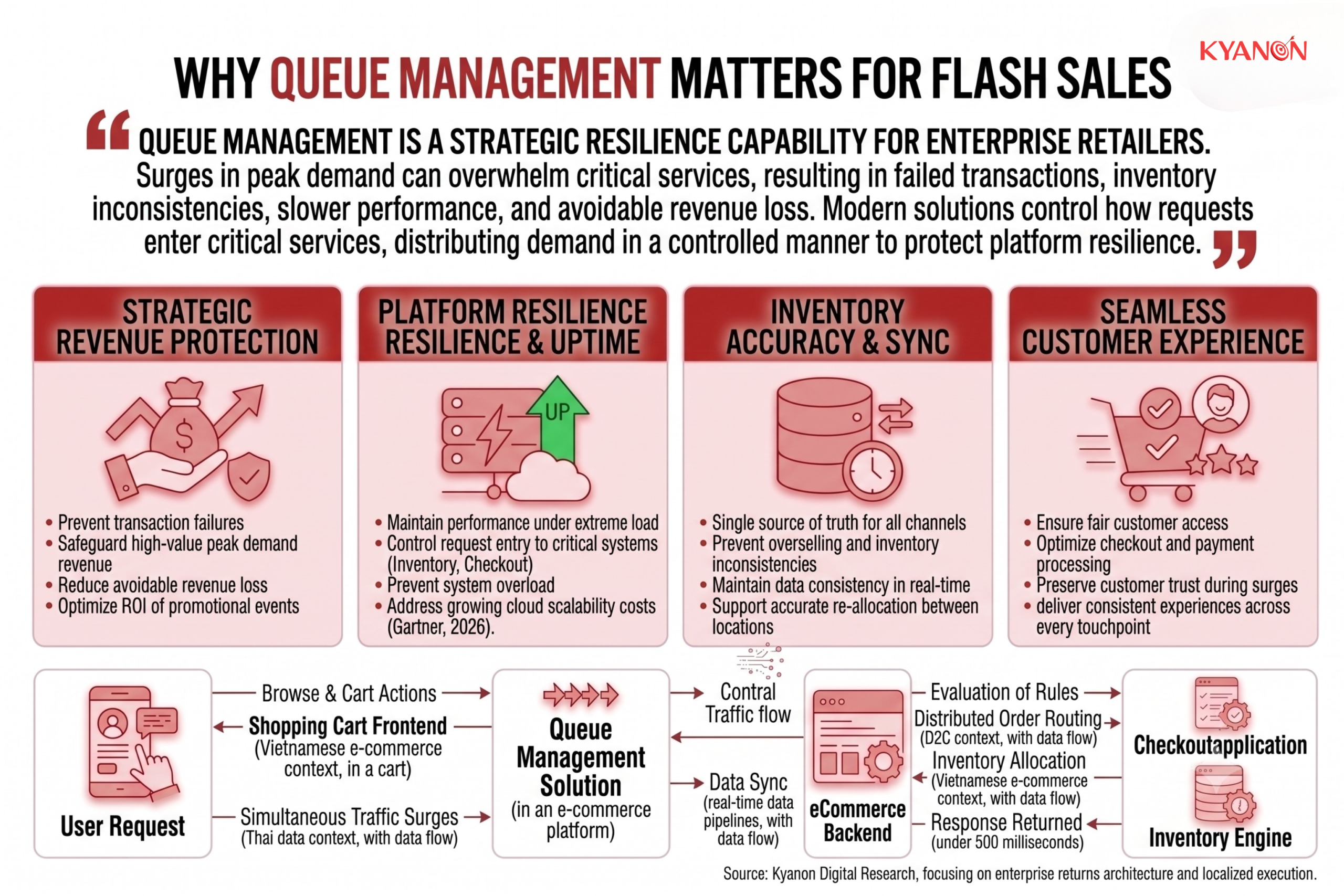
For enterprise retailers, flash sales, limited-edition launches, and major promotional campaigns represent high-value revenue opportunities, but they also introduce significant operational risk. During peak demand, thousands of customers may attempt to browse, reserve inventory, and complete checkout simultaneously. Without mechanisms to regulate traffic, these surges can overwhelm critical commerce services, resulting in failed transactions, inventory inconsistencies, slower checkout performance, and avoidable revenue loss.
As digital commerce scales, maintaining platform resilience has become a strategic priority. Gartner forecasts Infrastructure as a Service (IaaS) spending will grow by 29.3% in 2026, reflecting continued enterprise investment in cloud scalability. At the same time, Gartner reports that global data center electricity demand is expected to increase by 26%, driven by the rapid expansion of AI workloads and compute-intensive applications. These trends reinforce that infrastructure investment alone is no longer sufficient; commerce platforms also require intelligent traffic orchestration to maintain performance during periods of extreme demand.
A modern Queue Management solution addresses this challenge by controlling how requests enter critical services such as inventory allocation, checkout, and payment processing. Rather than allowing all traffic to compete for the same resources simultaneously, it distributes demand in a controlled manner, protecting system stability while ensuring fair customer access.
For executive leaders, Queue Management is more than an operational safeguard. It is a strategic resilience capability that protects revenue during high-profile campaigns, preserves customer trust, and enables the organization to scale promotional events without compromising platform performance.
Common Misconceptions
Queues drive customers away and drop sales
A traffic surge does not necessarily mean an e-commerce site will lose all sales. AWS notes that peak events can drive traffic 2-25x above normal levels within seconds, potentially exceeding what infrastructure can provision fast enough. A virtual waiting room helps control the rate at which users enter the application, protecting critical systems while giving customers clear wait-time visibility and a more predictable experience.
Good infrastructure makes queues obsolete
Even massive cloud architectures hit hard physical limits at the database checkout or inventory locking layer during sudden traffic micro-bursts. Queuing protects backend transaction engines from concurrent race conditions and database deadlocks that standard auto-scaling cannot resolve in real time.
Virtual lines do not improve digital speed
Uncontrolled incoming requests saturate server memory and bandwidth, causing severe page latency and gateway timeouts. Controlled pacing eliminates server timeouts, letting legitimate buyers complete checkouts smoothly instead of fighting endless page-reload lag.
How Kyanon Digital Applies Queue Management (Flash Sales)
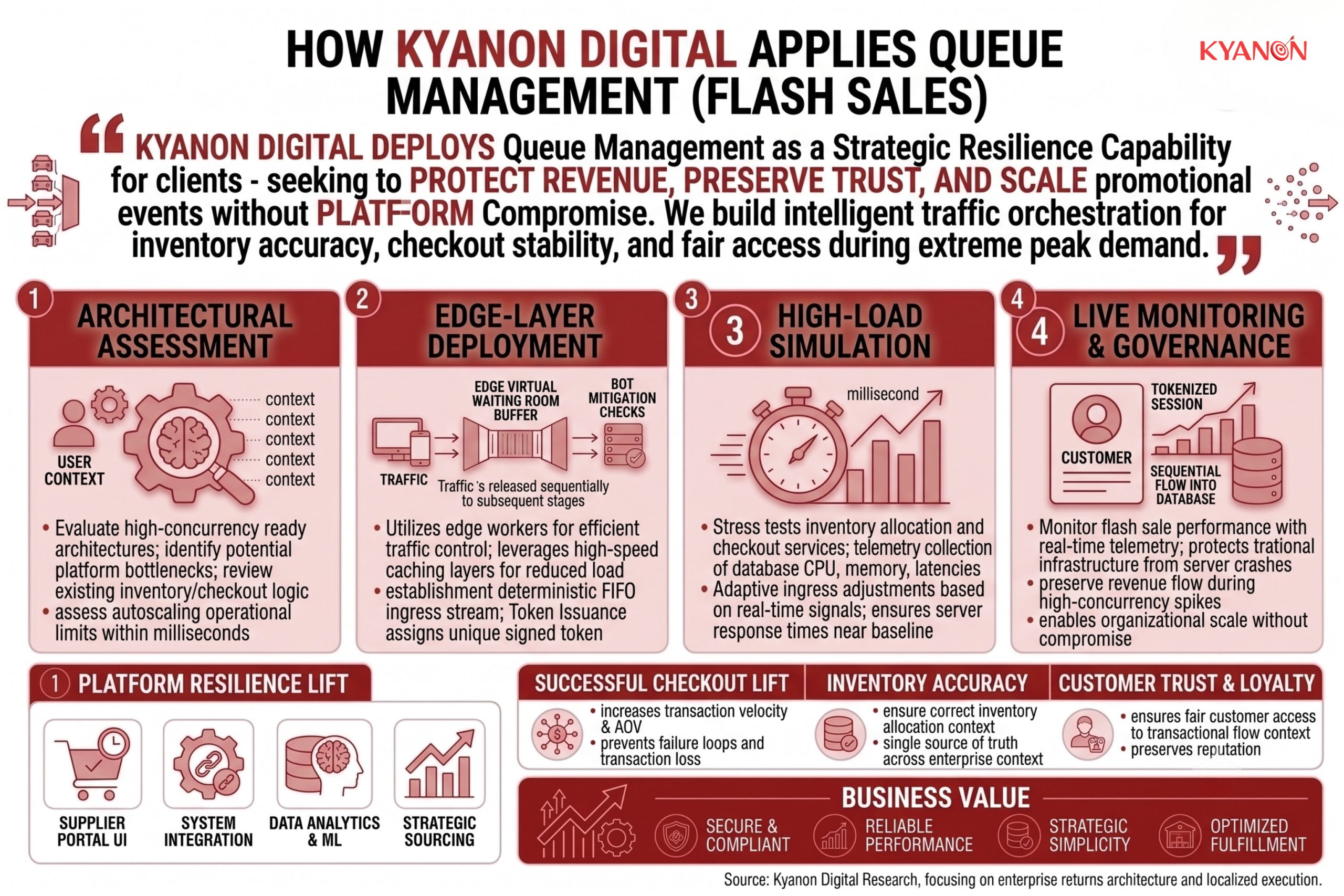
Kyanon Digital implements virtual waiting room and queue management systems in flash sale and high-concurrency e-commerce architectures for enterprise brands. Our engineering teams leverage edge workers, high-speed caching layers, and microservice rate-limiters to ensure high-demand digital sales perform smoothly under peak load.
Explore our services:

 Create project brief with AI