
What is random forest?
Random Forest is a versatile and widely used machine learning algorithm, trademarked by Leo Breiman and Adele Cutler. It works by merging the outputs of multiple decision trees to generate a single, unified result. Its popularity stems from its ease of use and its flexibility in solving both classification and regression problems. (IBM)
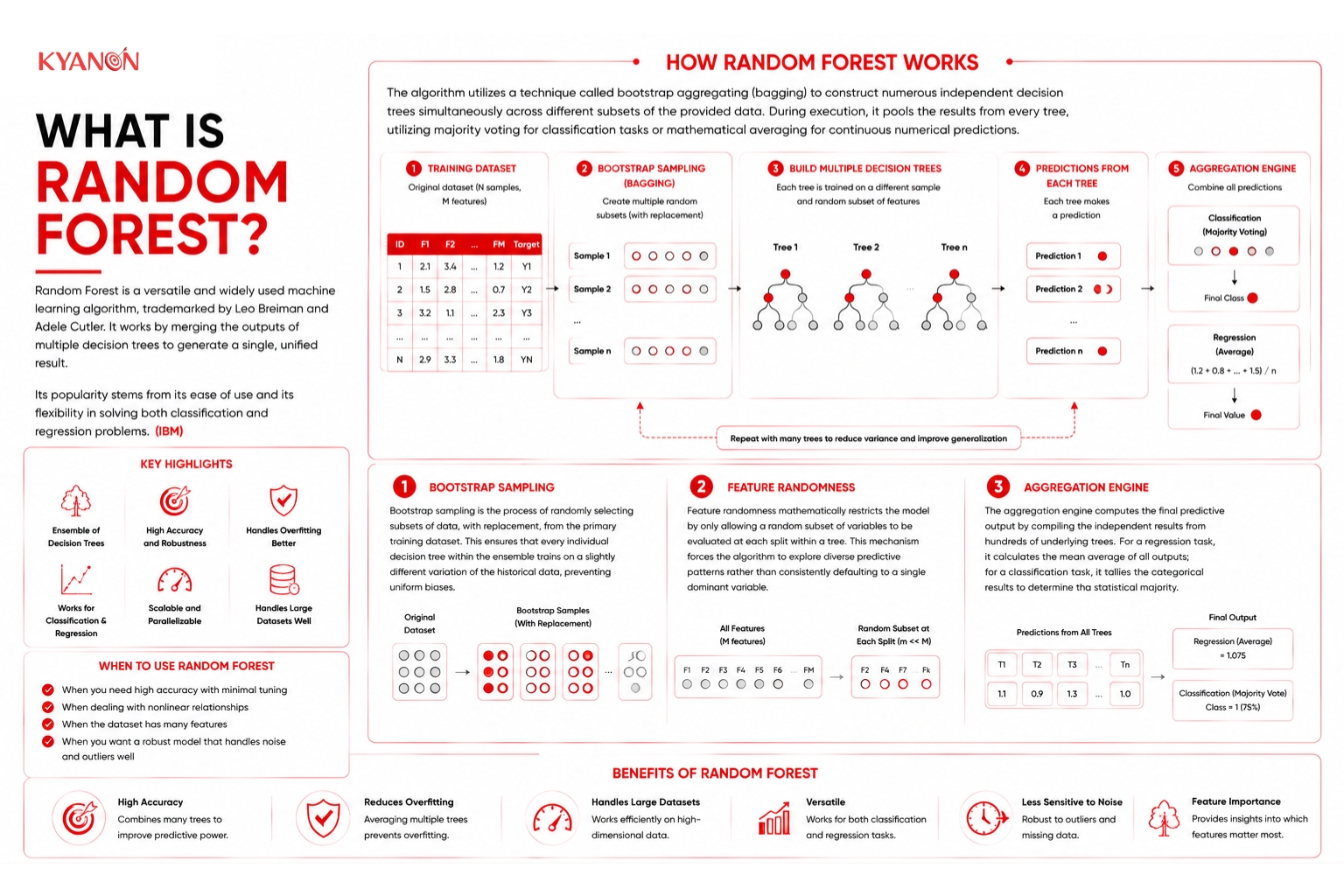
How random forest works
The algorithm utilizes a technique called bootstrap aggregating (bagging) to construct numerous independent decision trees simultaneously across different subsets of the provided data. During execution, it pools the results from every tree, utilizing majority voting for classification tasks or mathematical averaging for continuous numerical predictions.
Bootstrap Sampling
Bootstrap sampling is the process of randomly selecting subsets of data, with replacement, from the primary training dataset. This ensures that every individual decision tree within the ensemble trains on a slightly different variation of the historical data, preventing uniform biases.
Feature Randomness
Feature randomness mathematically restricts the model by only allowing a random subset of variables to be evaluated at each split within a tree. This mechanism forces the algorithm to explore diverse predictive patterns rather than consistently defaulting to a single dominant variable.
Aggregation Engine
The aggregation engine computes the final predictive output by compiling the independent results from hundreds of underlying trees. For a regression task, it calculates the mean average of all outputs; for a classification task, it tallies the categorical results to determine the statistical majority.

Random Forest vs XGBoost
Both algorithms utilize multiple decision trees to generate predictions, but they differ fundamentally in how those trees are constructed and mathematically optimized.
Dimension | Random Forest | XGBoost |
| Execution Style | Parallel (Trees built independently) | Sequential (Trees built based on prior errors) |
Optimization Mechanism | Variance reduction via bagging | Error correction via gradient boosting |
| Training Speed | Fast (Utilizes multi-core processing) | Slower (Requires sequential dependency) |
Sensitivity to Outliers | Low (Averaging mitigates extremes) | High (Forced to correct outlier errors) |
| Risk of Overfitting | Lower baseline risk | High if hyperparameters are poorly tuned |
When to consider random forest
Evaluating random forest requires assessing whether the primary data structure relies on tabular, historical records rather than sequential forecasting. Consider random forest if:
- Your engineering team needs to classify customer behavior across large, structured databases and requires high interpretability to explain feature importance to non-technical stakeholders.
- You are establishing a reliable baseline model for a new structured dataset and need an algorithm that performs effectively without demanding extensive hyperparameter tuning.
- Your server infrastructure relies heavily on multi-core processors, allowing the parallel training architecture of the model to drastically reduce compilation times.
It may not be the right priority if:
- Your enterprise requires processing highly unstructured data formats, such as audio files or raw pixel imagery, where deep neural networks offer vastly superior pattern recognition.
Why random forest matters for enterprise operations
A Random Forest model is critical for enterprise operations because it serves as an exceptionally stable, accurate, and low-maintenance machine learning framework for predictive analytics.While generative AI handles unstructured data like text, Random Forest is a primary operational tool for maximizing the value of structured corporate data (such as ERP spreadsheets, CRM logs, and transaction tables). It provides enterprises with high-accuracy predictions without requiring the massive compute resources or complex tuning associated with deep learning.
Common misconceptions
We can use this algorithm to forecast next year’s revenue targets and predict future market trends
Reality: Random forest models mathematically cannot extrapolate data. Because the algorithm makes decisions by averaging the numeric values of existing historical data points, it cannot predict a value that is higher or lower than the maximum or minimum targets already found in your training set.
Because it uses multiple trees, the model is entirely immune to overfitting on our training data
Reality: While the bagging process prevents the overall model from overfitting to variance as you add more trees, the individual decision trees can still overfit. If the trees are allowed to grow too deep on noisy, uncleaned data, the model’s ability to generalize to new, unseen production data will severely degrade.
Adding more trees will continuously make the model faster and more accurate
Reality: Adding more trees decreases mathematical variance up to a specific threshold, but it yields diminishing returns. Past a few hundred trees, adding more nodes will only consume computational memory and slow down prediction speeds without providing any measurable improvement to accuracy.
How Kyanon Digital applies random forest
Kyanon Digital implements random forest models for classification and regression tasks across enterprise client projects in the US, Nordic Europe, ANZ, and Southeast Asia. Our data engineering teams deploy these algorithms to analyze highly structured tabular data, valuing their interpretability and statistical stability. This approach ensures B2B decision-makers receive transparent predictive models that optimize conversion rates and lower the Total Cost of Ownership (TCO) associated with complex machine learning infrastructure.
Explore our Cloud and ML services:

 Create project brief with AI