
What is synthetic data?
Synthetic data is algorithmically generated data designed to mimic real-world information, typically utilized to fill specific gaps for fit-for-purpose data requirements. Although it can be used for simple random data generation, its primary utility is found in replicating rare edge cases and highly specific scenarios. This methodology effectively provides an alternative data source when specific real-world information is either difficult to acquire or poses operational risks to utilize. (SAS)
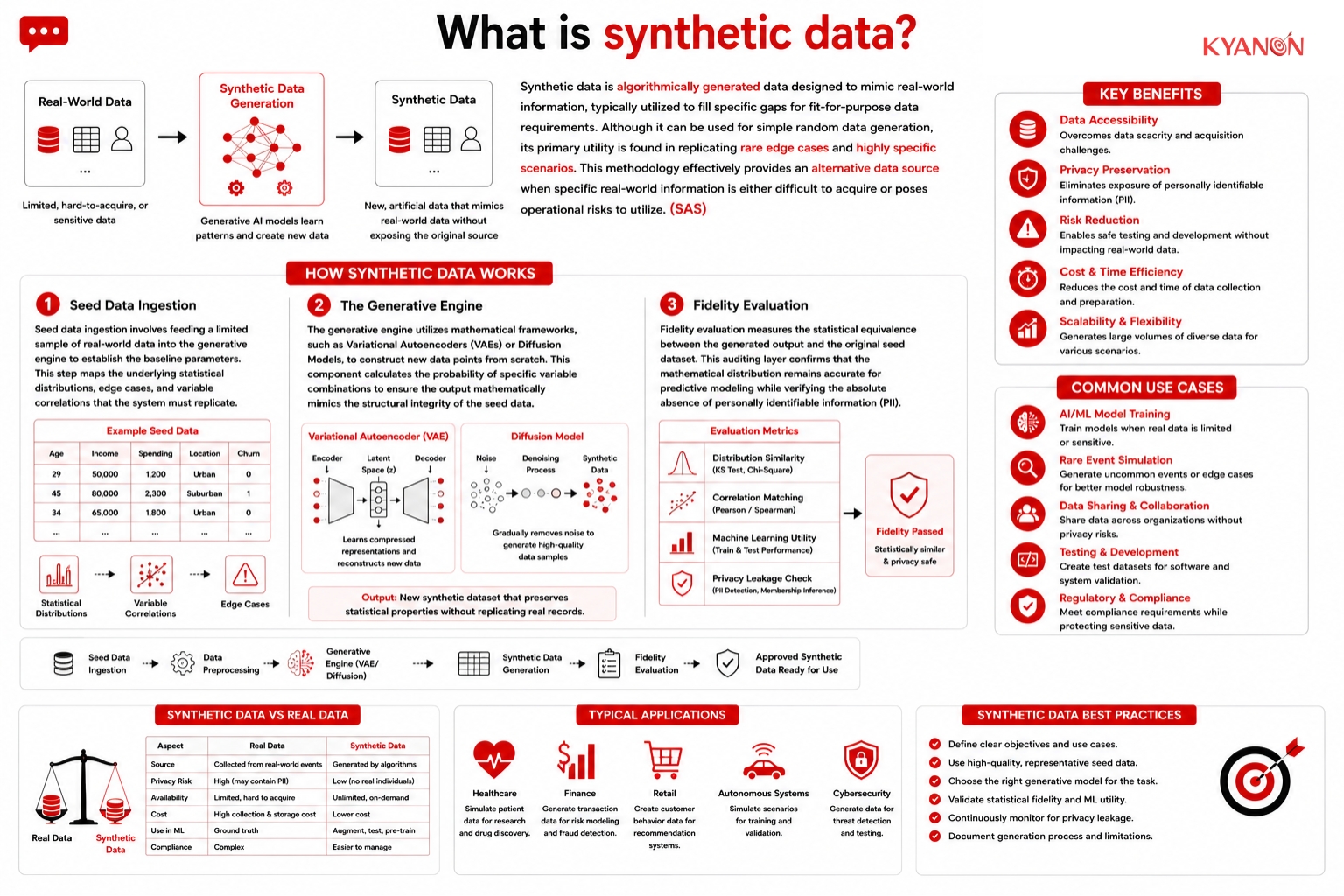
How synthetic data works
The generation of synthetic data relies on generative deep learning architectures to ingest a baseline sample, map its statistical correlations, and output a completely net-new population of data points. The resulting dataset maintains the mathematical behavior necessary for algorithmic training while severing all ties to the original input source.
Seed Data Ingestion
Seed data ingestion involves feeding a limited sample of real-world data into the generative engine to establish the baseline parameters. This step maps the underlying statistical distributions, edge cases, and variable correlations that the system must replicate.
The Generative Engine
The generative engine utilizes mathematical frameworks, such as Variational Autoencoders (VAEs) or Diffusion Models, to construct new data points from scratch. This component calculates the probability of specific variable combinations to ensure the output mathematically mimics the structural integrity of the seed data.
Fidelity Evaluation
Fidelity evaluation measures the statistical equivalence between the generated output and the original seed dataset. This auditing layer confirms that the mathematical distribution remains accurate for predictive modeling while verifying the absolute absence of personally identifiable information (PII).

The three major categories of Synthetic Data
Depending on your engineering needs, synthetic data can be generated across three foundational formats:
- Tabular Synthetic Data: Artificially generated tables, spreadsheets, or database rows. For example, creating 1 million “fake” banking customer profiles with realistic ages, credit scores, and purchase histories to test a financial software pipeline without exposing real customer data.
- Media / Unstructured Synthetic Data: Artificially generated images, audio, or video files. Computer vision models are frequently trained on synthetic images of cars, pedestrians, or manufacturing defects generated by 3D graphics engines like Unity or Unreal Engine.
- Text Synthetic Data: High-quality prose or code snippets generated by LLMs. This text is used to fine-tune smaller AI models or expand training datasets when human-written data is scarce.
Synthetic Data vs Anonymized Data
Both mechanisms aim to protect user privacy during data analytics, but they execute fundamentally different technical approaches to data alteration.
Dimension | synthetic data | Anonymized Data |
| Origin | Artificially generated from mathematical models | Modified directly from real historical records |
Re-identification Risk | Zero (No 1:1 mapping to real individuals) | Moderate to High (Vulnerable to linkage attacks) |
| GDPR / PII Applicability | Typically falls completely outside scope | Often remains subject to strict regulatory frameworks |
Data Utility Degradation | Low (Preserves macro-statistical relationships) | High (Heavy masking breaks analytical value) |
| Generation Speed | Highly scalable on demand | Bottlenecked by manual masking processes |
When to consider synthetic data
Enterprise IT directors deploy synthetic data when strict data residency laws prevent the cross-border transfer of raw customer information for global AI training. Consider synthetic data if:
- Your data science team is building a fraud detection algorithm but possesses a highly imbalanced dataset where actual fraudulent transactions account for less than 0.1% of the records.
- Your organization operates in the financial or healthcare sector and requires a method to share high-fidelity testing databases with external software vendors without triggering GDPR or HIPAA compliance violations.
- You are launching a net-new digital product and need to bootstrap machine learning pipelines before acquiring sufficient historical user behavior data.
It may not be the right priority if:
- Your core objective requires executing exact historical audits, forensic accounting, or precise user-level transactional rollbacks where artificial substitution nullifies the business requirement.
Why synthetic data matters for enterprise AI
As real-world data scarcity looms, synthetic data has shifted from a niche testing tool into a core enterprise strategy:
- Absolute Privacy Compliance (GDPR/CCPA): Because synthetic data is built mathematically from scratch, it contains zero Personally Identifiable Information (PII). Medical researchers can share highly realistic synthetic patient records globally without violating strict health privacy laws.
- Balances Asymmetric Datasets: Real-world operational data is heavily imbalanced. In fraud detection, 99.9% of transactions are legitimate, giving an AI very little data to learn what fraud looks like. Synthetic engines can intentionally generate thousands of rare fraud edge-cases to train models perfectly.
- Massive Cost Reductions: Manually collecting, sorting, cleaning, and human-labeling thousands of real-world images or documents is incredibly expensive and slow. Synthetic pipelines can generate millions of perfectly labeled data points in minutes for a fraction of the cost.
Common misconceptions
We can just run our customer database through an anonymization script; it is the exact same thing as synthetic data and perfectly safe for our external vendors
Reality: Traditional anonymization modifies original records via masking or obfuscation, which retains structural links to the source and remains highly vulnerable to linkage attacks. True synthetic data builds entirely new populations from scratch with zero structural links to any real individual, frequently placing it completely outside the scope of strict regulatory frameworks like GDPR.
Training our AI exclusively on infinite synthetic data will let us scale our models forever without paying for human data collection
Reality: Over-reliance on recursively generated synthetic data leads to a mathematical degradation known as model collapse. Without regular injections of fresh, real-world human anchor data, subsequent AI models begin to suffer from compounding statistical errors, informational decay, and severe hallucinations.
Because the machine generates it, the data will be completely objective and free from human bias
Reality: Synthetic models learn directly from human-curated inputs. If the underlying seed dataset contains historical prejudices or imbalanced demographics, the generative engine will effortlessly replicate, formalize, and mathematically amplify those exact biases into the new dataset.
How Kyanon Digital applies synthetic data
Kyanon Digital integrates synthetic data generation into enterprise AI architectures for clients across the US, Nordic Europe, ANZ, and Southeast Asia. Our data engineering teams deploy these generative frameworks to resolve data scarcity and class imbalance, specifically optimizing algorithms for fraud detection and predictive commerce. This approach allows enterprise clients to execute cross-border model training with strict data privacy compliance, ensuring a reduction in Total Cost of Ownership (TCO) and faster time-to-market for predictive AI solutions.
Explore our Generative AI Development services.

 Create project brief with AI