
What is Unsupervised Pre-Training?
Unsupervised Pre-Training is the initial phase of machine learning model development in which an algorithm learns from massive volumes of raw, unannotated data to build foundational representations of a domain before being adapted for specific tasks. Rather than relying on manually labeled datasets, it uses self-supervised learning techniques that generate training signals directly from the structure of the data itself, allowing the model to discover patterns, relationships, grammar, semantics, and other underlying statistical features without human annotation.

During this process, the model learns by solving proxy tasks that require it to infer missing information or predict relationships within the data. Through these learning objectives, it develops a generalized understanding of language, images, or other data types, enabling it to capture complex structural and contextual patterns at scale.
The result of unsupervised pre-training is a set of highly optimized model parameters, often referred to as foundational weights, that encode broad knowledge about the training domain. These learned representations provide a strong starting point for subsequent fine-tuning, allowing the model to be efficiently adapted to specialized downstream applications with significantly less labeled data.
How Unsupervised Pre-Training Works
Unsupervised pre-training works by transforming vast amounts of raw, unlabeled data into self-generated learning tasks that enable a model to discover patterns, relationships, and structures without human annotation. Rather than learning from manually labeled examples, the model creates its own training signals by predicting missing or sequential parts of the data. Through millions or billions of iterative optimization cycles, it gradually develops an internal representation of language, images, or other data domains and stores this knowledge within its model parameters.

Self-Supervised Objective Functions
The first stage creates learning objectives directly from the raw data itself. Instead of relying on human-generated labels, the model is tasked with predicting information that has been intentionally hidden or withheld from the input.
Common approaches include Masked Language Modeling (MLM), where selected words are hidden and the model must infer them using surrounding context, and Causal Language Modeling (CLM), where the model predicts the next token in a sequence based on preceding text. For each prediction, the model compares its output with the actual answer and calculates an error value, typically using cross-entropy loss. This error is then propagated through the network to update its parameters and improve future predictions.
Statistical Pattern Compression
As training progresses, the model continuously compresses information from massive datasets into its internal parameter structure. Early in training, it learns low-level statistical patterns such as token frequencies, common word pairings, grammatical structures, and punctuation rules.
Over time, as the model becomes increasingly efficient at representing these basic patterns, it begins capturing more sophisticated relationships. Higher-level semantic understanding, contextual awareness, conceptual associations, and long-range dependencies emerge as the model discovers increasingly efficient ways to minimize prediction errors across diverse datasets. This process enables the network to build a rich internal representation of the underlying data domain.
Weight Initialization and Foundation Learning
The final outcome of pre-training is a set of highly optimized model parameters, often referred to as foundation weights. Rather than beginning future learning tasks from random parameter values, the model starts with weights that already encode broad knowledge about language, visual structures, or other domain-specific patterns.
These pre-trained weights provide a strong mathematical foundation that captures the statistical regularities of the training data. As a result, subsequent fine-tuning tasks can build upon existing knowledge instead of learning from scratch, enabling faster convergence and more efficient adaptation to specialized use cases.

Unsupervised Pre-Training vs Fine-Tuning
Both phases modify a model’s internal weights, but they differ fundamentally in scale, objective, and data requirements.
Dimension | Unsupervised Pre-Training | Fine-Tuning |
| Primary objective | Broad pattern and syntax acquisition | Task-specific adaptation and alignment |
Data requirement | Massive volumes of raw, unlabeled data | Smaller, highly curated labeled datasets |
| Compute resources | Extremely high (months on GPU clusters) | Low to moderate (hours or days) |
Weight modification | Initializes and shapes the entire parameter space | Shifts existing weights toward specific outcomes |
| Output behavior | General, unaligned statistical generation | Constrained, instruction-following responses |
When to Consider Unsupervised Pre-Training
Consider Unsupervised Pre-Training (or selecting a custom domain-specific pre-trained model) if:
- Your enterprise operates in a highly specialized sector, such as genomics or legal tech, where generic foundation models fundamentally lack the necessary baseline vocabulary.
- You are building a proprietary foundation model from scratch to ensure absolute data sovereignty, security, and intellectual property control.
- Your current fine-tuned models suffer from catastrophic forgetting because the underlying base model was trained on a data distribution entirely unrelated to your production environment.
It may not be the right priority if:
- Your use case involves standard natural language tasks, such as sentiment analysis or basic document summarization, where off-the-shelf foundation models require only minor fine-tuning.
Why Unsupervised Pre-Training Matters for Enterprise AI
Unsupervised pre-training has become the foundation of modern enterprise AI because it enables organizations to create models that understand the language, terminology, patterns, and workflows specific to their industry before being adapted for specialized business applications. Rather than starting every AI initiative from scratch, enterprises can leverage pre-trained foundation models that have already learned broad representations from massive datasets and then refine them using domain-specific knowledge.
According to Gartner, foundation generative AI models remain the largest area of enterprise AI investment, with worldwide end-user spending on generative AI models projected to reach $14.2 billion in 2025. Foundation models are trained on vast amounts of data and serve as the baseline technology supporting a wide range of enterprise AI applications.
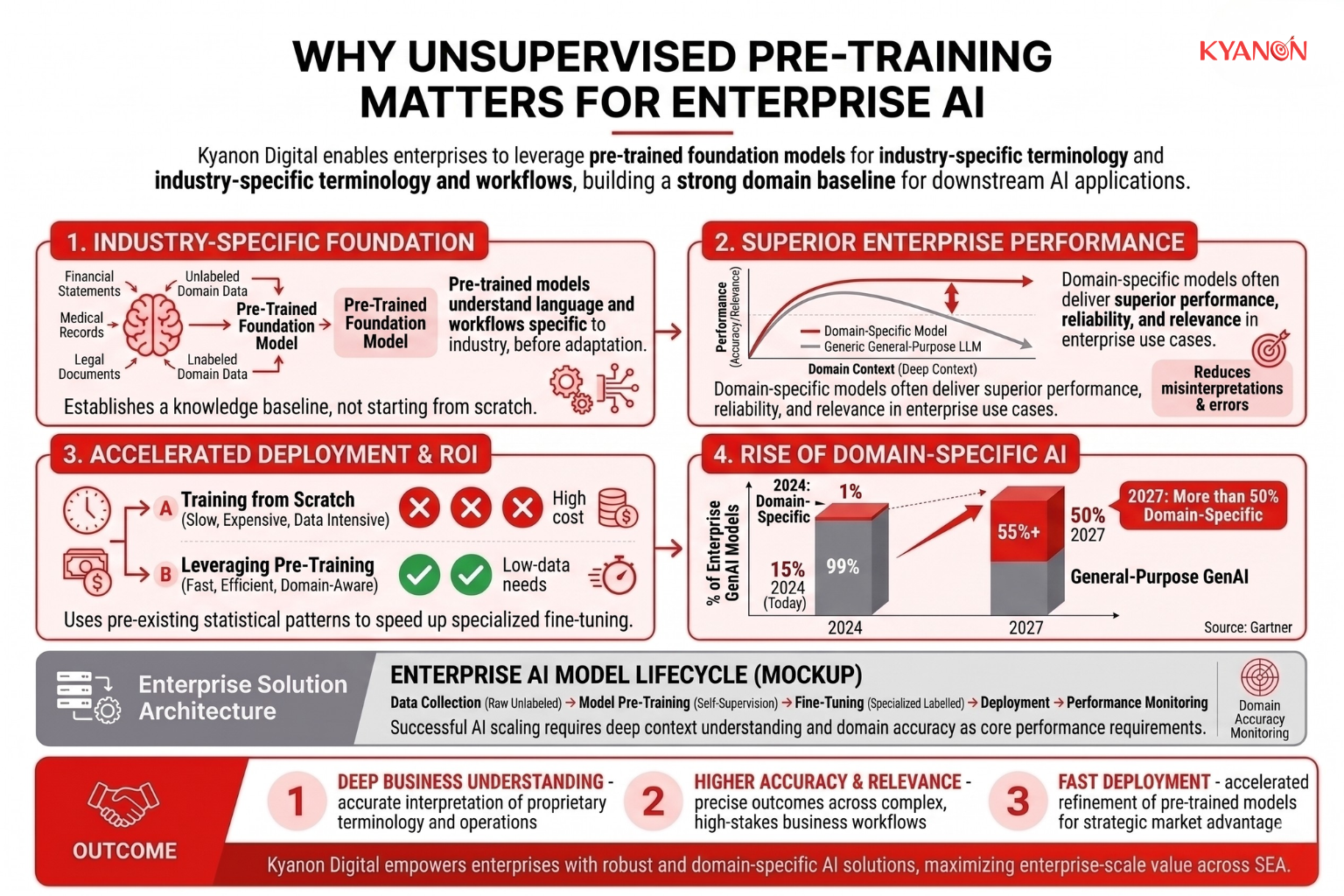
The strategic value of pre-training becomes even more apparent as enterprises move toward AI systems optimized for specific business domains. Gartner reports that domain-specific language models (DSLMs) can deliver higher reliability and up to 50% lower development costs than general-purpose models in specialized workflows. As a result, Gartner projects the DSLM market to reach $131 billion by 2035, reflecting growing enterprise demand for models pre-trained and adapted with industry-specific knowledge rather than relying exclusively on broad foundation models.
Organizations will use small, task-specific AI models at least three times more than general-purpose large language models by 2027. While general-purpose models provide strong language capabilities, their accuracy declines when tasks require deep business-domain context. As a result, enterprises are increasingly investing in models trained or refined on proprietary datasets that reflect their unique operational environments.
A practical example can be seen in legal services. A multinational legal firm deployed a foundation model pre-trained on historical case law, regulatory filings, and legal documentation before fine-tuning it for contract analysis. Because the model had already learned the statistical patterns, terminology, and structural conventions of legal language during pre-training, it was able to identify liability clauses and regulatory risks that generic models frequently overlooked. This illustrates a core principle of enterprise AI: the quality and relevance of the data used during pre-training often determine the upper limit of downstream model performance.
For enterprise leaders, the significance of unsupervised pre-training extends beyond technical efficiency. It establishes the knowledge foundation upon which AI systems build domain expertise, enabling faster deployment, higher accuracy, and more reliable outcomes across specialized business workflows. As organizations increasingly prioritize contextualized and industry-specific AI solutions, pre-training has become a critical factor in achieving enterprise-scale AI value.
Common Misconceptions
The model learns high-level reasoning and logic during the early stages of training
Mechanistic interpretability research shows that models learn basic token frequencies, n-grams, and local surface-level grammar rules first. High-level reasoning, logical deduction, and contextual tracking only emerge in the final stages of pre-training, after the model has saturated its capacity to compress simple structural patterns.
We can completely erase harmful biases or hallucinations using post-training guardrails
Relying entirely on fine-tuning or system prompts to override bad pre-training data is structurally flawed because the initial phase etches core statistical associations deep into the foundational layers. Because alignment fine-tuning only modifies a superficial outer layer of the network’s behavior, adversarial jailbreak prompts can easily bypass these guardrails, exposing the raw, unfiltered biases learned during the initial unsupervised phase.
Adding more uncurated data to the pre-training phase will infinitely scale the model’s performance
Model performance scales predictably only when engineering teams balance parameter size, compute budget, and data volume in precise ratios based on the Chinchilla Scaling Laws. Feeding a model low-quality web scrapes or repetitive AI-generated text causes a phenomenon known as Model Collapse, leading to a permanent drop in reasoning capabilities regardless of how many tokens the system processes.
How Kyanon Digital Applies Unsupervised Pre-Training
Kyanon Digital applies the principles of unsupervised pre-training as a foundational part of enterprise AI solution design, helping organizations accelerate AI adoption while minimizing development costs and deployment risks. Rather than treating all foundation models as interchangeable, our engineering and AI consulting teams evaluate the pre-training characteristics, domain coverage, architectural strengths, and performance trade-offs of both open-source and proprietary models before selecting the most suitable foundation for a specific business use case.

This approach begins with a detailed assessment of the client’s industry, operational workflows, data landscape, and target outcomes. Because the knowledge encoded during pre-training directly influences downstream model performance, Kyanon Digital analyzes whether a model’s original training data aligns with the client’s domain.
→ Explore our Artificial Intelligence services.

 Create project brief with AI