
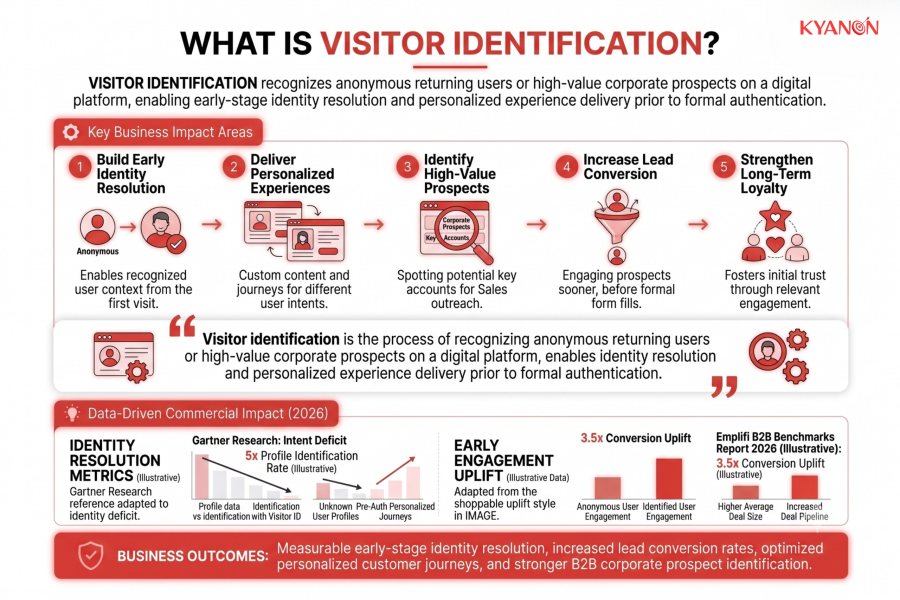
What is Visitor Identification?
Visitor identification is the process of recognizing anonymous returning users or high-value corporate prospects on a digital platform, enabling early-stage identity resolution and personalized experience delivery prior to formal authentication.
How Visitor Identification Works
Visitor identification bridges the gap between anonymous web traffic and known entity profiles by aggregating fragmented technical signals at the edge of the network. Rather than relying on explicit user input, the architecture queries incoming connection metadata against external identity graphs and corporate IP registries to map active sessions to specific organizations or unified customer profiles.
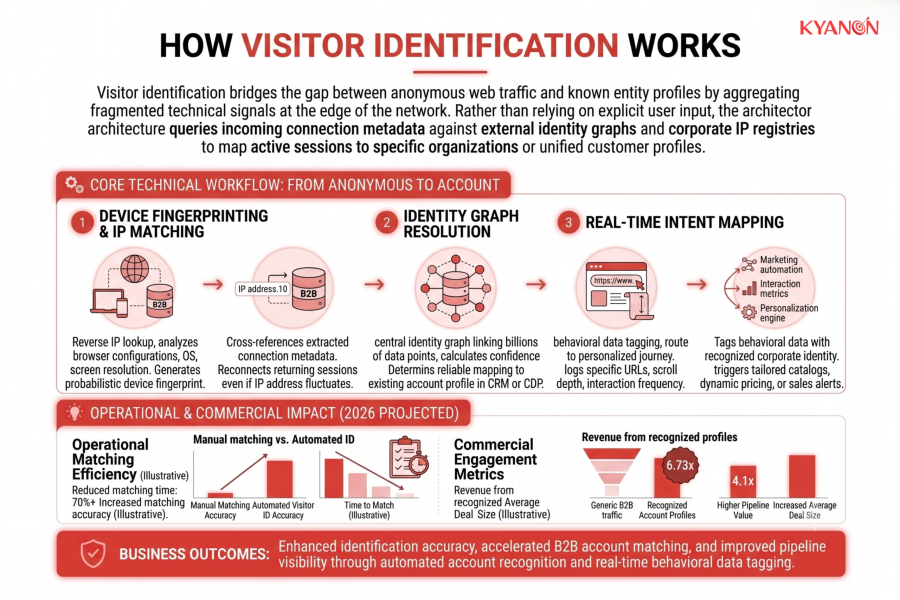
Device Fingerprinting & IP Matching
The system evaluates the incoming connection’s static IP address against commercial B2B databases to execute a reverse IP lookup. Simultaneously, it analyzes browser configurations, operating systems, and screen resolutions to generate a probabilistic device fingerprint, helping reconnect returning sessions even if IP addresses fluctuate.
Identity Graph Resolution
Extracted connection metadata is instantly cross-referenced against a centralized identity graph, a vast repository linking billions of device IDs, corporate networks, and behavioral patterns. This component calculates a confidence score, determining whether the current session maps reliably to an existing account profile in the CRM or Customer Data Platform (CDP).
Real-Time Intent Mapping
Once an account match is established, the architecture logs the specific URLs visited, scroll depth, and interaction frequency. This behavioral data is tagged with the recognized corporate identity and routed to downstream marketing automation and personalization engines to trigger dynamic pricing, tailored catalogs, or sales alerts.

Comparative Analysis: Visitor Identification vs. Traditional Web Analytics
While both architectures process web traffic, they serve fundamentally different operational objectives regarding data resolution and actionability.
Dimension | Visitor Identification | Traditional Web Analytics |
| Core Objective | Entity resolution and intent capture | Aggregate behavioral trend analysis |
User Visibility | Account-level and returning user tracking | Anonymous, generalized session tracking |
| Data Actionability | Triggers real-time personalization workflows | Requires manual retrospective analysis |
B2B Value | Maps activity to specific target accounts | Shows general traffic volume per page |
| Integration Depth | Bi-directional sync with CRM and CDP | One-way data collection to reporting dashboard |
When to Consider Visitor Identification
Consider Visitor Identification if:
- Your enterprise e-commerce platform experiences high traffic volume but low conversion rates among key B2B target accounts.
- Your engineering team is deploying AI-driven personalization engines that require immediate contextual data before the user authenticates.
- Your sales organization wastes significant operational hours chasing unfiltered, low-intent leads rather than focusing on accounts demonstrating active research behavior on high-value pages.
It may not be the right priority if:
- Your digital platform relies entirely on a mandatory, gated login for all users before any product discovery or catalog browsing can occur.
Why Visitor Identification Matters
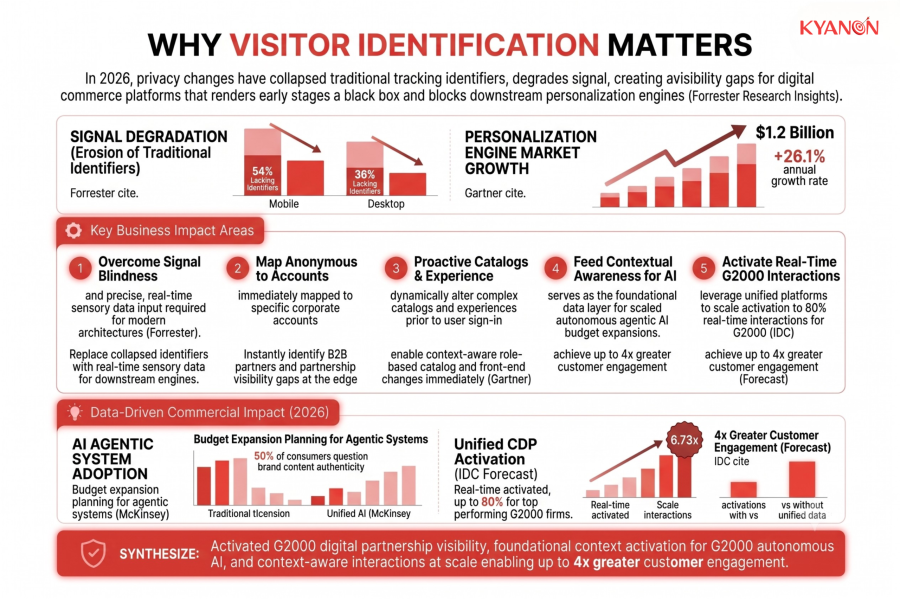
In modern B2B buying journeys, prospects complete up to 80% of their research independently before making direct contact with a vendor. As hyper-digital discovery patterns evolve, search behavior is shifting rapidly; research shows 60% of Gen Z consumers rely heavily on AI overviews at the top of digital search platforms instead of navigating traditional directory trees, according to McKinsey & Company. Because prospects transition from AI discovery platforms directly onto specific digital touchpoints, the temporal window to capture buying intent is extremely tight.
Delivering tailored experiences during these unauthenticated visits directly dictates market performance. Fast-growing enterprises derive 40% more of their revenue from tailored customer interactions than slower-growing competitors, as reported by McKinsey & Company. Resolving visitor identity upon arrival enables digital teams to anchor pre-login experiences to past behaviors and firmographic profiles, systematically capturing high-value intent before session drop-off occurs.
According to IDC, global enterprise investments in AI infrastructure and software are projected to exceed $500 billion by 2026. Enterprise IT directors and engineering leaders have pivoted away from isolated, standalone personalization scripts toward deeply integrated platform architectures. Visitor identification serves as the foundational data ingestion utility within this stack, converting raw anonymous web traffic into structured, governed intent data that powers machine learning models and automated revenue workflows across the enterprise.
Common Misconceptions
The 100% De-Anonymization Myth
A standard B2B setup typically yields an account-level match rate of 30% to 65%, with contact-level matches dropping to 5% to 20%. Privacy blockers, VPN configurations, and distributed remote work architectures make complete resolution technically impossible.
Conflating Tracking with Identification
Tracking tools merely document aggregated, anonymous behavioral data such as session length and scroll depth. Identification bridges the technical gap by linking those specific actions to known corporate identities or returning contacts.
Assuming Identity Resolution Means Personal Identification
Most reputable enterprise software operates strictly on Account-Level identification, mapping traffic to corporate entities rather than extracting the exact names and personal email addresses of remote browsers. Attempting to scrape personal details of un-opted-in users introduces severe legal liabilities.
Fear of Inherent Compliance Violations
Legitimate B2B identification focuses on corporate IP mapping, which is classified as business-to-business information rather than protected personal data. When privacy policies are accurately configured, this data can be collected lawfully under standard legitimate interest frameworks.
Treating All Intent Data Equally
Unfiltered identification tools capture all traffic, including competitors, students, and job seekers. Without applying strict behavioral filters, such as tracking repeated visits to high-value URLs like pricing or technical documentation, teams will misallocate resources reacting to false sales signals.
How Kyanon Digital Applies Visitor Identification
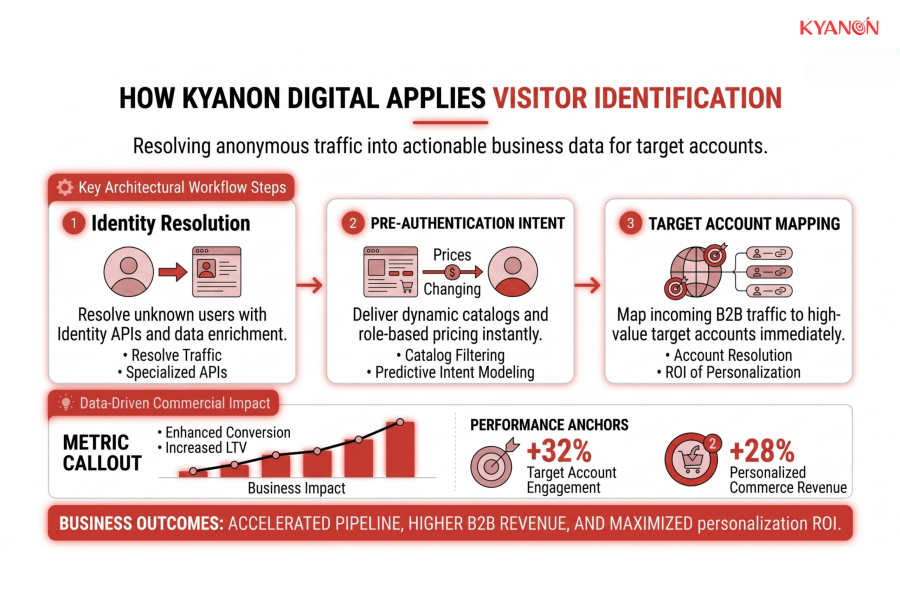
Kyanon Digital implements visitor identification capabilities within broader enterprise architectures to resolve anonymous traffic into actionable business data. By integrating specialized identity resolution APIs directly with advanced Customer Data Platforms and headless commerce engines, we enable organizations to deploy dynamic catalog filtering, role-based pricing, and predictive intent modeling before formal authentication. This approach ensures that incoming B2B traffic is instantly mapped to target accounts, maximizing the ROI of downstream personalization investments.
Explore our services:

 Create project brief with AI