
What is XaaS Experience Design?
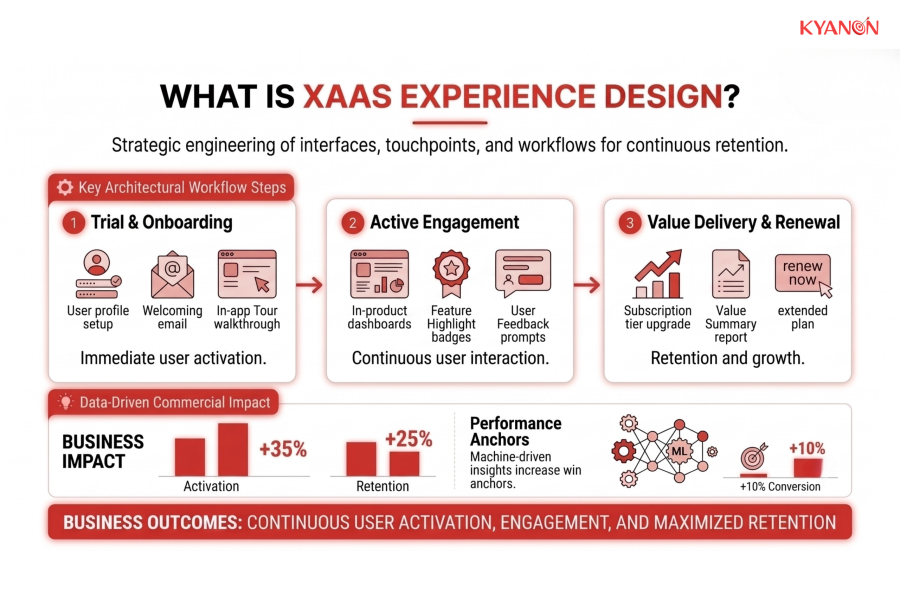
XaaS experience design is the strategic engineering of digital interfaces, system touchpoints, and lifecycle workflows to drive continuous user activation, engagement, and retention in as-a-service business models.
How XaaS Experience Design Works
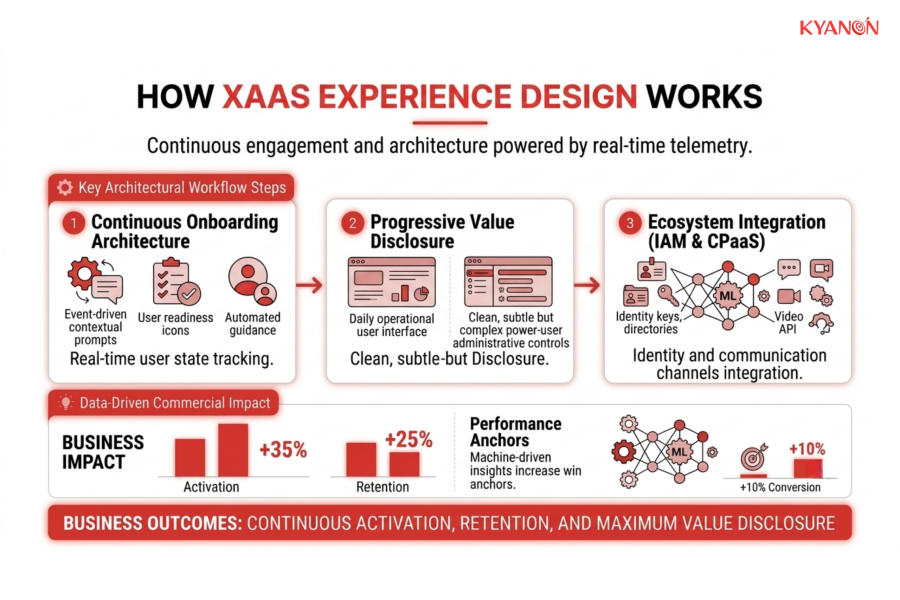
In consumption and subscription-based software, the core product must function as its own primary growth and retention engine. XaaS experience design shifts the architectural focus away from static, front-loaded marketing websites and into dynamic, in-app telemetry pipelines that respond instantly to user behavior, feature adoption, and account health.
Continuous Onboarding Architecture
Rather than relying on a single, unskippable product tour upon first login, the architecture utilizes event-driven, contextual prompts. As users transition from novice to power users, the system intelligently unlocks advanced workflows, surfacing educational materials and configuring features exactly when the user’s behavioral signals indicate readiness.
Progressive Value Disclosure
Complex enterprise platforms inherently require deep configuration settings, but exposing all options simultaneously creates extreme friction. XaaS design employs progressive disclosure, maintaining a clean, operational surface interface for daily tasks while keeping administrative controls, complex filtering, and API integrations instantly accessible for power users.
Ecosystem Integration (IAM & CPaaS)
Effective XaaS platforms do not operate in silos. They rely on tightly integrated Customer Identity and Access Management (IAM) and Communications Platforms as a Service (CPaaS). This underlying data structure ensures that usage alerts, billing limits, and API error logs are translated into clear, actionable touchpoints delivered seamlessly across the user’s preferred communication channels.

Comparative Analysis: XaaS Experience Design vs. Traditional Product Design
Dimension | XaaS Experience Design | Traditional Product Design |
| Core Metric | Net revenue retention and feature adoption | Initial point-of-sale conversion |
Onboarding Strategy | Continuous, multi-stage, event-driven | Single, front-loaded product tour |
| Interface Complexity | Progressive disclosure for multi-tier users | Binary (either overly simplified or cluttered) |
User Personas | Dual-track (End-user utility + Buyer ROI dashboard) | Single-track (End-user focus only) |
| Scope of Design | Includes APIs, billing alerts, and SLA notifications | Limited to the primary digital application screen |
When to Consider XaaS Experience Design
Consider XaaS Experience Design if:
- Your enterprise is transitioning from a traditional capital-expenditure hardware or software model to an outcome-based, pay-per-use subscription model.
- Customer churn spikes consistently between months three and six, indicating that users are failing to discover ongoing value after the initial onboarding phase.
- Your economic buyers (CIOs, CFOs) struggle to justify subscription renewals because your platform lacks administrative dashboards that clearly visualize ROI, cost efficiency, and active seat utilization.
It may not be the right priority if:
- Your organization sells simple, one-off digital downloads or single-license consumer utility apps that do not rely on recurring revenue or continuous, post-sale ecosystem engagement.
Why XaaS Experience Design Matters
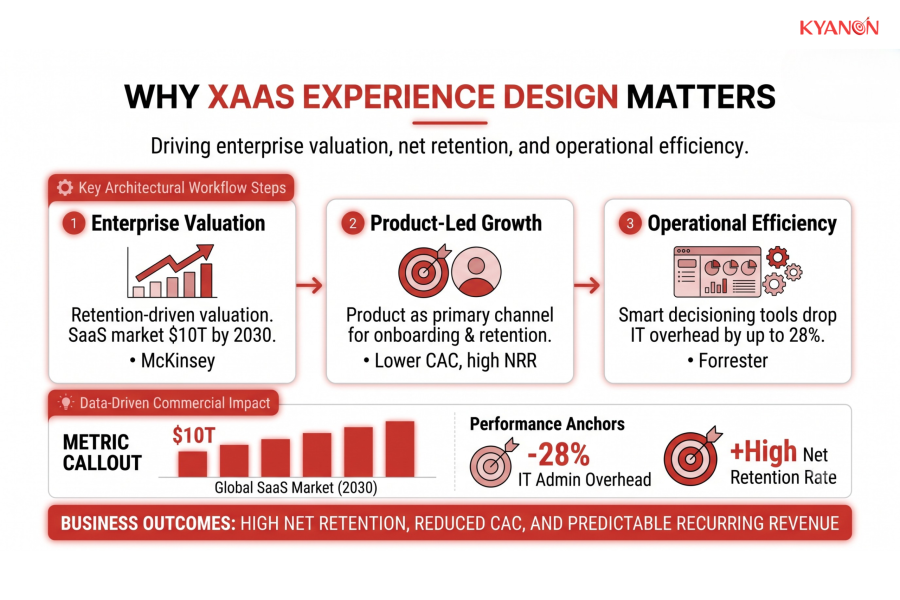
The transition to consumption-based software models has made customer retention the primary driver of enterprise valuation. Companies implementing highly structured, product-led architectures realize substantially lower sales acquisition costs alongside significantly higher net customer retention.
Corporate buyers in 2026 are actively abandoning vendors that offer only static consumption dashboards. Instead, they are prioritizing intelligent decisioning tools that proactively demonstrate value. Building an optimized XaaS service infrastructure directly supports this demand, empowering digital platform owners to drop legacy IT administration overhead.Transitioning to these flexible consumption structures grants vendors highly predictable recurring revenue, provided the technical deployment pipelines and frontend interfaces are completely rewired to eliminate friction and sustain continuous engagement.
Common Misconceptions
The Experience Ends at Conversion Fallacy
In a consumption- or subscription-based model, the pre-sale experience is just a tiny fraction of the lifetime relationship. XaaS UX must prioritize sustained product adoption and expanding utility. If the post-onboarding experience fails to consistently surface new value or simplify day-to-day tasks, users churn before the company recoups its customer acquisition costs.
Confusing UI Simplicity with Value Delivery
For complex XaaS platforms (like cloud infrastructure, developer tools, or enterprise data suites), over-simplification can introduce massive friction. Users need deep configuration options, advanced filtering, and clear visibility into complex background processes. High-performance XaaS design focuses on progressive disclosure—keeping the surface clean but making power-user tools immediately accessible when needed.
Assuming Onboarding is a One-Time Event
Onboarding in XaaS is a continuous, multi-stage architecture. As a user advances from a novice to a power user, or as the platform launches new features, they must be onboarded to higher levels of capability. A single, unskippable, front-loaded tour usually results in users clicking “Skip” because they lack the context to retain the information yet.
Overlooking the Buyer vs. User Dichotomy
In B2B XaaS, the person signing the renewal check (the CIO, CFO, or VP) is rarely the person using the tool daily. If the platform does not feature a well-designed administration, billing, and executive reporting dashboard that clearly visualizes ROI, cost efficiency, and seat utilization, the buyer will struggle to justify keeping the subscription.
Treating Offline and System Touchpoints as Out-of-Scope
For XaaS, the service is the product. If a developer cannot understand your API error logs, or if a manager gets an indecipherable automated email warning them that their usage cap has been breached, the overall customer experience crashes. Every system message, documentation page, and support interaction is a core element of XaaS design.
How Kyanon Digital Applies XaaS Experience Design
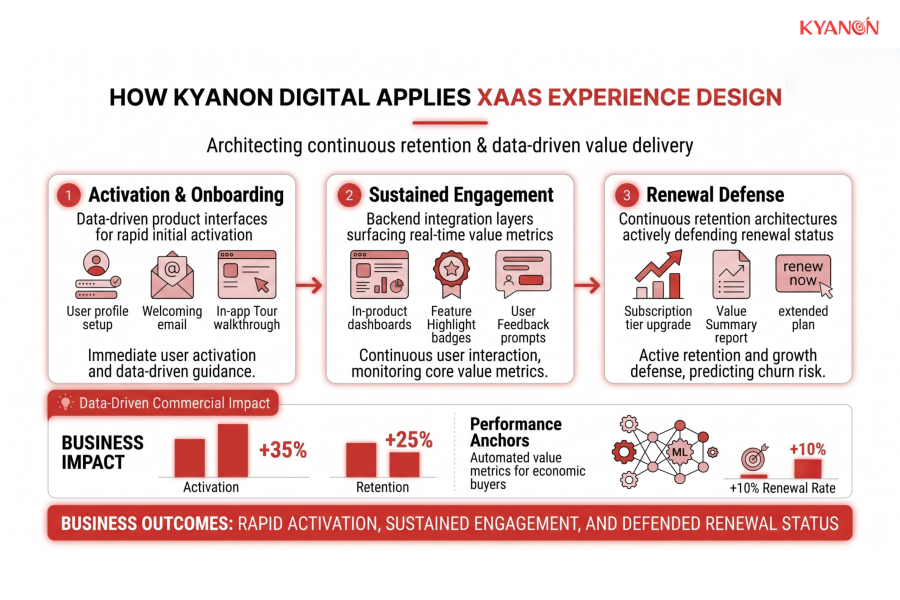
Kyanon Digital helps enterprise clients transitioning to XaaS models design comprehensive customer experiences that drive rapid activation, sustained engagement, and long-term retention. We architect data-driven product interfaces and backend integration layers that automatically surface value metrics to both end-users and economic buyers, ensuring your platform actively defends its renewal status.
Explore our services:

 Create project brief with AI