
What is the Zero-Churn Target?
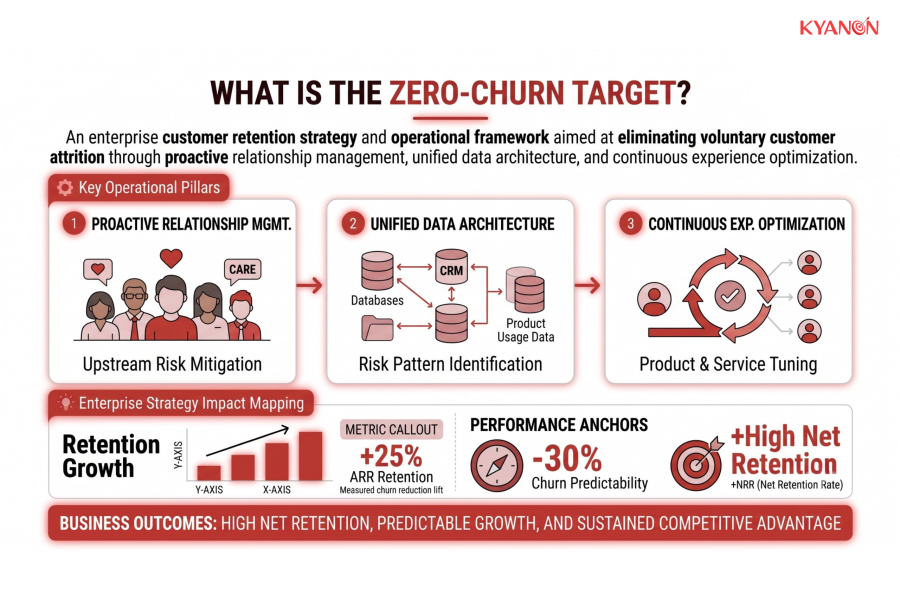
A Zero-Churn Target is an enterprise customer retention strategy and operational framework aimed at eliminating voluntary customer attrition through proactive relationship management, unified data architecture, and continuous experience optimization. It shifts organizational focus from reactive customer saves to upstream risk mitigation across product, sales, and service engineering.
How Zero-Churn Target Works
Achieving a Zero-Churn Target relies on transforming fragmented customer interactions into a unified, real-time feedback loop. Rather than waiting for a customer to submit a cancellation ticket, the underlying system architecture continuously captures behavioral telemetries, operational health signals, and transactional markers to identify friction points before they escalate into attrition.
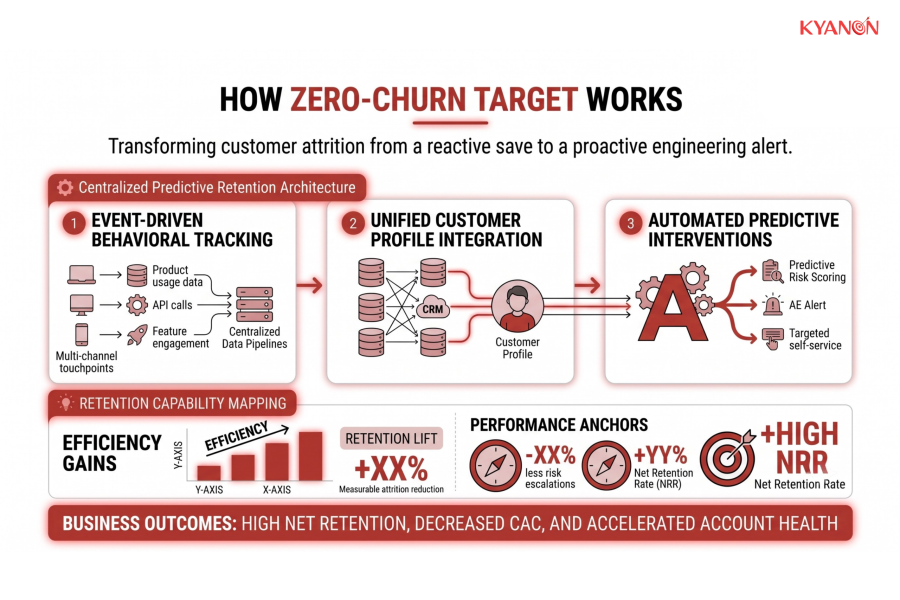
Event-Driven Behavioral Tracking
The core system ingests continuous product usage data, API calls, and feature engagement metrics in real time. Drops in engagement frequency or uncharacteristic user workflows serve as immediate digital indicators of potential churn risk.
Unified Customer Profile Integration
By consolidating data across CRM, support ticketing, and product platforms into a single operational profile, engineering teams eliminate cross-departmental blind spots. This ensures every customer-facing system reflects a single, accurate view of account health.
Automated Predictive Interventions
Machine learning models evaluate historical usage patterns against account milestones to score churn probability. High-risk accounts trigger automated workflows, alerting account executives or initiating targeted digital self-service solutions before account degradation occurs.

Comparative Analysis: Zero-Churn Target vs. Reactive Churn Management
Dimension | Zero-Churn Target Framework | Reactive Churn Management |
| Operational Focus | Root-cause prevention and upstream optimization | Post-facto saves and exit discounts |
Data Utilization | Real-time behavioral telemetries and unified CDP | Periodic surveys (NPS/CSAT) and support tickets |
| Departmental Ownership | Cross-functional (Product, Data, Sales, CS) | Isolated Customer Success team |
Primary Metric | Net Revenue Retention (NRR) & Lifetime Value | Raw Logo Retention Rate |
| Cost Efficiency | Low TCO via automated, proactive prevention | High CapEx spend on emergency retention tactics |
Why Zero-Churn Target Matters
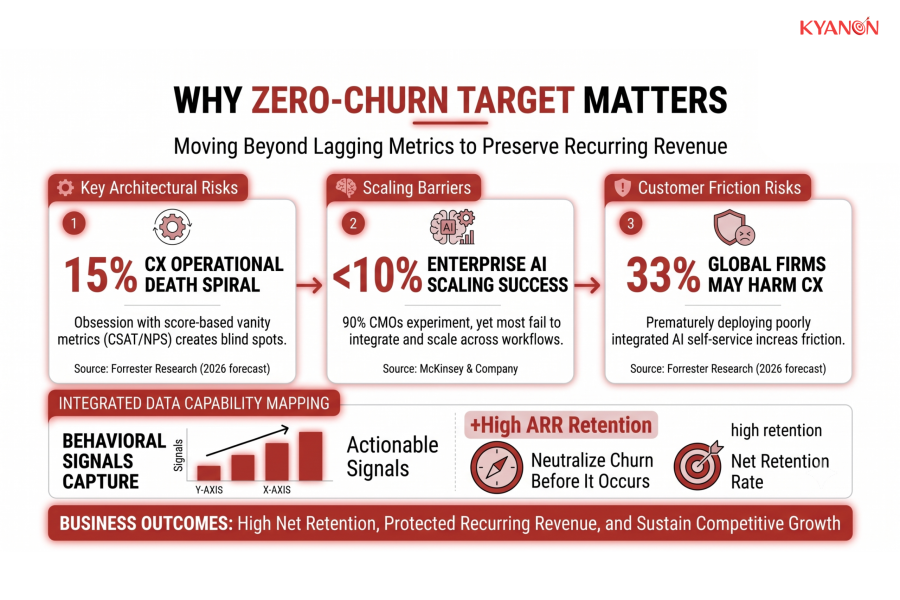
Modern enterprise growth requires moving beyond passive satisfaction scores toward deeply integrated data architectures that preserve recurring revenue. Relying solely on lagging metrics creates operational blind spots that conceal systemic friction points within the customer journey. According to Forrester Research, a narrow obsession with score-based vanity metrics like CSAT and NPS will cause 15% of underprepared CX teams to enter an operational death spiral. Enterprise leaders must instead build robust data pipelines that capture actionable behavioral signals to predict and neutralize churn before it occurs.
Building the technical foundation for zero voluntary attrition requires structural optimization rather than piecemeal digital additions. As reported by McKinsey & Company, 90% of Chief Marketing Officers are experimenting with AI use cases, yet fewer than 10% have successfully scaled these solutions across workflows, with only 28% of surveyed enterprise organizations pursuing the structural rewiring needed to thrive. Superficial feature additions fail to deliver long-term retention unless backed by unified backend systems that seamlessly align product performance with user expectations.
Furthermore, automated interfaces deployed without unified data architectures actively increase customer friction. Research from Forrester Research forecasts that one-third of global enterprise companies will actively harm customer experiences by prematurely deploying frustrating, poorly integrated AI self-service tools. To defend revenue margins, IT leaders must prioritize end-to-end integration over isolated automation, ensuring every touchpoint actively reinforces long-term customer loyalty.
Common Misconceptions
The Myth of the “Heroic Save” (CS is Solely Responsible)
Churn is an organizational symptom, not an isolated department failure. Upstream business decisions dictate retention. If Marketing and Sales close bad-fit clients to hit short-term quotas, or if Product fails to fix core stability issues, no amount of CS relationship-building can prevent eventual attrition.
Assuming All Churn is Evil (“Bad” vs. “Good” Churn)
Not all churn is regrettable. Forcing a blanket zero-churn policy leads teams to waste vast amounts of capital, discounts, and custom engineering hours attempting to retain customers who do not align with the company’s Ideal Customer Profile. Letting bad-fit clients go frees up critical technical and operational resources to focus on high-value, expandable accounts.
Conflating Customer Retention with Revenue Retention
Mathematically, a business can achieve net negative churn, retaining more than 100% of its recurring revenue, even while losing smaller logos. Retaining the right high-margin revenue matters vastly more than retaining every single user logo. Churning low-value, high-maintenance accounts while expanding loyal enterprise accounts creates a healthier path to sustained growth.
Over-Indexing on “Silent” or Deceptive Health Metrics
Silent churn occurs when unengaged users quietly abandon a product without opening support tickets because leaving is easier than complaining. Basic usage metrics like daily logins can be deceptive; a user might log in out of habit while actively trialing a competitor. True retention requires tracking actual business outcomes, API depth, and feature-level value realization.
Treating Voluntary and Involuntary Attrition the Same
Churn requires distinct operational fixes depending on its root cause. Voluntary churn is driven by active choices such as poor onboarding or lack of perceived value, requiring strategic product interventions. Involuntary churn is driven by passive operational failures such as expired credit cards or gateway errors, requiring automated dunning management and payment engine fixes.
How Kyanon Digital Applies Zero-Churn Target
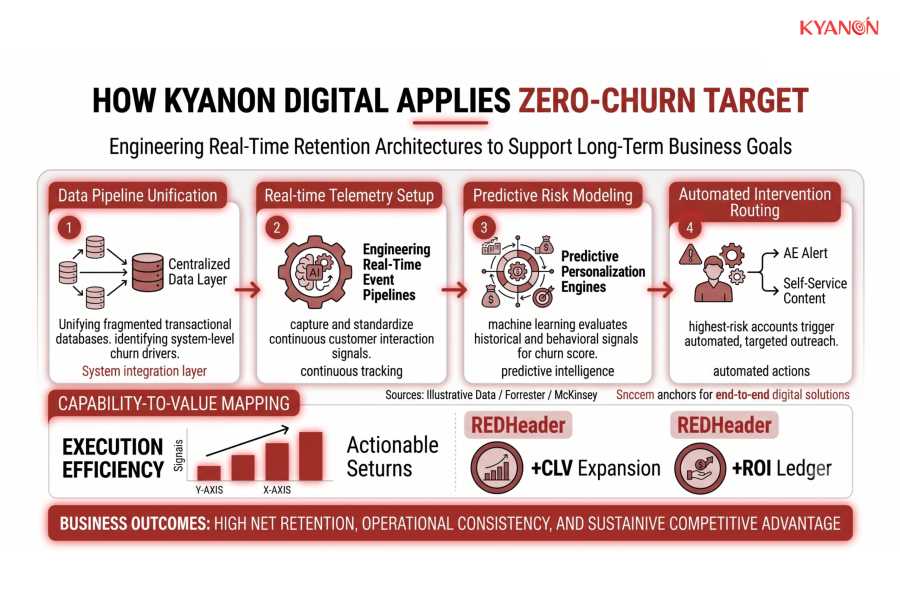
Kyanon Digital builds the scalable data infrastructure, predictive personalization engines, and enterprise integration layers required to support organizations pursuing a Zero-Churn Target. By unifying fragmented transactional databases and engineering real-time event pipelines, we enable enterprise clients to identify churn drivers at the system level. Our teams deliver end-to-end digital solutions that ensure long-term retention architectures align directly with business revenue goals.
Explore our services:

 Create project brief with AI