
What is Agent (AI agent)?
An agent (AI agent) is an autonomous software system driven by a foundation model that interprets user goals, formulates a multi-step execution plan, and interacts with external tools to complete complex tasks without human intervention. By bridging generative reasoning with operational execution, agents transition AI systems from passive information retrieval to active environmental manipulation.
How agent (AI agent) works
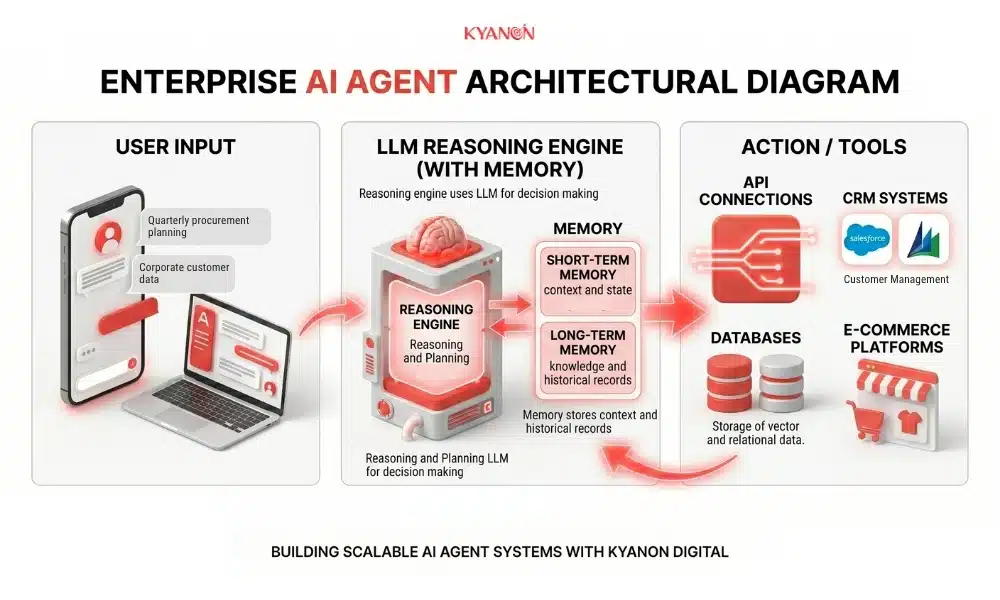
An AI agent operates on a continuous perception-action cycle, where it receives environmental context, evaluates potential actions against its programmed objective, and triggers external APIs to execute those actions. This architecture relies on dividing complex user intents into manageable sub-tasks, processing them sequentially or in parallel while maintaining strict state awareness across multiple enterprise systems.
The Reasoning Engine
The reasoning engine utilizes a Large Language Model (LLM) to process inputs and decide the optimal sequence of operations. It acts as the cognitive layer that translates abstract business goals into specific, logically sequenced steps.
Memory Systems
Memory systems provide the necessary context for ongoing operations by retaining both immediate session data and historical records. Short-term memory tracks the current execution state, while long-term memory utilizes vector databases to store institutional knowledge for future retrieval.
Tools and Actuators
Tools and actuators form the integration layer containing the defined APIs, scripts, and plugins the agent requires to interact with the outside world. This component allows the agent to read from, and write to, external databases, CRMs, or ERP platforms.
Agent (AI agent) vs Chatbots
Both interfaces utilize natural language processing to interact with human users, but they diverge fundamentally in their execution capabilities, system state management, and operational autonomy.
|
Dimension |
Agent (AI Agent) | Chatbot |
| Core function | Task execution and workflow automation |
Information retrieval and conversational response |
|
Autonomy |
High (creates and executes multi-step plans) | Low (follows pre-defined trees or single prompts) |
| External interaction | Reads and writes to external systems via APIs |
Typically read-only or limited to basic API queries |
|
State management |
Maintains complex long-term memory and context | Relies on short-term session memory |
| Best for | Procurement automation, compliance workflows |
Basic FAQs, customer triage, knowledge search |
When to consider agent (AI agent)
Consider an agent (AI agent) if:
- Your operational teams spend excessive hours manually synchronizing records, updating databases, or initiating transactions across disconnected enterprise systems.
- You are scaling high-volume internal workflows, such as vendor quote comparisons or compliance verification, and need to increase throughput without proportionally increasing headcount.
- Your current automation scripts frequently fail when encountering unstructured data or slight variations in input formats, requiring a system that can adaptively reason through exceptions.
It may not be the right priority if:
- Your immediate requirement is solely to route incoming customer service queries to specific human departments using static, predetermined logic rules.
Why agent (AI agent) matters for enterprise operations
Deploying autonomous systems to handle repetitive, multi-step workflows directly addresses rising operational overhead and execution latency. Gartner predicts at least 15% of day-to-day work decisions will be made autonomously through agentic AI by 2028, up from 0% in 2024. In addition, 33% of enterprise software applications will include agentic AI by 2028, up from less than 1% in 2024.
A regional telecommunications provider utilized an agent system to autonomously verify compliance documentation and cross-reference vendor databases during onboarding, reducing processing time from three days to under an hour. This demonstrates how shifting from generative text models to action-oriented agents translates directly into measurable workflow acceleration.
Common misconceptions
Giving the agent access to every internal tool and maximum context will make it smarter and more capable
Reality: Context overload and excessive tool access degrade an agent’s reasoning capabilities and reliability. Providing an agent with too many tools dilutes the statistical probability of it selecting the correct API for a specific task, leading to execution failures, hallucinated API parameters, and increased latency.
Once we deploy an agent and it passes QA, it will be a reliable, set-and-forget solution
Reality: Agent behavior is highly non-stationary in production environments. Minor, unannounced updates to the underlying foundation models or slight schema changes in third-party APIs can cause previously stable agent workflows to fail, requiring continuous monitoring, strict output guardrails, and version control.
How Kyanon Digital Applies agent (AI agent)
Kyanon Digital designs and integrates agent (AI agent) systems for enterprise clients across Southeast Asia, ANZ, and the US to automate complex workflows such as procurement, compliance monitoring, and multi-tier customer service. Our engineering approach builds tightly scoped, bounded agents that prioritize strict tool governance, measurable time-to-market acceleration, and reduced total cost of ownership (TCO) over unstructured, general-purpose AI deployments.
→ Explore our AI and Machine Learning consulting services











 Create project brief with AI