


Retail’s most consequential technology decisions are rarely made on the shop floor. They are made in boardrooms by executives weighing millions in investment against the risk of falling behind or the equal risk of moving too fast on foundations that aren’t ready.
Generative AI is now firmly on those agendas. McKinsey estimates that GenAI could add between $240 billion and $390 billion in value to the global retail sector, equivalent to a margin improvement of 1.2 to 1.9 percentage points across the industry. Yet in Gartner’s most recent survey, fewer than 15% of retail AI pilot programs progress to full-scale production. The gap between ambition and execution is wide, and it is mostly technical, not strategic.
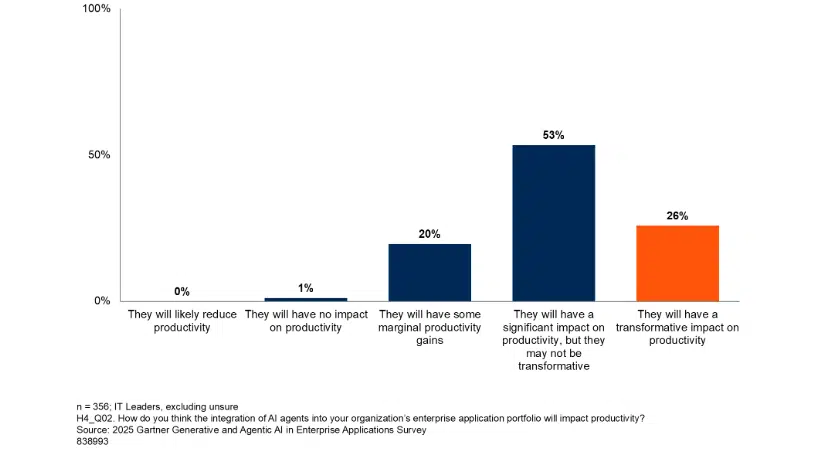
This article is for retail executives and technology leaders who want to understand what is genuinely working in production today, where the real barriers lie, and what separating the organisations that are capturing GenAI value from those still running pilots.
Key takeaways
- Generative AI for Retail is delivering measurable value across customer experience, marketing, pricing, and store operations.
- The strongest AI automation use cases today include AI shopping assistants, personalised recommendations, virtual try-ons, review summarisation, and AI copilots for store associates.
- Most retail GenAI pilots fail because organisations lack unified customer data and structured product information.
- Using AI for automation works best when retailers start with low-risk, high-impact use cases before scaling to complex operational decisions.
- The challenges of AI in retail are not only technical. Data quality, organisational trust, and ROI measurement are critical success factors.
- Retailers should focus on building the right data foundation first, because GenAI performance depends on data maturity.
Further reading:
- AI in Ecommerce and Retail: Trends, Use Cases, and Business Impact
- AI-Native Software Development for Enterprises in Singapore
- Biggest Software Trends in Retail & eCommerce for 2026
Why most retail GenAI pilots fail before they start
The failure mode is rarely the AI model. It is almost always the data infrastructure beneath it.
GenAI systems are, at their core, synthesis engines. They combine, interpret, and generate based on the data they are given. When that data is fragmented across a dozen legacy systems, point-of-sale platforms, e-commerce engines, loyalty databases, and ERP systems – the AI has nothing coherent to work with. The result is outputs that are confidently wrong: product recommendations that ignore recent purchases, pricing signals that contradict existing promotions, chatbot responses that reference out-of-stock inventory.
Many of retail organizations describe their data as “siloed” or “poorly integrated,” a structural problem that no amount of prompt engineering will fix. Deploying a large language model on top of fragmented data does not produce a transformation; it produces an expensive demonstration.
This is the context in which successful GenAI deployment must be understood. The organisations seeing real returns are not necessarily those with the most sophisticated models – they are the ones that invested in data infrastructure first, and then layered AI on top of a unified, clean, real-time foundation.
With that framing established, here is what is working.
The 7 GenAI use cases working in retail right now
Generative AI has moved beyond experimentation and into operational deployment across the retail value chain. The following seven use cases highlight where GenAI is already working in production environments, with clear business outcomes and scalable implementation paths.
Use case 1 – Conversational commerce (AI shopping assistants)
The first generation of retail chatbots was rule-based: narrow, brittle, and frustrating for customers who strayed outside a predefined decision tree. Generative AI has fundamentally changed the interaction model.
A shopper can now say, “Find me a waterproof jacket that’s breathable enough for a summer hike but looks smart enough for a post-trail dinner,” and a well-deployed AI assistant will understand the intent, reconcile the technical and aesthetic requirements, and surface accurate matches, without the customer touching a single filter. This is not a marginal improvement. It collapses the distance between discovery and purchase.
Retailers like Amazon and eBay are already using these natural language interfaces to help customers navigate catalogues of millions of SKUs using text, voice, and even photo prompts. Platforms such as Kore.ai and Juma provide the NLP infrastructure underpinning many of these deployments, enabling context-aware, multi-turn conversations that handle product queries, order tracking, and returns in a single session.
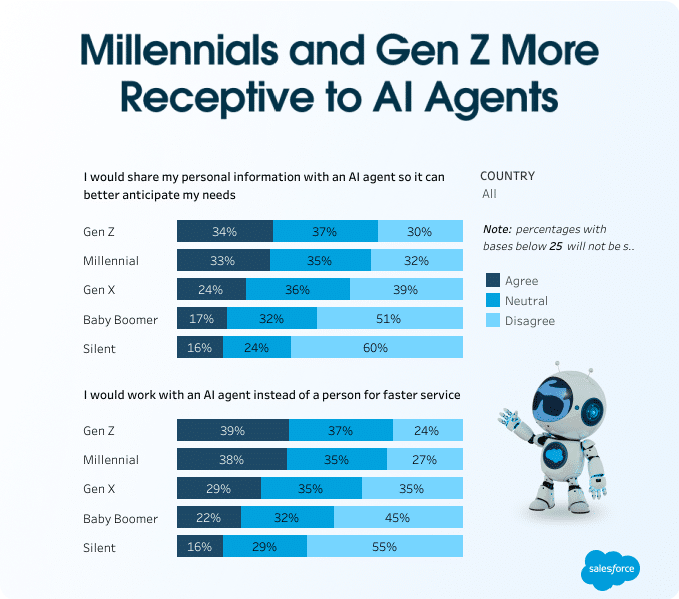
The commercial implication is significant. Salesforce research finds that younger generations, in particular, hold companies to a higher standard when it comes to adapting to and anticipating their needs – 43% of Gen Z and millennials say AI raises the bar for customer experiences compared to just 32% of baby boomers.
Gen Z and millennial consumers are also more likely than older generations to consider the benefits provided by agents.
Use case 2 – Personalised product recommendations at scale
Personalization in retail has long meant segments: women aged 25–40 who bought a coat last autumn. That model is obsolete. Generative AI enables what practitioners now call “segments of one” – recommendations calibrated to a specific individual’s browsing history, purchase cadence, return behaviour, and even seasonal context, updated in near-real time.
Generative AI (Gen AI) is transforming shopping, with 71% of consumers wanting it to be integrated into their purchasing experiences. The preference of Gen Z and Millennials, for hyper-personalization and seamless digital experiences is mainly driving this trend. This is according to the fourth edition of Capgemini Research Institute’s annual consumer trends report, ‘What Matters to Today’s Consumer’, which finds that technological innovation, shifting financial priorities, and increasing sustainability awareness are fueling consumer behaviors.
Technology from providers such as CalSoft Inc. enables retailers to analyse behavioural signals – category affinity, dwell time, cross-sell patterns and translate them into personalized ad placements and product surfaces across channels. The underlying principle is that every customer interaction contains a signal, and GenAI is now capable of acting on those signals at the scale and speed that mass personalization demands.
Use case 3 – AI-generated product descriptions and content
For any retailer managing more than a few thousand SKUs, product content is a perpetual bottleneck. Writing accurate, SEO-optimized, brand-consistent descriptions across a catalogue of 50,000 or 500,000 items and doing so in multiple languages for multiple channels is a task that overwhelms even large content teams.
GenAI resolves this constraint. Given a structured data input (dimensions, materials, category attributes), a well-configured model can produce high-quality product titles, long-form descriptions, meta tags, and social captions at a rate no human team can match, while maintaining a consistent brand voice.
According to a Retail Dive analysis, retailers that have deployed GenAI for content production report a reduction of 60–80% in time-to-publish for new product content, releasing marketing teams to focus on strategy, creative direction, and the higher-order work that still requires human judgement. CalSoft Inc. specializes in automating exactly these high-volume content tasks for enterprise retailers.
The SEO implications also merit attention: AI-generated descriptions, when properly supervised, consistently outperform manually written content on long-tail keyword coverage – a meaningful advantage in organic search visibility for large catalogs.
Use case 4 – Realistic virtual try-ons
Product returns remain one of the most structurally damaging cost centers in retail. According to the National Retail Federation (NRF), U.S. retailers handled approximately $890 billion in returns in 2024, representing 16.9% of total retail sales, with projections indicating around $849.9 billion in returns in 2025. A significant portion of these returns is driven by eCommerce, where return rates are expected to reach 19.3%, largely due to fit and appearance mismatches, issues that virtual try-on technology directly addresses.
GenAI-powered try-on models can take a single image of a garment and accurately render how it drapes, fits, and moves on diverse body types, skin tones, and poses without requiring a physical sample or a photographic shoot. Google has already introduced this capability for brands including H&M and Anthropologie, showing garments on real models ranging from sizes XXS to 4XL. The technology is no longer experimental.
For fashion and apparel retailers, reducing return rates has a direct impact on profitability. Returns erode margins through refunds and markdowns while adding significant reverse logistics, labor, and inventory costs. Research shows that return-related costs can account for a substantial share of product value and increase disproportionately as return rates rise, making even small improvements in return rates financially meaningful. This is one of the few GenAI applications where the financial case is both straightforward and measurable.
Use case 5 – Smart summarisation of customer reviews
Social proof is among the most powerful conversion drivers in e-commerce, but it only functions when customers can process it efficiently. A product page carrying 1,400 reviews, averaging 3.8 stars, tells a shopper almost nothing useful. The signal is buried in the noise.
GenAI changes this by synthesizing large volumes of unstructured review text into concise, structured summaries: the things customers consistently praise, the recurring concerns, the use-case-specific notes (“runs narrow,” “excellent for hiking but not trail running”). Amazon now uses GenAI to produce these summaries across its catalog, helping shoppers make faster, more confident purchase decisions while reducing the anxiety that drives cart abandonment.
The same capability has internal applications. Merchandising and buying teams can use AI-generated review synthesis to identify product quality issues, inform next-season selections, and monitor competitive sentiment, without manually reading tens of thousands of customer comments.
Use case 6 – Promotion and pricing optimisation
Dynamic pricing is not new. What is new is the quality of the signal it can now respond to.
Traditional dynamic pricing algorithms track competitor prices and stock levels. GenAI-enhanced systems go further: they incorporate real-time soft signals – a viral social media trend, a sudden weather event, a competitor’s flash sale, a local sporting event – and adjust pricing and promotional logic surgically, at the SKU and location level, within minutes.
AI-driven price optimisation can deliver measurable margin improvements. According to McKinsey & Company, advanced pricing and dynamic pricing strategies can generate 5–10% improvements in margins, alongside 2–5% increases in sales when effectively implemented
This use case requires robust real-time data pipelines and careful governance – automated pricing that lacks guardrails can trigger unintended promotional conflicts or reputational exposure – but for retailers with the data infrastructure in place, the returns are well-documented.
Use case 7 – Store operations intelligence (AI copilots for associates)
Digital transformation in retail has historically concentrated on the customer-facing front end. The back end – store operations, workforce enablement, associate knowledge – has lagged significantly. GenAI is now reaching the shop floor in the form of AI copilots: tools that give frontline staff instant access to product knowledge, real-time inventory levels, customer purchase history, and personalised upsell prompts, surfaced at the moment of need.
An associate no longer needs to leave a customer interaction to check stock in the back room or locate a manager to answer a product question. The information is available in seconds, through a natural language interface on a handheld device. The operational result is a 20–30% reduction in average customer handling time, documented in Microsoft’s retail solutions – a meaningful improvement in both customer experience and associate productivity.
According to Deloitte, insufficient product knowledge and limited access to real-time information among store associates are key factors that undermine in-store customer experience, contributing to missed sales opportunities and lower customer satisfaction. AI copilots address this structurally, rather than through training programmes that become outdated the moment a new product line launches.
What every successful retail GenAI use case has in common
Across every successful Generative AI for Retail deployment, the same operational pattern appears repeatedly.
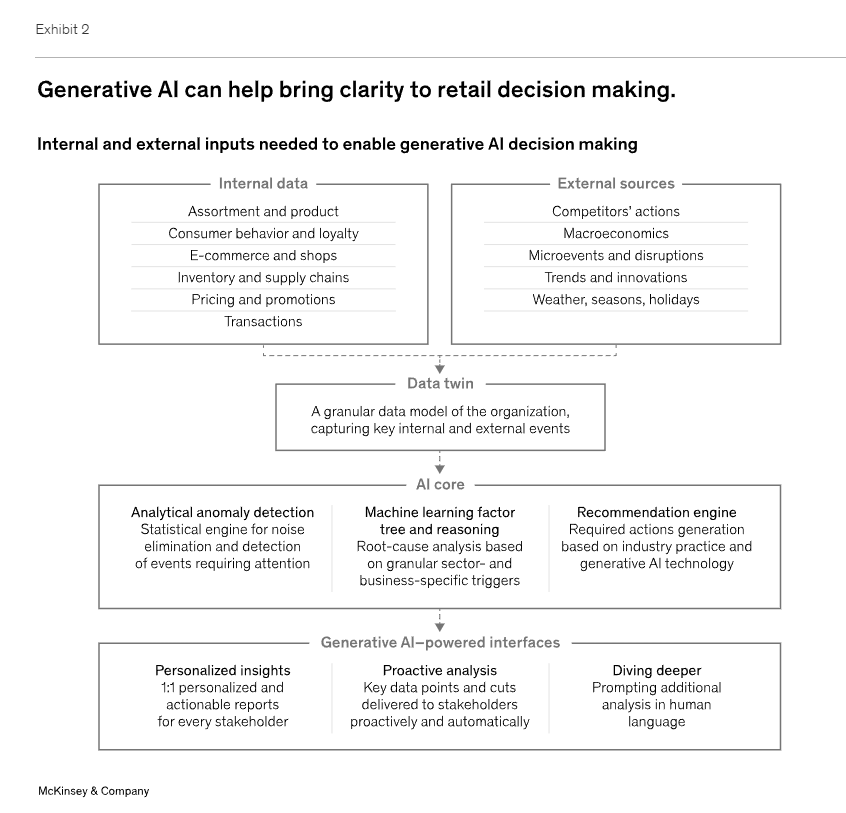
First, successful retailers build GenAI on top of a unified and trusted data foundation. The AI layer does not interact directly with fragmented CRM, POS, eCommerce, and loyalty data. Instead, organisations create a curated data environment that resolves customer identity, product information, and operational signals into a single usable layer.
This matters because fragmented retail data directly limits AI effectiveness. According to McKinsey retail personalization research, 67% of retailers identified customer data integration as their biggest obstacle to personalization initiatives. The same research found that retailers achieving personalization at scale typically started with strong data management capabilities before expanding AI deployment. Personalization leaders can generate a 1-2% uplift in total sales, with even higher impact in non-grocery retail categories.
Second, successful organisations define commercial KPIs before deployment. Many retail AI pilots fail because teams launch experiments without measurable business objectives. In practice, the retailers seeing measurable ROI define success upfront through metrics such as conversion uplift, reduction in content production time, lower customer support volume, or improved gross margin.
This execution gap is becoming increasingly visible across the industry. McKinsey’s retail GenAI research found that while most retailers are piloting GenAI initiatives, only a small number have successfully scaled deployments enterprise-wide because operational readiness and measurable value tracking remain weak.
Third, retailers that scale GenAI successfully usually begin with lower-risk operational use cases before moving into high-consequence decision-making. AI-generated product descriptions, review summarisation, and internal reporting are common starting points because errors are visible and easy to correct. AI-driven pricing, inventory optimisation, and automated purchasing decisions require much higher confidence in data quality, governance, and operational controls.
This phased approach reduces organisational resistance while improving internal trust in AI systems. McKinsey notes that most retailers are currently using GenAI first to augment internal workflows and customer service operations before expanding into broader autonomous decision-making environments.
Retail GenAI success is no longer determined by access to AI models alone. The competitive advantage now comes from operational readiness: unified data, measurable KPIs, governance, and deployment discipline. The retailers generating measurable ROI are treating GenAI as a business transformation capability, not a standalone technology experiment. That means investing in the data layer first, selecting commercially measurable use cases, and scaling gradually based on operational confidence rather than hype.
The challenges of AI in retail and how to overcome them
Implementing AI in retail is no longer a technology experiment. It is an operational transformation initiative with direct impact on revenue, customer experience, and workforce productivity. While the upside is significant, the retailers seeing measurable ROI are also the ones addressing the operational risks early.
As you move toward customer-facing AI (like chatbots or personalized pricing), the stakes for data privacy and bias increase. Retailers are finding success by being transparent about how data is used and regularly auditing models for fairness. Most organisations still struggle to move from isolated pilots to scalable enterprise deployment.
Fragmented data across retail systems
Most retailers operate with disconnected data environments. Customer profiles sit inside CRM platforms, transaction history remains inside POS systems, and behavioural signals live in separate eCommerce or analytics tools. This fragmentation creates inconsistent AI outputs and weak personalization accuracy. This is one of the main reasons many retail AI pilots fail to scale.
How to overcome:
Successful retailers invest in a unified data foundation before scaling AI deployment. This often includes:
- Customer Data Platforms (CDPs)
- Product Information Management (PIM) systems
- Real-time data pipelines
- Identity resolution layers across channels
The goal is not simply collecting more data, but creating a trusted operational data layer that AI systems can reliably use.
Workforce resistance and the AI skills gap
AI adoption often fails because operational teams do not trust the outputs. Store associates, merchandising teams, and category managers may resist AI recommendations if previous reporting systems suffered from poor data quality or inconsistent forecasts. The issue is not only technical capability. It is organisational confidence.
How to overcome:
Retailers seeing higher adoption rates usually start with AI augmentation rather than full automation. Examples include:
- AI-generated product descriptions
- Automated reporting summaries
- Internal knowledge copilots for store associates
These lower-risk use cases help employees experience productivity gains directly before AI expands into pricing, forecasting, or operational decision-making. AI fluency training also becomes critical. Teams need to understand both the strengths and limitations of AI systems to use them effectively.
High upfront costs & uncertain ROI
Retail AI projects often require investment in cloud infrastructure, data engineering, integration middleware, governance frameworks, and model deployment pipelines. Without clear business KPIs, organisations struggle to justify scaling costs. The biggest operational risk is not spending too much on AI. It is deploying AI without a measurable commercial objective.
How to overcome:
Retailers generating measurable ROI typically use a phased deployment strategy:
- Start with operational efficiency use cases
- Define measurable KPIs before deployment
- Validate business impact
- Expand gradually into customer-facing or decision-making systems
Typical early-stage KPIs include:
- Reduction in content production time
- Lower customer service volume
- Faster inventory reporting
- Increased recommendation click-through rates
This reduces investment risk while building internal confidence for broader AI transformation.
Integration with legacy systems
Many retailers still rely on legacy ERP, POS, and inventory management systems built long before modern AI architectures existed. Integrating GenAI into these environments can create latency, data inconsistency, and operational reliability issues.
The challenge becomes more severe in omnichannel retail environments where inventory visibility and pricing synchronization must happen in near real time.
How to overcome:
Rather than replacing core systems immediately, many retailers adopt middleware and API-led integration approaches to modernize incrementally.
Successful AI integration strategies usually include:
- API orchestration layers
- Cloud-based data synchronization
- Event-driven architectures
- Hybrid modernization strategies
This allows retailers to introduce AI capabilities without disrupting mission-critical retail operations.
How to assess your retail organisation’s GenAI readiness
Many retailers rush into Generative AI initiatives before assessing whether their operational foundation can actually support them. The result is predictable: promising pilots that fail to scale, inconsistent AI outputs, and unclear business impact.
The reality is that GenAI performance depends less on the sophistication of the model and more on the quality of the retail data ecosystem behind it.
According to McKinsey’s retail AI research, most retailers are still struggling to move GenAI from experimentation to enterprise-scale deployment because foundational data and operational readiness gaps remain unresolved.
Before investing heavily in GenAI, retail leaders should assess readiness across three critical areas.
Question 1: Can you create a unified customer profile across channels?
GenAI-powered personalization only works when the AI understands the full customer journey across every touchpoint.
However, many retailers still operate with fragmented customer data:
- Online browsing data in eCommerce platforms
- Transaction history inside POS systems
- Loyalty data in separate CRM tools
- Customer service interactions stored independently
This fragmentation creates incomplete customer context. As a result, AI-generated recommendations, promotions, and conversational experiences often feel generic or inconsistent.
For example, a customer who recently purchased a product in-store may still receive irrelevant promotional recommendations online because systems are not synchronized.
Why it matters
Personalization leaders outperform peers because they can integrate customer data across channels and activate it operationally in real time. If your organisation cannot produce a unified customer profile today, large-scale GenAI personalization initiatives will struggle to deliver measurable ROI. The priority should not be deploying more AI tools. It should be building a trusted customer data foundation first.
Question 2: Is your product catalogue structured and complete?
Generative AI does not understand products the way humans do. It relies entirely on structured metadata from your Product Information Management (PIM) systems.
If product data contains:
- Missing attributes
- Duplicate SKUs
- Inconsistent category structures
- Poor tagging standards
- Incomplete specifications
then AI-generated outputs become unreliable.
This is one of the biggest hidden operational risks in retail AI deployment. Poor product data quality can lead to inaccurate recommendations, incorrect product descriptions, and AI “hallucinations” that damage customer trust.
For example, inconsistent sizing or material attributes in fashion retail can cause virtual try-on engines or recommendation systems to generate misleading outputs, increasing return rates rather than reducing them. Retailers successfully scaling GenAI typically standardize product taxonomy and governance before expanding AI-driven commerce experiences.
Why it matters
AI maturity is directly tied to product data maturity. If your catalogue structure is inconsistent across channels, GenAI will amplify operational inefficiencies instead of solving them. A strong PIM strategy becomes a commercial requirement, not just a technical initiative.
Question 3: Are your systems operating in real time or nightly batches?
Many GenAI retail use cases depend on real-time operational awareness:
- Inventory availability
- Dynamic pricing
- Order status
- Fulfillment visibility
- Store-level stock movement
However, many legacy retail systems still rely on nightly batch synchronization. This creates a dangerous gap between what the AI believes is true and what is actually happening operationally.
For example, an AI shopping assistant recommending out-of-stock products or displaying outdated pricing creates immediate customer trust issues.
Why it matters
Real-time data infrastructure is becoming a competitive requirement for AI-enabled retail operations. If your systems still rely heavily on delayed synchronization or manual reconciliation processes, AI responsiveness and accuracy will remain limited regardless of model quality.
If you answered “No” or “Partially” to any of the above, here’s where to start: Contact Kyanon Digital today to request a Free GenAI Readiness Assessment. Our team of AI experts will help you analyze your current data infrastructure, pinpoint operational gaps, and build a strategic integration roadmap before you expand your GenAI investment.
How Kyanon Digital helps retailers deploy GenAI that works
Kyanon Digital’s Generative AI Consulting Services help retail enterprises across APAC move beyond disconnected AI pilots and deploy scalable GenAI solutions with measurable business impact.
Our engagement spans the full GenAI deployment lifecycle, from AI readiness assessment and data foundation evaluation to solution architecture, integration, deployment, and optimisation. We help retailers identify practical AI automation use cases that align with operational realities, customer experience goals, and commercial KPIs.
At Kyanon Digital, we believe successful Generative AI for Retail starts with the data layer, not the AI model itself. Before deploying conversational commerce, AI recommendation engines, or retail copilots, we assess critical operational factors such as:
- Customer identity unification across channels,
- Product catalogue structure and governance,
- Real-time inventory and operational visibility,
- System integration readiness across CRM, POS, ERP, and eCommerce platforms.
This approach helps retailers reduce one of the biggest risks in AI adoption: deploying GenAI on top of fragmented or low-quality data environments that cannot scale operationally.
By combining AI engineering, retail domain expertise, and enterprise data modernization capabilities, Kyanon Digital helps organisations deploy GenAI systems that are commercially measurable, operationally reliable, and scalable across omnichannel retail environments.
Case study: AI-Driven BI & Data Warehouse For A Leading Retail Corporation

Kyanon Digital helped a leading retail corporation transform its fragmented, manual reporting ecosystem into a centralized AI-driven BI and Data Warehouse platform designed for scalable, real-time decision intelligence.
The solution focused heavily on data engineering and analytics services, including centralized data warehousing, automated reporting workflows, standardized enterprise data structures, and Microsoft Power BI integration for live operational dashboards.
By consolidating data from nearly 200 retail stores into a unified platform, Kyanon Digital enabled real-time KPI monitoring, faster report approvals, improved data consistency, and more accurate business insights. The project demonstrated Kyanon Digital’s expertise in AI-driven BI, enterprise data platforms, data governance, analytics automation, and scalable data infrastructure for large retail operations.
Explore the full case study here: AI-Driven BI & Data Warehouse For A Leading Retail Corporation
Discuss your retail GenAI roadmap
Kyanon Digital build the foundation first, because it is the only way to build something that scales.
Retailers across APAC are moving from pilot to production. If you are assessing your own GenAI readiness or planning your roadmap for the next twelve to eighteen months, our team is ready to help you understand where you stand and what the path forward looks like. Contact Kyanon Digital today.




















 Create project brief with AI