
What is Embedding?
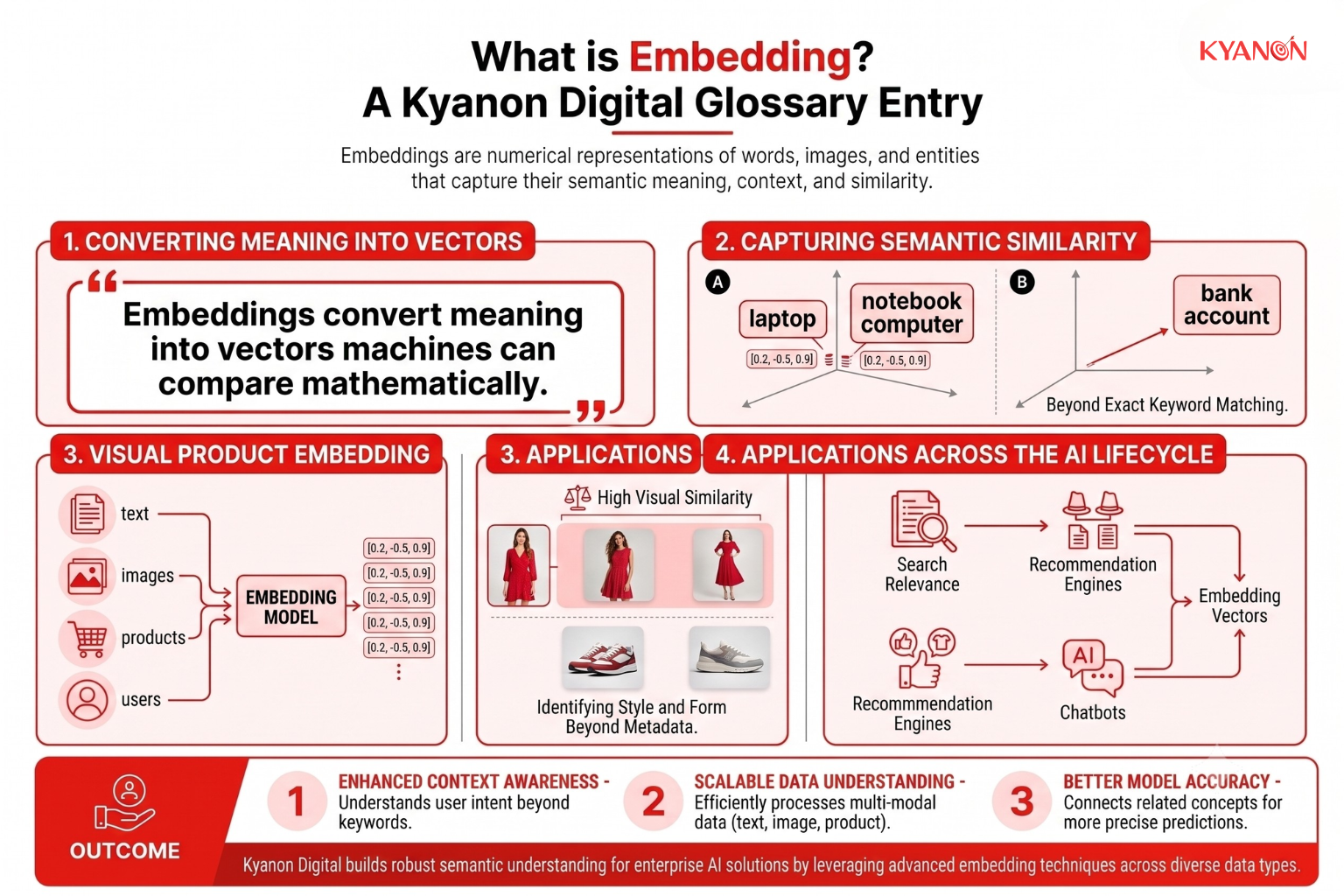
Embedding is a machine learning technique that converts text, images, products, users, or other data into numerical vectors that preserve semantic relationships between items. AI systems use embeddings to identify similarity, context, and intent mathematically rather than relying on exact keyword matching.
For example, in a well-trained embedding space:
- “laptop” and “notebook computer” will have highly similar vector representations.
- “bank account” will be closer to “financial services” than to “mountain hiking.”
- Two product images showing similar clothing styles may appear near each other even if their filenames, descriptions, or categories differ.
This allows AI systems to understand context, intent, and conceptual relationships beyond exact keyword matches.
How Embedding Works
Embedding models transform raw inputs into high-dimensional vectors where semantically related items are positioned closer together in vector space. Rather than relying on exact keyword matching, AI systems compare these vectors mathematically using similarity metrics such as cosine similarity, Euclidean distance, or dot product. This enables machines to understand context, intent, and conceptual relationships across large volumes of data.
The embedding workflow typically follows four stages:
- Raw Input – Unstructured data such as text, images, audio, products, or user profiles enters the system.
- Embedding Model – A specialized machine learning model converts the input into a dense numerical vector while preserving semantic meaning and contextual relationships.
- Vector Representation – The resulting vector acts as a unique mathematical coordinate representing the meaning of the original input.
- Vector Database & Semantic Retrieval – Vectors are indexed and stored for high-speed similarity search, allowing the system to retrieve the most contextually relevant information based on conceptual proximity rather than exact matches.
This process transforms complex, unstructured information into a machine-readable format that can be searched, compared, and analyzed at scale.

Embedding Model
The embedding model serves as the translation layer between raw data and machine-understandable representations. It converts text, images, audio, or behavioral data into vectors containing hundreds or thousands of dimensions, typically ranging from 384 to more than 3,000 values.
Each dimension captures abstract patterns learned during training, such as sentiment, topic relevance, user intent, visual characteristics, or contextual relationships. Because embeddings are domain-dependent, different models are optimized for different use cases. For example, a model trained on healthcare data may perform poorly when applied to eCommerce product search, while a retail-focused model may struggle with legal document analysis.
Vector Space Representation
Once generated, embeddings exist within a multidimensional vector space where semantic relationships are preserved geometrically. Concepts that share similar meaning naturally cluster together, creating neighborhoods of related information.
For example, terms such as latte, espresso, cappuccino, and coffee beans may appear close to one another because they frequently occur in similar contexts. Advanced embedding models also incorporate contextual understanding. The word Python, for instance, may be positioned near programming concepts in one context and near reptiles in another, depending on the surrounding text.
This mathematical structure allows AI systems to reason about similarity by measuring distances between vectors rather than comparing words directly.
Vector Database and Retrieval
A vector database acts as the storage and retrieval engine for embeddings. Unlike traditional databases that search for exact values, vector databases index high-dimensional vectors and perform similarity searches across millions or even billions of records.
Modern vector databases use specialized indexing techniques such as Hierarchical Navigable Small Worlds (HNSW) and Approximate Nearest Neighbor (ANN) algorithms to deliver sub-millisecond retrieval performance. When a user submits a query, the system generates a new embedding and identifies the nearest vectors using distance metrics such as cosine similarity or Euclidean distance.
This retrieval layer powers many enterprise AI applications, including semantic search, recommendation engines, customer personalization, fraud detection, knowledge discovery, and Retrieval-Augmented Generation (RAG), where relevant context is supplied to Large Language Models (LLMs) to improve response accuracy and reduce hallucinations.
Embedding vs Semantic Search
Both technologies improve information retrieval, but embeddings represent data mathematically while semantic search applies embeddings to retrieve contextually relevant results.
|
Dimension |
Embedding | Semantic Search |
| Primary role | Data representation |
Information retrieval |
|
Core function |
Converts data into vectors | Finds meaning-based matches |
| Dependency | Foundational AI component |
Depends on embeddings |
|
Output type |
Numerical vectors | Ranked search results |
| Best for | AI understanding and similarity mapping |
Enterprise knowledge retrieval |
|
Infrastructure requirement |
Embedding model + vector storage | Search engine + retrieval layer |
| Typical use case | Recommendations, clustering, RAG |
Enterprise search experiences |
When to Consider Embedding
Embedding becomes relevant when traditional keyword-based systems fail to capture intent, similarity, or contextual meaning across enterprise datasets.
Consider Embedding if:
- Your ecommerce or content platform returns poor search results unless users type exact keywords. Embeddings enable semantic retrieval based on intent rather than literal matching.
- Your organization is deploying Retrieval-Augmented Generation (RAG) and needs AI systems to retrieve relevant internal documents accurately. Vector embeddings are a foundational layer in RAG architectures.
- Your recommendation engine relies heavily on manual tagging or rigid business rules. Embeddings allow systems to identify behavioral and contextual similarity dynamically.
It may not be the right priority if:
- Your product catalog, knowledge base, or dataset is still small and primarily structured. Simpler search or rule-based systems may deliver acceptable accuracy with lower operational complexity.
Why Embedding Matters for Enterprise AI
Embedding has become a foundational technology for enterprise AI because modern intelligent systems increasingly depend on understanding meaning, context, and intent rather than simply matching keywords. As organizations manage growing volumes of unstructured data, from customer interactions and product catalogs to internal documents and knowledge bases, embeddings enable AI applications to identify relevant information based on semantic relationships, even when different words are used to express the same idea.
This capability powers many of today’s most valuable AI use cases, including semantic search, recommendation engines, personalized customer experiences, intelligent document retrieval, and Retrieval-Augmented Generation (RAG). By transforming complex data into machine-readable vector representations, embeddings help organizations unlock insights that traditional rule-based search systems often miss.
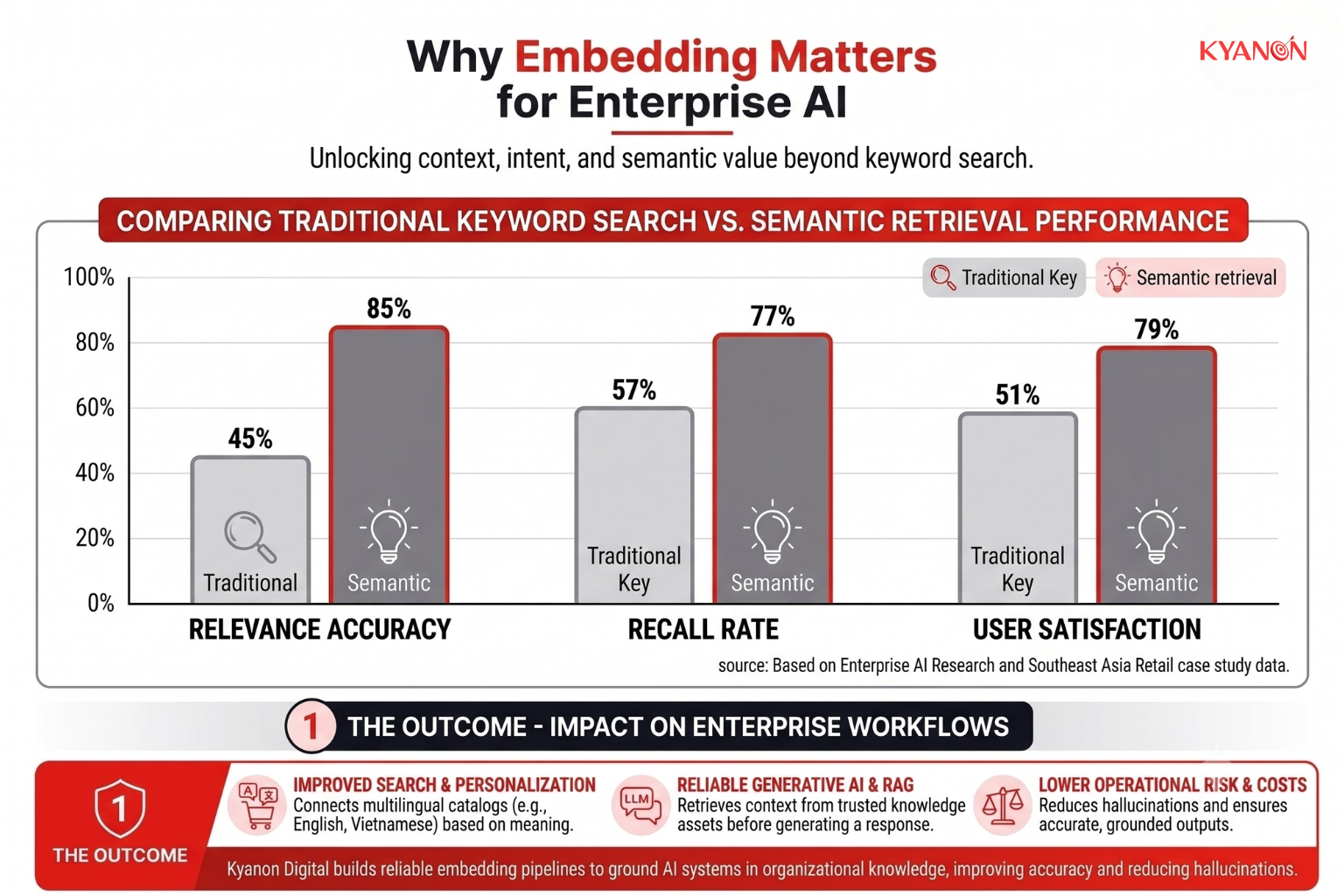
Consider a Southeast Asian eCommerce retailer managing multilingual product catalogs across English and Vietnamese markets. Traditional keyword-based search often struggles when customers use different terminology, synonyms, or language variations. By implementing embedding-based semantic search, the retailer can match products according to meaning rather than exact wording, improving product discoverability, reducing irrelevant search results, and creating a more consistent shopping experience across channels.
Beyond search and recommendations, embeddings are also a critical component of modern generative AI architectures. Large Language Models (LLMs) use embeddings internally to represent relationships between words, concepts, and contextual meaning. In enterprise environments, embeddings further support RAG systems by connecting user queries to the most relevant documents, knowledge assets, or business data before generating a response. This additional retrieval layer helps improve accuracy, reduce hallucinations, and ensure AI outputs are grounded in trusted organizational information.
Common Misconceptions
Enterprise teams often misunderstand embeddings because the technology is discussed using visualization demos rather than operational AI architecture.
Embeddings are human-readable representations
Embeddings are numerical vectors designed for machine computation, not human interpretation. Visualization tools can project embeddings into 2D charts, but the underlying vectors themselves are not meaningful to humans directly.
Embeddings are fixed lookup tables that work universally
Embeddings depend heavily on the model, training data, and business context. An embedding model trained for ecommerce recommendations behaves differently from one trained for legal document retrieval or healthcare search.
Embeddings automatically remove bias from AI systems
Embeddings inherit statistical patterns from training data, including human and societal bias. Governance, evaluation, and monitoring are still required to reduce biased retrieval or recommendation outcomes.
How Kyanon Digital Applies Embedding
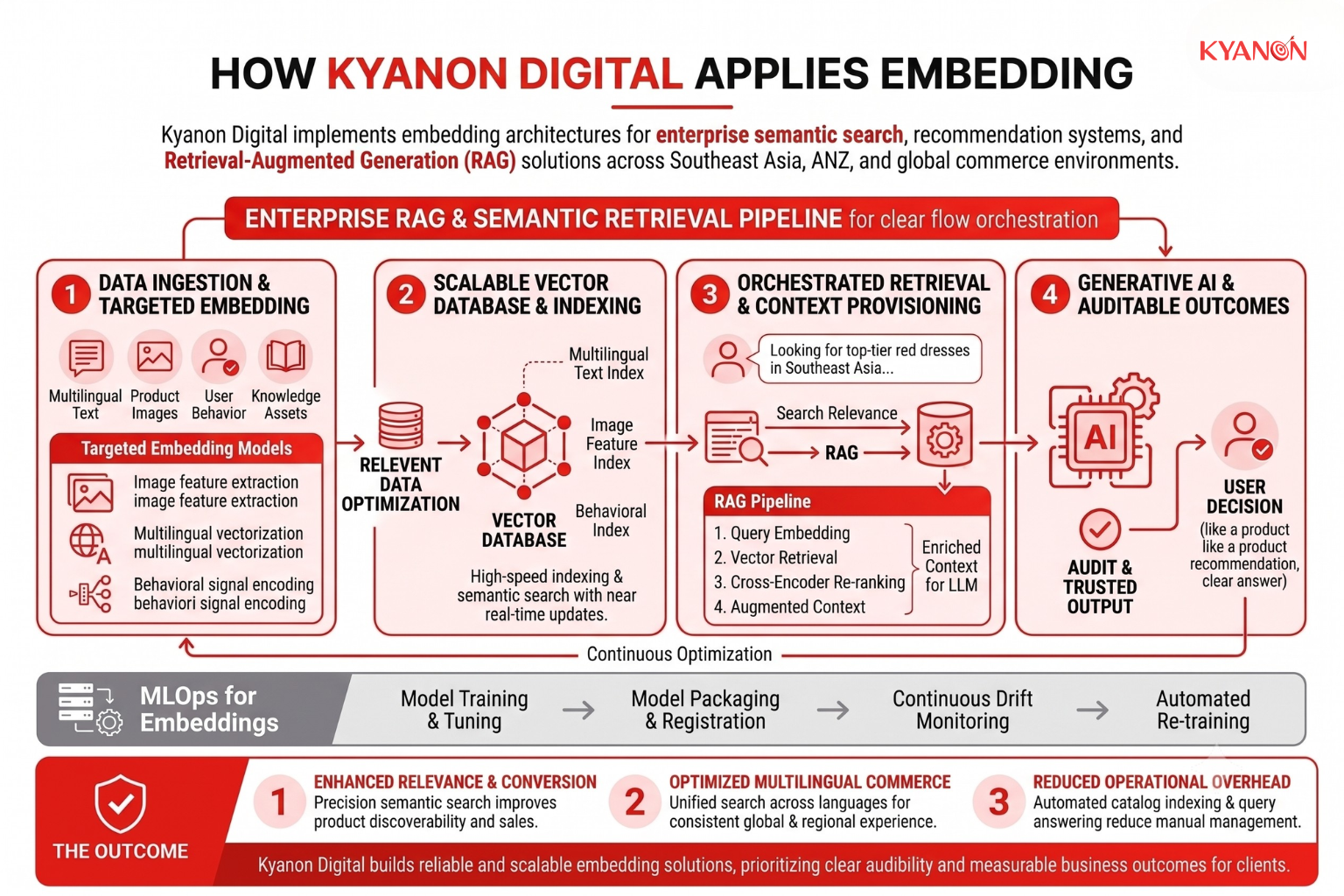
Kyanon Digital implements embedding architectures for enterprise semantic search, recommendation systems, and Retrieval-Augmented Generation (RAG) solutions across Southeast Asia, ANZ, and global commerce environments. Our implementation approach focuses on scalable vector retrieval, multilingual search optimization, and measurable business outcomes such as search relevance, conversion improvement, and reduced manual catalog management overhead.
→ Explore our AI Integration Services.











 Create project brief with AI