




AI ecommerce automation is very important for first-time online retailers because it removes the support, cart recovery, and product cataloging ceiling that limits small teams before they can afford to hire. The best approach is to identify the biggest bottleneck, deploy one quick-win AI tool, and keep human oversight in place during the first 2–4 weeks.
The urgency is especially evident in Southeast Asia. Singapore’s Infocomm Media Development Authority (IMDA) has expanded its Retail Industry Digital Plan (IDP) to help over 2,000 SMEs adopt AI and digital technologies to address rising costs, labor shortages, and growing ecommerce competition.
Rather than chasing every AI trend, the priority is to fix the operational issues causing the greatest revenue loss. This guide presents a practical three-step framework: identify the biggest operational bottlenecks, prioritize high-impact AI tools, and establish human oversight to build a scalable automation strategy.
Key takeaways
- AI ecommerce automation is the structured process of deploying narrow machine learning applications to eliminate specific operational bottlenecks, such as support ticket volume, slow cataloging, and cart abandonment.
- First-time online retailers face a structurally different and harder growth problem than established enterprises because scaling revenue manually requires hiring headcount they cannot yet afford.
- The three most common failures without automation: product search returns generic results, abandoned carts leak high-intent revenue, and customer support becomes a severe bottleneck leading to founder burnout.
- A four-step rollout framework covers identifying bottlenecks, prioritizing quick-win tools, establishing human oversight, and continuously optimizing the system, in that order.
- The build-vs-buy decision for early-stage merchants follows a clear rule: Prioritize ecosystem-native, “plug-and-play” applications to avoid the technical debt of custom middleware development.
- The right AI ecommerce solutions combine native platform data, specialized SaaS applications, and human-in-the-loop escalation logic, not a single monolithic tool.
Further Reading
- Generative AI for Retail: 7 Real Use Cases
- AI-Driven Retail Analytics: From Data to Decisions
- AI in Ecommerce and Retail: Trends, Use Cases, and Business Impact
How to evaluate AI automation tools as a first-time retailer
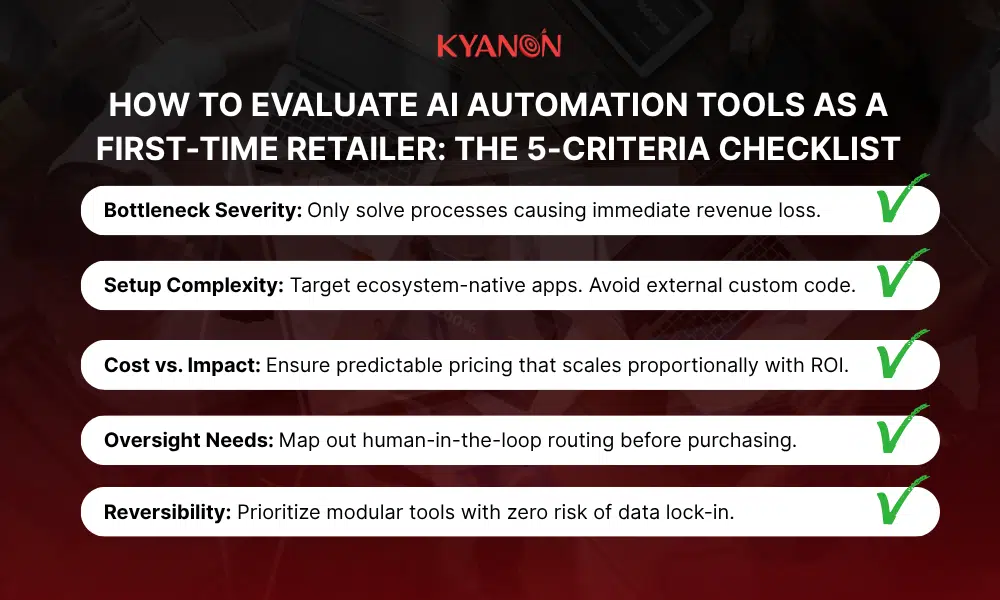
The enterprise software market is saturated with fragmented AI applications promising exponential growth. For early-stage merchants, selecting software requires a rigorous evaluation framework balancing commercial risk with technical feasibility, as deploying complex multi-agent systems without mature data infrastructure causes severe technical debt and business disruption.
The following evaluation matrix helps first-time retailers assess potential software investments through both business continuity and technical integration lenses, supporting decisions to adopt, pilot, or reject specific tools.
AI automation evaluation matrix
|
Evaluation criteria |
Business owner lens | Ops/technical lens |
| Bottleneck severity | Does this solve a process currently causing immediate revenue loss or excessive time drain? |
What is the measurable ticket volume, cart abandonment rate, or cataloging backlog being addressed? |
|
Setup complexity |
Can the organization launch this tool without hiring an external software developer? | What are the API requirements, native platform compatibility, and data schema dependencies? |
| Cost vs. impact | Does the predictable monthly subscription cost align with the measurable hours of human labor saved? |
Will the API token consumption or compute costs scale disproportionately during traffic surges? |
|
Oversight requirement |
How much manual monitoring is required during the initial deployment phase? | What is the configurable escalation logic and human-in-the-loop routing architecture? |
| Reversibility | Can the business instantly deactivate the tool if it hallucinates or underperforms? |
Are there risks of permanent data lock-in or deep architectural dependencies that complicate removal? |
This evaluation matrix implies that early-stage retailers must prioritize low-risk, reversible applications over maximum technological complexity. Inaction allows competitors using modular tools to operate with lower costs and acquire customers more efficiently, whereas over-engineering risks damaging trust and margins through complex pricing failures. According to McKinsey, generative AI could unlock $240 billion to $390 billion in annual value for the retail sector, equivalent to an industry-wide 1.2%–1.9% margin increase. Early implementations of AI-powered decision systems have also shown the potential to generate up to 5% incremental sales while improving EBIT margins by 0.2%–0.4%. These findings suggest that focused, practical AI deployment delivers measurable business value without requiring large-scale platform replacement. First-time online retailers should therefore address operational bottlenecks before expanding marketing budgets.
Kyanon Digital’s perspective: For first-time retailers, the best AI tool is not the most advanced one. It is the one that solves a visible revenue or time leak without locking the business into a complex technology stack.
Quick-win AI tools by bottleneck, at a glance
Operating a digital storefront with limited bandwidth and capital requires targeted optimization. Lean teams should deploy narrow, specialized machine learning applications to eliminate friction points causing margin leaks, rather than overextending resources across the entire value chain.
The tactical mapping below pairs standard e-commerce operational liabilities with low-complexity, reversible automated solutions. This table helps founders quickly match severe pain points with the right software category for faster procurement and deployment decisions.
Tactical mapping of E-commerce bottlenecks to automation solutions
|
Operational bottleneck |
Commercial impact to retailer | AI tool category | Typical operational yield |
| Repetitive customer support | Fragmented responses, ticket backlogs, and direct solo-founder burnout from routine status queries. | Conversational helpdesk algorithms |
AI enables more issues to be resolved per hour, shorter handling times, and a significant reduction in human-handled contacts. |
|
Abandoned cart recovery |
Compounding loss of marketing capital and leaked revenue from high-intent shopper sessions. | Behavioral trigger flows and recovery automation | Recovers abandoned sessions through autonomous email and SMS sequences. |
| Slow product cataloging | Delayed launch velocity, high manual labor spend, and inconsistent SEO indexing. | Automated content and metadata generation |
Minimizes timeframes, dropping listing creation speed from hours to minutes per item. |
|
Static shopping experience |
Depressed conversion metrics, lower average order values, and reduced customer lifetime value. | Algorithmic personalization engines |
Delivers tailored product recommendations that increase basket sizes and checkout velocity. |
Attempting to automate the entire supply chain simultaneously is a strategic error; retailers get the highest ROI by isolating the single most expensive bottleneck with a narrow solution. Advanced conversational and generative tools are fundamentally shifting consumer habits, making back-end integration vital. A recent study by the Gartner research and advisory firm projects that AI-driven automation in the marketing sector will surge significantly. Specifically, marketing executives anticipate this automation will jump from 16% in 2026 to 36% by 2028. To remain competitive, early-stage operations must immediately secure native data streams and introduce automated retention channels like behavioral abandoned cart tracking, avoiding an insurmountable operational deficit against AI-leveraged rivals.
The 4-step framework for rolling out AI automation
Deploying AI in a new digital retail environment requires a structured methodology prioritizing systematic readiness over broad integration. It should not be viewed as a universal cure-all, but as a modular sequence designed to safely elevate a lean storefront’s operational capacity.
This guide uses a practical rollout framework: identify bottlenecks, choose quick-win tools, test workflows, and keep humans in the loop.
Step 1: Identify operational bottlenecks
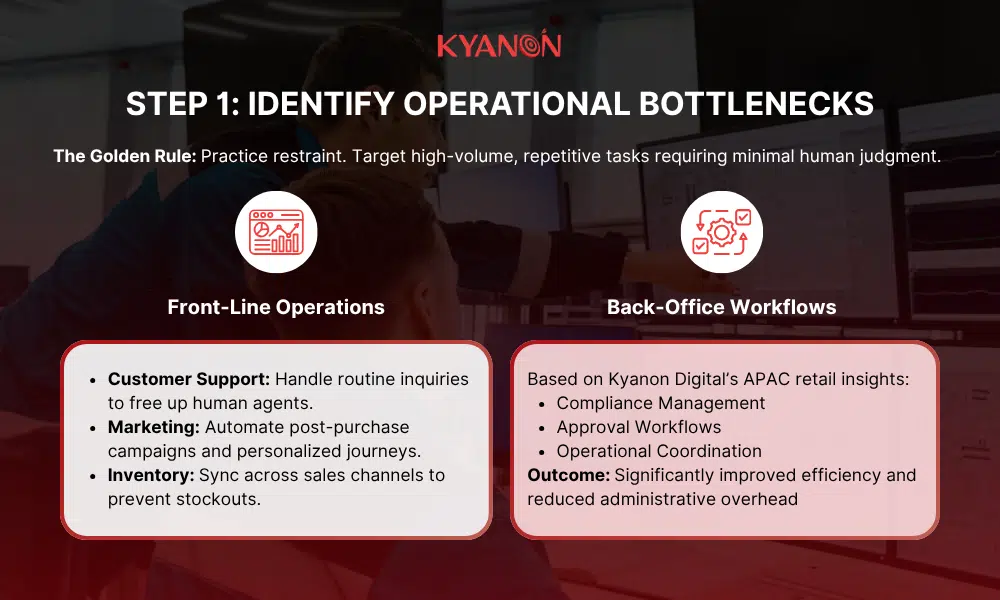
The first principle of AI automation is restraint. Organizations should avoid trying to automate every workflow at once. Instead, begin by identifying the highest-volume, most repetitive processes that consume significant time while requiring minimal human judgment.
Key AI automation areas for retailers:
- Customer support: Automate routine inquiries to free up your team for complex, high-value customer interactions.
- Marketing: Scale engagement effortlessly through automated, personalized post-purchase campaigns and customer journeys.
- Inventory management: Sync stock levels across all sales channels in real-time to eliminate stockouts and reduce manual coordination.
- Back-Office operations: Streamline critical internal workflows, including compliance management, approvals, and operational coordination, to boost efficiency and minimize administrative overhead.
Explore Kyanon Digital’s AI Integration Services to identify high-impact automation opportunities, streamline business workflows, and build scalable AI-powered operations.
Step 2: Choose the right AI tools
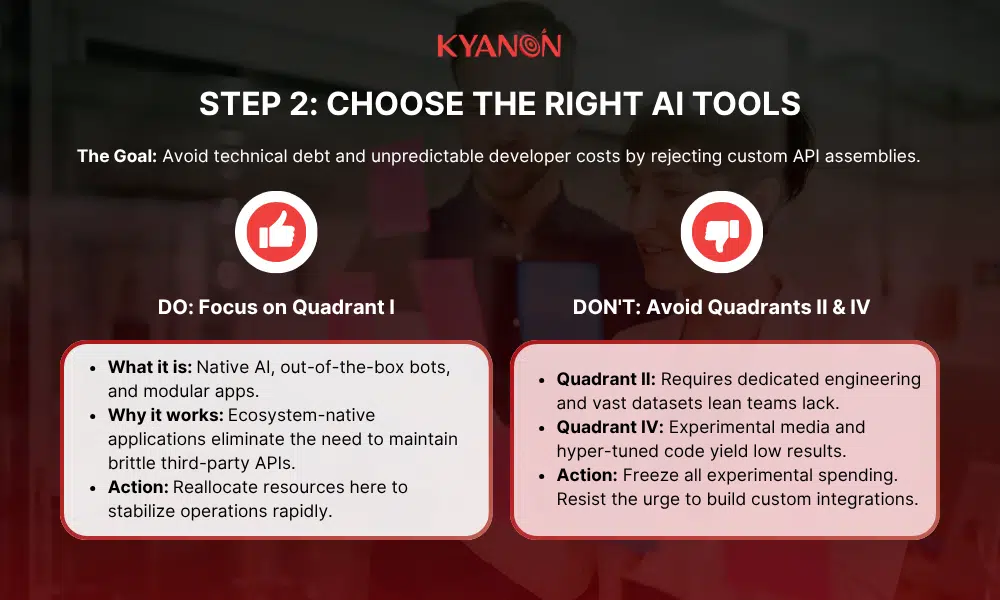
When executing the rollout framework, digital retailers must actively resist the urge to build bespoke, custom artificial intelligence integrations. Attempting custom API assemblies introduces severe technical debt, unpredictable developer costs, and long implementation timelines delaying the time-to-value. The operational objective is to deploy narrow, low-risk features built natively into the existing e-commerce ecosystem.
The priority assessment matrix below categorizes potential software implementations based on their business impact and setup complexity.
Priority assessment matrix for retail deployments
|
Business impact |
High setup complexity | Low setup complexity |
| High yield | Quadrant II: overhauls (Multi-agent chains, fine-tuning, custom pipelines) |
Quadrant I: quick wins (Native AI, out-of-the-box bots, modular apps) |
|
Low yield |
Quadrant IV: distractions (Experimental media, front-end novelty, hyper-tuned code) |
Quadrant III: patches (Rule-based filters, basic macros, static flows) |
The priority assessment matrix demonstrates that early-stage businesses must exclusively operate within Quadrant I during their initial growth phases. Pursuing Quadrant II initiatives requires dedicated engineering teams and vast datasets that lean teams simply do not possess. Retailers often assume disparate systems will natively integrate, yet a significant percentage of mid-market stack combinations require custom connector development. By focusing exclusively on ecosystem-native applications, retailers avoid the technical debt associated with maintaining brittle third-party APIs, preserving working capital for core business activities.
The timing implication is immediate: Retailers must freeze all experimental Quadrant IV spending and reallocate those resources to Quadrant I to stabilize operations.
Step 3: Build and test workflows
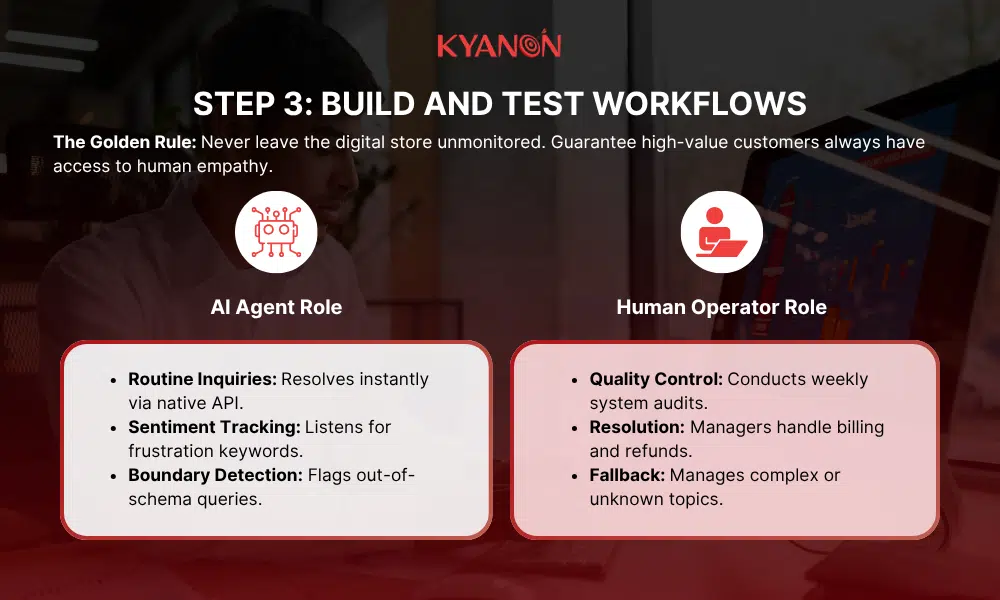
Automating front-facing operations does not entail leaving the digital store entirely unmonitored. For a new brand, a single poorly handled customer escalation or an unverified algorithmic hallucination can permanently damage brand equity. Establishing a rigid human-in-the-loop configuration is a critical operational guardrail keeping automated systems stable, accurate, and aligned with commercial interests.
The following escalation logic table outlines how to configure routing principles between algorithmic agents and human operators.
Operational guardrails and escalation logic
|
Customer interaction type |
Algorithmic action |
Human intervention required |
|
Routine status inquiry |
Instant tracking link and delivery timeline response via native API. | Weekly log audits for API stability and accuracy. |
| Negative sentiment detected | Immediate reply pause triggered by keywords like “broken” or “frustrated”. |
Direct transfer to live support with a transparent handover message. |
|
Complex billing dispute |
Categorizes query and gathers invoice data without resolving. |
Immediate escalation to a manager authorized to process refunds. |
| Out-of-schema query | Recognizes untargeted topics outside the vector database and starts a fallback loop. |
Transferred to human workspace to avoid circular loops. |
The business implication of this escalation architecture is the preservation of consumer trust. Consumers are encountering generative AI more frequently, but brands must use the technology to enhance consumer control rather than replace it. If a retailer fails to implement these specific guardrails, they risk alienating their customer base through frustrating, dead-end automated interactions. Implementing strict semantic triggers and transparent fallbacks ensures the business captures the efficiency gains of automation while guaranteeing high-value customers always have access to human empathy when a dispute arises. This governance model must be established before activating any automated customer-facing tool.
Step 4: Keep humans in the loop
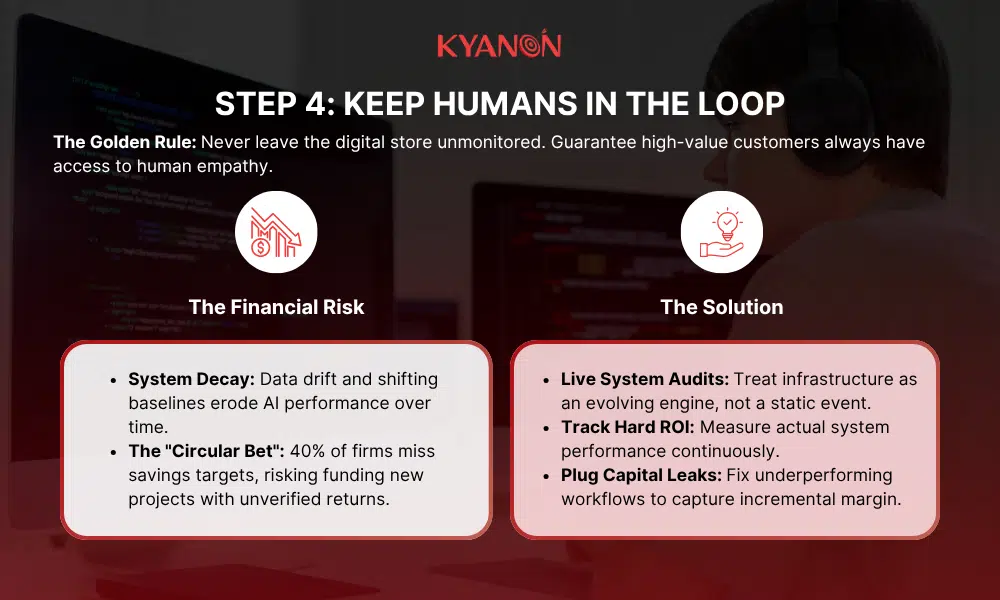
Deploying an algorithmic workflow is not a static event. Automated systems operating in live retail environments suffer from data drift, changing consumer behavior, and shifting platform algorithm baselines. Treating automated infrastructure as a live, evolving system is imperative to protect the customer experience and capture incremental margin opportunities.
The table below outlines a continuous diagnostic methodology for small retail teams.
Weekly diagnostic and optimization loops
|
Diagnostic action |
Target metric | Remediation strategy |
| Audit conversations | Deflection and intent accuracy. |
Update knowledge base and prompts to fix gaps. |
|
Analyze cart abandonment |
Recovery email/SMS conversion rates. | Adjust timing and test personalized offers. |
| Audit omnichannel stock | Inventory synchronization accuracy. |
Refine restock triggers for seasonal delays. |
|
Review margin impact |
Actual savings vs. projected ROI. |
Shift budget toward high-performance tools. |
The business risk of neglecting this optimization phase is severe financial underperformance. Bain & Company reveals that nearly 40% of companies measuring their artificial intelligence cost savings landed below 10%, despite targeting significantly higher margins. The research notes a dangerous “circular bet” where organizations fund new initiatives using projected savings from previous automation programs that ultimately underperformed. To avoid this structural leak, retailers must audit their actual system performance continuously.
How to choose your first AI automation tool
The decision to implement machine intelligence must be rooted in strict commercial logic rather than technological novelty. Retailers succeeding with digital automation typically win by fully resolving one clear operational bottleneck before expanding their technology stack, rather than spreading limited capital across multiple half-implemented applications.
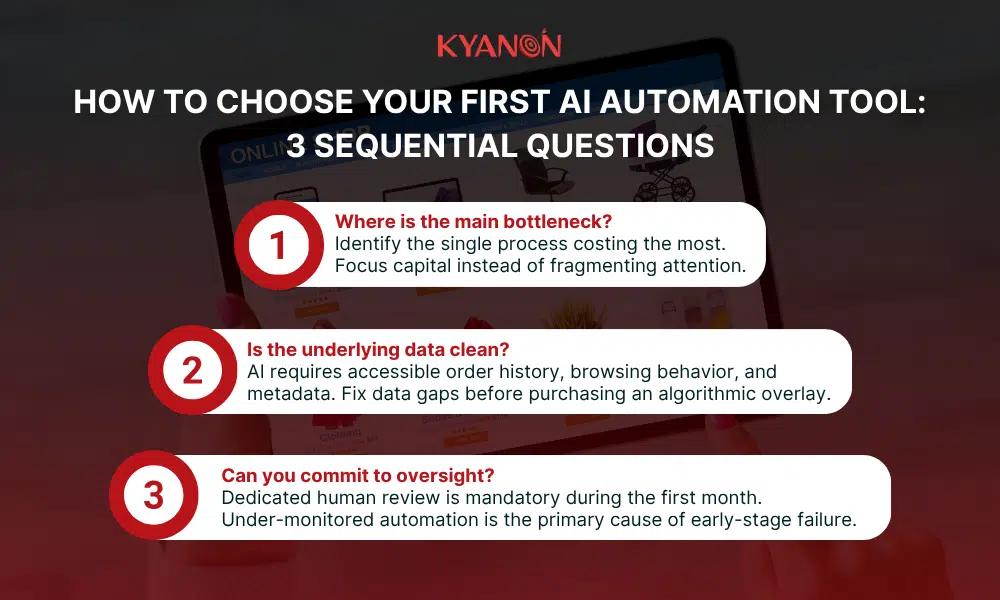
When evaluating the first tool, leaders must answer three sequential architectural questions.
- First, which single bottleneck is costing the business the most right now? Organizations must choose between excessive support time, lost checkout carts, or slow product cataloging. Attempting to deploy solutions for all three simultaneously fragments executive attention and increases the likelihood of system failure.
- Second, does the organization possess the clean, standardized data required for the tool to function? The deployment of ecommerce personalization AI tools relies entirely on accessible order histories, browsing behavior, and product metadata. Data access and integration remain the single biggest barrier to algorithmic progress globally, surpassing concerns over compliance or budget. If the core commerce platform does not expose accurate product inventory levels and customer telemetry, leaders must address that foundational data gap before purchasing an algorithmic overlay.
- Third, can the team commit to a rigorous human oversight period? If the organization cannot dedicate the necessary hours to reviewing system outputs during the first month, the rollout must be delayed. Under-monitored automation is the primary cause of early-stage integration failures.
The urgency to secure this data infrastructure and deploy effective tools is paramount. Analysis from Accenture estimates that by 2030, more than 30% of online commerce could run through autonomous agents, representing close to $3.1 trillion in transaction volume. Furthermore, the analysis also notes that up to 45% of shoppers are expected to shift at least half of their commerce activities into agent-mediated ecosystems in the near future. To capture this emerging traffic channel, new storefronts must iteratively build a standardized data layer that external machine models can easily index, ensuring their product catalogs are visible to both human shoppers and digital shopping assistants.
What AI automation looks like for a first-time retailer in practice
Transitioning from theory to practical application requires viewing the e-commerce technology stack as an integrated ecosystem rather than a collection of independent applications. In practice, algorithmic deployment for a first-time retailer involves synchronizing the front-end customer experience with back-end operational governance to create a seamless transaction lifecycle.
When executed correctly, an incoming customer query regarding shipping status is instantly intercepted by a natural language processing agent. This agent securely queries the order management system, retrieves the live tracking API data, cross-references the geographic location against known transit delays, and formulates a highly contextual response within seconds. Simultaneously, an algorithmic pricing engine monitors competitor inventory across the web, subtly adjusting the retailer’s digital storefront pricing to maintain margin parity while triggering automated reorder alerts to suppliers.
The shift toward this highly integrated model is accelerating rapidly across the software industry. Gartner predicts that up to 40% of enterprise applications will feature task-specific artificial intelligence agents by 2026, up from less than 5% in 2025. This projection underlines the reality that software without embedded decision-making capabilities will soon be obsolete. Early-stage businesses must position their digital architecture to leverage these embedded agents seamlessly, moving away from fragmented applications toward a unified operational command center.
2026 Trends in AI ecommerce automation

The retail landscape in 2026 marks a major shift: AI is no longer an optional enhancement but a core part of modern ecommerce operations. For new online retailers, scalable growth increasingly depends on intelligent automation rather than manual processes.
- One of the biggest changes is the move from rule-based chatbots to AI agents capable of completing entire workflows, such as handling returns, generating shipping labels, and updating inventory automatically. This enables small teams to deliver enterprise-level customer service.
- At the same time, AI-powered personalization has become a standard feature across leading ecommerce platforms. The competitive advantage now comes from maintaining clean, high-quality customer and product data that powers these recommendation engines.
- AI is also transforming product catalog management. Modern tools can generate product descriptions, SEO metadata, and even lifestyle images from a single supplier photo, helping retailers launch products faster with fewer manual resources.
- As automation expands, human oversight remains essential. More platforms now include built-in approval and escalation workflows, ensuring AI decisions remain accurate, compliant, and aligned with business policies.
- Rising expectations for 24/7 responsiveness have become a significant driver in the market. As AI support becomes normalized, customer tolerance for slow manual response times continues to drop, raising the cost of delaying automation.
For first-time retailers, the priority is clear: start with modular, well-governed AI automation while building the clean data foundation needed to support long-term growth and increasingly AI-driven commerce.
Case study: How Kyanon Digital built a scalable eCommerce system for a luxury brand

The luxury consumer goods project demonstrates how digital transformation resolves operational data failures and fragmented customer journeys by unifying CRM data and automating omnichannel personalization to drive repeat purchases.
Kyanon Digital partnered with a leading luxury brand to integrate loyalty, CRM, and e-commerce, enhancing engagement and matching its high-end image.
The challenge:
The brand needed a connected experience but faced fragmented customer data, limited personalization, and disconnected online-offline shopping journeys.
The solution:
Kyanon Digital implemented a digital commerce ecosystem that included:
- Integrated loyalty application: A personalized app featuring gamified rewards and tiered memberships.
- Automated marketing engine: Real-time promotions and exclusive offers to boost engagement and conversions.
- Omnichannel architecture: Connected mobile, web, and in-store systems for seamless cross-channel visibility.
- Centralized data layer: CRM and ERP connectivity for centralized data and smarter campaign management.
The impact:
- Enhanced customer experience: Transformed engagement, significantly increasing loyalty and enabling seamless omnichannel interactions.
- Operational scalability: A data-driven system built specifically for luxury growth without increasing operational overhead.
- Boosted conversions: Higher transaction volumes achieved through real-time, personalized offer deployments.
Read more: Comprehensive E-Commerce Solution For A High-End Luxury Consumer Goods Brand
In conclusion
AI eCommerce automation is not about automating every process at once. For retailers adopting AI for the first time, the most effective approach is to identify a single operational bottleneck, whether it’s customer support, abandoned cart recovery, product catalog management, or personalized recommendations, and optimize that workflow before expanding further.
From Kyanon Digital’s experience delivering enterprise retail transformation, AI generates measurable business value only when it is supported by well-designed workflows, high-quality data, and appropriate human oversight. Without these foundations, automation often introduces new inefficiencies instead of eliminating existing ones.
Ready to identify the right starting point for your AI automation journey?
Contact Kyanon Digital to assess your retail operations and build a practical AI roadmap that delivers measurable business impact.


















 Create project brief with AI