

Digital transformation in BFSI is entering a harder phase across Asia-Pacific: the challenge is no longer simply moving transactions online but modernizing the technology, data, operating model, and controls behind those digital experiences.
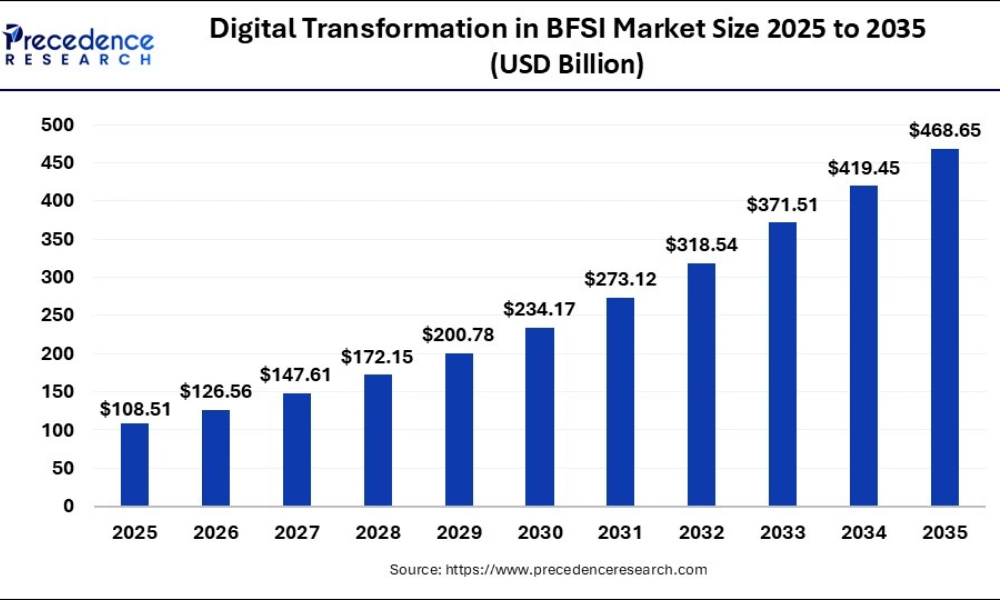
The investment pressure remains high. 2026 evidence: Precedence Research estimates the global digital transformation in the BFSI market at USD 126.56 billion in 2026 and expects Asia-Pacific to be the fastest-growing region over its forecast period.
But investment does not equal transformation maturity. Core systems may still constrain product releases. Customer data may remain fragmented across channels and business units. AI pilots may work technically without meeting governance requirements. Open APIs may expand distribution while also increasing third-party and operational risk.
The gap is particularly visible in emerging technologies. 2026 evidence: IBM found that 26% of surveyed banking executives consider tokenization core to strategy, yet only 9% said their initiatives were live or ready to deploy in 2026.
APAC adds another layer of complexity because it is not one banking market. Financial institutions operate across mature financial hubs, fast-digitizing emerging markets, different data and cloud requirements, distinct payment infrastructures, and different approaches to AI and open finance. In 2026, Singapore proposed the SAFR framework to govern AI agents in financial services, while Hong Kong’s Fintech Promotion Blueprint prioritized more sophisticated applications of AI and distributed ledger technology.
A useful BFSI digital transformation framework therefore has to answer more than what technology should be adopted.
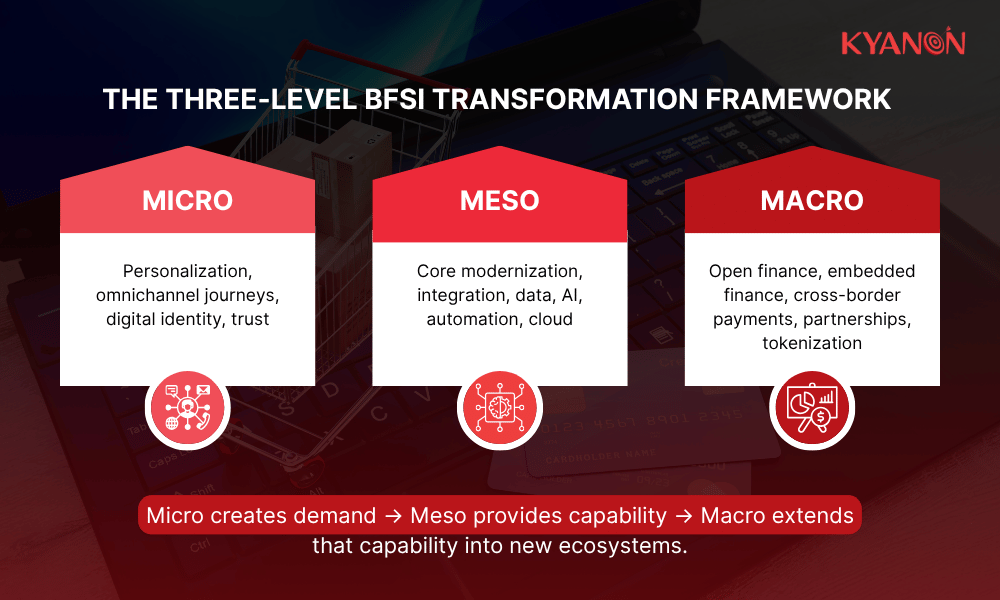
A strong BFSI transformation framework connects three levels:
- Micro: Customer experience, personalization and digital trust.
- Meso: Core systems, data, AI, automation, and operational agility.
- Macro: Open banking, embedded finance, partnerships, and ecosystem growth.
These levels are interdependent. Customer innovation cannot scale without strong operational foundations, while ecosystem expansion increases risk when data, integration, and governance are immature.
In this article, Kyanon Digital examines digital transformation in BFSI through this three-level framework to help businesses prioritize investments, sequence transformation initiatives, and assess what capabilities are required across APAC.
Key takeaways
- Digital transformation in BFSI is an operating-model change, not a channel upgrade. Customer experience, core systems, data, AI, security and ecosystem strategy need to evolve together.
- Use three levels to structure investment. Micro addresses customer engagement; meso addresses operational and technological capability; macro addresses ecosystem and market expansion.
- The meso layer is usually the gating layer. Weak core architecture, fragmented data or poor integration can limit personalization, automation and open-banking ambitions.
- Sequence transformation by maturity and risk. Institutions at an early stage should strengthen core, identity, data, and controls before pursuing complex embedded-finance or autonomous-AI models.
- Do not treat every APAC institution the same. Foundation-led, data-efficiency, and innovation-expansion strategies represent different valid responses to different maturity and risk conditions.
- The target state is a hybrid digital banking model. Stable core services support governed data; governed data supports connected experiences; those capabilities then support controlled ecosystem participation.
- 2026 priorities are moving toward governed AI, open finance, payment interoperability, and tokenized infrastructure. The business issue is increasingly how these technologies connect to controlled production environments, not whether they can be demonstrated.
Further reading:
- Top 10 Digital Transformation Challenges in the BFSI Industry
- Hyper Personalization in Banking With AI
- Agentic Workflow Development for Enterprise Software
- How to Choose a CuBFSI Software Development Company in Singapore
What makes a strong BFSI transformation framework?
A strong framework connects business outcomes, architecture, operations, and risk. It prevents transformation from becoming separate cloud, AI, mobile, and automation projects with no shared target state.
The key distinction is simple:
- Digitization improves an existing process.
- Transformation changes how the business creates, delivers, or protects value.
For example, putting a loan application online is digitization. Connecting onboarding, identity, credit decisioning, customer data, document processing, and servicing into one reusable digital journey is transformation.
Six characteristics of a strong framework
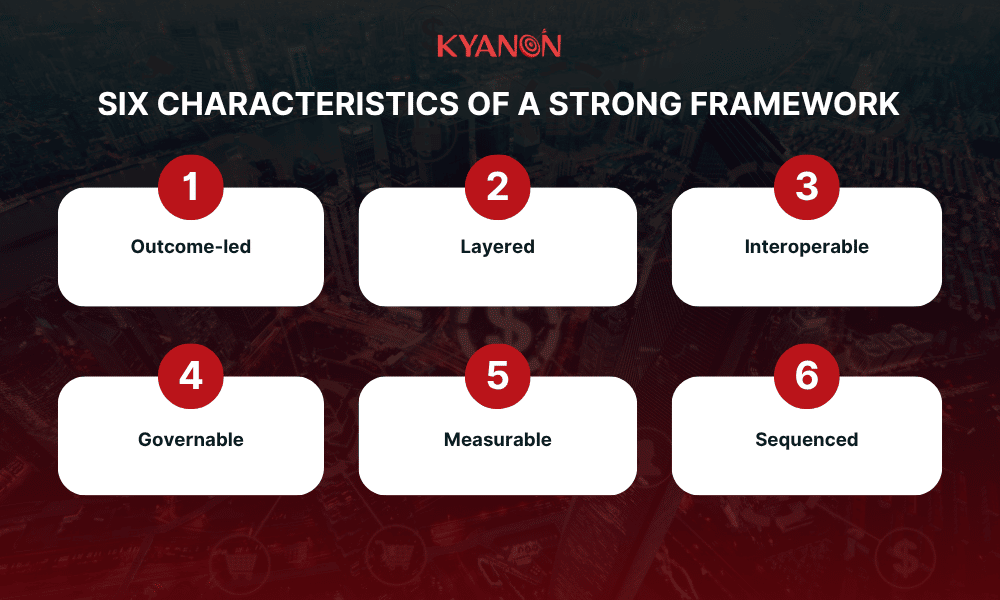
A practical framework should be:
- Outcome-led: Start with growth, customer, risk, or operational outcomes.
- Layered: Separate customer experiences from shared technology foundations.
- Interoperable: Use APIs, shared data models, and modular services to reduce repeated integration work.
- Governable: Build security, privacy, AI controls, and auditability into architecture.
- Measurable: Connect technology changes to business KPIs.
- Sequenced: Build dependencies before capabilities that rely on them.
|
Weak transformation logic |
Stronger decision logic |
|
Move everything to cloud |
Identify which workloads need elasticity, resilience or faster releases |
| Add generative AI |
Select workflows where AI changes a measurable outcome |
|
Replace the core |
Identify which core constraints actually block growth or resilience |
| Launch APIs |
Define consent, security, commercial and partner controls first |
|
Automate operations |
Redesign inefficient processes before automating them |
| Build a data lake |
Define which decisions require trusted, shared data |
Where APAC aligns with global BFSI transformation -and where it differs
The global direction is broadly consistent: modern cores, cloud infrastructure, AI, integrated data, cybersecurity, and more digital customer journeys.
The execution environment is more fragmented across APAC.
| Transformation issue | Global direction |
APAC execution consideration |
|
AI |
From copilots toward increasingly autonomous workflows | Governance maturity differs by jurisdiction; Singapore is already addressing runtime governance for financial AI agents. |
| Open finance | More external data and service exchange |
ADB’s 2026 research covers implementation across 16 APAC economies, reflecting widely different market structures and maturity. |
|
Payments |
Faster, more interoperable rails | Regional connectivity makes ISO 20022, standard APIs and domestic fast-payment compatibility strategic architecture concerns. |
| DLT and tokenization | Growing experimentation around assets and settlement |
Regulatory and infrastructure readiness varies significantly; Hong Kong is explicitly promoting more advanced DLT applications. |
|
Customer experience |
Personalization and omnichannel service |
Mobile-first journeys, local payment methods, digital identity and financial-access conditions differ materially between markets |
Decision implication: Standardize common architecture where scale matters, but localize controls, data and ecosystem integration by market.
The three-level BFSI transformation framework at a glance
The framework separates transformation into customer value, enterprise capability and ecosystem growth.
| Level | Focus | Core question |
Priority capabilities |
|
Micro |
Customer engagement | How do we improve each interaction? | Personalization, omnichannel journeys, digital identity, trust |
| Meso | Operational agility | How do we deliver reliably and efficiently? |
Core modernization, integration, data, AI, automation, cloud |
|
Macro |
Ecosystem growth | How do we create value beyond existing channels? |
Open finance, embedded finance, cross-border payments, partnerships, tokenization |
The levels are interdependent:
Micro creates demand → Meso provides capability → Macro extends that capability into new ecosystems.
The levels are not three independent programs. Micro creates demand on meso; meso establishes the controls required for macro; macro creates new requirements for both.
Micro level – Customer-centric strategies
At the micro level, digital transformation for BFSI should improve customer relevance, speed, continuity and trust.
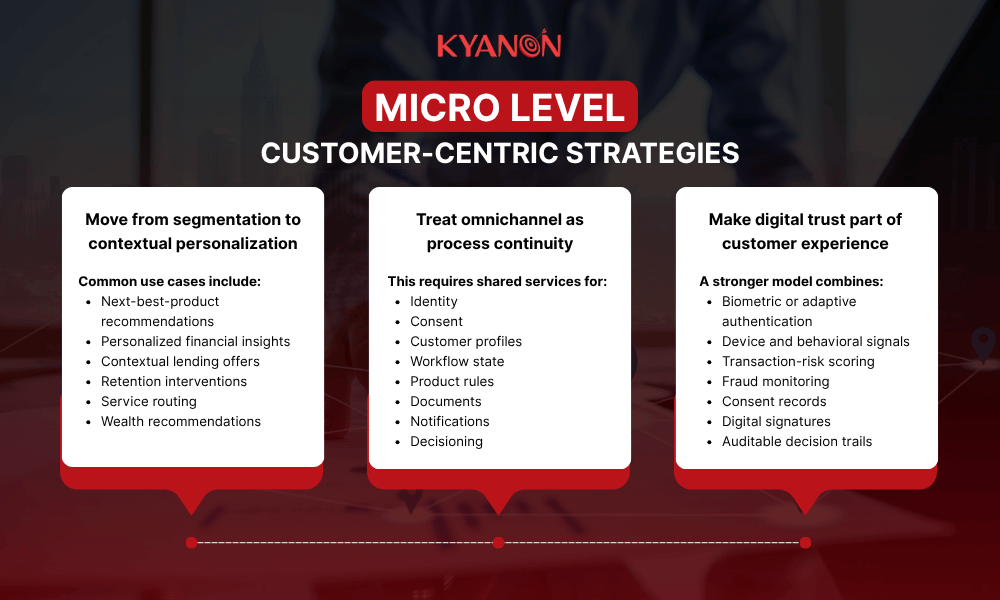
Move from segmentation to contextual personalization
Traditional segmentation groups customers by broad attributes. More mature models combine customer, transaction, and real-time behavioral data to determine the next relevant action.
Decision test:
- Is the data permitted and current?
- Can important recommendations be explained?
- Can low-confidence cases move to human review?
- Can incorrect decisions be challenged or reversed?
2026 APAC signal: Commonwealth Bank says AI is now used across fraud protection, cybersecurity, and customer experience. In the first half of FY2026, AI-supported fraud controls contributed to a more than 20% year-over-year decline in customer fraud losses.
Decision implication: Personalization becomes valuable when trusted data, decision rules, and controls operate together, not when another recommendation model is added.
Treat omnichannel as process continuity
Omnichannel is not the number of channels available.
It is whether the same customer journey can continue across mobile, web and assisted service without repeating data, identity checks, or process steps.
Decision implication: Modernize shared services behind the channels before investing heavily in additional front-end experiences.
Make digital trust part of customer experience
Security and customer experience should not be designed separately.
A stronger model combines:
- Biometric or adaptive authentication
- Device and behavioral signals
- Transaction-risk scoring
- Fraud monitoring
- Consent records
- Digital signatures
- Auditable decision trails
The target is risk-adjusted friction: stronger controls where risk rises, lower friction where confidence is high.
Meso level – Operational agility and technology stack
The meso layer determines whether customer innovation can scale securely, reliably, and efficiently.
| Priority | What it means | Key focus | Decision implication |
|---|---|---|---|
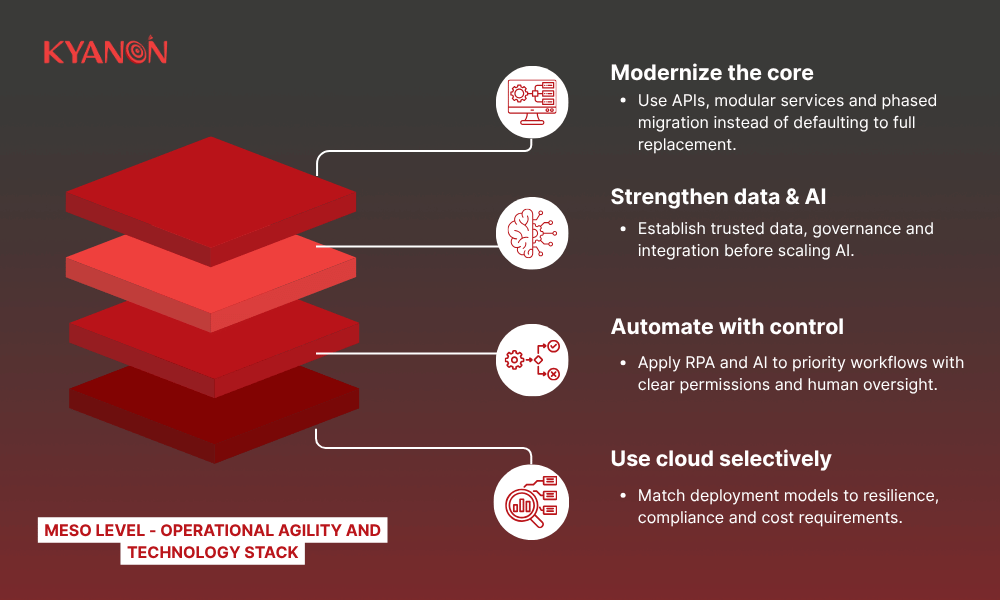
| Core modernization | Modernize legacy constraints without defaulting to full replacement. | APIs, modular services, phased migration, integration | Replace or modernize only where the core blocks measurable business outcomes. |
| Trusted data & AI | Build reliable, governed data before scaling AI. | Ownership, quality, lineage, access, shared data, monitoring | Poor production data cannot be fixed by adding more AI models. |
| Controlled automation | Move from RPA toward AI-assisted and agentic workflows with stronger controls. | Permissions, thresholds, human review, logging, rollback | More AI autonomy requires more technical governance. |
| Selective cloud | Choose deployment models by workload needs rather than a universal cloud-first rule. | Regulation, resilience, latency, integration, cost, exit risk | Match public, private, hybrid, or on-premises architecture to risk and economics. |
2026 APAC signals: Maybank’s ROAR30 strategy strengthens its technology foundation around cloud and AI, while Singapore’s SAFR proposal introduces runtime safeguards for AI agents in financial services.
Meso-level takeaway: Build a trusted, integrated, and resilient technology foundation before scaling customer-facing or ecosystem innovation.
How Kyanon Digital improved digital insurance launch readiness from 62% to 91%
A Singapore-based digital insurance provider needed to stabilize its mobile platform before pilot launch across policyholder, agent, broker, and partner journeys.
This case from Kyanon Digital shows that BFSI transformation succeeds when customer-facing innovation is reinforced by security, governance, and operational readiness.
Challenges
- Inconsistent customer and agent journeys
- Limited visibility into launch readiness
- Security and testing gaps
- High coordination pressure on the internal technology team
Solution
- Stabilized critical mobile journeys, including claims, policy viewing and document submission
- Introduced structured sprint, blocker and readiness governance
- Strengthened code review, testing, MFA, and repository controls
- Applied AI-assisted engineering while retaining human review for release decisions
Results
- Pilot readiness: 62% → 91%
- Open blockers: reduced 72%, from 18 to 5
- High-priority defects: reduced 46%
- Priority journey smoke-test coverage: reached 100%
BFSI transformation lesson: Customer-facing digital transformation becomes more reliable when experience improvements are supported by delivery governance, security and operational readiness, not frontend development alone.
Explore more: Accelerating Singapore Digital Insurance App Launch Readiness with an AI-Driven Agile Team
Macro level – Ecosystem and market expansion
The macro level changes how financial products reach customers and how the institution connects with external ecosystems.
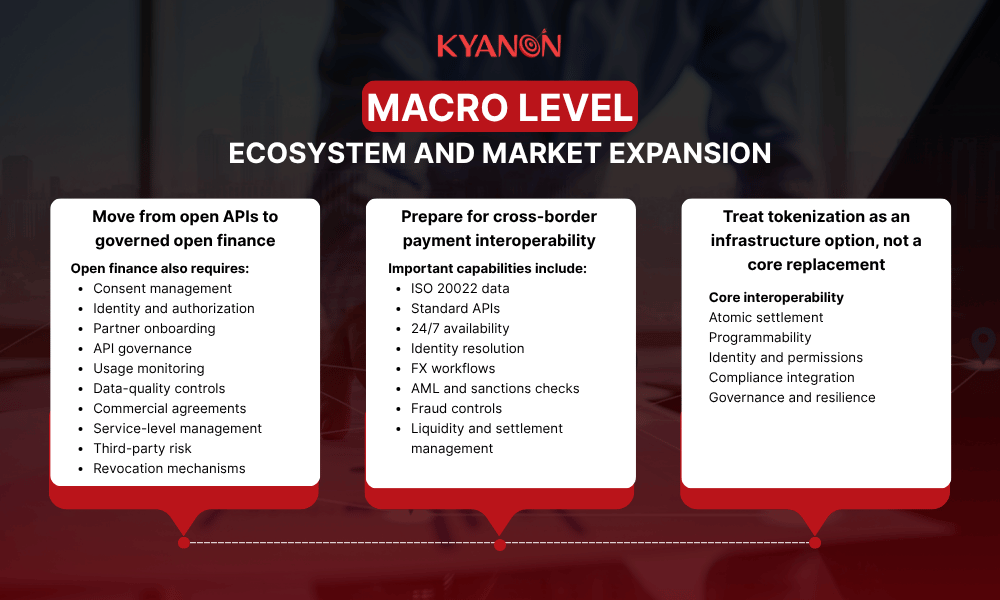
Move from open APIs to governed open finance
Publishing APIs solves only the connectivity problem.
2026 evidence: ADB highlighted in June 2026 that the benefits of open finance in Asia-Pacific depend on whether its privacy, cybersecurity, consumer-protection and operational risks are managed effectively.
Decision implication: Do not scale ecosystem participation faster than identity, consent and third-party governance can support it.
Prepare for cross-border payment interoperability
Payment modernization is increasingly becoming an integration problem across systems and jurisdictions.
2026 evidence: BIS states that interoperability by design, ISO 20022 harmonization, and standardized API frameworks are key foundations for improving cross-border payments.
Decision implication: Proprietary interfaces and fragmented payment data can become a direct constraint on regional growth.
Treat tokenization as an infrastructure option, not a core replacement
Tokenization is becoming more operationally credible, but readiness remains uneven.
2026 evidence: BIS Project Agorá progressed from demonstrating atomic settlement with tokenized central- and commercial-bank money in May to real-value testing across 28 institutions and 17 scenarios in July, while IBM found only 9% of surveyed banks were live or ready to deploy tokenization initiatives in 2026.
Decision implication: Build interoperability and architectural optionality before assuming tokenized infrastructure should replace existing systems of record.
How APAC banks should sequence their transformation
The right transformation sequence depends on three questions:
- What is the current digital maturity?
- What level of risk can the institution absorb?
- Where is revenue currently constrained or exposed?
These questions prevent transformation from being sequenced according to technology popularity.
What is the current digital maturity?
For planning, businesses can use a five-stage maturity sequence.
|
Stage |
Typical condition | Priority |
Avoid |
|
Initiation |
Fragmented digital channels and legacy-heavy operations | Identity, security, integration and data ownership | Autonomous AI or complex ecosystem programs |
| Development | Digital products exist but processes remain duplicated | APIs, shared services, workflow modernization |
More disconnected point solutions |
|
Integration |
Customer journeys are digital but systems remain fragmented | Data, orchestration, unified identity | Front-end expansion without backend convergence |
| Optimization | Integrated platforms and reliable data exist | AI, personalization and intelligent automation |
Automation with no measurable business case |
|
Innovation |
Modular architecture and strong governance exist | Open finance, embedded finance, agentic workflows, tokenization |
Innovation without risk and portfolio discipline |
Decision rule: Do not pursue macro-level complexity while critical meso dependencies remain unresolved.
What is the institution’s risk posture?
Three archetypes provide a practical decision lens.
These are analytical models, not labels used by individual banks.
| Archetype | Best fit |
Priority |
|
Safety–incremental |
Legacy exposure, resilience or regulatory risk is high | Core, security, governance, controlled modernization |
| Data–efficiency | Digital foundations exist but decision-making remains fragmented |
Data, analytics, AI, personalization, automation |
|
Innovation–expansion |
Architecture and governance can support external complexity |
Ecosystems, fintech partnerships, embedded services, new rails |
Business note: The correct model depends on the starting architecture, risk capacity, and growth strategy.
Where is the revenue pressure?
Use revenue exposure to break ties between competing initiatives.
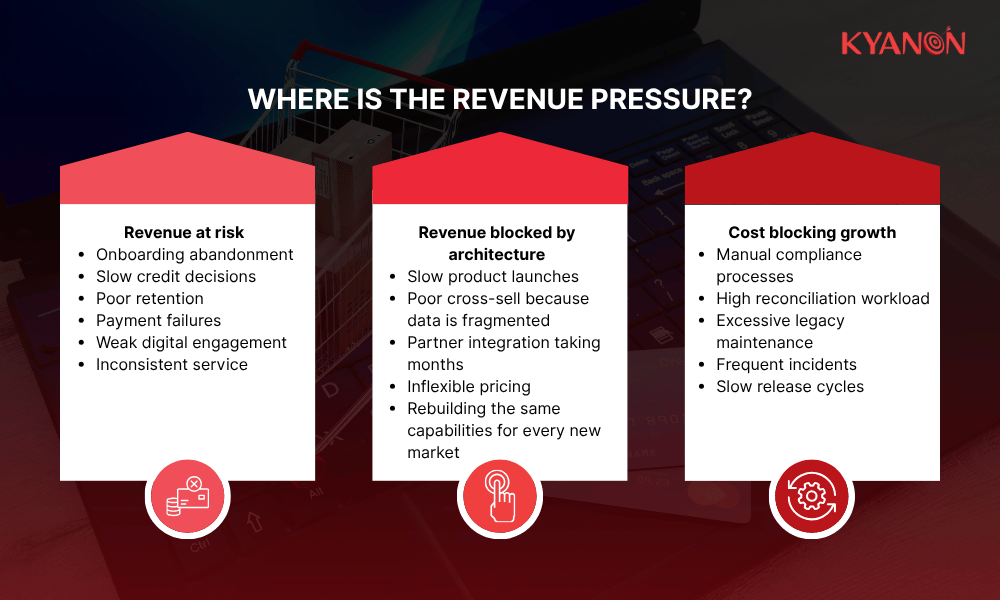
Portfolio principle: Prioritize transformation where removing a technology or process constraint changes a measurable business outcome.
Not every manual process needs AI. Not every legacy system needs replacement. Not every customer interaction needs personalization.
The target state: A hybrid digital banking model
The three transformation levels should move toward a four-layer target architecture.
| Layer | Purpose | Core capabilities |
Readiness test |
|
Core |
Stability and regulated transaction processing | Accounts, ledger, payments, lending, identity, security | Can critical services operate reliably and expose controlled interfaces? |
| Data | Shared intelligence | Governed data, customer 360, analytics, AI, decision engines |
Can important decisions access trusted and traceable data? |
|
Experience |
Connected interaction | Mobile, web, assisted channels, personalization, workflow continuity | Can customers move between journeys without duplicated process state? |
| Open | Ecosystem participation | APIs, open finance, embedded finance, partner platforms, emerging settlement rails |
Can external participants connect without weakening control or resilience? |
The hybrid digital banking model does not mean every system should remain hybrid indefinitely.
It means modernization should preserve stable regulated functions while progressively introducing modular data, experience, and ecosystem capabilities.
The north star is therefore not “fully cloud-native” or “AI-first.”
It is a stable core, trusted data, composable experiences, and controlled openness.
Where additional engineering capacity is required, external partners should be assessed against this architecture rather than selected simply for access to a particular platform.
Kyanon Digital’s BFSI capabilities include legacy system modernization, data management, cybersecurity and compliance, and omnichannel digital experience; these should still be assessed against the target architecture, control requirements, and measurable delivery outcomes.
A practical 2026 transformation roadmap
Transformation should move through capability gates rather than launch every initiative at once.
| Phase | Priority |
Key actions |
|
0–90 days |
Establish baseline | Map priority journeys, core constraints, APIs, data domains, risk requirements and KPIs |
| 3–6 months | Strengthen foundations |
Improve integrations, identity, consent, data quality, reusable APIs and observability |
|
6–12 months |
Scale intelligence | Add real-time analytics, governed AI, straight-through processing and targeted personalization |
| 12–18 months | Expand selectively |
Add open-finance partnerships, regional payment connectivity, bounded AI agents and relevant tokenization use cases |
Gate rule: Progress when the required capability is operationally ready, not simply because the previous project has reached go-live.
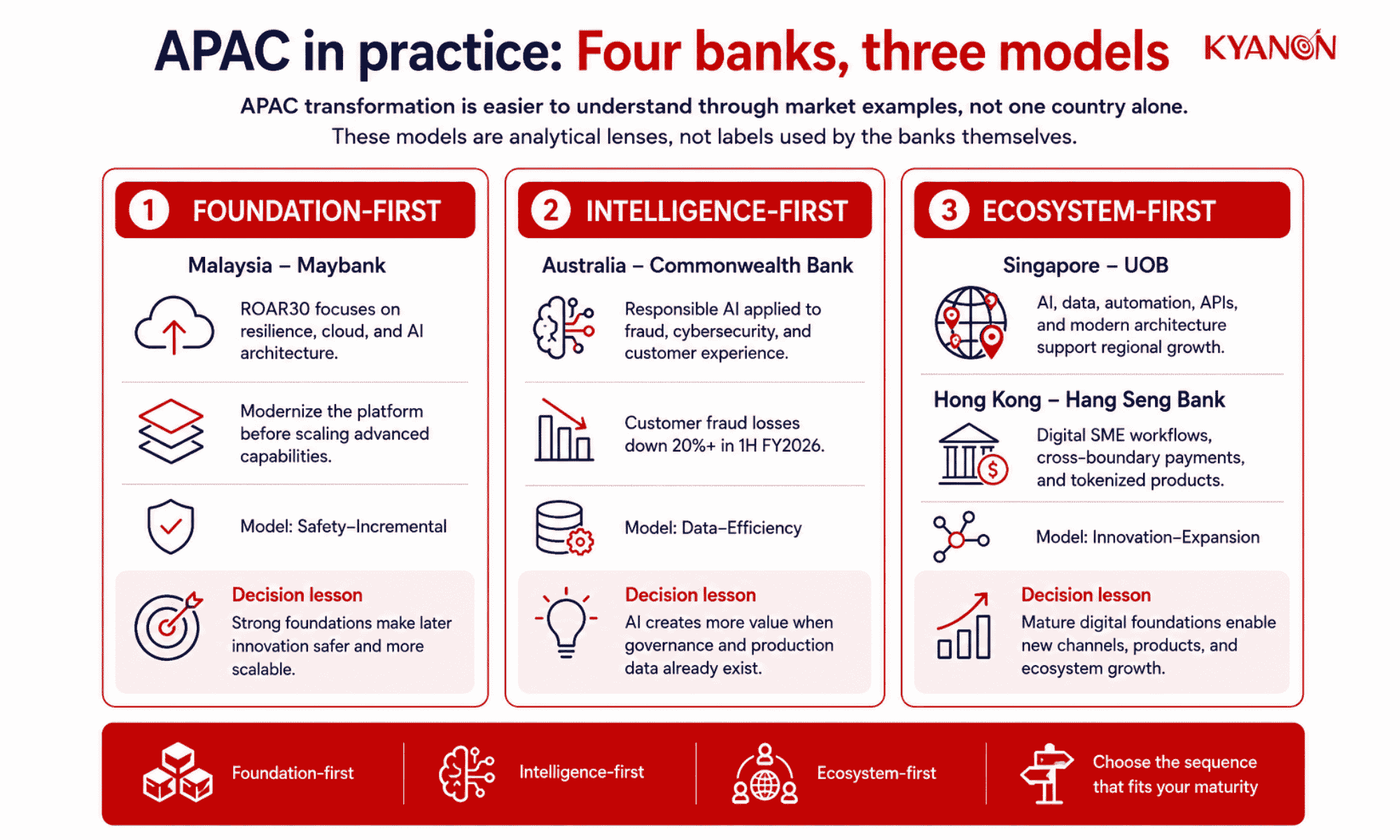
APAC in practice: Four banks, three models
APAC transformation is better understood through different markets rather than one country.
The following classifications are analytical lenses, not labels used by the banks themselves.
|
Market / bank |
Observed 2026 direction | Analytical model |
Decision lesson |
|
Malaysia – Maybank |
Technology modernization, reliability, cloud and AI architecture under ROAR30 | Safety–Incremental | Strengthen the platform before scaling advanced capabilities |
| Australia – Commonwealth Bank | Responsible AI applied across fraud, cybersecurity and customer experience | Data–Efficiency |
AI creates more value when governance and production data already exist |
|
Singapore – UOB |
AI, data, automation, APIs and modern architecture tied to regional banking transformation | Innovation–Expansion | Technology modernization can support ecosystem and regional growth |
| Hong Kong – Hang Seng Bank | Digital SME workflows, tokenized products and cross-boundary payment initiatives | Innovation–Expansion |
Mature digital foundations enable new channels, products and financial rails |
Maybank: modernize the foundation before scaling
Maybank launched ROAR30 in January 2026 with investment designed to strengthen resilience and increase adoption of cloud and AI architecture.
What this shows: Advanced AI ambitions still depend on reliable technology foundations. Modernization and innovation do not need to be separate programs.
Commonwealth Bank: scale AI with governance and measurable outcomes
In February 2026, Commonwealth Bank published its organization-wide approach to developing, deploying and managing AI responsibly. Its AI applications include fraud, cybersecurity, and customer experience, with customer fraud losses down by more than 20% in the first half of FY2026 versus the prior-year period.
What this shows: AI maturity is not the number of pilots. It is the ability to connect models to production data, governance and measurable business outcomes.
UOB: connect modernization with regional growth
In June 2026, UOB announced collaboration covering AI, digital banking transformation, fintech innovation and regional growth, using data analytics, automation, cloud, APIs and modern architecture.
What this shows: Meso capabilities become strategically valuable when they can be reused across markets and ecosystem relationships.
Hang Seng Bank: expand from digital process to new financial rails
Hang Seng’s 2026 milestones include Hong Kong’s first fully digitalized 80% SME Financing Guarantee Scheme application, a market-first e-Passbook, support for Payment Connect, and the launch of a tokenized gold ETF unlisted class.
What this shows: Macro innovation becomes easier when digital workflows and ecosystem connectivity are already operational.
The cases above illustrate three valid sequences:
Foundation-first → Intelligence-first → Ecosystem-first
A business should choose the sequence that matches its own maturity rather than imitate the most visible technology initiative in the market.
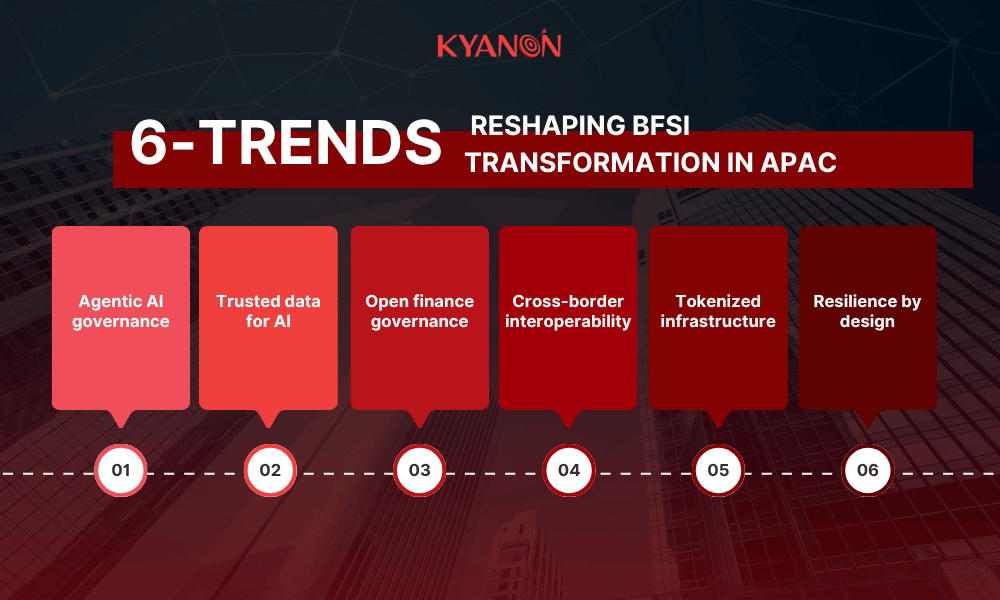
Trends reshaping BFSI transformation in APAC
In 2026, BFSI transformation in APAC is shifting from isolated digital initiatives toward governed AI, trusted data, interoperable ecosystems, and resilient infrastructure.
| 2026 BFSI trend | What is changing | APAC / market signal |
Decision implication |
|
Agentic AI governance |
AI agents can retrieve data, select tools, trigger workflows and execute approved actions. | Singapore’s SAFR proposal introduces safeguards for AI agents performing financial tasks. | Build permissions, execution limits, escalation and monitoring into AI workflows. |
| Trusted data for AI | AI exposes fragmented identities, poor lineage, inconsistent definitions and weak access controls. | Banks are moving from isolated AI pilots toward governed enterprise data and AI foundations. |
Fix data quality, integration and governance before scaling more AI models. |
|
Open finance governance |
Open finance is moving beyond API connectivity to controlled data and service sharing. | ADB’s 2026 guidance highlights privacy, cybersecurity, consumer and financial-stability risks. | Treat consent, identity, partner governance and data lineage as core architecture. |
| Cross-border interoperability | Regional payments increasingly depend on connected payment rails and common standards. | BIS highlighted interoperability, ISO 20022 harmonization and standardized APIs in 2026. |
Modernize payment architecture so it can connect reliably with external and regional rails. |
|
Tokenized infrastructure |
Tokenization is moving from pilots toward controlled real-value settlement. | BIS Project Agorá tested real-value transactions across 28 institutions and 17 scenarios; IBM found only 9% of surveyed banks were deployment-ready in 2026. | Prepare for interoperability with tokenized systems without assuming near-term core replacement. |
| Resilience by design | More cloud, AI, fintech and API dependencies increase operational complexity. | Expanding digital ecosystems create greater third-party and concentration risk. |
Design recovery, fallback, isolation and provider-risk controls alongside innovation. |
Kyanon Digital perspective: From our experience supporting enterprise modernization, the next phase of digital transformation in BFSI is less about adding new technologies and more about integrating AI, data, core systems, security, and ecosystem connectivity so they remain governable, interoperable, and resilient at scale.
In conclusion
Digital transformation in BFSI works best when customer experience, operational capability, and ecosystem growth move together.
For APAC businesses, the priority should be to strengthen the Core → Data → Experience → Open layers in the right sequence, based on maturity, risk, and business impact.
Before investing, ask:
- What business constraint will this remove?
- Is the required data and architecture ready?
- What new risk or dependency will it create?
- What measurable capability will remain after implementation?
For businesses assessing how to turn this framework into an actionable architecture and delivery roadmap, Kyanon Digital can support the discussion across system modernization, integration, data, AI, and digital experience. The appropriate starting point is a bounded assessment of current capabilities, dependencies, and measurable business priorities, not a predetermined technology program.
Contact Kyanon Digital to assess your transformation priorities and define the next practical step.


















 Create project brief with AI