



Digital transformation in insurance is the modernization of insurance operations, technology, data, and customer experiences through cloud, APIs, AI, automation, analytics, and modern software architecture. For enterprise insurers in Singapore and Malaysia, transformation is increasingly focused on modernizing legacy systems, improving claims and underwriting efficiency, strengthening digital customer experiences, and adopting AI while maintaining cybersecurity, resilience, data governance, and regulatory controls.
This guide summarizes the key technologies, use cases, challenges, and strategic priorities insurance leaders should consider in 2026.
Key takeaways
- The legacy barrier: Monolithic core systems and fragmented data are the primary obstacles preventing insurers from meeting modern customer expectations, reducing operational costs, and effectively scaling AI across the enterprise.
- Technological shift: Successful modernization requires transitioning from isolated legacy platforms to scalable, cloud-driven microservices, API-first integrations, and a unified, governed data foundation.
- Human-in-the-Loop AI integration: Insurers can achieve the highest ROI by embedding Generative and Agentic AI into high-volume, historically manual workflows like claims triage and risk assessment, while retaining human oversight for complex decisions.
- Strategic, phased implementation: Rather than executing a high-risk, “big-bang” core replacement, insurance leaders should adopt incremental modernization, piloting high-value use cases first and embedding strict cybersecurity and regulatory governance from the start.
- Measurable business impact: Connecting data, cloud, and AI transitions an insurer from reactive, paper-heavy models to proactive, real-time operations, resulting in significantly shorter claim cycles, instant risk evaluation, and resilient operational growth.
Further reading:
- Digital Transformation Roadmap: From Zero to Hero Business
- Top 10 Digital Transformation Challenges in the BFSI Industry
What is digital transformation in insurance?
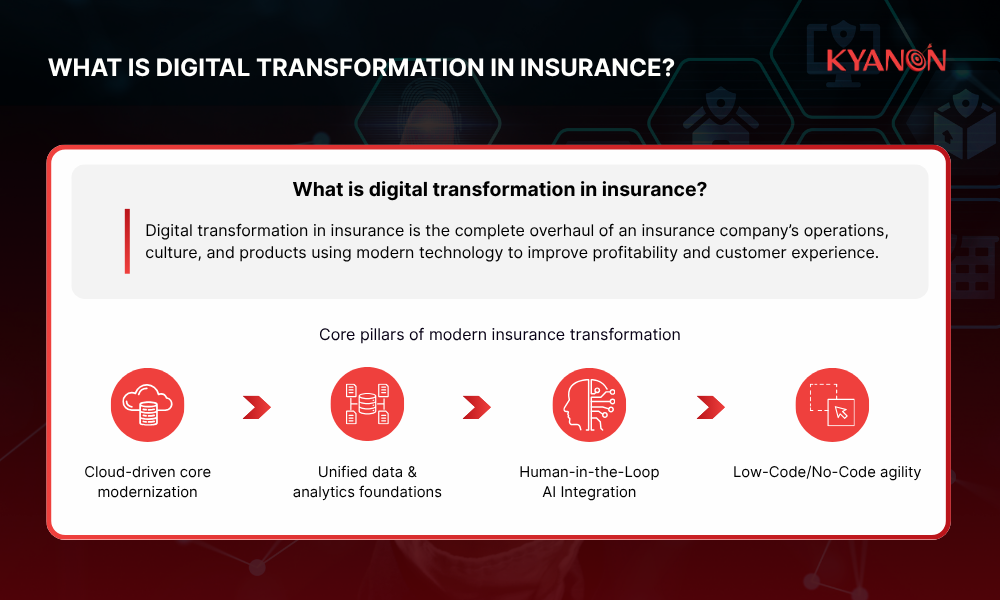
Digital transformation in insurance is the complete overhaul of an insurance company’s operations, culture, and products using modern technology to improve profitability and customer experience. It goes beyond simply digitizing paper documents; it fundamentally changes how a carrier assesses risk, manages claims, and interacts with policyholders.
Core pillars of modern insurance transformation
The current generation of digital transformation relies heavily on breaking down legacy software silos to build unified, adaptable corporate structures.
- Cloud-driven core modernization: Re-platforming monolithic legacy systems using modular, API-first microservices to ensure rapid code updates, enterprise elasticity, and friction-free partner integrations.
- Unified data & analytics foundations: Establishing governed, first-party data ecosystems to achieve a absolute 360-degree customer view, feeding real-time internal dashboards and financial metrics.
- Human-in-the-Loop AI Integration: Implementing governed machine learning and generative AI tools that handle baseline document workflows while feeding auditable insights to human decision-makers.
- Low-Code/No-Code agility: Equipping non-technical operations teams with rapid-build software tools to launch new products or adjust workflows in hours rather than months.
Why digital transformation matters for insurance companies
Deloitte identifies legacy-system modernization and data strategies as top technology priorities, with insurers pursuing cloud-based transformation. It also emphasizes that fragmented data and outdated systems can prevent insurers from getting value from AI.
Insurance companies face five major transformation pressures:
- Legacy systems: Monolithic applications and fragmented architectures make change expensive and slow.
- Customer expectations: Customers expect fast, mobile-first, personalized services.
- Operational costs: Manual underwriting, claims, and servicing processes create unnecessary workload.
- AI adoption: Competitors are using AI to improve underwriting, claims, fraud detection, and customer service.
- Regulatory and technology risk: Cloud, AI, data, and third-party technologies require stronger governance and resilience.
|
Traditional Insurance Model |
Digitally Transformed Model |
| Paper-heavy, manual underwriting (takes days) |
AI-driven, instant risk evaluation (takes minutes) |
|
Disconnected, siloed legacy systems |
Unified cloud platforms connected via APIs |
| Reactive fraud detection after payouts |
Predictive, automated real-time fraud mitigation |
|
Rigid, fixed annual premium models |
Flexible, usage-based, and embedded products |
For insurers in Singapore and Malaysia, transformation therefore requires a balance between innovation, operational resilience, cybersecurity, and regulatory readiness.
Key technologies driving digital transformation in insurance
For enterprise insurers, these technologies should not be treated as isolated initiatives. The greatest value comes from connecting AI, data, cloud, APIs, and automation to modernize core insurance processes and create scalable digital capabilities. The most important technologies are:
|
Technology |
Key Insurance Applications | Business Value |
| Artificial Intelligence & Machine Learning | Underwriting, fraud detection, claims triage, risk assessment, customer segmentation, predictive analytics |
Faster decisions, improved risk accuracy, and higher operational efficiency |
|
Generative AI |
Policy and claims summarization, document extraction, employee copilots, customer-service assistants | Reduces manual work and accelerates knowledge-intensive processes |
| Agentic AI | Information gathering, eligibility checks, workflow orchestration, recommendation generation, exception escalation |
Automates multi-step processes while keeping humans involved in complex decisions |
|
Cloud Computing |
Modern applications, data platforms, analytics, AI workloads, core-system modernization | Scalable infrastructure, faster deployment, and greater technology flexibility |
| APIs & Modern Integration | Connecting insurers with brokers, banks, healthcare providers, automotive platforms, and embedded-insurance ecosystems |
Enables seamless data exchange, ecosystem integration, and new distribution models |
|
Data & Analytics |
Real-time reporting, predictive analytics, personalization, fraud detection, AI model development | Creates a unified view of customers and risks and supports data-driven decisions |
| Automation & RPA | Claims processing, underwriting workflows, policy servicing, finance, and back-office operations |
Reduces repetitive manual work, processing time, and operational costs |
|
IoT & Telematics |
Connected vehicles, wearables, smart homes, and other connected devices |
Provides real-time behavioral and risk data for dynamic pricing and proactive risk management |
Digital transformation across the insurance value chain
Digital transformation in the insurance sector can improve almost every stage of the insurance lifecycle.
|
Area |
Digital transformation use case | Key outcome |
| Underwriting | AI risk assessment and automated workflows |
Faster decisions |
|
Claims |
Digital submission and AI-assisted validation | Shorter claim cycles |
| Policy administration | Modern platforms and APIs |
Greater agility |
|
Customer service |
AI assistants and self-service | Faster support |
| Distribution | Digital channels and embedded insurance |
New revenue opportunities |
|
Pricing |
Advanced analytics and behavioral data | Better risk segmentation |
| Fraud | Machine learning and anomaly detection |
Earlier risk identification |
The greatest value comes from connecting these capabilities, rather than optimizing each process separately.
Digital transformation in life insurance
The digital transformation in life insurance industry is focused on simplifying complex customer, distribution, underwriting, and servicing processes.
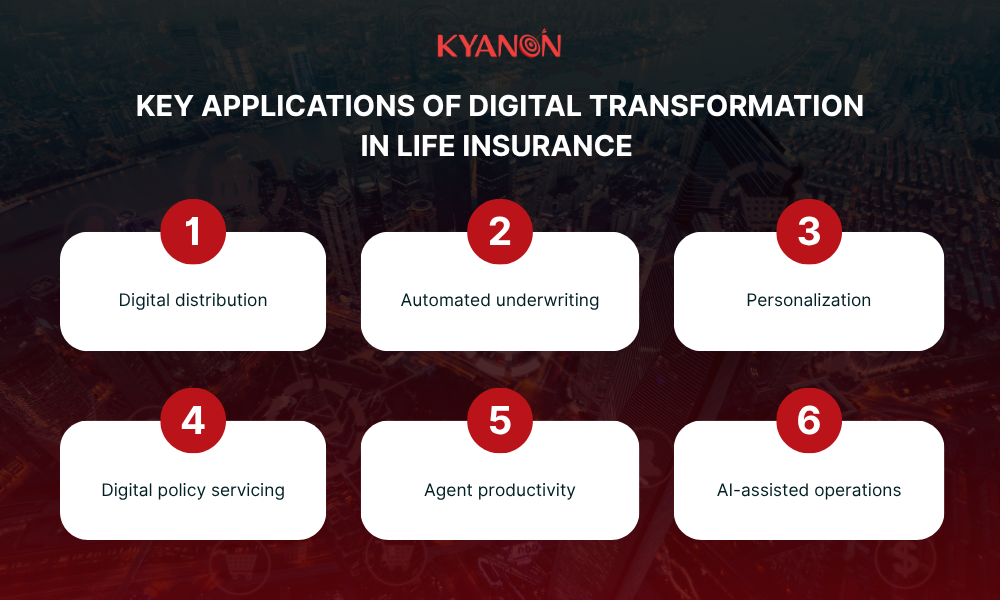
Key applications include:
- Digital distribution: Online quotation, application, verification, payment, and policy issuance.
- Automated underwriting: AI and data integration support faster risk assessment.
- Personalization: Customer data enables more relevant products and communications.
- Digital policy servicing: Customers can manage policies, documents, payments, and service requests online.
- Agent productivity: AI copilots provide customer insights, summaries, recommendations, and administrative support.
- AI-assisted operations: AI can support document processing, customer service, fraud detection, and analytics.
For life insurers, the priority should be reducing customer friction without compromising risk controls and human oversight.
Digital transformation in insurance claims
Claims are a strategic priority for digital transformation in insurance because they directly affect customer trust, operational cost, and retention. Deloitte’s 2026 research found that many policyholders still experience complex and fragmented claims processes, creating opportunities for AI and modern claims platforms to improve speed, clarity, and consistency.
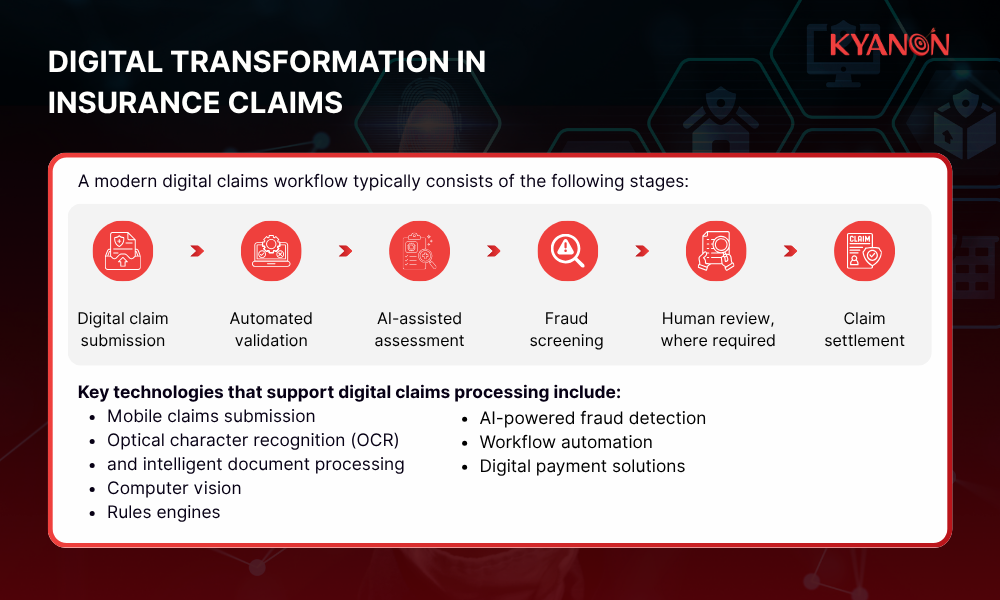
A modern digital claims workflow typically consists of the following stages:
- Digital claim submission
- Automated validation
- AI-assisted assessment
- Fraud screening
- Human review, where required
- Claim settlement
Key technologies that support digital claims processing include:
- Mobile claims submission
- Optical character recognition (OCR) and intelligent document processing
- Computer vision
- Rules engines
- AI-powered fraud detection
- Workflow automation
- Digital payment solutions
The objective is not to automate every claim. Instead, insurers should automate predictable, low-risk activities while keeping human expertise involved in complex or high-impact decisions. A 2026 Aon report similarly notes that insurers are using AI and digital claims tools primarily for triage and administrative efficiency, rather than fully automating settlement decisions.
Digital transformation in insurance underwriting
Digital transformation in insurance underwriting uses AI, analytics, automation, APIs, and modern data platforms to make risk assessment faster, more consistent, and scalable. Traditional underwriting often requires underwriters to collect information manually from multiple systems, review documents, assess risk, and move cases between workflows. Digital transformation can automate repetitive activities while giving underwriters better data and decision support.
Deloitte identifies AI, automation, alternative data, and advanced analytics as key technologies reshaping underwriting. A typical workflow is:
|
Stage |
Description |
| Data ingestion |
Collect relevant internal and external data |
|
Data validation |
Check data quality, completeness, and accuracy |
| Risk scoring |
Assess risk using predictive models and analytics |
|
Rules evaluation |
Apply underwriting rules and eligibility criteria |
| AI recommendation |
Generate risk insights and decision recommendations |
|
Underwriter decision |
Review the recommendation and make the final decision |
Key capabilities include:
- Automated data collection
- Predictive risk models
- AI-assisted underwriting
- Automated workflow routing
- External data integration
- Real-time analytics
The best enterprise model is human-AI collaboration: AI handles data-intensive analysis while underwriters retain responsibility for complex decisions, exceptions, and accountability.
Digital customer experience in insurance
Customers increasingly expect insurance to provide the same digital convenience as banking and e-commerce. Important capabilities include:
- Customer portals
- Mobile applications
- Digital claims
- Online policy servicing
- AI chatbots and assistants
- Omnichannel communication
- Personalized recommendations
- Real-time notifications
A successful digital customer experience requires more than a new front-end. Customer-facing applications must be connected to policy, claims, CRM, payment, and other core systems.
Data and analytics in insurance transformation
Data is the foundation of modern insurance transformation. Insurance organizations should connect data from:
- Policy systems
- Claims platforms
- CRM
- Finance
- Distribution channels
- External data providers
- IoT and telematics
- Digital customer interactions
A strong data foundation requires: Data integration + data quality + governance + security + analytics. This enables insurers to develop a more complete customer and risk view and supports use cases such as:
- Predictive risk assessment
- Fraud detection
- Customer churn prediction
- Personalization
- Claims analytics
- Portfolio management
AI and automation in insurance
GenAI is moving from experimentation to strategic investment in insurance. EY’s 2025 survey found that 68% of insurers have allocated specific portions of their IT and technology budgets to GenAI initiatives, while 77% have allocated up to 10% of their budget to GenAI since 2024. Insurers expect this allocation to increase to as much as 15% over the following two years.
Agentic AI is also gaining traction: nearly half of insurers surveyed by EY are already testing or deploying agentic AI. The leading applications include risk assessment and mitigation (69%), customer service and engagement (60%), and regulatory/compliance decisions (48%).
High-value AI use cases:
- AI-assisted underwriting
- Claims classification and triage
- Fraud detection
- Document extraction
- Customer-service assistants
- Policy summarization
- Predictive analytics
- Employee copilots
- Software development
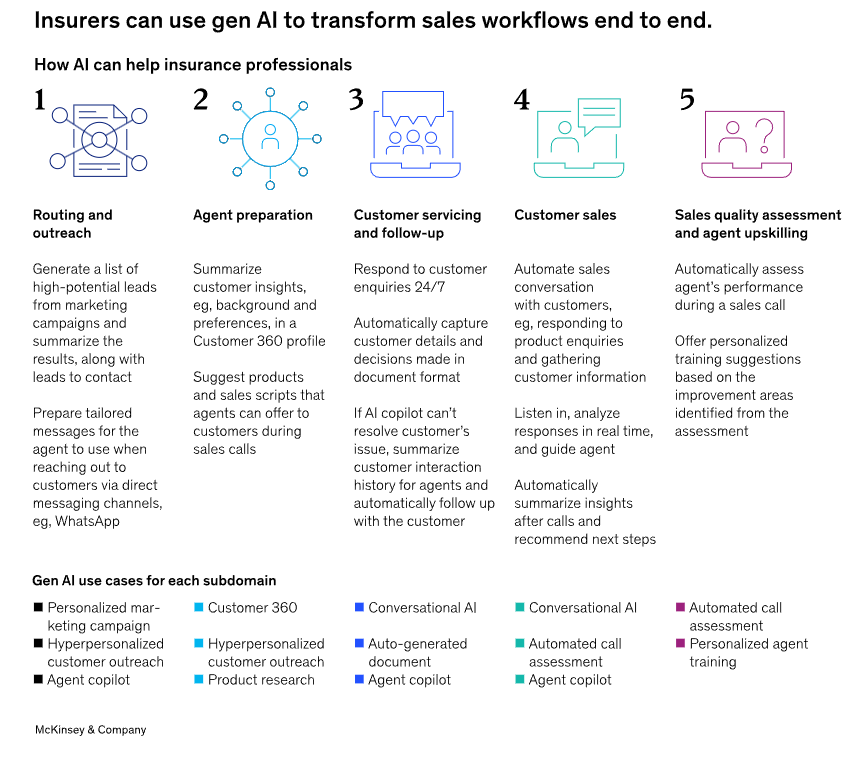
For enterprise insurers, AI adoption should include human oversight, access controls, auditability, model monitoring, data protection, and clear escalation paths.
Cybersecurity, privacy, and AI governance
Digital transformation increases an insurer’s dependence on cloud platforms, APIs, data, AI, and third-party technologies. Transformation programs should therefore address:
- Data encryption
- Identity and access management
- API security
- Cloud security
- Data privacy
- Third-party risk
- AI bias
- Explainability
- Model monitoring
- Auditability
- Operational resilience
In Singapore, insurers are subject to MAS technology-risk requirements. In Malaysia, technology risk, operational resilience, AI, and digital insurance/takaful are also important components of the evolving regulatory environment. Technology modernization and governance should be designed together, not sequentially.
Major challenges of digital transformation in insurance
Legacy systems remain one of the biggest barriers to digital transformation in insurance. McKinsey’s 2025 analysis identifies core-system modernization as one of the most pressing challenges for P&C insurers, linking outdated platforms to operational inefficiencies, rising IT maintenance costs, and slower delivery of digital experiences. The problem extends beyond maintenance. Deloitte’s 2026 insurance outlook notes that outdated systems and fragmented data can limit insurers’ ability to scale AI, making legacy modernization and data foundations strategic priorities.
|
Challenge |
What it means for Insurers | Recommended approach |
| Legacy systems & technical debt | Aging core platforms increase maintenance costs and make it difficult to adopt cloud, AI, APIs, and modern applications. |
Use phased modernization, API decoupling, and the Strangler Fig Pattern instead of high-risk big-bang replacement. |
|
Data silos & poor data quality |
Customer, policy, claims, and risk data may be distributed across disconnected systems, limiting analytics and AI. | Build a governed data foundation with standardized data models, integration, and clear data ownership. |
| Integration complexity | New digital channels and AI solutions must work with policy administration, claims, billing, CRM, and external ecosystem platforms. |
Adopt API-first integration and modular architecture. |
|
Cybersecurity & privacy |
Cloud, APIs, AI, and connected devices increase the attack surface and the volume of sensitive customer data being processed. | Embed security, privacy, identity management, monitoring, and risk controls into the architecture. |
| AI governance & model risk | AI-generated or automated decisions can introduce bias, explainability, accuracy, and accountability risks. |
Establish model governance, human oversight, audit trails, testing, and continuous monitoring. |
|
Regulatory complexity |
Insurance technology must comply with evolving requirements around data protection, outsourcing, cybersecurity, and AI. | Design compliance requirements into technology architecture and transformation processes from the beginning. |
| Skills & organizational resistance | Insurers may lack cloud, data, AI, and modern engineering capabilities while employees may resist changes to established workflows. |
Combine technology modernization with upskilling, change management, and access to specialized engineering capabilities. |
|
Transformation cost & ROI |
Large modernization programs require significant investment and may take years to deliver measurable business value. | Prioritize high-value use cases, establish measurable KPIs, pilot first, and scale proven solutions progressively. |
| Business continuity | Core insurance systems support critical processes such as claims, underwriting, and policy administration, leaving little tolerance for disruption. |
Use incremental migration, parallel operations, automated testing, and controlled releases. |
Do not assume that replacing every legacy system is the right strategy. For many insurers, incremental modernization reduces operational risk while enabling faster delivery of new capabilities.
Digital transformation strategy for insurance companies
A successful insurance transformation strategy connects business priorities with technology, data, people, and governance. Rather than pursuing every emerging technology at once, insurers should prioritize initiatives that deliver measurable value, reduce operational risk, and create a foundation for future innovation.
|
Step |
Transformation activity | What it involves |
| 1 | Define business objectives |
Set measurable outcomes, such as reducing claims processing time or improving digital conversion. |
|
2 |
Assess digital maturity | Evaluate applications, data, cloud, integration, cybersecurity, AI readiness, and customer experience. |
| 3 | Prioritize use cases |
Rank initiatives according to business value, feasibility, complexity, data readiness, and risk. |
|
4 |
Build the data foundation | Establish data integration, quality, governance, security, and analytics capabilities. |
| 5 | Modernize the architecture |
Introduce cloud, APIs, modular applications, automation, and DevOps where they create measurable value. |
|
6 |
Pilot high-value initiatives | Start with controlled use cases such as claims automation or AI-assisted underwriting. |
| 7 | Establish governance |
Define architecture, cybersecurity, data, AI, vendor, and operational controls. |
|
8 |
Scale what works |
Integrate successful pilots into enterprise platforms and extend them across business functions. |
Explore the case study of insurance digital transformation from Kyanon Digital here: Accelerating Singapore Digital Insurance App Launch Readiness with an AI-Driven Agile Team
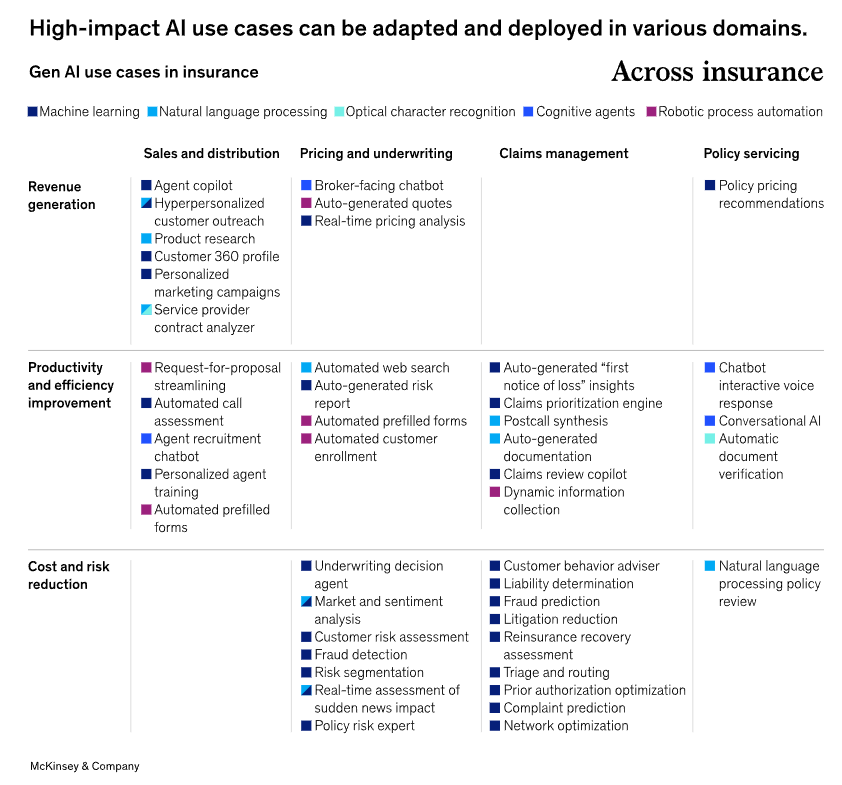
High-value digital transformation use cases for insurance
Insurance companies can prioritize transformation initiatives that directly improve underwriting, claims, customer experience, operational efficiency, and risk management.
|
Use Case |
How It Works | Business Impact |
| AI-powered underwriting | AI analyzes customer, policy, behavioral, and external data to support risk assessment and underwriting decisions. |
Faster underwriting, improved risk segmentation, and higher underwriter productivity |
|
Automated claims processing |
Digital FNOL, document extraction, AI-assisted validation, claims triage, and workflow automation streamline the claims journey. | Shorter claims cycles, lower processing costs, and better customer experience |
| AI-powered fraud detection | Machine learning identifies unusual claims patterns, behaviors, and transactions for further investigation. |
Earlier fraud detection and reduced claims leakage |
|
Digital customer service |
AI assistants, chatbots, portals, and self-service tools provide 24/7 support for common customer needs. | Faster response times and reduced service workload |
| Personalized insurance products | Customer and behavioral data are analyzed to tailor coverage, pricing, offers, and communications. |
Higher conversion, engagement, and retention |
|
Predictive risk management |
AI, analytics, IoT, and external data help identify risks before they result in losses. | Proactive risk mitigation and improved loss ratios |
| Embedded insurance | APIs integrate insurance products directly into banking, travel, automotive, e-commerce, and other digital journeys. |
New distribution channels and lower customer acquisition friction |
|
Digital sales & distribution |
Online quoting, digital onboarding, e-signatures, automated eligibility checks, and omnichannel journeys digitize the sales process. | Faster conversion and lower acquisition costs |
| Intelligent document processing | AI extracts and classifies information from applications, policies, medical documents, invoices, and claims files. |
Less manual data entry and faster processing |
|
Agent & broker productivity |
AI copilots provide agents and brokers with policy information, customer insights, recommendations, and automated administrative support. |
Higher productivity and more time for customer-facing activities |
Where insurers should start:
- For enterprise insurers, the highest-value transformation opportunities typically combine high transaction volumes, repetitive processes, and measurable customer or operational impact.
- Insurers should prioritize claims, underwriting, customer service, fraud detection, distribution, and predictive risk management based on business value, implementation feasibility, and strategic importance.
- These use cases should be supported by an integrated technology foundation covering legacy modernization, cloud, APIs, data platforms, AI, and workflow automation, rather than implemented as isolated initiatives.
Digital transformation KPIs for insurance
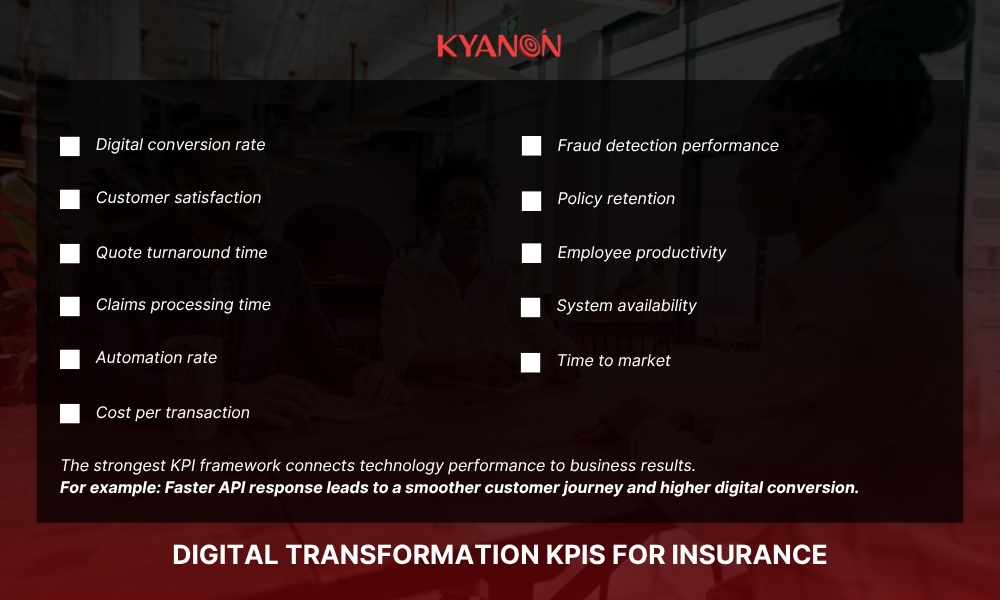
Transformation should be measured through business outcomes. Key KPIs include:
- Digital conversion rate: Percentage of customers completing purchases through digital channels
- Customer satisfaction: Customer satisfaction with digital products and services
- Quote turnaround time: Time required to generate an insurance quote
- Claims processing time: Time from claim submission to resolution
- Automation rate: Percentage of processes completed with limited manual intervention
- Cost per transaction: Average cost of processing a policy, claim, or service request
- Fraud detection performance: Accuracy and effectiveness of fraud identification
- Policy retention: Percentage of customers who renew their policies
- Employee productivity: Output or transactions handled per employee
- System availability: Percentage of time critical digital systems remain operational
- Time to market: Time required to launch new products, features, or digital services
The strongest KPI framework connects technology performance to business results. For example: Faster API response leads to a smoother customer journey and higher digital conversion.
Future of digital transformation in insurance
The next phase of insurance transformation will be defined by five major trends:
- AI-native operations: AI becomes embedded into everyday underwriting, claims, service, and operational workflows.
- Agentic AI: AI systems increasingly coordinate multi-step processes under controlled permissions.
- Real-time insurance: IoT, telematics, and APIs enable insurance decisions based on more current risk information.
- Predict-and-prevent models: Insurers increasingly use data to help customers prevent losses rather than only compensate for them.
- Intelligent ecosystems: APIs connect insurers with banks, healthcare providers, automotive companies, brokers, retailers, and technology platforms.
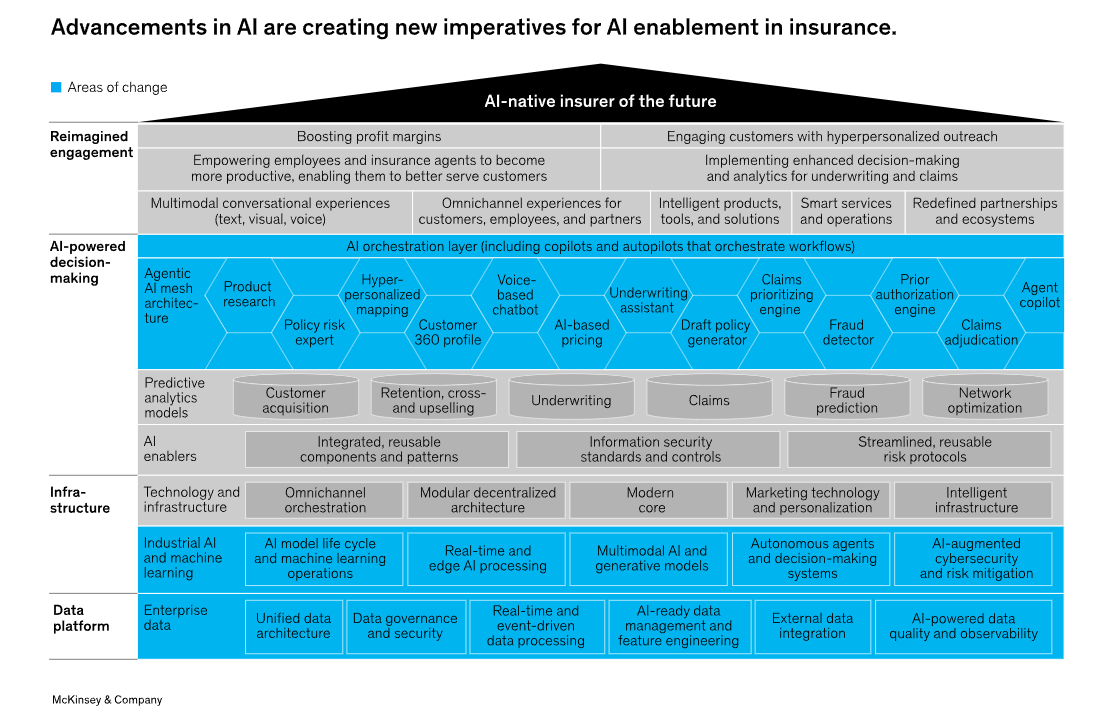
The strategic direction is moving from reactive, transaction-based insurance toward connected, data-driven, and increasingly proactive insurance models.
What insurance leaders should prioritize in 2026
Digital transformation in insurance is no longer optional. 80% of insurance executives surveyed by Concentrix in 2025 said digital transformation is essential for survival. For enterprise insurers, the most important priorities are:
- Modernize critical legacy systems progressively.
- Build a governed data foundation before scaling AI.
- Automate high-volume processes such as claims and underwriting.
- Use AI where business value can be measured.
- Connect digital channels with core insurance platforms.
- Adopt API-led architecture for ecosystem integration.
- Strengthen cybersecurity and operational resilience.
- Establish responsible AI governance.
- Measure transformation through business outcomes.
- Work with technology partners that can execute, not only advise.
The right partner does not simply recommend what to build. It helps your organization build, integrate, modernize, and scale it.
Conclusion: Turning insurance transformation into business value
Digital transformation of insurance industry operations requires more than adopting individual technologies. Enterprise insurers need a practical roadmap connecting legacy modernization, cloud, data, AI, integration, automation, and digital customer experience.
Kyanon Digital helps enterprise organizations assess, modernize, build, integrate, and scale digital technology capabilities through digital consulting, software engineering, cloud, data & AI, application modernization, and dedicated engineering teams.
If your organization is evaluating an insurance transformation initiative, talk to Kyanon Digital about your technology roadmap.


















 Create project brief with AI