

AI is changing how Australian businesses use data, moving business analytics beyond periodic reporting toward predictive insights, real-time decision-making, and greater automation. But as AI adoption grows, how can enterprises turn expanding data volumes into measurable business value without creating new governance, skills, and integration challenges?
“The core currency of any business going forward will be the ability to reason over its data using AI to drive competitive advantage.”
— Satya Nadella, CEO, Microsoft
For Australian enterprises, this shift means using AI not simply to analyze more data, but to turn data into faster decisions and more actionable insights. This is particularly relevant across industries where timely decisions can directly affect customer experience, operational efficiency, revenue, and risk.
This guide explores how AI is transforming business analytics across financial services, mining, retail, agriculture, and healthcare, covering key use cases, business benefits, implementation challenges, and emerging trends. Read on to understand the capabilities, foundations, and governance considerations Australian leaders need to scale AI analytics effectively.
Key takeaways
- AI is shifting analytics from reporting to action. Businesses can forecast demand, spot risks, and respond to changes earlier.
- Five applications are reshaping business analytics. Predictive analytics, real-time decision-making, customer intelligence, analytics automation, and risk management are driving the shift.
- AI adoption varies across Australian industries. Financial services lead in fraud detection and customer intelligence, while mining, retail, agriculture, and healthcare focus on forecasting and operations.
- AI works best with connected business data. Combining customer, transaction, operational, and equipment data gives teams better visibility for decision-making.
- Scaling AI requires more than technology. Data quality, skills, privacy, integration, and clear business outcomes determine whether AI can deliver value at scale.
Further reading:
- Exploratory Data Analytics: From Raw Data to Business Insights
- AI-Driven Retail Analytics: From Data to Decisions
- 7 Retail Analytics Decisions That Impact Revenue Most
The rise of AI in enterprise business analytics
AI is changing business analytics because organizations now need to make decisions faster while managing growing volumes of customer, operational, and market data. Traditional reporting can explain what happened, but businesses increasingly need to understand what may happen next and decide how to respond.
AI-powered analytics helps businesses move from looking backward to planning ahead. By analyzing more data and identifying patterns earlier, it can support better forecasting, faster decisions, and more responsive operations.
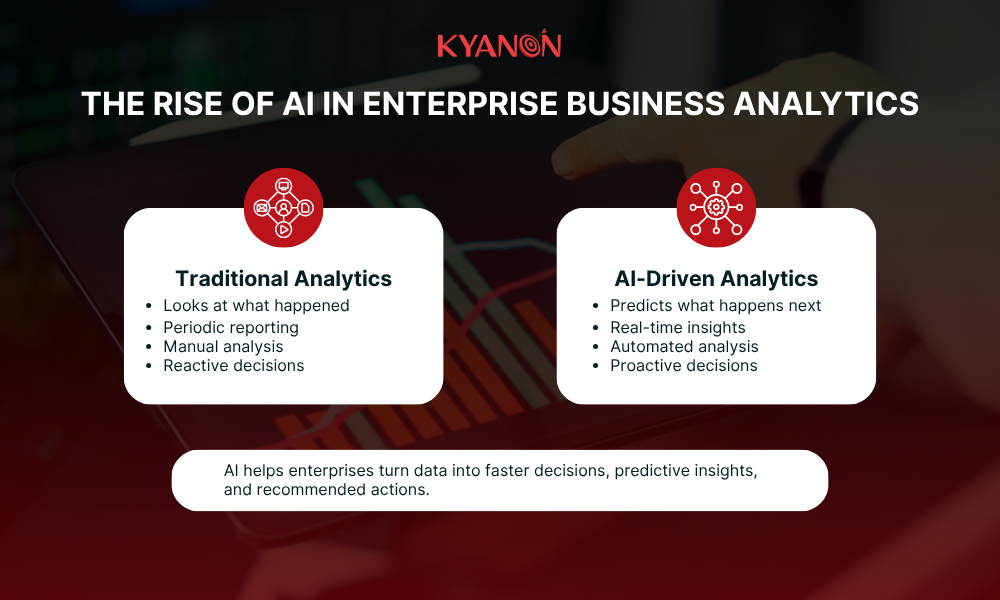
From reporting what happened to planning what comes next
Traditional dashboards are useful for tracking past performance, but they often leave leaders with a simple question: what should we do next?
AI-powered analytics can help answer that question by combining historical information with current business signals. Businesses can use these insights to anticipate demand, identify emerging risks, understand changing customer behavior, and adjust operations earlier.
This shift is important because adopting AI is not the same as making AI useful across the business. McKinsey found that 86% of leaders feel their organizations are not prepared to adopt AI in day-to-day operations. The challenge is therefore moving beyond AI experiments and connecting AI to the decisions and processes that affect business performance.
AI adoption is growing across Australia
Australia’s AI adoption is accelerating, but progress varies significantly across industries. According to the latest 2026 AI Enterprise Data, average corporate AI investment has reached AU$35.5 million per organization, with Financial and Professional Services leading in the adoption of automated workflows. By comparison, industries such as Mining and Logistics are taking a more measured approach, prioritizing data governance and infrastructure readiness.
These differences reflect each sector’s unique priorities. Financial institutions may focus on fraud detection and customer intelligence, while mining companies may prioritize equipment performance and operational planning.
For enterprise leaders, the priority is not simply adopting AI, but identifying where better use of data can improve decisions, customer experiences, operations, or risk management, and building the capabilities to scale that value.

Key ways AI is transforming business analytics
AI analytics can help businesses turn data into actions that support day-to-day decisions. Instead of using data only to review past performance, organizations can use it to forecast demand, respond to changes, understand customers, automate routine work, and identify risks earlier.
The value depends on how well these capabilities connect to real business needs. The most useful applications are those that help teams make better decisions, improve customer experiences, reduce manual effort, or respond to risks before they become larger problems.
Predictive analytics for business decision-making
Businesses often make decisions based on what has already happened, even when demand and market conditions are changing. AI analytics help them look ahead. By using historical performance alongside current business information, AI analytics can help forecast demand, sales, equipment issues, and other changes that may affect business performance.
This gives leaders more time to adjust inventory, staffing, capacity, or maintenance before a problem becomes costly.
Common applications include:
- Forecasting customer demand
- Predicting sales performance
- Optimizing inventory levels
- Anticipating equipment failures
- Forecasting market trends
- Assessing financial and credit risks
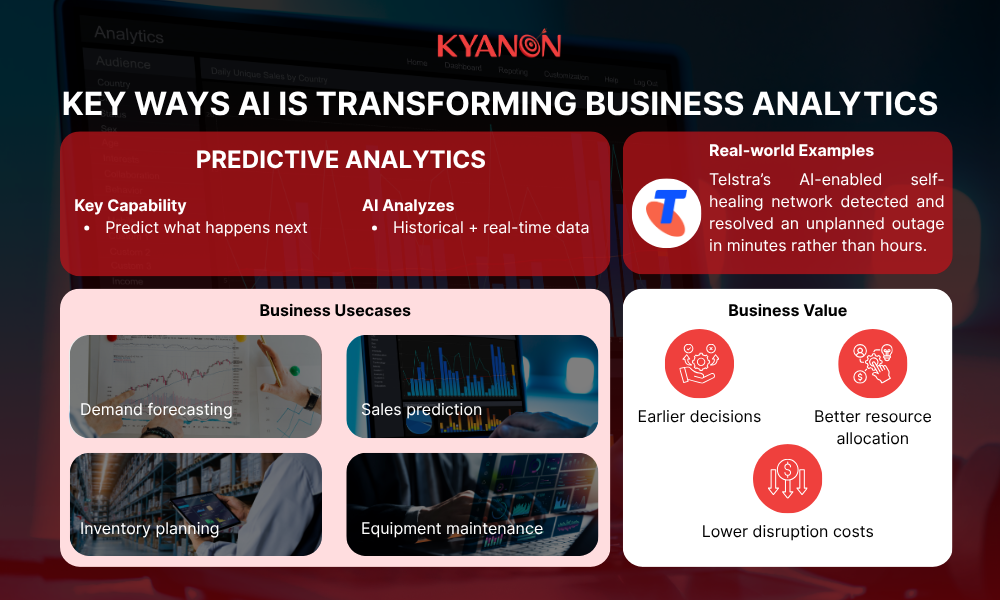
The value is not simply having a more advanced forecast. It is having more time to act on the information. A retailer can adjust inventory before demand changes, while a manufacturer can plan maintenance before equipment problems disrupt production.
Telstra provides an example of this approach. Its AI-enabled self-healing network capability can detect and resolve certain infrastructure issues in minutes rather than hours. For businesses, responding to infrastructure issues faster can reduce disruption and help maintain more reliable services.
Real-time analytics for faster decision-making
Scheduled reports can provide a useful view of business performance, but they may not be enough when conditions change quickly. When an issue develops between reporting cycles, teams may only see it after it has already affected customers, operations, or revenue.
When teams have access to information as it changes, AI analytics can help them identify important changes and respond before they have a larger impact. This gives businesses more time to address risks, adjust operations, or act on emerging opportunities.
Common applications include:
- Detecting suspicious financial transactions
- Monitoring supply chain disruptions
- Adjusting pricing based on demand
- Prioritizing customer service requests
- Identifying operational issues
- Responding to changing customer behavior
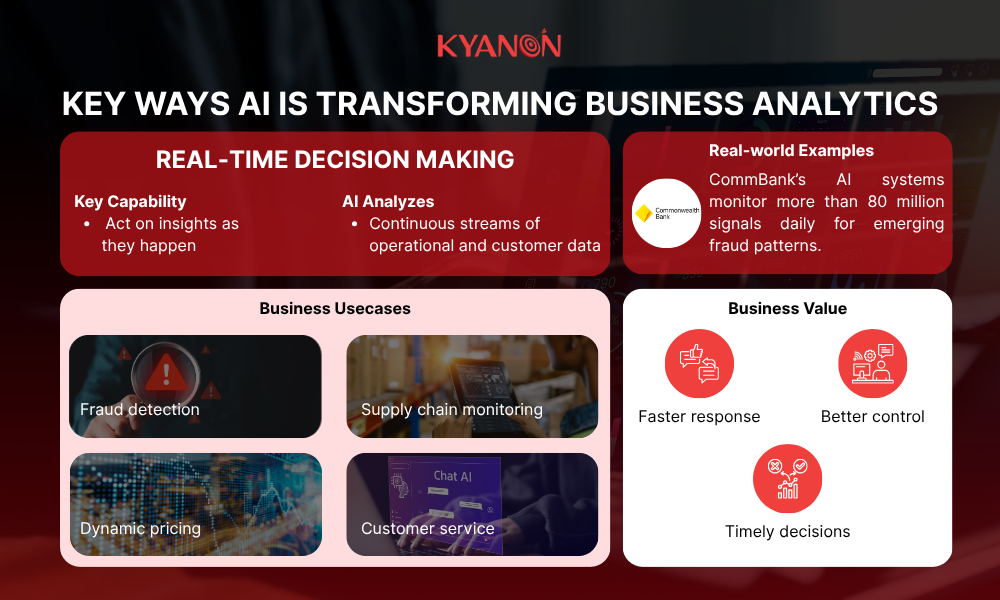
The value is not simply having more real-time data. It is being able to act sooner. When teams can see an issue while it is still developing, they have more opportunity to limit its impact or take advantage of an emerging opportunity.
Commonwealth Bank provides an example in financial services. According to CommBank, its fraud protection capabilities monitor more than 80 million signals each day across transactions, payments, and digital banking channels. The bank also uses an AI agent to identify emerging fraud patterns and propose new detection rules, which human fraud analytics teams review before implementation.
The example shows how AI and human judgment can work together. For businesses beyond financial services, the same approach can support faster responses to operational issues, customer needs, and changing market conditions before they have a larger impact.
AI-powered customer analytics and personalization
Customer information is often spread across different channels, making it difficult for businesses to build a complete view of customer needs and behavior. When teams cannot connect these signals, they may miss changes in customer preferences, service needs, or opportunities to strengthen relationships.
Once this information is connected, businesses can get a clearer view of customer needs and respond to changes more quickly. AI analytics can help identify patterns across different customer interactions.
AI can help connect and analyze data from:
- Online purchases
- Website and app activity
- Customer service interactions
- Social channels
- Loyalty programs
- Transaction history
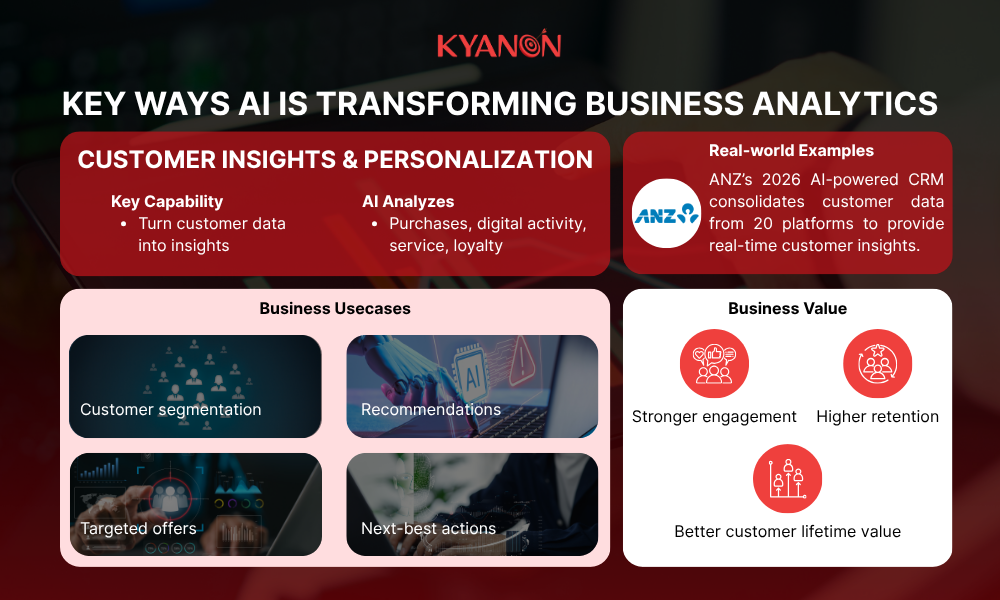
By looking at these signals together, businesses can better understand customer preferences, identify changes in behavior, and determine which products, services, or offers may be more relevant. A retailer, for example, can respond to changes in purchasing behavior with more relevant recommendations, while a bank can use customer activity to identify services that may better match a customer’s needs.
ANZ provides an example in business banking. The bank consolidated customer information from 20 platforms into one dashboard, giving bankers a more complete view of customer relationships. Its AI capabilities then help summarize accounts, identify opportunities, and prioritize activities.
The value is not simply having more customer data. It is being able to turn that data into better customer decisions. For Australian enterprises, stronger customer intelligence can support more relevant experiences, better service, higher retention, and greater customer value.
Automating data analytics with AI
Analytics teams can spend significant time preparing data, producing recurring reports, updating dashboards, and checking routine changes. As data volumes grow, this repetitive work can take more time away from analysis and business decision-making.
AI can automate parts of these activities, helping teams handle routine analytics work more efficiently and spend more time on issues that require human judgment.
Common applications include:
- Data cleaning and transformation
- Report generation
- Dashboard updates
- Trend identification
- Anomaly detection
- Performance monitoring
- Data summarization
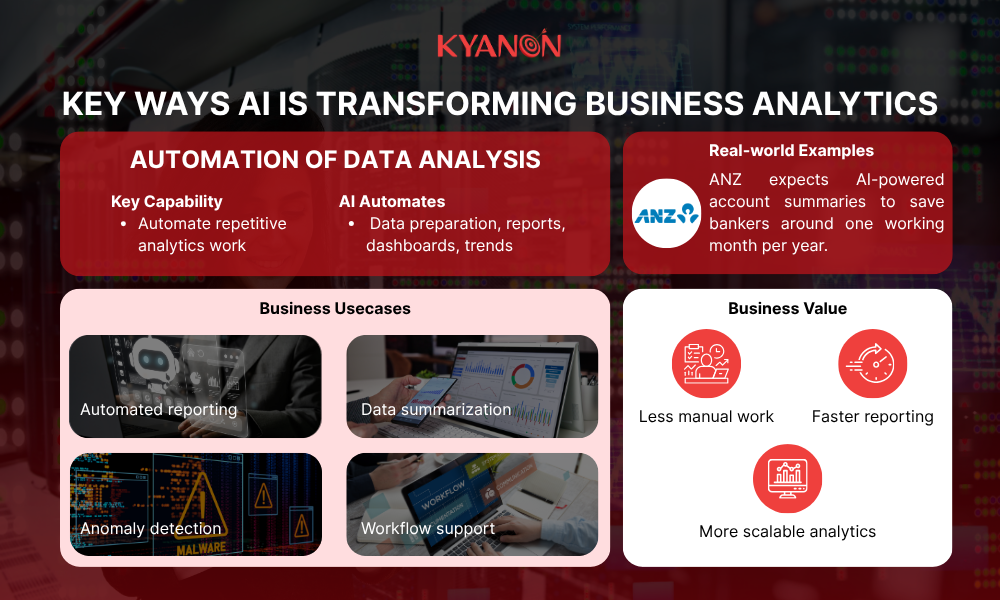
The value is not simply producing reports faster. It is reducing repetitive work so teams can focus more on understanding business problems, making recommendations, and acting on insights.
ANZ’s 2026 CRM transformation illustrates this potential. By bringing information from 20 platforms into one dashboard and using AI to organize information and generate account summaries, the bank expects the account-summary capability alone to save bankers the equivalent of around one working month each year.
For other enterprises, the same principle can apply across reporting and analytics operations. Automating routine work can help teams handle growing data volumes more efficiently while giving analysts and business leaders more time for higher-value decisions.
AI analytics for enterprise risk management
Businesses often rely on rules, periodic reviews, and manual monitoring to manage risk. This can make it difficult to spot new or changing risks early, especially when businesses handle large volumes of transactions and operational activity.
AI analytics can continuously review business activity and identify unusual patterns that may require attention. This gives teams an additional way to spot potential problems while they are still developing.
AI can help businesses:
- Detect unusual transaction patterns
- Identify potential fraud
- Flag compliance risks
- Monitor cybersecurity threats
- Predict equipment maintenance needs
- Identify emerging operational issues
- Detect changes in customer or market behavior
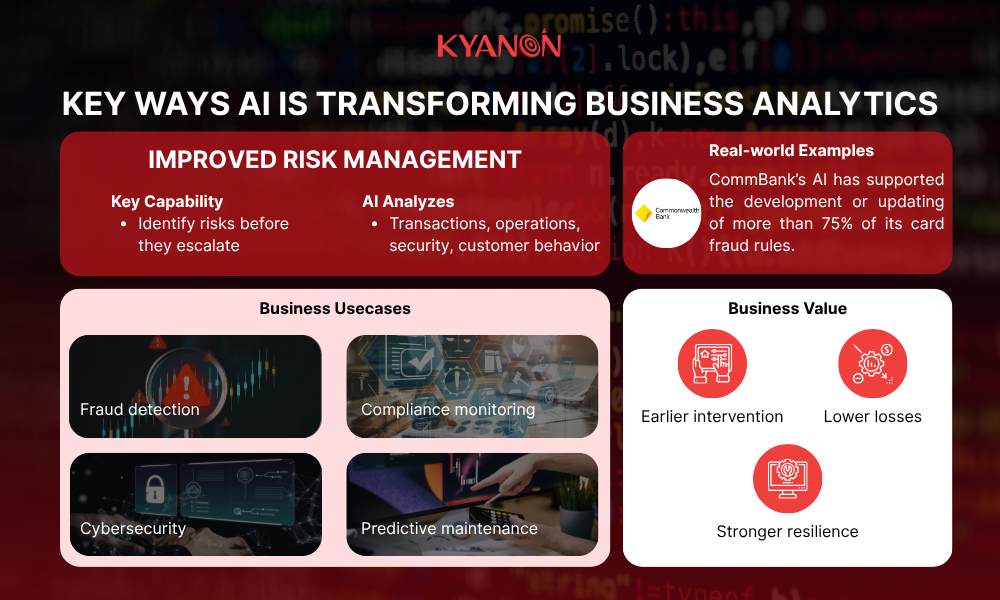
The value is not simply monitoring more activity. It is gaining earlier visibility into potential problems. When businesses identify a risk sooner, teams have more time to investigate, respond, and reduce its impact.
CommBank‘s 2026 fraud initiative demonstrates this approach. Its AI agent identifies emerging fraud and scam patterns and proposes new detection rules, while human fraud analytics teams review and approve those rules before implementation. CommBank reported that customer fraud losses fell by more than 20% in the first half of FY2026 compared with the same period a year earlier.
For Australian enterprises, the same principle can extend beyond financial fraud. Earlier visibility into operational, financial, security, and customer risks can give teams more time to take action before those risks become larger business problems.
AI business analytics applications in Australia
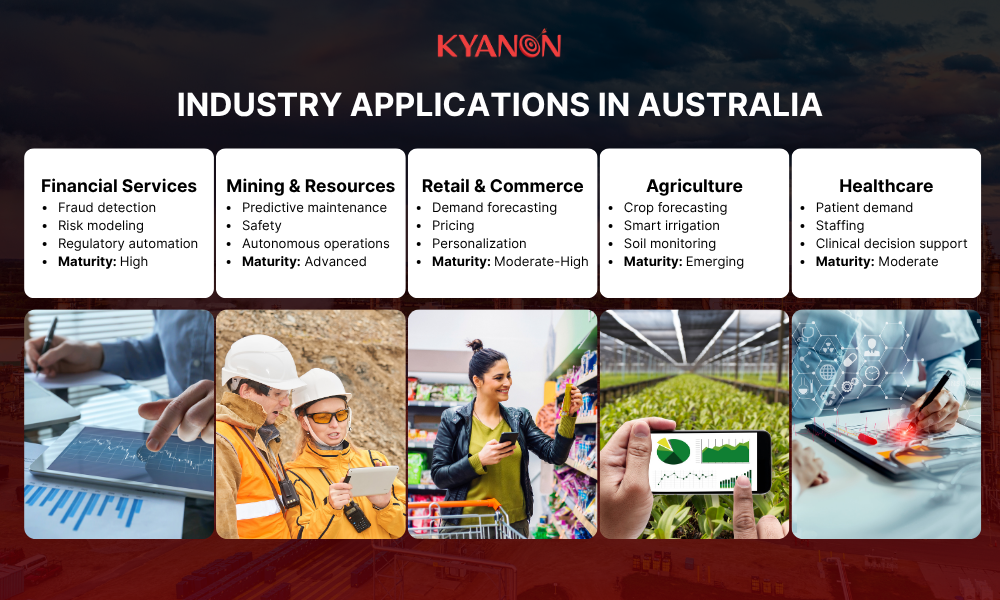
AI is not transforming every Australian industry in the same way. Adoption patterns vary based on data availability, operational complexity, regulatory requirements, and the cost of disruption. Financial services and resources are among the more mature adopters, while retail, agriculture, and healthcare are expanding AI use across forecasting, automation, and decision support.
Financial services and banking leadership
Australia’s financial institutions are among the country’s most advanced adopters of AI and data analytics. Banks increasingly use machine learning for transaction processing, credit risk assessment, fraud detection, and regulatory reporting, helping improve operational efficiency and risk management.
Commonwealth Bank of Australia (CBA) illustrates how AI can be applied at enterprise scale. The bank has invested heavily in cybersecurity and fraud prevention, using an advanced agentic system integrated with its cloud infrastructure and Snowflake data platform.
CBA also uses AI to analyze more than 20 million payments daily, identifying unusual patterns and strengthening fraud detection. This approach contributed to a more than 20% reduction in customer fraud losses during the first half of FY2026 compared with the same period a year earlier, as reported by CommBank.
Beyond fraud prevention, AI is also being applied to improve internal productivity and streamline financial workflows. CommBank reported a 46% productivity gain in its software engineering division through generative AI tools. Meanwhile, Australian banks are adopting document intelligence to streamline loan underwriting and mortgage processing, reducing manual effort and accelerating decision-making.
Mining, resources, and heavy industry
The Australian mining and resources sector operates complex, capital-intensive equipment in remote geographical locations where unplanned machinery downtime carries extreme financial costs. Resource conglomerates integrate predictive maintenance analytics into heavy haulage fleets, processing plants, and rail transport networks to identify mechanical fatigue prior to functional failure.
AI and advanced analytics are increasingly being applied across mine site safety, autonomous equipment, predictive maintenance, fleet scheduling, and environmental monitoring. By combining equipment data, operational signals, and predictive models, resource companies can identify potential failures earlier, improve asset utilization, and reduce unplanned downtime.
These analytical breakthroughs are actively applied across mine site safety monitoring, autonomous haulage fleet scheduling, and environmental impact tracking. By transitioning from fixed calendar maintenance to condition-based predictive maintenance, Australian industrial operators extend equipment lifecycles and reduce operating expenditures.
Retail, agriculture, and supply chain modernization
In the retail sector, shifting consumer demand patterns and volatile supply chains require precise coordination between consumer signals and inventory distribution. Australian retailers deploy machine learning frameworks to synthesize e-commerce data, regional demographic shifts, and local weather forecasts to help optimize stock levels and reduce the risk of stockouts and excess inventory.
In agriculture, AI and data analytics are supporting precision farming through satellite imagery, IoT soil sensors, weather data, and predictive models. These technologies can help producers optimize planting schedules, irrigation, fertilizer use, and resource allocation while responding more effectively to changing environmental conditions.
In healthcare, predictive analytics can support operational planning by helping organizations forecast demand, allocate resources, and identify patterns in patient and service data. These applications can improve capacity planning and resource management while supporting more data-driven decisions.
Benefits of AI-powered business analytics
AI-powered analytics helps organizations turn large volumes of data into faster decisions, more accurate forecasts, and measurable business outcomes. Its value extends across customer experience, operations, revenue growth, and risk management.
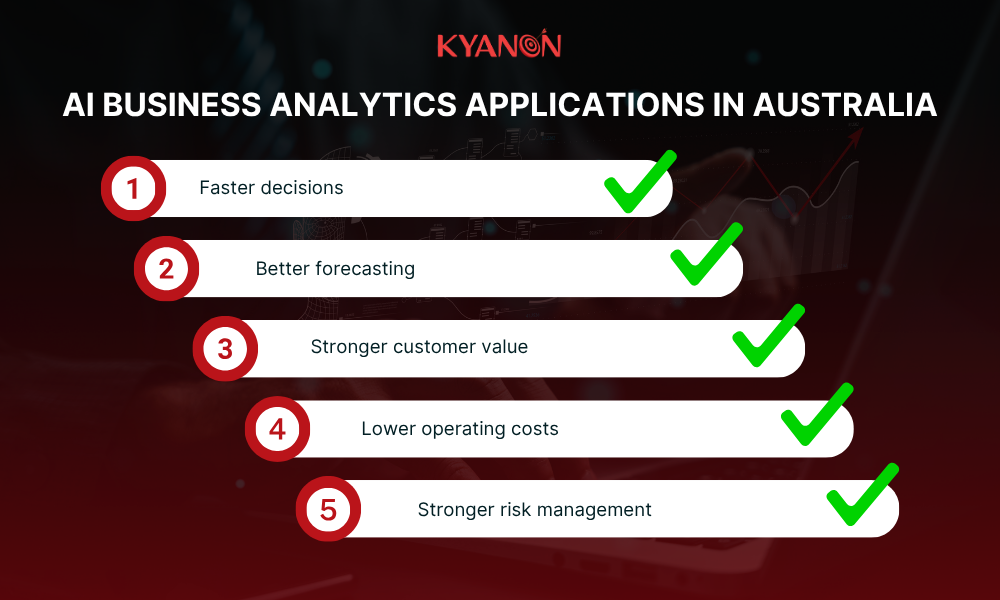
- Faster decision-making: AI can analyze large volumes of data in near real time, helping teams identify trends, anomalies, and emerging issues faster and act on current business conditions.
- Higher operational efficiency: Automating repetitive analysis and operational tasks reduces manual work while improving resource allocation, inventory planning, workflow management, and overall productivity.
- Better forecasting: AI can combine historical data with current business signals to support better forecasts and planning.
- Better customer experiences: By analyzing purchase history, browsing behavior, and customer interactions, AI can support more relevant recommendations, promotions, and personalized customer journeys.
- Reduced operational costs: Predictive analytics can identify inefficiencies, demand changes, and potential disruptions earlier, helping organizations reduce waste, optimize resources, and control operating costs.
- Increased revenue opportunities: Customer insights, personalization, demand forecasting, and churn prediction can help businesses improve retention, identify new opportunities, and increase customer value.
- Enhanced risk management: AI-powered monitoring can detect unusual transactions, operational anomalies, security threats, and potential compliance issues earlier, enabling faster intervention and reducing potential losses.
- Greater competitive advantage: By combining faster decisions, stronger forecasting, lower costs, and better customer experiences, AI analytics helps organizations respond more effectively to changing market conditions and compete more effectively.
These benefits make AI-powered business analytics more than a reporting tool. When supported by reliable data, skilled teams, and the right technology infrastructure, AI analytics can become a strategic capability that improves operational performance, strengthens customer relationships, and supports sustainable business growth.
Business analytics implementation challenges
Despite its advantages, implementing AI in business analytics presents several challenges. For Australian enterprises, successful adoption depends not only on selecting the right AI tools, but also on the quality of underlying data, availability of skilled talent, responsible data governance, and compatibility with existing technology environments.
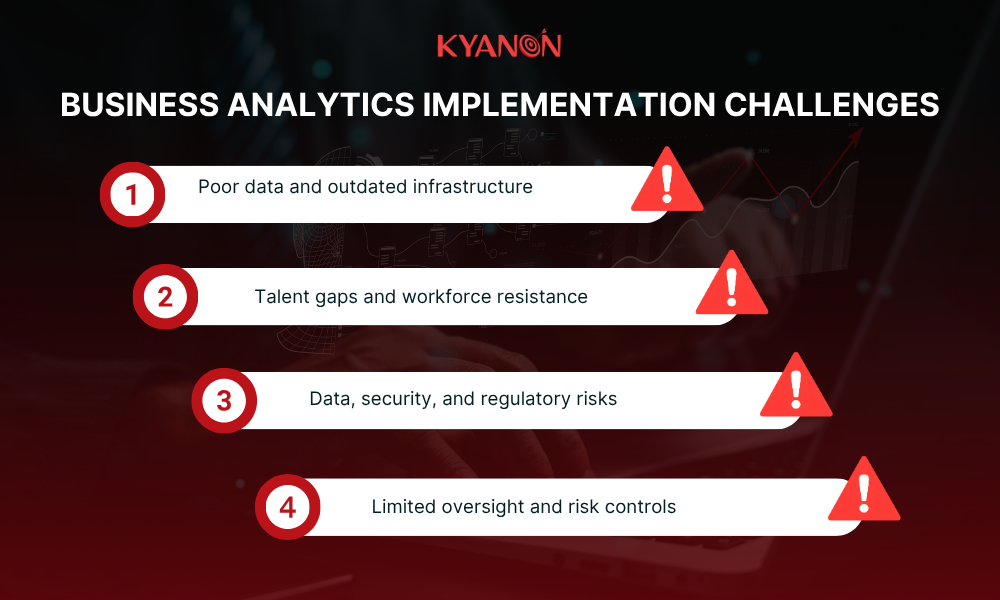
- Data quality: AI is only as useful as the business data behind it. If customer, sales, inventory, or operational data is incomplete or inconsistent, leaders may receive insights they cannot confidently act on.
- Skills gap: Businesses need people who can connect AI capabilities with real business problems. Technical skills matter, but adoption also depends on whether employees understand how AI should fit into their daily work.
- Privacy and security: AI often works with sensitive customer and business information. Leaders therefore need clear rules for how data is collected, accessed, shared, and used.
- Integration with existing systems: AI rarely operates on its own. It needs to work with the systems teams already use, such as CRM, ERP, finance, customer service, and operational platforms. Poor integration can slow adoption and make a promising AI initiative difficult to scale.
Together, these challenges show that AI adoption is as much an enterprise transformation effort as a technology deployment. Addressing data foundations, workforce capabilities, privacy controls, and system integration early can help organizations move beyond isolated AI pilots and build analytics capabilities that deliver measurable business value at scale.
The future of AI analytics in Australia
AI analytics is moving beyond dashboards and reporting toward tools that help businesses understand data, make decisions, and take action. For Australian businesses, the next stage is less about adopting every new AI capability and more about preparing to use AI where it can create measurable business value.
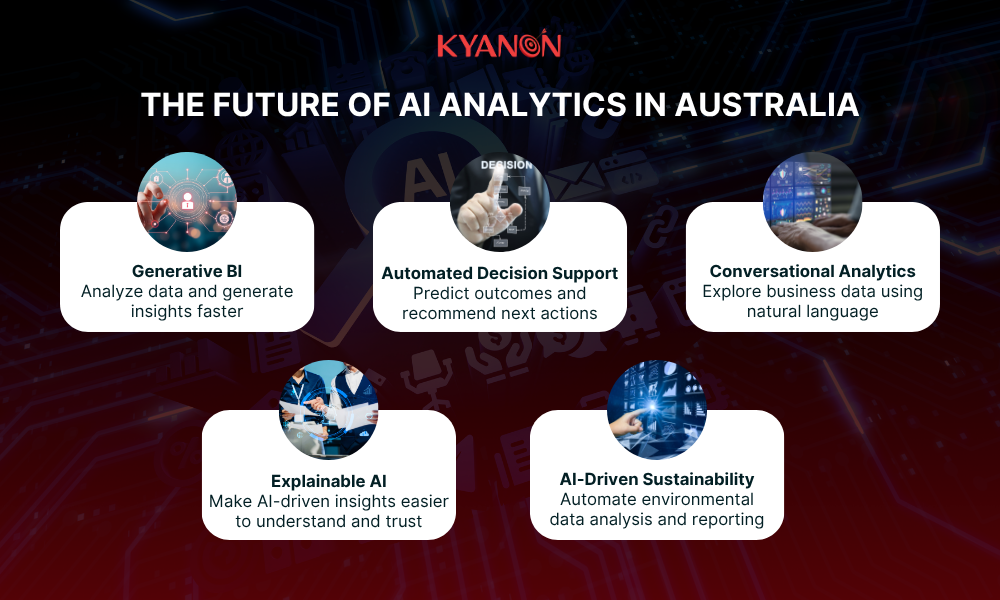
Emerging trends in AI analytics:
- Generative AI for business intelligence can help teams analyze data, generate reports, and surface insights faster.
- Automated decision support can help businesses identify patterns, forecast outcomes, and recommend actions based on large datasets.
- Conversational analytics allows business users to explore data and ask questions using natural language, reducing reliance on technical teams.
- Explainable AI helps organizations understand how AI-driven insights and recommendations are generated, supporting greater transparency and trust.
- AI-driven sustainability reporting can automate the analysis of operational and environmental data, helping businesses track performance and reporting requirements.
These changes mean leaders should prepare for analytics to become a more active part of how the business operates. This includes making reliable data easier to access, helping teams use AI effectively, and defining where human oversight is needed.
The priority should not be adopting every new AI capability. Leaders should focus on the business decisions and processes where better use of data can create the most value, then build the data, people, and capabilities needed to scale those use cases.
The businesses best positioned for the next stage of AI analytics will not necessarily be those using the most AI tools. They will be those that can connect reliable data and AI-supported decisions to measurable outcomes in customer experience, operations, revenue, and risk management.
Case study: How Kyanon Digital built an AI-driven BI & data warehouse for a leading retail corporation
This project demonstrates how centralized data warehousing and business intelligence can help large retailers eliminate manual reporting, improve data consistency, and gain real-time visibility into store performance.
Kyanon Digital partnered with a leading Vietnamese retail and trading corporation operating 193+ stores nationwide to build an automated reporting ecosystem powered by a centralized Data Warehouse and Microsoft Power BI.
The challenge:
The retailer relied on manual reporting, fragmented data sources, and inconsistent reporting formats, making data reconciliation time-consuming and limiting leadership visibility into real-time store performance.
The solution:
Kyanon Digital implemented an enterprise reporting platform featuring:
- Centralized data management: Standardized store reports and consolidated data into a centralized Data Warehouse.
- Automated report submission: Replaced manual and paper-based processes with standardized digital reporting workflows.
- Automated approval workflows: Digitized multi-level review, approval, notifications, and status tracking.
- Real-time BI dashboards: Integrated Microsoft Power BI to visualize store KPIs, trends, and performance across regions and product categories.
The impact:
- Higher reporting efficiency: Reduced manual work, follow-ups, and reporting errors.
- Better data consistency: Standardized reporting across nearly 200 retail locations and reduced reconciliation effort.
- Faster decision-making: Real-time Power BI dashboards gave leadership greater visibility into store performance and operational trends.
- Scalable analytics foundation: Centralized data and integrated workflows created a stronger foundation for future analytics and business growth.
This case demonstrates that effective AI-driven business analytics starts with strong data foundations. By centralizing enterprise data and automating reporting workflows, retailers can move from manual, retrospective reporting toward faster, more actionable business intelligence.
Read more: AI-Driven BI & Data Warehouse For A Leading Retail Corporation
In conclusion
Business analytics in Australia is moving toward more real-time, predictive, and automated models of decision support.
However, technology alone does not guarantee success. The real difference between market leaders and lagging companies comes down to four essentials:
- Data hygiene: Ensuring high-quality, reliable data assets.
- Workforce enablement: Upskilling teams to adopt new tools.
- AI governance: Setting clear policies for safe tech execution.
- Zero-trust security: Protecting sensitive operational data.
For executive leaders, the question is no longer simply whether AI can be deployed. The bigger question is whether it can solve a meaningful business problem, fit existing operations, and deliver measurable value at scale.
The right partner should therefore bring more than AI capabilities. They should understand the business context, customer journey, operational processes, data, and outcomes that the organization is trying to achieve.
Ready to evaluate your analytics maturity and build a high-impact data strategy?
Contact Kyanon Digital today to schedule an executive briefing or start your Data Enablement Sprint!



 Create project brief with AI