

A digital transformation roadmap is a phased plan that helps enterprises align business priorities, technology investments, and organizational capabilities with measurable outcomes. It guides decisions on what to modernize, integrate, or automate based on business value and implementation readiness. Kyanon Digital helps enterprises translate these priorities into actionable roadmaps that address technical dependencies, operational risks, and long-term scalability. For business leaders, the challenge is no longer simply adopting new technologies. It is deciding where to invest first, what to retain or replace, and how to justify transformation spending without disrupting existing operations.
As enterprises evaluate AI agents, automation, cloud modernization, and connected customer experiences, fragmented data, legacy systems, and uncertain ROI can make investment decisions increasingly complex.
So, how can enterprises build a digital transformation roadmap that balances business value, implementation feasibility, and long-term scalability? This guide breaks down the key phases, decision frameworks, and practical examples to help leaders prioritize investments, manage transformation risks, and move from strategy to execution with confidence.
Key takeaways
- Start with business priorities, not technology. Identify measurable operational challenges before deciding what to modernize, integrate, or replace.
- Prioritize investments by value and readiness. Evaluate technical dependencies, total cost of ownership, expected ROI, and implementation risks before allocating budgets.
- Validate before scaling. Start with focused pilots, measure business outcomes against baseline KPIs, and expand only when results justify further investment.
- Build a reliable foundation for AI. Address data quality, system integration, governance, and workforce readiness before deploying AI and automation at scale.
- Connect strategy with execution. Kyanon Digital recommends assessing existing architecture and integration opportunities before committing to major platform replacements, helping enterprises align transformation priorities with technical feasibility and long-term scalability.
Further reading:
- Custom Retail Platforms for Enterprise Operations
- How Do You Build an Enterprise AI ROI Framework in Singapore?
- AI-Driven Retail Analytics: From Data to Decisions
- What Are the Top 5 CX Tech Investments for Singapore Retailers?
What is a digital transformation roadmap?
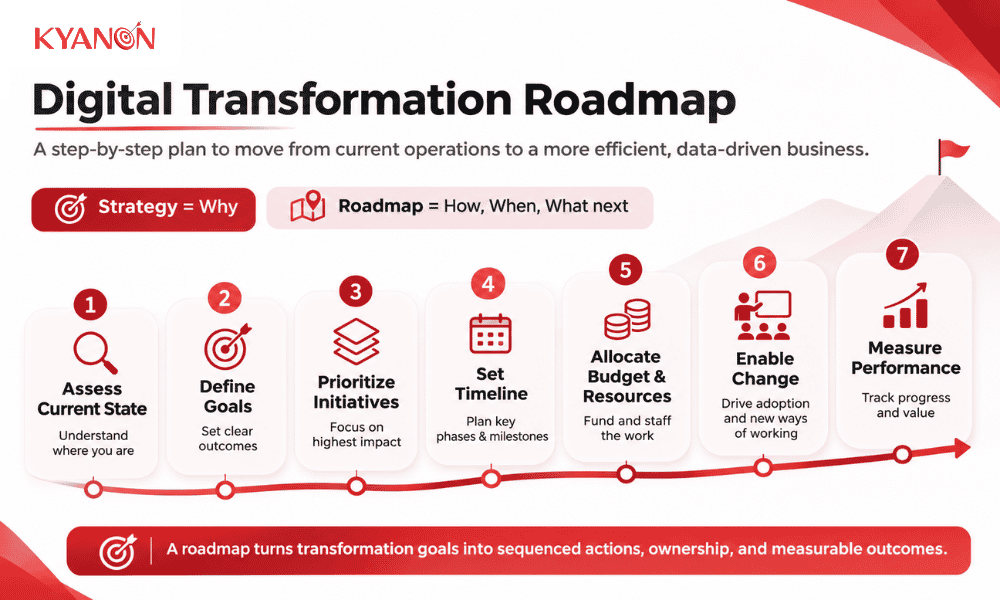
A digital transformation roadmap is a strategic, step-by-step plan that guides an organization from its current operating model toward a more efficient, data-driven, and digitally connected business. It translates high-level transformation goals into prioritized initiatives, timelines, budgets, responsibilities, and measurable outcomes.
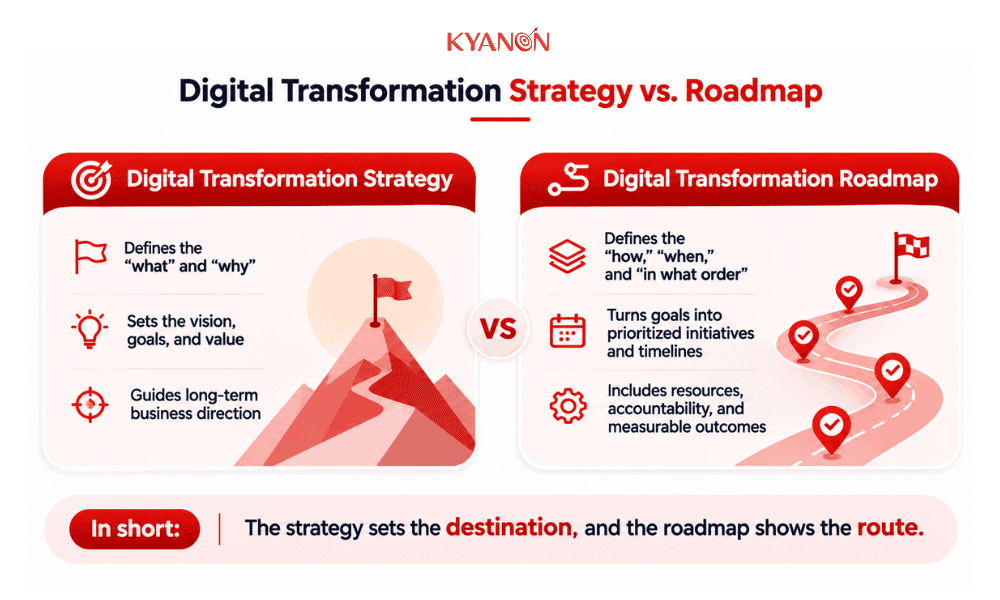
Unlike a digital transformation strategy, which defines what the business wants to achieve and why, a roadmap establishes how, when, and in what order those objectives should be executed.
What should a digital transformation roadmap include?
An effective enterprise digital transformation roadmap should cover seven core components:
|
Core component |
What it includes |
Key business decision |
|
Current-state assessment |
Existing systems, workflows, data maturity, workforce capabilities, and technical debt | What needs improvement, integration, or replacement? |
| Business vision and goals | Strategic priorities, target outcomes, and measurable KPIs |
Which initiatives support the greatest business value? |
|
Prioritized initiatives |
Sequenced projects based on value, feasibility, dependencies, and risk | What should be implemented first or postponed? |
| Timeline and milestones | Implementation phases, delivery checkpoints, and decision gates |
When is the organization ready to move forward? |
|
Budget and resources |
Implementation costs, ongoing maintenance, internal capabilities, and external support | Is the investment financially and operationally viable? |
| Change management | Leadership accountability, employee training, adoption, and communication |
Can teams adopt and sustain the changes? |
|
Performance measurement |
Baseline KPIs, success thresholds, and ROI evaluation |
Should the initiative be scaled, adjusted, or discontinued? |
For enterprise decision-makers, the roadmap’s value lies in making investment trade-offs explicit before committing resources.
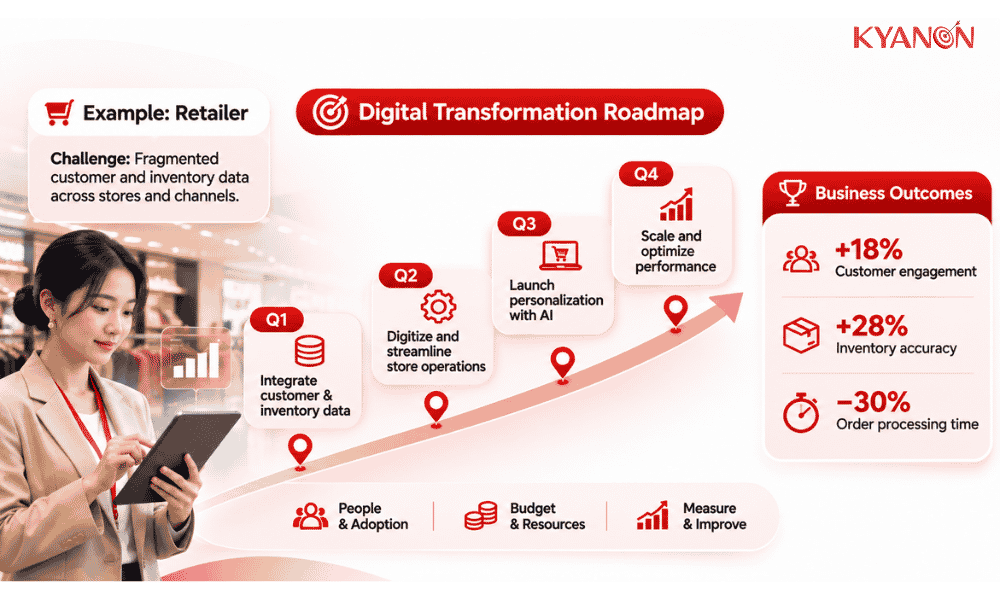
For example, a retailer facing fragmented customer and inventory data may need to prioritize system integration before investing in AI-driven personalization. Similarly, a manufacturer experiencing production delays should evaluate process redesign and existing ERP capabilities before approving a complete system replacement.
A well-structured roadmap helps leadership balance strategic value, technical readiness, total cost of ownership (TCO), security requirements, and workforce adoption. It also reduces the risk of disconnected technology investments, vendor lock-in, and transformation initiatives that fail to deliver measurable business outcomes.

What are the key phases of a digital transformation roadmap?
A successful digital transformation roadmap follows five phases, helping enterprises prioritize investments, validate technical readiness, and minimize implementation risks before scaling.
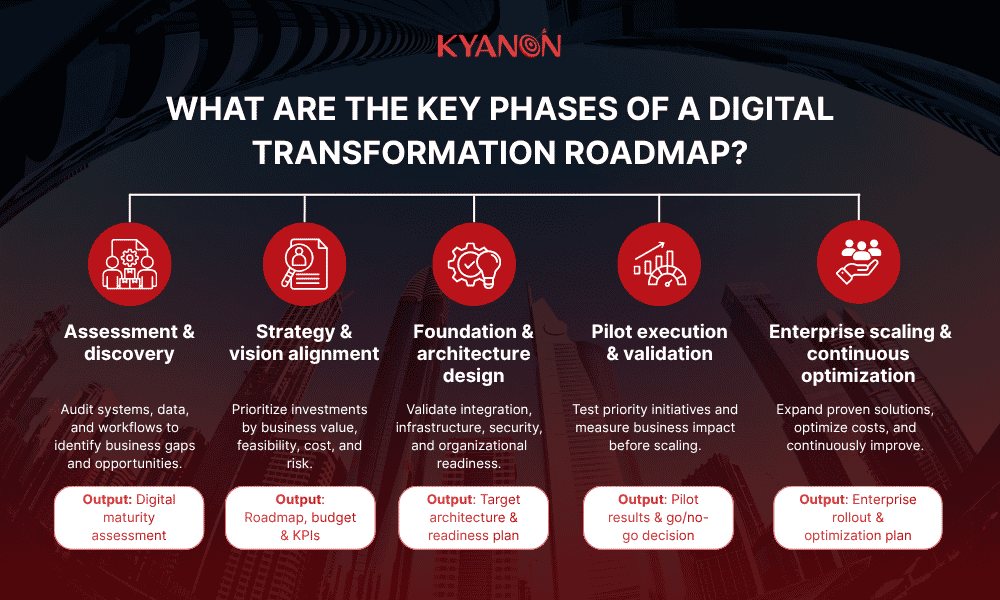
Phase 1: Assessment & discovery
Identify business challenges and evaluate existing technology, data quality, and organizational readiness.
- Audit legacy systems, integration gaps, and inefficient workflows.
- Identify high-impact opportunities and current capability limitations.
Output: Digital maturity assessment and prioritized business challenges.
Phase 2: Strategy & vision alignment
Define measurable business objectives and decide which initiatives deserve investment.
- Prioritize projects by business value, feasibility, cost, and risk.
- Establish KPIs, budgets, executive ownership, and implementation priorities.
Output: Prioritized roadmap and investment plan.
Phase 3: Foundation & architecture design
Validate whether existing systems and infrastructure can support the proposed transformation.
- Assess ERP, CRM, cloud, and data integration requirements.
- Address security, governance, and workforce readiness.
Output: Target architecture and implementation readiness plan.
Phase 4: Pilot execution & validation
Test high-priority initiatives before committing to enterprise-wide deployment.
- Launch a controlled pilot with clear performance targets.
- Measure business impact, user adoption, costs, and operational risks.
Output: Validated pilot results and a scale, revise, or stop decision.
Phase 5: Enterprise scaling & continuous optimization
Expand successful initiatives while maintaining operational stability and long-term value.
- Roll out validated solutions across relevant business functions.
- Monitor KPIs, optimize costs, and modernize legacy systems where justified.
Output: Enterprise rollout and continuous improvement plan.
For enterprises facing complex integration dependencies or uncertain investment priorities, Kyanon Digital’s End-to-End Digital Transformation services connect strategic roadmapping with architecture assessment, integration planning, and phased implementation, helping businesses evaluate feasibility and manage risks before scaling.
What are the best practices for successful digital transformation?
Successful digital transformation requires more than adopting new technologies. Enterprises must align investments with business outcomes, prepare employees for change, and implement initiatives through measurable, manageable phases. The following best practices help business leaders reduce implementation risks and make more informed investment decisions.
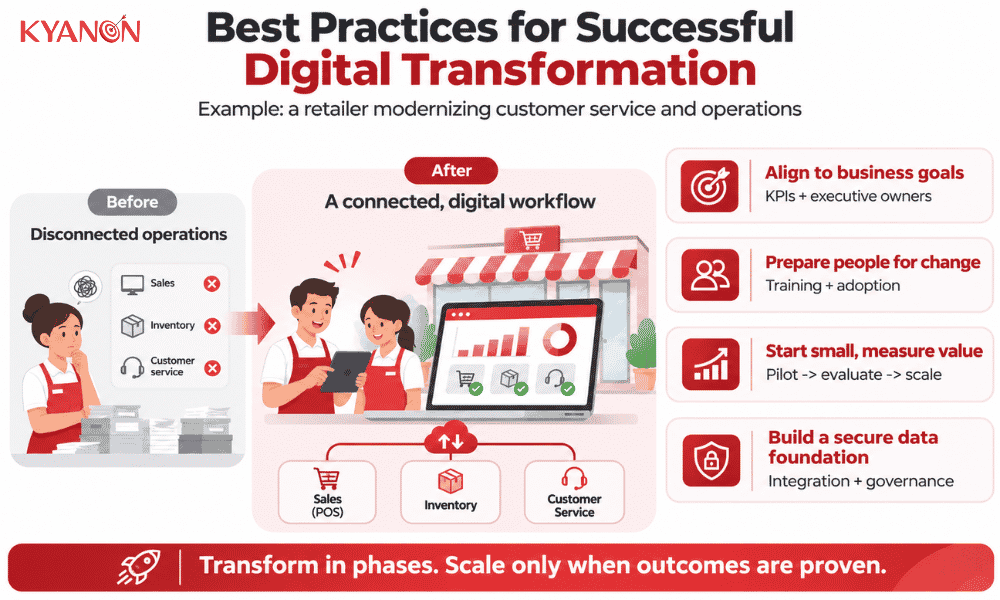
Align digital initiatives with business goals and leadership
Every transformation initiative should address a measurable business problem rather than follow emerging technology trends.
- Define business outcomes: Set clear KPIs, such as reducing operating costs, improving customer retention, or shortening processing time.
- Secure executive sponsorship: Involve leadership across IT, finance, operations, and business functions to align priorities and resources.
- Establish accountability: Assign business owners responsible for outcomes alongside technical teams responsible for implementation.
Prioritize people and change management
Even technically sound solutions can underperform if employees cannot effectively adopt them.
- Engage employees early: Involve operational teams in identifying workflow challenges and evaluating proposed changes.
- Invest in role-specific training: Equip employees with the skills needed to operate new systems and AI-enabled workflows.
- Manage organizational resistance: Communicate how transformation affects responsibilities, processes, and performance expectations.
Frameworks such as the Prosci ADKAR Model can help organizations structure individual change and adoption.
Implement in phases and measure business impact
Instead of pursuing large-scale transformation immediately, prioritize initiatives with clear business value and manageable implementation dependencies.
- Start with focused pilots: Validate solutions in selected workflows before committing to wider deployment.
- Evaluate total cost of ownership: Account for integration, customization, maintenance, training, and operational support, not just initial implementation costs.
- Measure actual outcomes: Track user adoption, operational efficiency, customer satisfaction, and financial performance against established baselines.
Scale initiatives only when their results justify further investment.
Build a secure, integrated technology and data foundation
Technology decisions should consider existing infrastructure, data readiness, and long-term scalability.
- Assess legacy systems: Determine whether optimization, integration, modernization, or replacement offers the best business fit.
- Strengthen data governance: Establish reliable data quality, ownership, and access controls before introducing advanced analytics or AI automation.
- Plan secure transitions: Incorporate cybersecurity, applicable regulatory requirements, integration testing, and rollback procedures into implementation plans.
What common mistakes should businesses avoid?
A roadmap becomes ineffective when initiatives are approved without a clear relationship to business outcomes or implementation readiness.
| Common mistake | Business consequence |
Recommended response |
|
Prioritizing technology trends |
Investment without a defined business case | Establish measurable business objectives |
| Replacing systems prematurely | Higher migration cost and disruption |
Compare optimization, integration, modernization, and replacement |
|
Ignoring data readiness |
Unreliable analytics and automation | Resolve ownership, quality, and access issues |
| Underestimating change management | Low adoption and process workarounds |
Involve operational teams early |
|
Scaling pilots without evidence |
Recurring costs without demonstrated value |
Use outcome-based expansion criteria |
One particularly important decision is when not to proceed. If a business cannot identify the owner of a critical process, establish a reliable performance baseline, or access the data required for a proposed AI initiative, resolving those prerequisites may be more valuable than deploying another platform.
Digital transformation roadmap example: How Kyanon Digital modernized a leading retail group in Thailand
How Kyanon Digital modernized a leading retail group in Thailand
A leading retail group in Thailand partnered with Kyanon Digital to modernize its fragmented eCommerce ecosystem and connect physical stores with digital sales channels. The business needed to improve inventory visibility, order fulfillment, and scalability while maintaining existing operations.
Challenges
- Legacy commerce platforms lacked the flexibility to support growing transaction volumes and marketplace integrations.
- Disconnected inventory, pricing, promotions, and order systems limited operational visibility.
- Fragmented fulfillment workflows complicated coordination across stores, warehouses, and online channels.
Solution from Kyanon Digital
Kyanon Digital developed an integrated commerce platform built around a microservices architecture and centralized operational engine. The project illustrates how a digital transformation roadmap can connect business priorities with technical implementation:
| Roadmap phase | Kyanon Digital’s approach |
Business decision addressed |
|
Assessment |
Identified legacy limitations and fragmented omnichannel operations | What needs modernization? |
| Strategy | Developed a core operational engine roadmap covering inventory, pricing, promotions, and orders |
Which capabilities should be prioritized? |
|
Architecture |
Designed microservices and integrated legacy systems with digital channels | How can systems scale without losing operational continuity? |
| Implementation | Delivered a mobile ordering application and connected commerce platforms through APIs |
How can online and offline operations work together? |
|
Scaling |
Enabled centralized operations across stores, websites, mobile applications, and marketplaces |
Can the platform support increasing transaction volumes? |
Results and impact
According to Kyanon Digital’s published case study, the transformation delivered:
- 26,000+ SKUs managed across six digital sales channels.
- Real-time inventory management across nine physical stores.
- 8,000+ orders processed daily without system interruptions.
- 99% of offline promotions transitioned into online campaigns.
The case demonstrates why enterprise transformation should prioritize a connected operational foundation before expanding digital capabilities. By modernizing its architecture and integrating existing systems, the retailer established shared inventory, order, and promotion capabilities across its commerce ecosystem.
Read the full case study: Integrated Commerce Platform for Thailand’s Largest Retail Group.
Why choose Kyanon Digital for digital transformation?
Kyanon Digital helps enterprises turn digital transformation strategies into actionable roadmaps, connecting business priorities with technology architecture, system integration, and measurable outcomes.
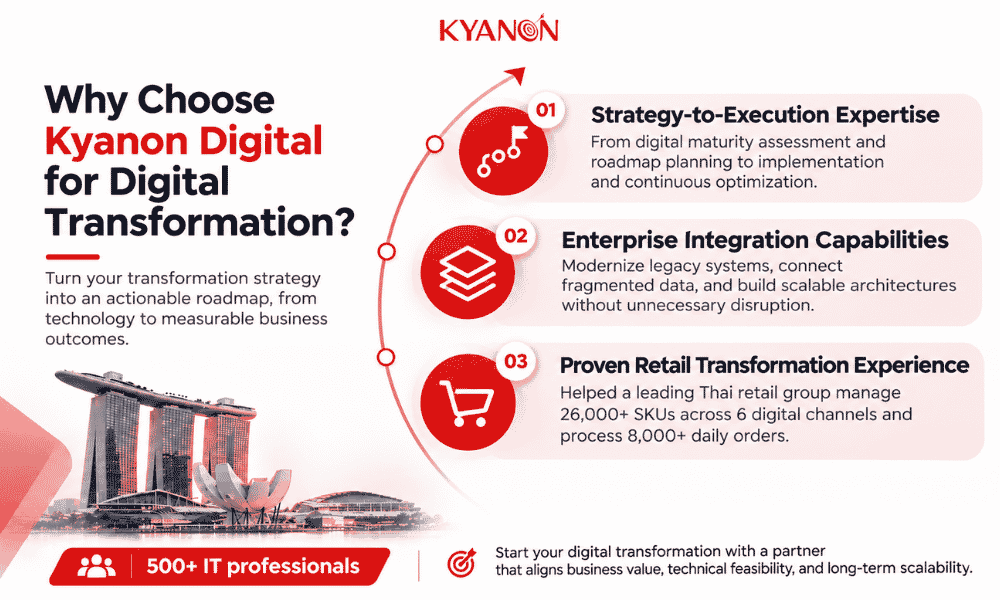
- Strategy-to-execution expertise: From digital maturity assessment and roadmap planning to implementation and continuous optimization.
- Enterprise integration capabilities: Modernize legacy systems, connect fragmented data, and build scalable architectures without unnecessary disruption.
- Proven retail transformation experience: Kyanon Digital helped a leading Thai retail group manage 26,000+ SKUs across six digital channels and process 8,000+ daily orders through an integrated commerce platform.
For organizations deciding where to invest first, Kyanon Digital’s End-to-End Digital Transformation services help align technical feasibility, business value, and long-term scalability.
How should enterprises get started with their digital transformation roadmap?
The first decision should be which business problem merits investment, not which technology appears most advanced. Begin by identifying one measurable constraint, the systems and teams involved, and the evidence required to improve it. Use those findings to determine whether the next step is process redesign, integration, modernization, or a controlled AI initiative.
Kyanon Digital supports enterprise digital transformation through strategic roadmapping, architecture assessment, data and system integration, process optimization, and implementation planning. Its approach connects business priorities with technical execution while accounting for existing enterprise environments.
If your organization is evaluating competing transformation initiatives, discuss your digital transformation roadmap with Kyanon Digital to examine your current architecture, investment priorities, dependencies, and a feasible first implementation scope.
References
- New Playbook Charts a Clear AI Transformation Path for Local Enterprises — Infocomm Media Development Authority (IMDA), May 2026.
- IBM Study: Chief AI Officers See Where AI Creates Value, but Few Control Investment Decisions — IBM Institute for Business Value, November 2026.
- Refreshed Industry Digital Plan to Support Retailers — IMDA and Enterprise Singapore, May 2026.
- End-to-End Digital Transformation — Kyanon Digital, official service documentation.








 Create project brief with AI