
What is Transaction Fee Optimization?
Transaction fee optimization is the strategic alignment of payment orchestration, dynamic routing, interchange management, and payment service provider (PSP) terms to minimize payment processing overhead in eCommerce. It ensures digital commerce platforms retain higher margins by evaluating card network rates, local payment methods, and authorization logic without disrupting checkout conversion.
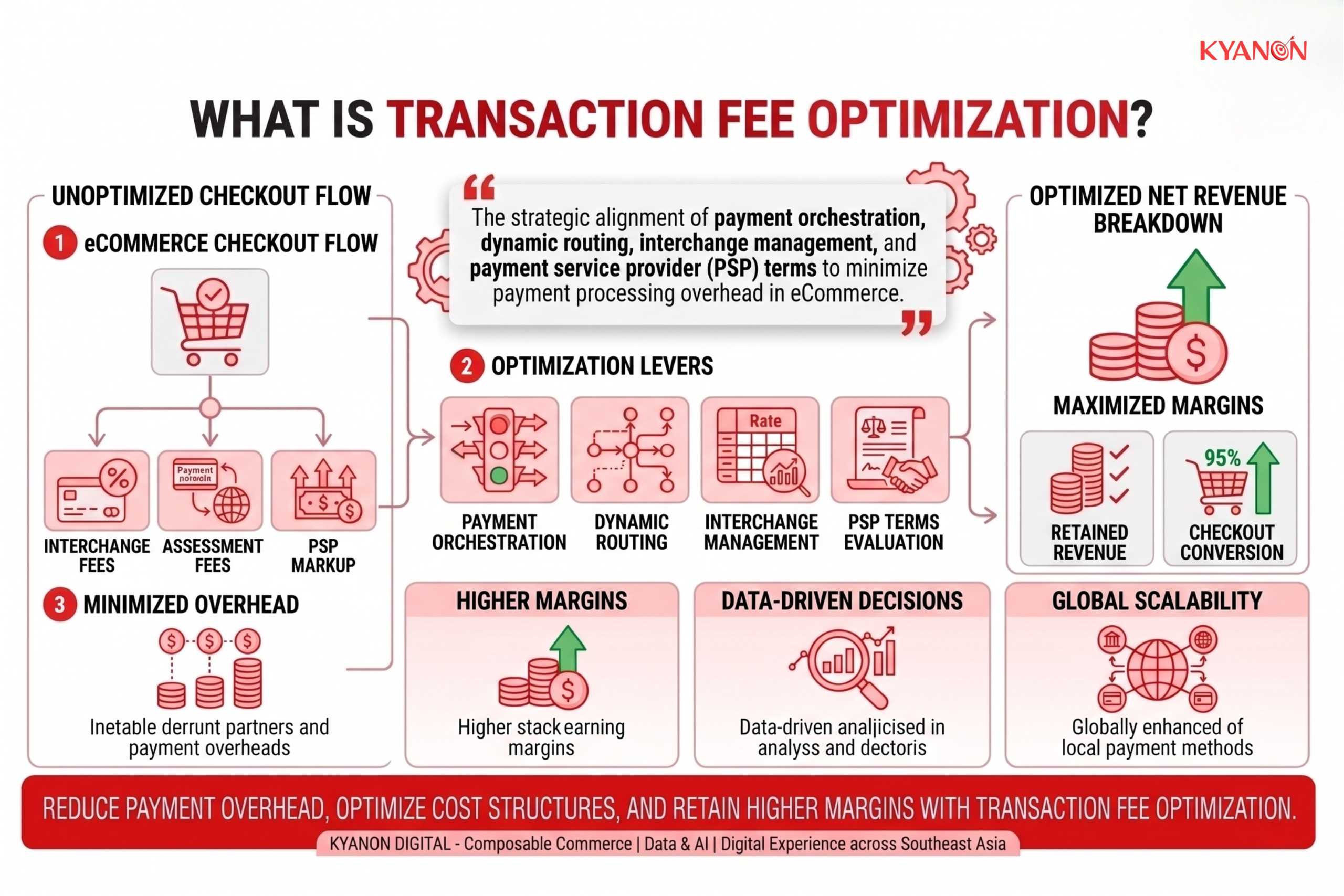
How Transaction Fee Optimization Works
Transaction fee optimization reduces payment costs by selecting the most cost-effective processing route for each transaction. Instead of relying on a single gateway with fixed rates, merchants can apply real-time decision logic based on transaction characteristics and processor performance.
Key factors can include:
- Card type and issuer: Different cards and issuing banks can carry different interchange and processing costs.
- Transaction value: Higher-value transactions may require different routing strategies to maintain cost efficiency.
- Customer location: Geographic routing can help merchants leverage lower-cost local acquiring and payment networks.
- Processing fees: Routing logic can prioritize providers with more favorable fee structures.
- Authorization performance: The lowest-cost route is not always the best route if it has a lower approval rate.

Dynamic Payment Routing
A dynamic routing engine evaluates each transaction in real time and selects the most suitable payment processor based on cost, location, payment method, and authorization performance.
- Routes transactions across multiple acquirers and PSPs
- Compares processing costs and authorization rates
- Applies predefined routing rules based on transaction conditions
- Automatically adjusts routing as processor performance changes
This allows merchants to balance lower transaction costs with higher payment approval rates, rather than optimizing for fees alone.
Interchange & Network Assessment Optimization
Interchange fees can vary depending on how transaction data is categorized and submitted. Providing complete and accurate transaction information can help merchants qualify for more favorable pricing tiers.
- Passes eligible Level 2 and Level 3 data
- Improves transaction data completeness and accuracy
- Applies the correct merchant and transaction classifications
- Helps reduce avoidable interchange and assessment costs across major card networks
The goal is to ensure each eligible transaction receives the most appropriate pricing treatment based on the available transaction data.
Local Payment Method Integration
Supporting local payment methods gives merchants more ways to process transactions without relying exclusively on international card networks. This becomes particularly valuable for retailers operating across multiple markets.
- Integrates regional wallets and payment methods
- Supports local bank transfers and debit schemes
- Routes customers toward preferred local payment options
- Reduces reliance on higher-cost cross-border card processing
- Helps lower payment surcharges while improving checkout flexibility
Together, these capabilities create a payment architecture that continuously balances cost, authorization success, and customer payment preferences.
Comparative Analysis: Transaction Fee Optimization vs. Legacy Single-Gateway Processing
The table below contrasts standard static payment setups with optimized multi-gateway payment orchestration:
Dimension | Legacy Single-Gateway Processing | Transaction Fee Optimization |
| Routing Flexibility | Static single path | Dynamic real-time least-cost routing |
Interchange Efficiency | Standard flat rates regardless of data | Qualified rates via data enrichment (Level 2/3) |
| Cross-Border Surcharges | High cross-border & FX markup fees | Local acquiring routing to eliminate cross-border tiers |
Margin Control | Passive payment processing costs | Active TCO reduction and authorization gains |
| Cost Structure | High CapEx/OpEx fixed margin drag | Optimized variable cost structure per channel |
When to Consider Transaction Fee Optimization
Consider Transaction Fee Optimization if:
- Your digital commerce engine operates across multiple regions or handles high transaction volumes where flat processing fees erode product margins.
- Your current payment configuration relies on a single merchant processor with rising non-qualified interchange fees or unoptimized cross-border surcharges.
- False authorization declines are driving up indirect transaction costs and customer acquisition loss.
It may not be the right priority if:
- Your platform is an early-stage MVP processing low monthly sales volume where flat-rate pricing models offer sufficient operational simplicity.
Why Transaction Fee Optimization Matters
Payment optimization is no longer just about reducing processing costs. As retail moves toward automated and agentic commerce, payment architecture increasingly influences revenue, conversion, and customer retention.
IBM shows that 76% of retail executives are transforming their business models to leverage automated, agentic AI systems. This shift is also changing how payments are managed, with leading retailers integrating loyalty, checkout, and backend payment orchestration into a more connected flow. By reducing fragmented systems and processes, merchants can streamline transactions while improving payment efficiency.
This becomes increasingly important as agentic commerce scales. McKinsey projects that by 2030, $3 trillion to $5 trillion in global B2C commerce revenue could flow through orchestrated commerce models, where AI assistants shop and transact on behalf of consumers. Merchants will need payment infrastructure that supports fast execution, low-friction checkouts, and localized payment rails across markets.

A smoother payment experience can also support customer growth. Gartner research shows that data-driven commerce companies using advanced checkout analytics are 23% more likely to acquire new customers and 19% more likely to retain them. This makes payment optimization a broader business priority, connecting transaction efficiency with conversion and customer value.
At the platform level, payment orchestration becomes a strategic lever for improving both cost efficiency and revenue performance, rather than simply a back-office optimization exercise.
Common Misconceptions
The Lowest Quoted Rate is the Cheapest
Merchants focus on headline percentage rates, missing non-qualified surcharges, cross-border penalties, and fixed authorization fees that inflate the effective cost. Evaluating processing agreements requires measuring the true effective rate after factoring in interchange tiers, batch fees, and network assessments.
Fees Only Occur on Successful Sales
Refunded or charged-back transactions often retain base processing fees or incur penalty costs, destroying margins on reversed orders. Unoptimized payment setups frequently absorb non-refundable processor markups even when the original sale amount is fully returned to the consumer.
All Payment Methods Cost the Same
Treating rewards credit cards, premium travel cards, and local debit options as identical ignores steep variations in underlying interchange. Processing a premium rewards card can cost twice as much in interchange fees compared to standard debit or direct bank transfer rails.
Optimization is a One-Time Fix
Negotiating a contract once fails because card networks routinely update baseline assessment rules and interchange fees bi-annually. Ongoing transaction fee management requires continuous data audits, routing updates, and monitoring of card scheme compliance guidelines.
Minimizing Failures Doesn’t Impact Net Fees
Forcing overly strict fraud filters to block suspicious transactions causes false declines that cost more in lost revenue than the averted fraud. Optimizing authorization rules ensures legitimate payments pass through low-cost routes without creating redundant penalty authorizations.
How Kyanon Digital Applies Transaction Fee Optimization
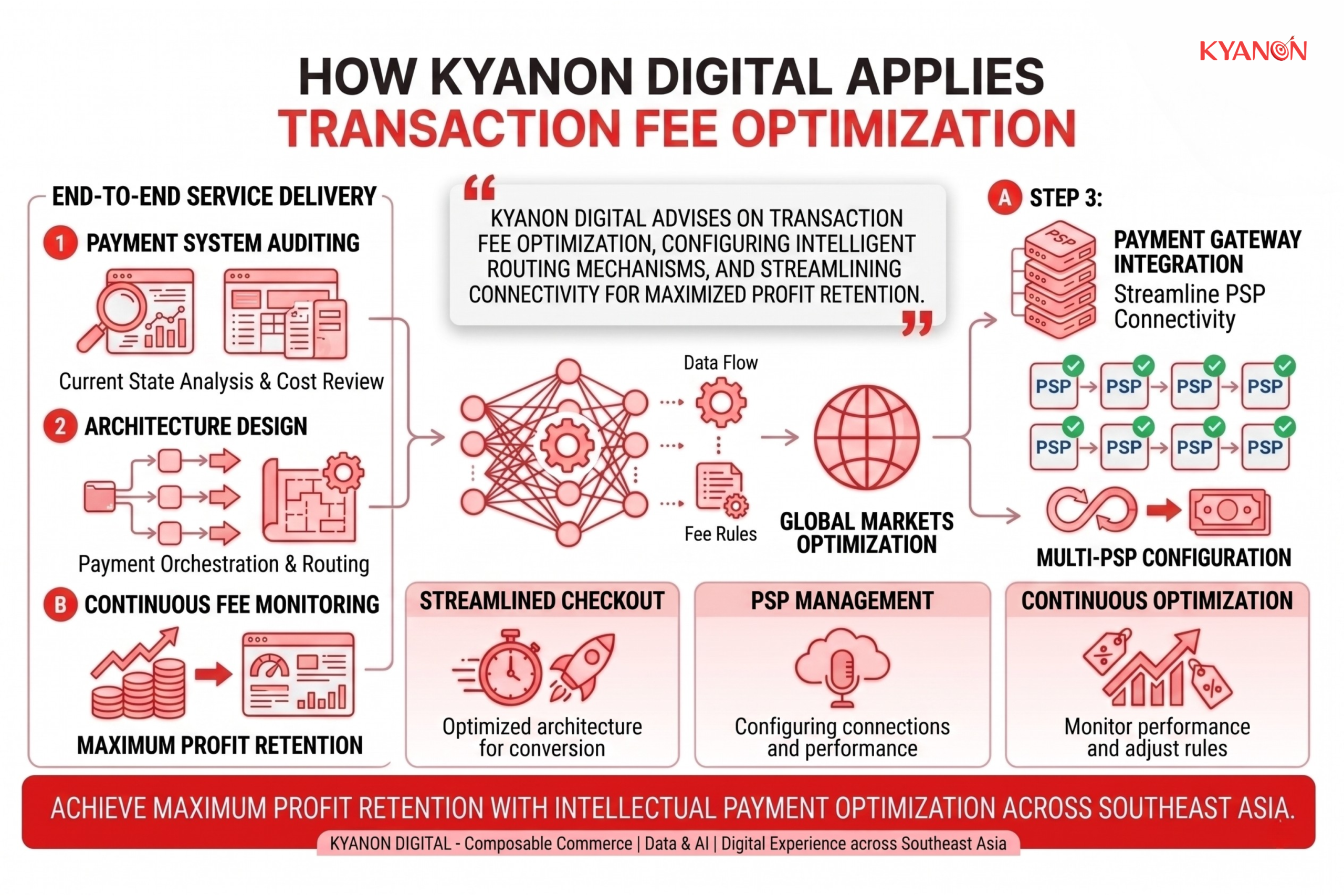
Kyanon Digital advises eCommerce clients on transaction fee optimization as part of payment orchestration and platform architecture engagements across Southeast Asia and global markets. Our engineering teams configure intelligent payment routing mechanisms, streamline PSP connectivity, and optimize checkout architectures to ensure maximum profit retention.
Explore our services:











 Create project brief with AI