


Pure vibe coding is best suited to disposable prototypes, hackathon tools, and low-risk exploratory scripts that use mock data and remain isolated from production systems. Enterprise MVPs, customer-facing applications, regulated workflows, and core business platforms should not rely on unreviewed AI-generated code. These projects need appropriate engineering oversight, testing, and security controls to manage operational, technical, and compliance risks.
Generative AI has lowered the barrier to software development, allowing teams to create user interfaces and lightweight automation by describing requirements in plain language. While this accelerates early experimentation, AI-generated code should not be assumed production-ready without testing, validation, and review.
For enterprise leaders, the key question is whether the risks of unreviewed AI-generated code are acceptable for a specific project. This guide provides a practical risk assessment framework, compares development approaches, and examines real-world scenarios to help teams determine the appropriate level of engineering oversight.
Key takeaways
- Use pure vibe coding primarily for disposable prototypes, internal hackathon projects, and exploratory scripts that use mock data and remain isolated from production systems.
- Mandate human-led engineering governance for customer-facing MVPs, revenue-generating workflows, core business platforms, and regulated data environments.
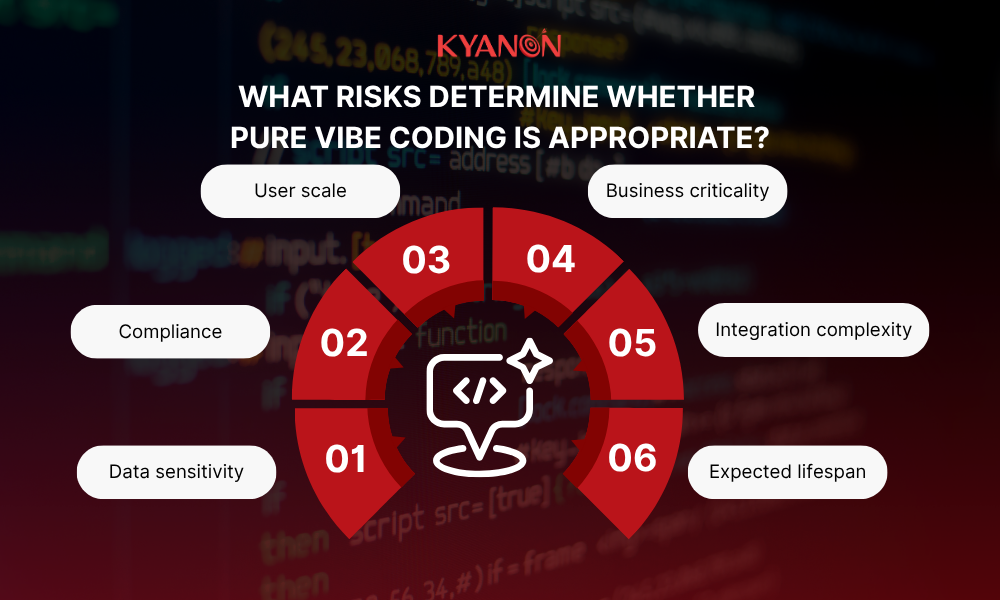
- Assess six project risks: data sensitivity, compliance obligations, user scale and workload, business criticality, integration complexity, and expected lifespan.
- Kyanon Digital recommends treating AI as a productivity multiplier within governed engineering lifecycles, maintaining human architectural ownership, security gates, and code review.
- Match engineering oversight to the potential impact of failure, considering data sensitivity, operational criticality, integration complexity, and long-term maintenance needs.
What does enterprise application risk assessment involve for pure vibe coding?
Determining whether an enterprise application or MVP can tolerate unvetted AI code generation requires assessing six fundamental business vectors. As software moves from internal experimentation to production dependency, the financial and operational consequences of unhandled edge cases, architectural decay, or security flaws scale exponentially.
Enterprise application risk assessment framework
|
Risk dimension |
Lower-risk conditions | Higher-risk conditions |
| Data sensitivity | Mock or public data with no sensitive information |
Personal, financial, health, or proprietary data |
|
Compliance obligations |
No material regulatory or contractual requirements | Applicable privacy, financial-sector, or industry requirements |
| User scale and workload | Isolated testing with limited workload |
High concurrency, multiple tenants, or critical workloads |
|
Business criticality |
Failure has limited, recoverable impact | Failure affects revenue, customers, or business continuity |
| Integration complexity | Standalone tools with no production connections |
Live ERP, CRM, databases, or transactional APIs |
|
Expected lifespan |
Disposable experiment with no production dependency |
Long-term application requiring maintenance and upgrades |
These categories are indicative rather than absolute. A single high-risk factor, such as access to sensitive data or a live production database, may justify additional engineering controls even when the application is small or temporary.
Data sensitivity and privacy
Pure vibe coding generates functional code using pattern recognition without inherent awareness of secure data handling. Unreviewed AI outputs regularly lack granular access controls, proper input sanitization, and robust encryption protocols.
When software handles personal information, payment data, or trade secrets, unreviewed AI-generated code can introduce security weaknesses that expose sensitive information. Applications that handle sensitive data need access controls, appropriate data encryption, and secure database design. The safeguards should match the sensitivity of the information and the risks of the application.
Compliance and regulatory mandates
Organizations operating in regulated environments, including applicable financial services under the Monetary Authority of Singapore (MAS) framework or businesses subject to Singapore’s Personal Data Protection Act (PDPA), must assess the regulatory and data-protection obligations relevant to their applications. Depending on those obligations, teams may need documented changes, audit logs, access controls, and clear accountability for software releases. AI-generated code may contain outdated dependencies, inconsistent business rules, or exposed credentials. Teams should review the code, verify dependencies, and test security controls before deployment, particularly in regulated environments. Teams should validate AI-generated code against applicable regulatory, security, and audit requirements rather than assume that successful code generation guarantees compliance.
User scale and system criticality
Passing a small functional test does not necessarily mean an application is ready for production traffic. Regardless of how the code is generated, teams should validate performance, transaction integrity, availability, and recovery behavior against the expected workload and business impact of failure. Without adequate performance and recovery testing, applications may slow down or become unavailable under peak demand. Systems supporting revenue or core operations therefore need testing and recovery measures proportionate to their business criticality.
Integration complexity and expected lifespan
Standalone utility scripts function adequately in isolation. However, enterprise applications must integrate reliably with core platforms such as SAP, Salesforce, or legacy backend databases. Without proper design and testing, changes can break integrations, disrupt workflows, or create inconsistent records across systems. For applications expected to run for years, missing documentation, testing, and clear code structure can make future updates slower and more expensive. Structured engineering helps teams maintain and extend the software as business needs change.

Which development approach fits each enterprise project?
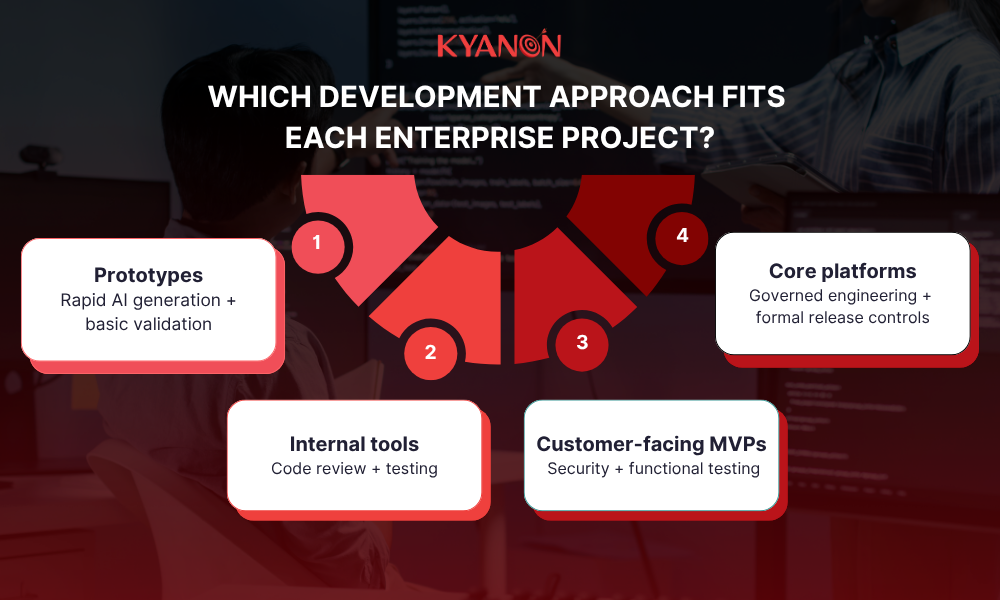
After completing an enterprise application risk assessment, teams can select a development approach that reflects the project’s technical constraints and business impact. The objective is not to eliminate AI-generated code, but to determine where rapid generation is sufficient and where additional engineering controls are necessary.
Pure vibe coding use cases generally involve isolated experimentation with limited consequences if the software fails. AI-assisted development adds engineering review and testing, while structured engineering provides a more governed process for applications with complex integrations, sensitive data, or significant operational responsibilities.
The following matrix maps common enterprise project types to their main risks and recommended development approaches.
Recommended development approaches by enterprise project type
|
Project category |
Main risk exposure | Recommended delivery approach |
| Disposable prototype | Low, provided it uses mock data and remains isolated |
Rapid AI generation with basic validation |
|
Internal utility tool |
Depends on data access and operational impact | AI-assisted development with code review and testing |
| Customer-facing MVP | Customer data, reliability, integrations, brand impact |
AI-accelerated engineering with security and functional testing |
|
Core financial, healthcare, or operational platform |
Applicable compliance, transaction integrity, continuity |
Governed engineering with formal testing and release controls |
In enterprise projects, unreviewed AI-generated code can increase the likelihood of rework when integration requirements, security controls, or architectural constraints are not addressed early. Engineering teams can reduce these risks through appropriate technical planning, code review, and automated testing.
Technology leaders navigating these trade-offs frequently partner with specialized implementation teams. Assessing technical readiness through Kyanon Digital’s software engineering services allows organizations to establish secure cloud architecture, automated deployment pipelines, and human-in-the-loop review processes that balance rapid delivery with enterprise governance.
How do pure vibe coding use cases differ across enterprise projects?
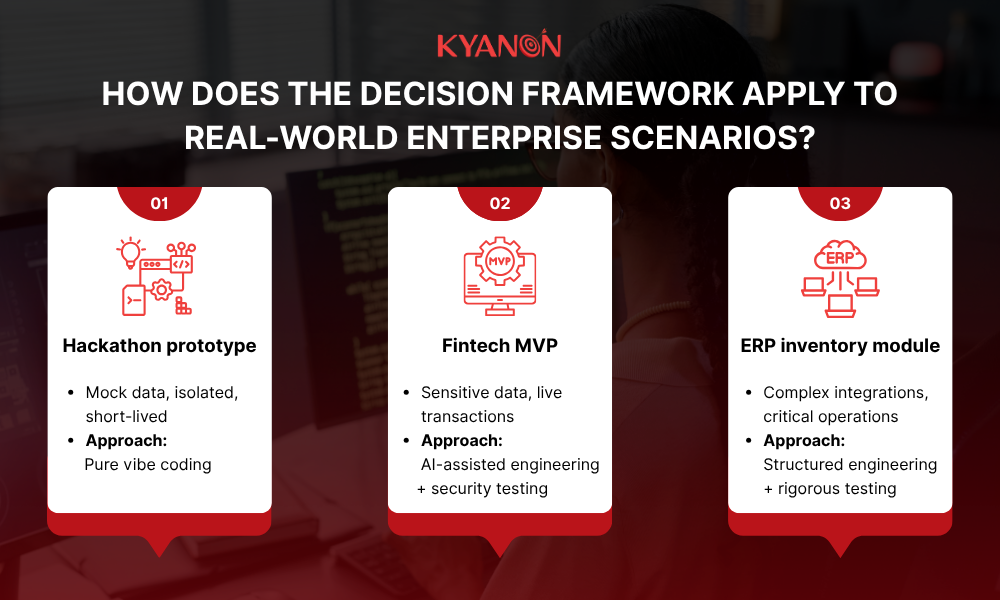
Real-world scenarios illustrate how data sensitivity, integration complexity, and business criticality determine whether pure vibe coding, AI-assisted development, or structured engineering is appropriate.
Scenario 1: Internal hackathon logistics visualizer
- Context: A regional logistics operator conducts an internal hackathon to visualize driver routing efficiency using static, mock telemetry data.
- Evaluation: Data sensitivity is non-existent, system criticality is low, and the tool will be discarded after two weeks.
- Verdict: Pure vibe coding may be appropriate for this isolated prototype. The team can use AI to generate interface components and data transformation scripts, provided the tool uses mock data, has no production access, and undergoes basic functional validation before demonstration.
Scenario 2: Customer-facing fintech investment MVP
- Context: A financial services firm is developing a customer-facing MVP that connects to external financial accounts and processes customer transactions.
- Evaluation: The application handles sensitive financial data, relies on external integrations, and may fall under applicable financial-sector and data-protection requirements. Errors could affect customers, transactions, and business operations.
- Verdict: Use structured engineering with AI assistance. AI can help draft interface components and routine code, but qualified engineers must review security, transaction handling, access controls, and integrations before launch.
Scenario 3: Enterprise ERP inventory allocation module
- Context: A global manufacturer develops an automated inventory allocation system connecting legacy SAP infrastructure with regional warehouse management software.
- Evaluation: The module depends on multiple enterprise systems, supports core inventory operations, and must maintain data consistency over a long operating lifespan. Errors could lead to incorrect stock records, allocation conflicts, or fulfillment delays.
- Verdict: Structured engineering is required. Engineers should validate data consistency, transaction handling, integration failures, recovery procedures, and maintainability. AI-generated code can accelerate implementation, but it should undergo appropriate review and testing before deployment.
How can Kyanon Digital support enterprise MVP development?
Enterprise MVP development requires balancing speed to market with product validation, software quality, security, and maintainability. Kyanon Digital helps businesses define core features, validate assumptions, and build an MVP with a technical foundation that can evolve as requirements change. For projects using AI-generated code, the appropriate level of engineering oversight should be determined by data sensitivity, integration complexity, and the potential impact of failure.
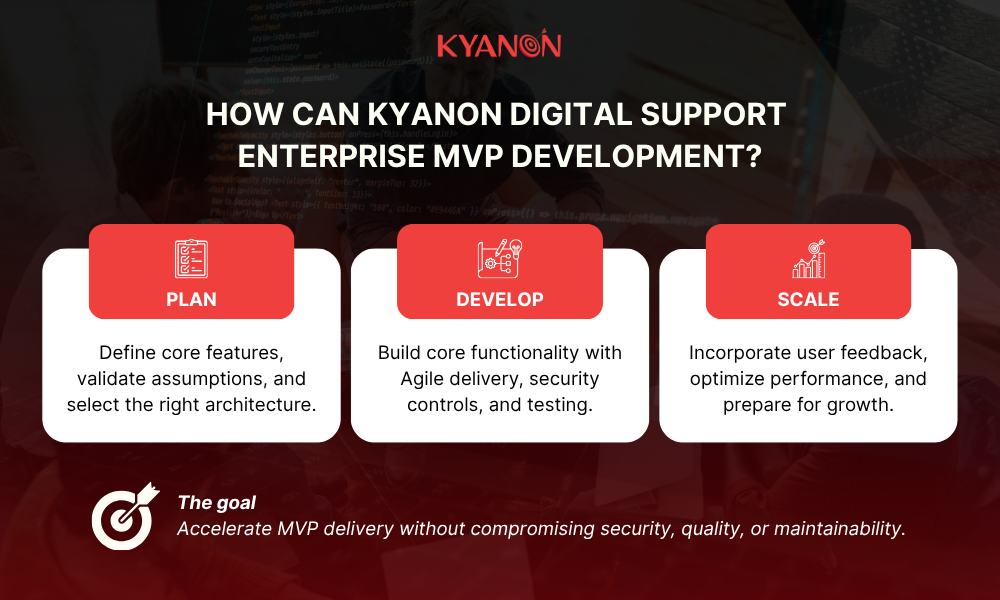
Plan MVP scope and technical strategy
- Define core features based on user needs and business priorities.
- Assess technical requirements and select an appropriate architecture and technology stack.
- Use a proof of concept (PoC) or UI prototype where needed to validate ideas before full development.
Develop, test, and deploy the MVP
- Build and refine core application features through an Agile development approach.
- Conduct software testing and apply appropriate security measures before deployment.
- Validate the MVP through user acceptance testing and prepare it for launch.
Improve the product and prepare for scale
- Refine features based on real user feedback and evolving business requirements.
- Optimize application performance, automate delivery workflows through CI/CD, and improve cloud efficiency where appropriate.
- Scale the technical team and extend product capabilities as business needs grow.
How Kyanon Digital built an AI-ready Deal Room MVP for Australian cross-border trade

A leading Australian cross-border trade and logistics enterprise needed to replace fragmented messaging and manual document handling with a centralized digital workspace. Kyanon Digital delivered a chat-first Deal Room MVP that streamlined multi-party trade coordination while establishing a structured data foundation for future AI capabilities.
Challenges
- Trade negotiations and critical documents were scattered across messaging apps and email.
- Manual status tracking limited visibility into transactions and shipment progress.
- The client needed to launch quickly without compromising the platform’s ability to support future AI-driven capabilities.
Solution from Kyanon Digital
- Built dedicated deal rooms with secure invitation links to simplify external partner onboarding.
- Developed the application using Next.js, React, and TypeScript, with Vercel hosting.
- Integrated Supabase PostgreSQL and Storage with role-based data access controls.
- Structured deal, chat, document, and participant data to support future AI-driven trade intelligence.
- Used an Agile delivery approach with frontend, backend, QA, UX/UI, and DevOps expertise.
Results and impact
- Approximately 40% faster MVP delivery compared with the planned baseline.
- 90% external adoption rate within the first 30 days of launch.
- Estimated 65% reduction in communication overhead.
- 30% reduction in infrastructure total cost of ownership.
- A structured data foundation for future AI-powered automation and trade intelligence.
This case study illustrates how an enterprise MVP can address immediate business needs while establishing a foundation for future capabilities. Although it does not directly compare pure vibe coding with structured engineering, it highlights why teams should consider data access, system design, testing, and maintainability when selecting an MVP development approach.
Explore how Kyanon Digital helps businesses build AI-ready MVPs and scalable digital platforms.
Self-assessment checklist: Is an enterprise project safe for pure vibe coding?
Before approving pure vibe coding, assess whether the project handles sensitive data, falls under compliance requirements, connects to core enterprise systems, or carries significant operational risk. Consider whether the application must remain maintainable and scalable beyond its initial prototype.
- Does the software process personal information, customer records, financial transactions, or proprietary data?
- Is the workflow subject to requirements such as PDPA, MAS, GDPR, HIPAA, or SOC 2?
- Does it connect to core enterprise platforms, such as SAP, Salesforce, custom ERPs, or live transactional databases?
- Could an outage, logic error, or performance issue affect revenue or business operations?
- Will the application require ongoing maintenance, future updates, or support from other engineers?
If any answer is Yes, assess the associated risk and determine which engineering controls are necessary before deployment. Applications involving sensitive data, regulated workflows, critical operations, or live enterprise integrations should not rely on unreviewed AI-generated code.
Conclusion
Pure vibe coding is most useful when experimentation is inexpensive, isolated, and easy to discard. As an application takes on sensitive data, production integrations, or business-critical responsibilities, engineering oversight becomes increasingly important. Enterprise teams should evaluate the consequences of failure before deciding how AI-generated code will be reviewed, tested, and deployed.
Planning an enterprise MVP or evaluating AI-assisted development? Talk to Kyanon Digital about assessing project risks, reviewing technical requirements, and choosing an engineering approach that balances delivery speed with long-term reliability.
References
Vibe Coding to Replace Management Tools Creates Technical Debt — Gartner, 2026.
From Vibe Coding to Reliable Software — Gartner, 2026.
How to Secure Vibe-Coded and AI-Developed Applications — Gartner, 2026.
Top AI Code Security Solutions for AI-Assisted Development — IBM, 2026.
Building an AI-Ready Deal Room MVP for Australian Cross-Border Trade — Kyanon Digital, 2026.


 Create project brief with AI