

Hyperautomation AI removes logistics bottlenecks by combining AI, robotic process automation (RPA), and real-time analytics to automate end-to-end workflows rather than isolated tasks. It reduces manual processing delays, improves system coordination, and enables faster responses to disruptions. Kyanon Digital helps enterprises integrate these capabilities into existing logistics operations, with implementation priorities depending on system readiness and operational bottlenecks.
For logistics enterprises, shipment delays, inventory discrepancies, disconnected ERP/WMS/TMS systems, and rising operational costs can persist despite significant investments in automation. When systems cannot exchange information or respond to disruptions quickly, businesses risk missed delivery commitments, higher fulfillment costs, and reduced customer satisfaction.
The critical question is where hyperautomation AI can deliver measurable ROI without adding unnecessary complexity or replacing existing infrastructure. Should enterprises automate individual bottlenecks, integrate fragmented systems, or invest in end-to-end intelligent workflows?
With experience in enterprise system integration and supply chain automation, Kyanon Digital understands the importance of connecting AI capabilities to existing operations rather than introducing technology in isolation. In this guide, we explore which logistics bottlenecks to prioritize, how to select the right automation approach, and what enterprises should evaluate before investing and scaling.
Key takeaways
- Prioritize end-to-end bottlenecks: Hyperautomation AI delivers greater operational value when delays involve disconnected systems, manual handoffs, and cross-functional decisions.
- Match automation to the problem: Use RPA and intelligent document processing for repetitive paperwork, while AI-driven orchestration is better suited to dynamic inventory, transportation, and fulfillment workflows.
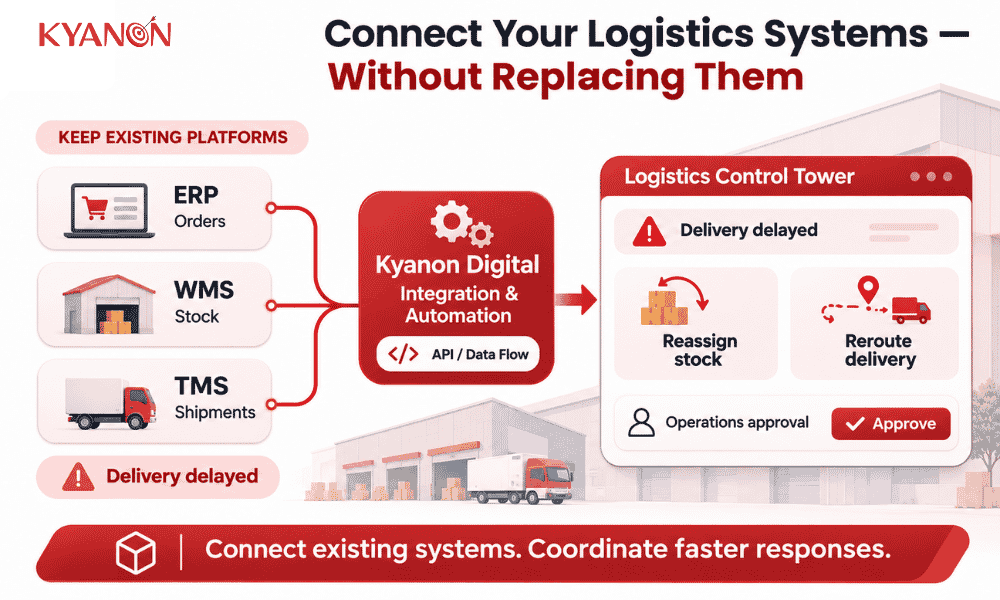
- Integration comes before intelligent automation: Kyanon Digital’s supply chain engineering capabilities help enterprises connect existing ERP, WMS, and TMS environments to support coordinated operational workflows.
- Start with measurable outcomes: Evaluate investments against document processing time, truck turnaround, delivery reliability, and cost per shipment before scaling.
- Validate before expanding: Kyanon Digital’s supply chain automation experience shows how targeted improvements to existing systems can address operational bottlenecks without requiring wholesale platform replacement.
Further reading:
- AI-Ready Deal Room MVP for Cross-Border Trade
- Logistics Automation with AI: What Works in 2026
- How Enterprises Hire AI Developers for Logistics Solutions
- How Should Singapore Enterprises Assess AI Delivery Capacity
Traditional automation vs. hyperautomation AI in logistics
Traditional automation is suitable for repetitive, rule-based logistics tasks, while hyperautomation AI is better suited to complex workflows requiring cross-system coordination, predictive insights, and adaptive responses to disruptions.
For logistics decision-makers, the choice depends on exception frequency, system integration requirements, scalability, and the total cost of ownership (TCO).
Key differences between traditional automation and hyperautomation AI
| Dimension | Traditional automation |
Hyperautomation AI |
|
Data processing |
Relies primarily on structured data and predefined inputs | Uses AI, NLP, and intelligent document processing to handle structured and unstructured information |
| Decision-making | Executes predefined rules and requires human intervention for decisions outside those rules |
Uses contextual data and predictive insights to recommend or execute approved actions |
|
Disruption management |
Generates alerts or follows fixed responses when exceptions occur | Detects potential disruptions and can recommend or trigger corrective workflows |
| Warehouse operations | Follows fixed scheduling and resource allocation rules |
Supports dynamic workload planning, dock scheduling, and resource allocation |
|
System connectivity |
Often automates individual tasks or system-specific processes | Orchestrates workflows across connected ERP, WMS, TMS, and other enterprise platforms |
| Process improvement | Requires manual process reviews and rule updates |
Uses process mining and operational insights to identify optimization opportunities |
|
Implementation cost & maintenance |
Generally simpler to implement for isolated tasks, but may require frequent rule updates |
Requires greater integration and governance investment, with potential value from reducing cross-system inefficiencies |
The key distinction: Traditional automation makes individual tasks faster. Hyperautomation AI connects and optimizes processes across logistics operations, provided the required data and system integrations are available.
When should logistics enterprises choose each approach?
Choose traditional automation when:
- Workflows are standardized, repetitive, and involve predictable inputs.
- The primary objective is to reduce manual work within a single process.
- Existing systems already provide reliable data.
- A lower-complexity implementation can resolve the identified bottleneck.
Choose hyperautomation AI when:
- High exception volumes require frequent manual intervention.
- Disconnected ERP, WMS, and TMS systems delay operational decisions.
- Transportation, inventory, or warehouse workflows need to respond to changing conditions.
- Enterprises need to coordinate multiple processes rather than automate isolated tasks.
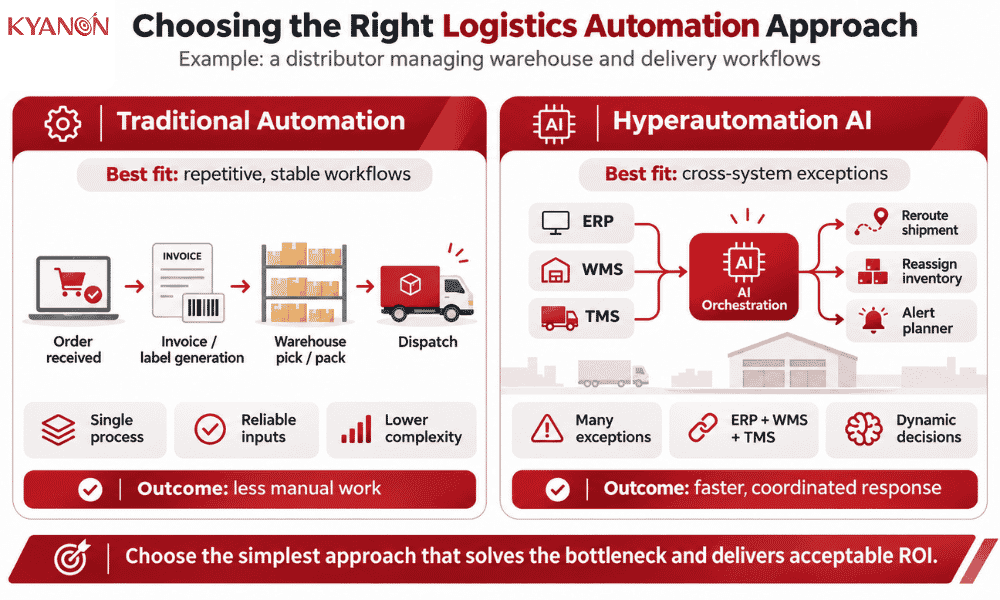
Before investing in hyperautomation AI, logistics leaders should also evaluate integration readiness, data quality, TCO, and time-to-value. More advanced automation does not necessarily deliver better ROI if the underlying problem can be resolved through simpler workflow improvements.
For enterprises operating fragmented logistics platforms, Kyanon Digital’s Supply Chain & Fulfillment solutions provide a relevant starting point for evaluating system integration and connected automation opportunities without assuming that existing ERP, WMS, or TMS platforms must be replaced.

What logistics bottlenecks can hyperautomation AI eliminate?
Hyperautomation AI addresses six major logistics bottlenecks: customs documentation, warehouse fulfillment, yard congestion, transportation disruptions, inventory imbalances, and freight billing. By connecting AI-driven decisions with automated workflows, enterprises can reduce manual delays and improve operational efficiency across the supply chain.
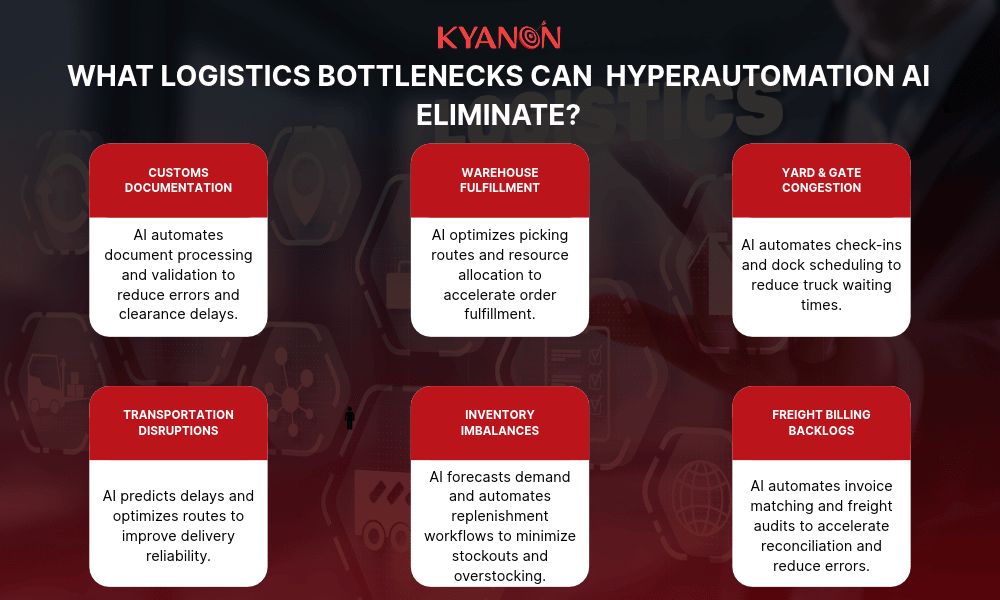
Manual documentation and customs clearance delays
- Bottleneck: Manual processing of bills of lading, customs declarations, and freight documents causes errors and shipment delays.
- AI solution: Intelligent document processing (IDP) extracts and validates data, while RPA transfers approved information into ERP, TMS, and customs systems.
- Business impact: Faster document processing, fewer errors, and reduced clearance-related delays.
- Prioritize when: Documentation backlogs repeatedly delay shipment release or reconciliation.
For cross-border operations involving multiple stakeholders, Kyanon Digital’s AI-Ready Deal Room MVP demonstrates how centralized trade documentation and collaboration can support future automation.
Warehouse picking and fulfillment slowdowns
- Bottleneck: Inefficient picking routes, fixed storage layouts, and poorly coordinated workloads slow order fulfillment.
- AI solution: AI optimizes picking sequences, warehouse slotting, and resource allocation using order and inventory data.
- Business impact: Faster order processing, better labor utilization, and improved fulfillment throughput.
- Prioritize when picking productivity and fulfillment speed decline during high-demand periods.
For retailers experiencing seasonal fulfillment pressure, explore Kyanon Digital’s Peak-Season Retail Fulfillment solutions.
Warehouse yard and gate congestion
- Bottleneck: Manual check-ins, unpredictable truck arrivals, and inefficient dock scheduling increase waiting times.
- AI solution: Computer vision, predictive arrival estimates, and automated dock allocation improve yard coordination.
- Business impact: Reduced truck turnaround time, better dock utilization, and fewer avoidable waiting costs.
- Prioritize when: Recurring yard congestion results from scheduling and coordination rather than insufficient physical capacity.
Transportation and last-mile disruptions
- Bottleneck: Static routes and manual dispatching struggle to respond to traffic, weather, and changing delivery priorities.
- AI solution: AI predicts disruptions and supports dynamic routing, load consolidation, ETA updates, and automated notifications.
- Business impact: Better delivery reliability, improved vehicle utilization, and lower avoidable transportation costs.
- Prioritize when: Frequent delivery exceptions and manual dispatch coordination increase operating costs.
Inventory imbalances and demand forecasting
- Bottleneck: Disconnected inventory records and inaccurate forecasts create stockouts, excess inventory, and replenishment delays.
- AI solution: Machine learning forecasts demand and triggers approved replenishment recommendations or inter-warehouse transfers.
- Business impact: Better stock visibility, more responsive replenishment, and reduced unnecessary inventory holding.
- Prioritize when: Inventory discrepancies or repeated stockouts result from slow data synchronization and replenishment decisions.
Back-office billing and freight audit backlogs
- Bottleneck: Manual invoice matching, freight audits, and dispute handling delay payments and increase administrative workload.
- AI solution: AI extracts invoice data, validates charges against shipment records and rate cards, and flags discrepancies for review.
- Business impact: Faster invoice reconciliation, fewer billing errors, and lower administrative workload.
- Prioritize when: High invoice volumes and recurring disputes create finance backlogs.
How can enterprises build a hyperautomation framework for logistics?
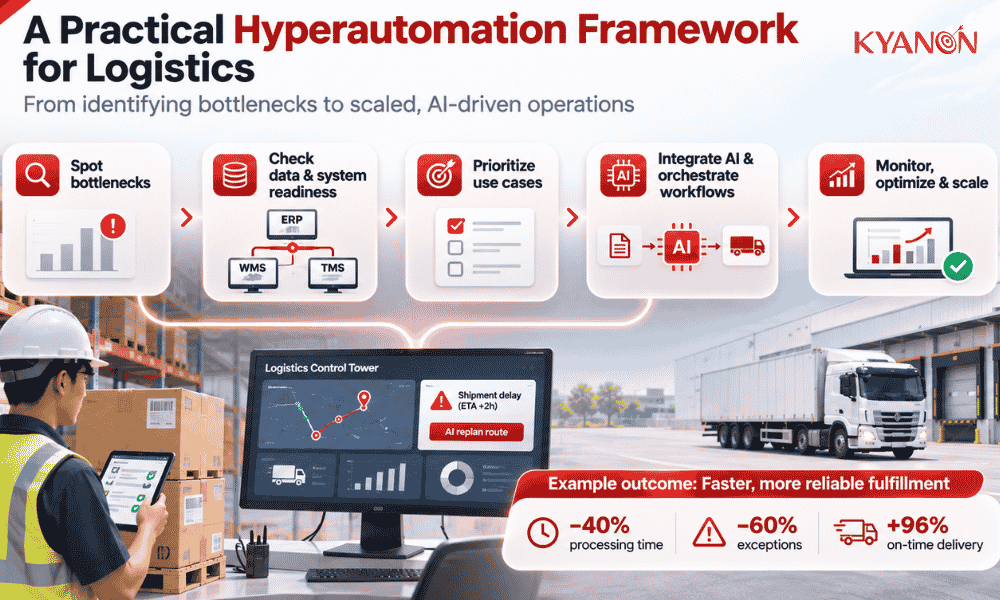
An effective hyperautomation framework should begin with a measurable operational problem rather than an enterprise-wide decision to deploy AI.
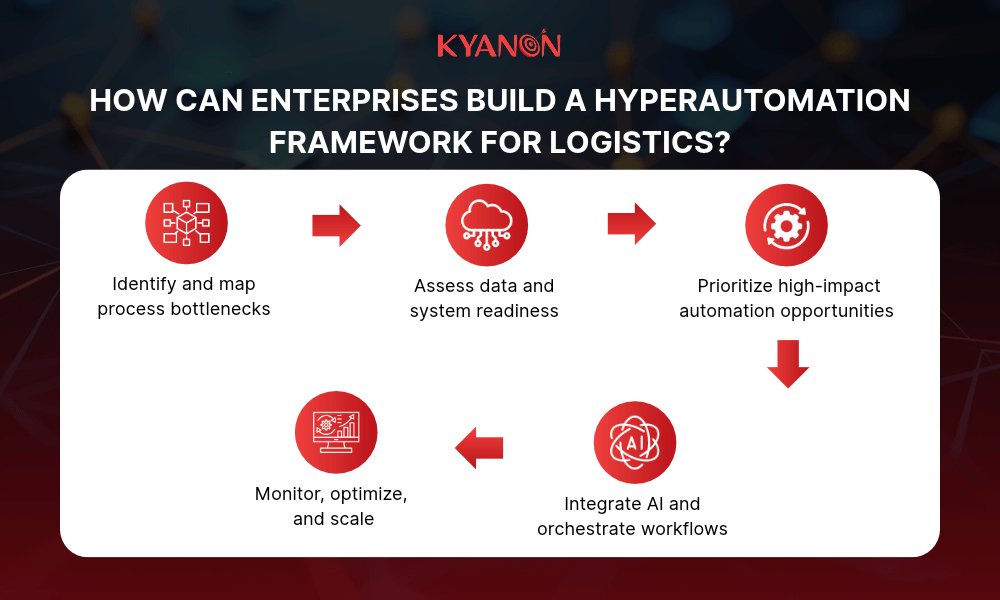
Stage 1: Identify and map process bottlenecks
Use process mining, system event logs, and operational data to identify delays, repetitive tasks, manual handoffs, and costly process deviations.
Expected output: A prioritized bottleneck map with baseline processing times, exception volumes, and accountable process owners.
Stage 2: Assess data and system readiness
Evaluate ERP, WMS, TMS, integration interfaces, data quality, existing automation infrastructure, and system access permissions. Determine whether the primary constraint is fragmented data, insufficient integration, or inefficient operating procedures.
Expected output: An integration readiness assessment identifying which workflows can be automated using existing infrastructure.
When ERP, WMS, and TMS systems cannot exchange reliable operational data, introducing additional AI tools may increase complexity without eliminating bottlenecks. Enterprises facing these constraints can explore Kyanon Digital’s Supply Chain & Fulfillment solutions to evaluate integration dependencies and prioritize connected automation opportunities.
Stage 3: Prioritize high-impact automation opportunities
Compare opportunities based on business impact, implementation complexity, data readiness, and operational risk.
|
Operational signal |
Recommended first move |
|
High-volume, standardized document processing |
IDP and RPA |
| Repeated discrepancies across ERP, WMS, and TMS |
System integration and workflow orchestration |
|
Frequent transportation disruptions with usable operational data |
Predictive analytics and exception management |
| Unreliable inventory records |
Data reconciliation and governance before AI automation |
Expected output: One bounded pilot with clear success criteria, implementation ownership, and financial assumptions.
Stage 4: Integrate AI and orchestrate workflows
Combine the required AI, ML, RPA, IDP, and integration components around the selected workflow. Define system ownership, approval thresholds, exception escalation, audit logs, and fallback procedures. Test incorrect model outputs, data inconsistencies, and integration failures before deployment.
Expected output: An operational workflow capable of executing approved actions and escalating unresolved exceptions.
Stage 5: Monitor, optimize, and scale
Compare pilot performance against the original baseline. Monitor exception handling, operational outcomes, system reliability, and ongoing maintenance costs. Expand only when the implementation demonstrates measurable business value without introducing unacceptable operational risk.
Expected output: An evidence-based decision to scale, redesign, or stop the initiative.
For enterprises evaluating whether existing engineering capacity can support this progression, How Enterprises Hire AI Developers for Logistics Solutions provides additional guidance on logistics AI delivery capabilities and integration requirements.
How can enterprises measure the ROI of hyperautomation AI in logistics?
Hyperautomation ROI should be evaluated through operational improvements and financial outcomes rather than the number of automated tasks.
The following KPIs help logistics leaders establish a baseline and assess whether automation creates measurable business value.
|
KPI |
What it measures |
Business value |
|
Order processing time |
Time from order receipt to processing completion | Faster order fulfillment |
| Document processing time | Time required to validate and process logistics documents |
Lower administrative workload |
|
Truck turnaround time |
Time from facility arrival to departure | Improved yard efficiency |
| On-time delivery rate | Percentage of deliveries completed within agreed windows |
Improved service reliability |
|
Inventory turnover |
Inventory sold or consumed relative to average inventory | Better working-capital efficiency |
| Cost per shipment | Total attributable logistics costs divided by shipment volume |
Improved cost efficiency |
|
Exception resolution time |
Time between disruption detection and resolution |
Faster operational recovery |
How should enterprises calculate hyperautomation ROI?
A financial assessment should compare expected benefits against the total investment and ongoing operating costs over the same period.
ROI = [(Total Financial Benefits − Total Costs) ÷ Total Costs] × 100%
Financial benefits may include reduced overtime, avoided penalties, lower rework costs, and demonstrable throughput improvements.
Total costs should account for integration, licensing, infrastructure, implementation, training, AI usage, monitoring, and maintenance.
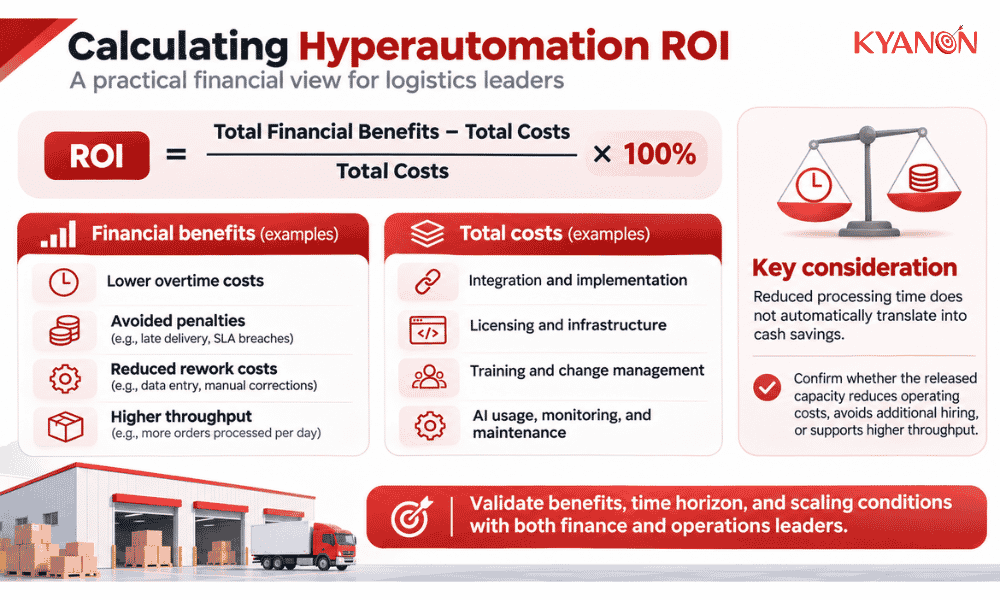
An important consideration: Reduced processing time does not automatically translate into equivalent cash savings. Enterprises must demonstrate whether released capacity reduces operating expenditure, avoids additional hiring, or supports increased throughput.
Before approving enterprise-wide deployment, finance and operations leaders should jointly validate the benefit assumptions, measurement period, and conditions for scaling.
How Kyanon Digital automated supply chain operations for a Singapore retail enterprise
Kyanon Digital supports enterprise logistics transformation through AI engineering, enterprise integration, data synchronization, and workflow automation.
Its intelligent supply chain automation project for a Singapore retailer demonstrates how targeted AI and integration capabilities can resolve connected operational bottlenecks without replacing established enterprise systems.
Challenges
- Thousands of supplier invoices, delivery orders, and inventory transactions required substantial manual processing.
- Disconnected SAP, POS, and omnichannel systems complicated information exchange and financial reconciliation.
- Inventory discrepancies across retail, eCommerce, and B2B wholesale channels affected fulfillment visibility and accuracy.
Solution from Kyanon Digital
- Implemented AI-powered supplier document extraction and validation.
- Automated three-way reconciliation between purchase orders, goods receipts, and SAP records.
- Established an event-driven integration architecture to synchronize inventory information across existing enterprise systems.
- Introduced exception handling and transaction traceability to support operational governance.
Results and impact
- 90% reduction in manual data entry time across supplier document processing and financial reconciliation.
- Supplier invoice processing reduced from days to under 30 minutes.
- Over 80% reduction in omnichannel inventory discrepancy incidents.
These client-reported results demonstrate the potential value of combining AI-powered document processing with enterprise integration. They should not be interpreted as guaranteed results for other logistics environments.
For enterprises evaluating hyperautomation, the practical lesson is that connecting existing systems and automating one high-friction workflow can establish a measurable foundation for broader intelligent operations.
Conclusion
Hyperautomation AI can remove logistics bottlenecks when intelligent automation is connected to the systems, data, and decisions responsible for operational delays. However, not every bottleneck requires a comprehensive AI platform. Enterprises should first identify their highest-impact constraint, verify integration readiness, and evaluate one workflow against measurable operational and financial outcomes.
Kyanon Digital combines enterprise AI, data engineering, and integration capabilities to support intelligent logistics operations built around existing systems and business priorities.
Ready to address recurring logistics bottlenecks? Discuss your logistics hyperautomation roadmap with Kyanon Digital to evaluate integration dependencies, prioritize a feasible first workflow, and define the KPIs needed to justify investment.
References
- What Is Hyperautomation? — IBM, 2021. Foundational explanation of hyperautomation and its technologies.
- Scaling Singapore Retail Operations with Intelligent Supply Chain Automation — Kyanon Digital, 2026.
- Building an AI-Ready Deal Room MVP for Australian Cross-Border Trade — Kyanon Digital, 2026.
- AI-Driven Agile Team for Peak-Season Retail Fulfillment — Kyanon Digital, 2026.




 Create project brief with AI