

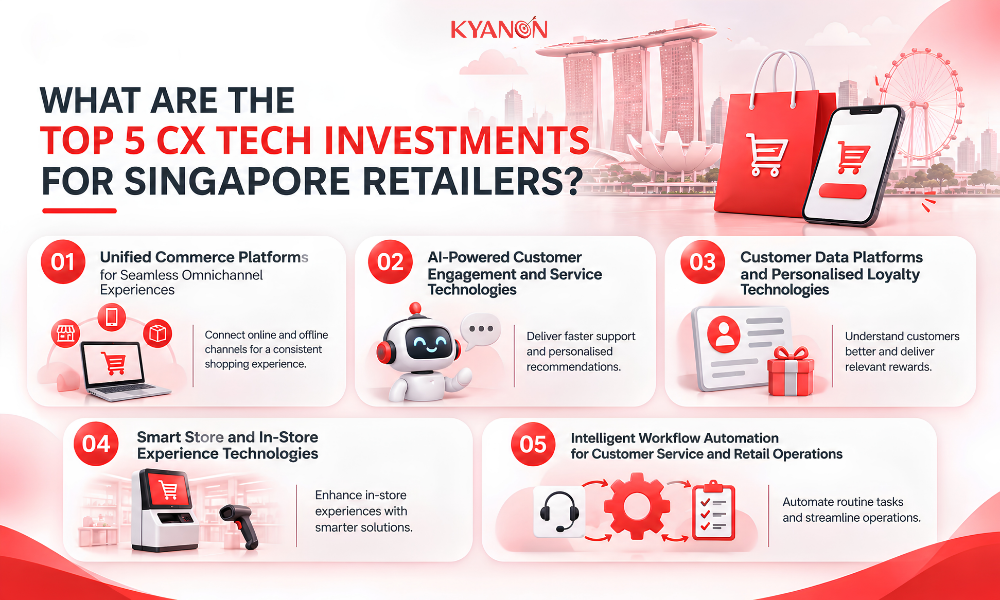
The top 5 CX tech investments for Singapore retailers are unified commerce platforms, smart store technologies, AI-powered customer engagement, customer data and loyalty platforms, and intelligent workflow automation. These investments address common retail challenges, including inconsistent product availability, long checkout queues, fragmented customer data, slow customer support, and manual service processes.
Singapore retailers face high store operating costs, limited frontline staffing capacity, and rising expectations for convenient shopping. When employees spend more time checking stock, processing orders, or handling repetitive inquiries, service quality and operational efficiency can suffer.
Effective CX technology adoption requires more than launching new apps or digital touchpoints. Retailers must identify where customer journeys break down, assess whether existing systems can support new capabilities, and prioritize investments based on business impact. CX technology consulting helps evaluate these requirements before committing capital to new platforms.
Key takeaways
- Prioritize unified commerce as the operational backbone before deploying customer-facing AI agents or dynamic digital displays.
- Balance capital allocation by funding physical store network improvements alongside digital touchpoints to capture real omnichannel footfall.
- Kyanon Digital recommends auditing enterprise API readiness and inventory synchronization latency before committing capital to customer-facing front-end interfaces.
- Target checkout friction and staff labor constraints as the primary business cases for in-store smart technology investments.
- Partner with Kyanon Digital to architect resilient system integrations that link point-of-sale registers, loyalty engines, and enterprise systems into a single operational workflow.
Further reading
- How to Measure CX ROI for Singapore Enterprises?
- Singapore 10 Best Ecommerce Website Development Companies
- How Omnichannel Loyalty Programs Drive Retention in Retail
Why should Singapore retailers prioritise CX tech investments now?
Singapore retailers face growing pressure from rising operating costs, manpower constraints, and competition from global e-commerce businesses. These challenges were highlighted by IMDA and Enterprise Singapore in the refreshed Retail Industry Digital Plan. Frontline staffing is also a concern: a Ministry of Manpower report identifies difficulties in hiring for retail roles, with shop sales assistants among the occupations with the highest number of vacancies. This makes improving store productivity and helping employees serve customers more efficiently and important business priority.
At the same time, online shopping represents a significant part of Singapore’s retail market. Online sales accounted for 17.7% of total retail sales in September 2026, according to the Singapore Department of Statistics. Retailers therefore need to provide a consistent experience across digital and physical channels, from checking product availability to placing orders and arranging collection or delivery. When sales channels and inventory records are disconnected, inaccurate stock information and delays can undermine that experience.
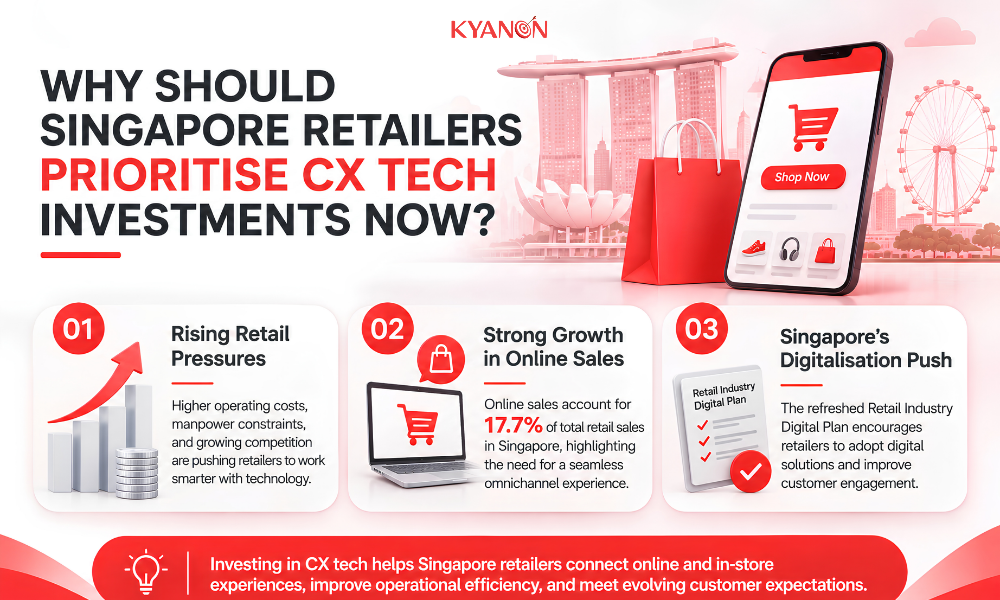
Singapore’s digitalisation initiatives also reflect the growing role of technology in retail operations. The refreshed Retail Industry Digital Plan provides SME retailers with guidance on adopting digital solutions across customer-facing services, store operations, and business management. For retailers of different sizes, the business priority is to identify where technology can remove friction, improve service efficiency, and connect the shopping journey across channels. Rather than adopting tools simply because they are new, investments should address measurable customer and operational needs.

What are the top 5 CX tech investments for Singapore retailers?
Singapore’s fast-evolving retail market demands seamless, high-speed personalization across both digital channels and physical stores. To overcome labor constraints and boost loyalty, making the right CX tech investment has become essential. Many brands now rely on modern CX technology, supported by CX technology consulting, to bridge operational gaps and drive sustainable growth.
Unified commerce platforms for seamless omnichannel experiences
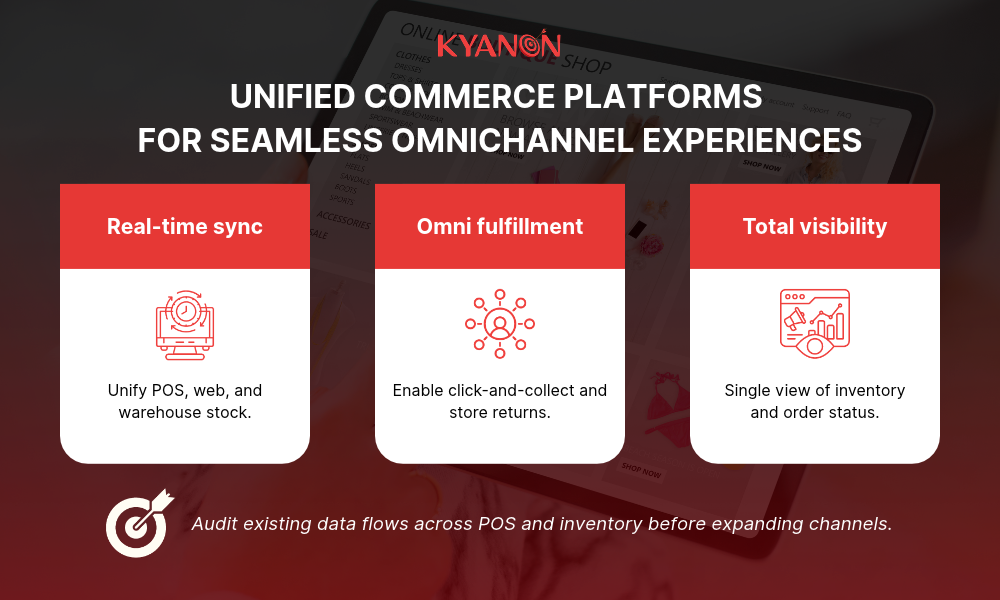
Unified commerce connects online stores, physical stores, POS systems, and inventory platforms so customers can access consistent product information, stock availability, and purchasing options across channels.
- Business problems it solves: Helps retailers address situations where customers see products listed as available online but find them out of stock in stores, or cannot return online purchases at physical locations.
- Enterprise business value: Gives retail managers a clearer view of product availability and order status across channels, helping reduce order cancellations, improve fulfillment coordination, and make better inventory decisions.
- Key technologies: Unified commerce platforms, order management systems (OMS), and integrations with existing inventory and business management systems.
- Investment considerations: Retailers should ensure product, inventory, and order information remains accurate across all channels. Existing systems must work together effectively to prevent stock discrepancies, order delays, and inconsistent customer experiences.
Retailers experiencing frequent order cancellations, inconsistent stock information, or difficulties managing online and in-store purchases may need to improve how their business systems communicate. Kyanon Digital’s system integration services help connect existing platforms, synchronize data flows, and build a more cohesive technology ecosystem to support efficient omnichannel operations.
AI-powered customer engagement and service technologies

AI-powered customer engagement tools use chatbots and virtual assistants to answer customer questions, recommend products, and support service requests across websites, mobile apps, and messaging platforms such as WhatsApp.
- Business problems it solves: Retailers receiving large volumes of repetitive inquiries about product availability, delivery status, store locations, and return policies may struggle to maintain fast response times, especially during promotional periods.
- Enterprise business value: Reduces the time employees spend answering routine questions, helps customers receive faster responses, and gives support agents relevant order and purchase information when handling more complex requests.
- Key technologies: AI chatbots, virtual assistants, and automated customer inquiry management.
- Investment considerations: AI assistants should provide accurate information about products, pricing, delivery, and returns. Customers should also be able to reach human support when their requests require further assistance.
Customer data platforms and personalised loyalty technologies

When customer information is scattered across store transactions, eCommerce accounts, and loyalty programs, retailers struggle to understand individual shopping preferences. Customer data platforms (CDPs) bring these records together to create more complete customer profiles.
- Business problems it solves: Retailers may struggle to recognize returning customers across channels, send relevant promotions, or understand why loyalty members stop purchasing after their initial transactions.
- Enterprise business value: Helps marketing teams segment customers more effectively, deliver relevant promotions, understand repeat purchasing behavior, and allocate campaign budgets based on customer value.
- Key technologies: Customer data platforms (CDPs), loyalty management systems, and marketing automation tools.
- Investment considerations: Retailers should ensure customer information is accurate, securely managed, and used in accordance with Singapore’s PDPA requirements.
Smart store and in-store experience technologies
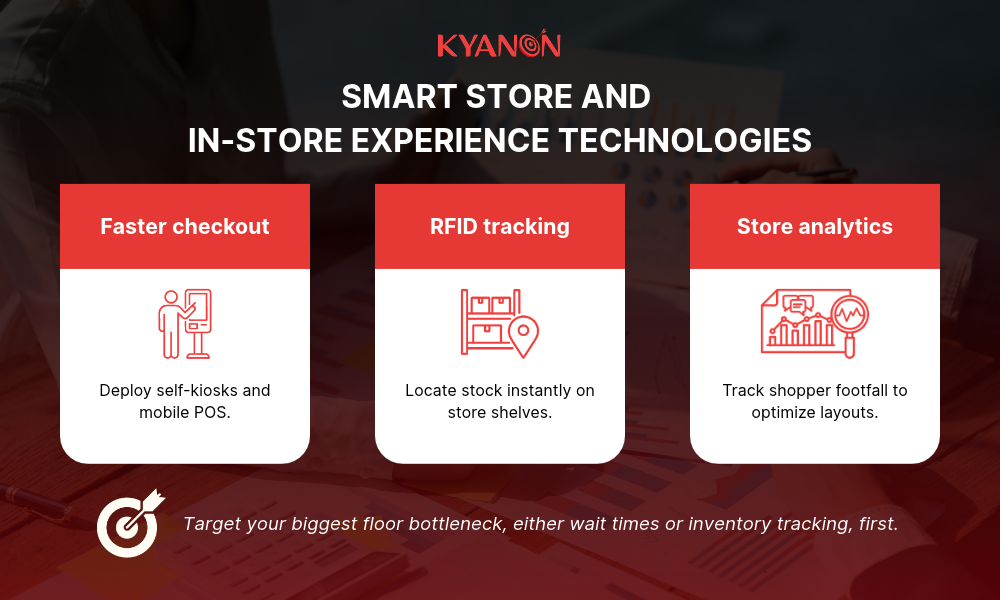
Smart store technologies improve physical shopping experiences through tools such as self-checkout kiosks, mobile POS devices, RFID inventory tracking, and in-store analytics. These solutions help retailers reduce checkout delays, monitor product availability, and provide faster customer assistance.
- Business problems it solves: Long checkout queues during peak hours, employees spending too much time locating products, and limited staff availability to assist customers on the shop floor.
- Enterprise business value: Reduces checkout waiting times, helps employees locate products faster, and frees store associates to spend more time assisting customers. Retailers can also use store performance data to identify service bottlenecks and improve space utilization.
- Key technologies: Self-checkout systems, mobile POS devices, RFID inventory tracking, and in-store analytics.
- Investment considerations: Retailers should select technologies based on specific store challenges. For example, self-checkout may help reduce queues, while RFID can improve product tracking and stock accuracy. These solutions should also work with existing inventory systems.
Intelligent workflow automation for customer service and retail operations
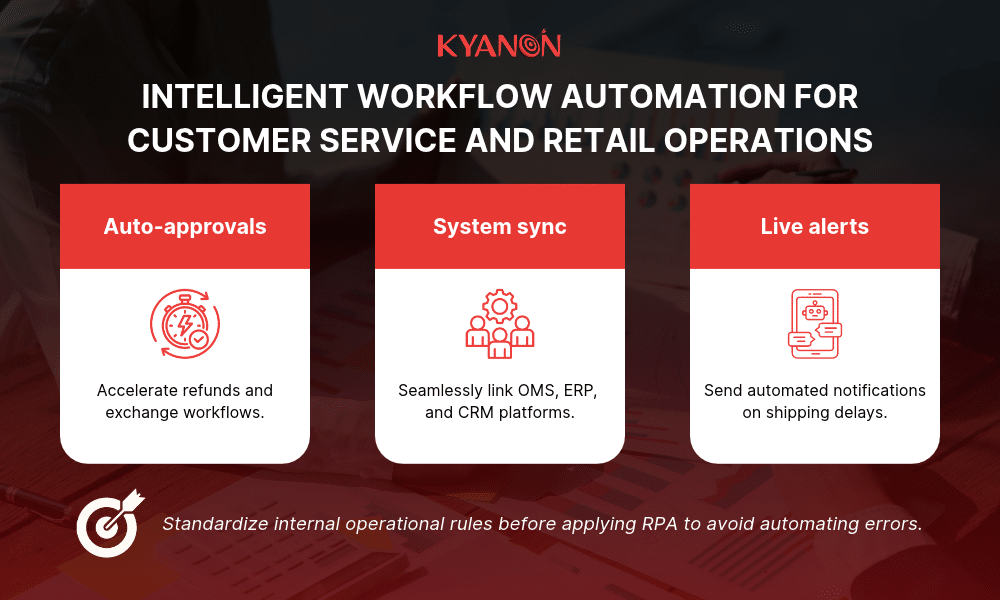
Intelligent workflow automation connects routine business processes across customer service, order management, and fulfillment. It helps retailers process refunds, update order statuses, and coordinate service requests without relying on repetitive manual work.
- Business problems it solves: Employees manually transferring customer information between systems, customers waiting too long for refunds, and service teams struggling to coordinate responses when orders are delayed or products are unavailable.
- Enterprise business value: Reduces repetitive administrative work, helps employees process refunds and service requests faster, and ensures customers receive more consistent updates when orders or deliveries encounter problems.
- Key technologies: Robotic process automation (RPA), automated approval workflows, and order management tools.
- Investment considerations: Retailers should review and improve existing processes before automating them. This helps prevent automation from repeating errors or unnecessary steps in order, refund, and customer service workflows.
How should retailers measure the ROI of CX technology investments?
Singapore retailers should measure CX technology ROI by comparing business performance before and after implementation. Key indicators include fewer cancelled orders, faster customer support, more repeat purchases, shorter checkout queues, and lower operating costs.
CX technology investment ROI framework
|
CX technology investment |
What to measure | Expected business improvements | Business owner |
| Unified commerce platforms | Stock accuracy; cancelled orders; order fulfillment accuracy | Fewer stock-related cancellations; more complete and on-time deliveries |
Head of Omnichannel / Retail Operations |
|
AI-powered customer engagement |
Customer response time; service costs; customer satisfaction | Faster support; lower service costs; more routine inquiries handled without staff assistance | Head of Customer Service / CX |
| Customer data and loyalty platforms | Repeat purchases; purchase frequency; customer retention | More returning customers; more frequent purchases; stronger customer loyalty |
CMO / Head of CRM |
|
Smart store technologies |
Checkout waiting time; staff productivity; self-checkout usage | Shorter queues; better staff utilization; faster checkout during peak hours | Head of Retail Operations |
| Intelligent workflow automation | Time spent on manual tasks; order and refund processing time; processing errors | Less manual work; faster processing; fewer operational errors |
Head of Operations |
Before implementation, retailers should record current performance to establish a baseline. After deployment, they can compare results while accounting for seasonal demand, promotions, and changes in store traffic. The measurement period should reflect the expected outcome: checkout improvements may appear quickly, while customer retention and repeat purchases take longer to assess.
Tracking these indicators helps retailers understand whether each investment improves customer experience, makes daily operations more efficient, and delivers measurable business value.
How can Kyanon Digital help Singapore retailers build a connected CX technology ecosystem?
As an enterprise digital transformation partner, Kyanon Digital helps Singapore retailers build and modernize omnichannel commerce ecosystems. By combining customer experience design, data-driven insights, and AI-powered automation, Kyanon supports businesses in connecting customer touchpoints, improving operational efficiency, and creating scalable digital commerce experiences.

Kyanon Digital’s capabilities cover four key areas:
- Customer experience (CX) design: Design intuitive shopping journeys across websites, mobile apps, and physical stores, with a focus on conversion optimization, accessibility, and customer engagement.
- Data-driven insights and intelligence: Connect customer and transaction data through analytics, tracking, customer segmentation, and predictive modeling to support better business decisions and identify growth opportunities.
- Omnichannel commerce platforms: Implement and modernize scalable eCommerce platforms, including Adobe Commerce, Shopify Plus, Salesforce Commerce Cloud, composable commerce solutions, and custom-built platforms.
- AI-powered automation: Apply AI to product recommendations, dynamic pricing, automated customer service, and predictive inventory management to improve customer engagement and streamline retail operations.
For retailers planning to modernize their commerce platforms or connect online and in-store experiences, explore Kyanon Digital’s omnichannel eCommerce development services to learn more about its solutions, technology expertise, and engagement models.
Case study: How Kyanon Digital helps an iconic Singaporean retailer modernize customer experience
How Kyanon Digital helps an iconic Singaporean retailer modernize customer experience
Kyanon Digital helped an iconic Singaporean retailer strengthen its customer experience through digital storefront modernization, mobile commerce, connected store technologies, and unified customer data. The project demonstrates how integrated CX technology investments can create more seamless shopping journeys across online and offline channels.
Challenges
- Outdated digital storefronts: Legacy website and mobile app experiences limited usability and product discovery.
- Disconnected shopping channels: Siloed online and in-store systems created friction across purchasing, pickup, and returns.
- Fragmented customer data: Disconnected CRM, inventory, and fulfillment systems restricted personalized engagement and consistent service.
Solution from Kyanon Digital
- Unified commerce platform: Migrated from the legacy customized eCommerce solution to a standardized enterprise platform to improve scalability and support future digital capabilities.
- Digital storefront and mobile commerce: Redesigned the eStore and mobile app to improve navigation, product discovery, and mobile shopping.
- Smart store technology: Introduced mobile POS to help store associates process transactions, retrieve orders, and assist customers across the shop floor.
- Fulfillment automation: Implemented a mobile fulfillment app to streamline store-level picking, packing, and delivery.
- Customer data integration: Connected CRM, PIM, OMS, and WMS to coordinate customer information, product data, orders, and inventory across channels.
Results and business impact
- Seamless omnichannel shopping: Enabled online purchases with in-store pickup or returns, as well as in-store purchases with home delivery.
- More convenient shopping experiences: Improved website and mobile app usability while enabling store associates to assist customers through mobile POS.
- Better fulfillment coordination: Connected inventory and order management systems to improve stock visibility and order processing.
- More personalized engagement: Unified CRM data to support personalized marketing and customer lifecycle insights.
Kyanon Digital’s recommendation: Singapore retailers facing fragmented online and in-store experiences should first assess whether their eCommerce, POS, CRM, and inventory systems can support consistent customer journeys. Connecting these core systems provides a foundation for mobile-assisted shopping, personalized engagement, and more efficient fulfillment.
Explore the full Kyanon Digital iconic Singaporean retailer case study to examine the technical architecture and delivery phases.
Conclusion
The top 5 CX tech investments for Singapore retailers address different business priorities, from improving online and in-store shopping to personalizing customer engagement and reducing manual service tasks. Rather than purchasing disconnected tools, retailers should prioritize technologies that work together to improve customer convenience and operational efficiency.
Before expanding capital expenditure on generative AI co-pilots or smart store sensors, validate that your core inventory and customer identity data synchronize accurately across all operating channels. Establishing baseline operational KPIs ensures your technology investments generate verifiable improvements in margin, staff productivity, and customer retention.
Planning your next retail transformation initiative? Book a consultation with Kyanon Digital to assess your technical architecture, eliminate data friction, and build an integrated CX technology ecosystem.
References
Refreshed Industry Digital Plan to Support Retailers — Infocomm Media Development Authority, 2026.
Retail Sales Index and Food & Beverage Services Index September 2026 — Singapore Department of Statistics, 2026.
What Are the Key Metrics to Consider in Customer Experience Benchmarking — APQC, 2026.
Perfect Order Performance — APQC, 2026.
14 Customer Retention Strategies for Ecommerce — Shopify, 2026.
What Is Customer Lifetime Value? How to Calculate CLV — Shopify, 2026.
Retail Transformation For An Iconic Singaporean Retailer — Kyanon Digital, 2025.







 Create project brief with AI