

Generative AI adoption in Singapore is growing, but enterprise-wide integration remains limited. The Ministry of Manpower (MOM) reports that 28.5% of firms have adopted AI, rising to 76.4% among firms with more than 500 employees. For enterprises, the priority is moving beyond isolated pilots to secure, integrated applications that improve measurable business outcomes.
Key takeaways
- Reveals that avoiding vendor lock-in requires a model-agnostic orchestration layer; in Kyanon Digital’s experience deploying enterprise platforms, decoupling business workflows from proprietary LLMs protects operational agility as model costs and benchmarks evolve.
- Warns against scaling generative AI beyond isolated pilots until data readiness and governance frameworks are strictly established, because unstructured data stores and missing audit trails reliably bottleneck core process integration.
- Clarifies that generative AI delivers measurable ROI only when embedded directly into existing departmental workflows, particularly for high-volume tasks such as operational knowledge retrieval, automated drafting, and customer service escalation.
- Shows that selecting the right retail solution depends entirely on use-case prioritization and systems integration, as our team at Kyanon Digital has seen off-the-shelf bots fail when disconnected from live inventory, CRM, and localized customer data.
Further reading:
- How Can Singapore Firms Build a GenAI Center of Excellence
- Generative AI for Retail: 7 Real Use Cases
- How Should Singapore Enterprises Assess AI Delivery Capacity
How can Singapore enterprises avoid GenAI vendor lock-in?
Generative AI vendor lock-in occurs when an organisation becomes dependent on one model provider, cloud platform or proprietary ecosystem. This can limit its ability to control costs, change models or adapt as technology evolves.
For Singapore enterprises, the risk is not simply choosing the wrong AI vendor. It is building business-critical workflows around technology that cannot easily be replaced.
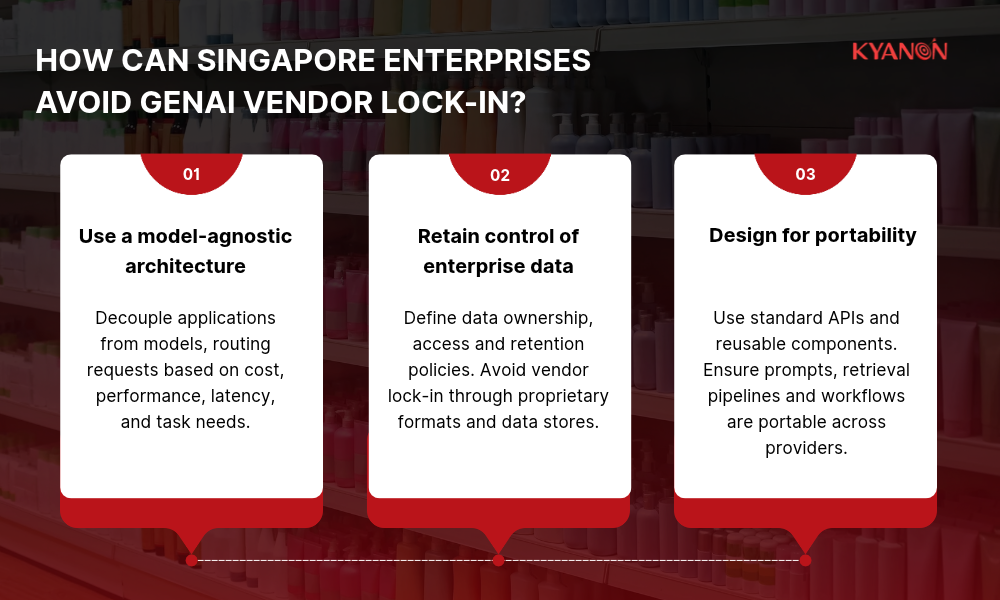
Three architectural decisions can reduce this exposure:
- Use a model-agnostic architecture. Separate business applications from the underlying language model. An orchestration layer can route requests to different models based on cost, performance, latency and task requirements.
- Retain control of enterprise data. Establish clear data ownership, access controls and retention policies. Avoid unnecessary dependence on vendor-specific data formats or proprietary knowledge stores.
- Design for portability. Use documented APIs, standard integration patterns and reusable components. Test whether prompts, retrieval pipelines and workflows can be transferred when changing providers.
A multi-model strategy does not mean using every available model. It means preserving the flexibility to select the appropriate model for each use case without rebuilding the entire solution.

What generative AI trends are shaping Singapore enterprises?
Singapore’s AI adoption figures show both momentum and an implementation gap. MOM‘s 2026 report found that 28.5% of firms had adopted AI, while 70.7% of AI-using firms reported productivity improvements. However, only 3.8% of firms had integrated AI into core business processes. High implementation costs (44.9%) and limited in-house expertise (42.4%) remain significant barriers.
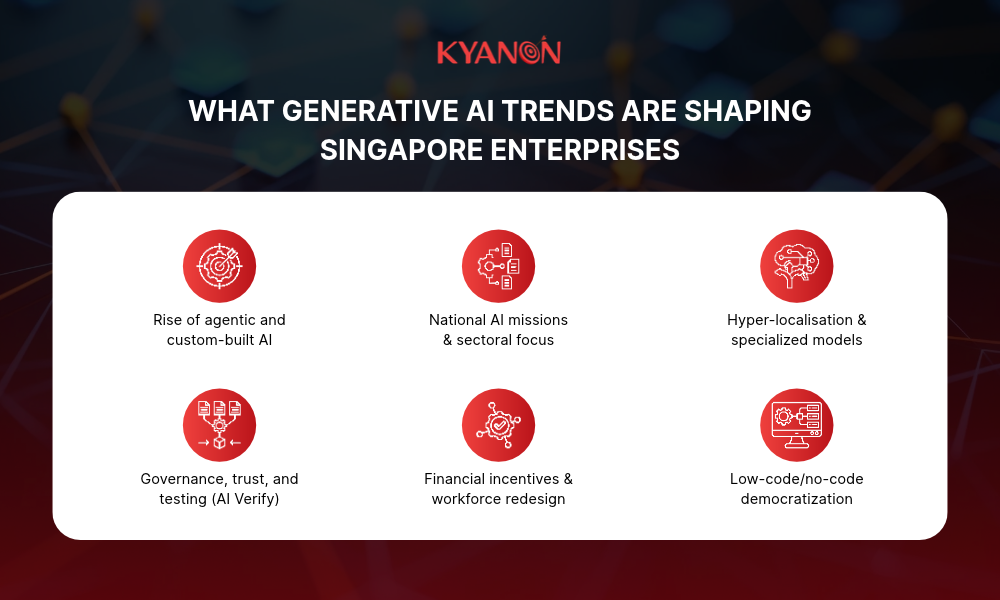
Rise of agentic and custom-built AI
According to a CPA Australia Business Technology Report, 93% of Singapore businesses use AI, and 56% expect to increase their use of agentic AI (autonomous systems capable of executing multi-step tasks) over the next year, the highest demand among surveyed regional markets. (The Business Times)
National AI missions & sectoral focus
Guided by the refreshed National AI Strategy (NAIS) 2.0 and overseen by the National AI Council chaired by Prime Minister Lawrence Wong, Singapore is driving GenAI and automation across four core sectors: Advanced Manufacturing, Financial Services, Connectivity, and Healthcare.
Hyper-localisation and specialized models
Generic chatbots are being replaced by custom-trained models that understand local Singaporean consumer behavior, multilingual nuances, and regional supply chain data.
Low-code/no-code democratization
Non-technical department heads in SMEs and enterprises are increasingly using no-code platforms to build custom workflows and integrate AI into legacy systems (such as CRMs and ERPs) without full-scale software engineering overhauls.
Governance, trust, and testing (AI Verify)
With near-universal adoption, governance and data security have become top priorities. Enterprises are heavily utilizing the IMDA AI Verify Framework and tools like Project Moonshot to test generative models for safety and bias before live deployment.
Financial incentives & workforce redesign
Through Budget 2026 and the Enterprise Innovation Scheme, businesses can access up to a 400% tax deduction on qualifying AI expenditures, alongside programs like “Champions of AI” to help companies redesign workflows and upskill workers.
How to choose the best Generative AI for Retail
There is no single best generative AI platform for every retailer. The right choice depends on the business use case, existing technology environment, data sensitivity and required level of integration.
Singapore’s retail sector is already exploring AI across customer engagement and operations. The 2026 Retail Industry Digital Plan, refreshed by Enterprise Singapore and IMDA, identifies GenAI customer engagement chatbots, marketing and sales content generation, and digital training systems as relevant applications. It also highlights demand forecasting as an AI-enabled operational capability.
Retailers can prioritise applications based on business value:
|
Retail use case |
Generative AI application | Business value |
| Customer service | Product enquiries, delivery updates and returns assistance |
Faster responses and improved service availability |
|
Marketing and sales |
Product descriptions, campaign content and promotional variations | Reduced content production effort |
| Employee training | Conversational training assistants and knowledge retrieval |
More accessible operational guidance |
|
Product discovery |
Natural-language search and personalised product explanations | Easier product discovery |
| Store operations | Internal assistants for SOPs, policies and operational queries |
Less time spent searching for information |
What must be in place before an enterprise scales GenAI?
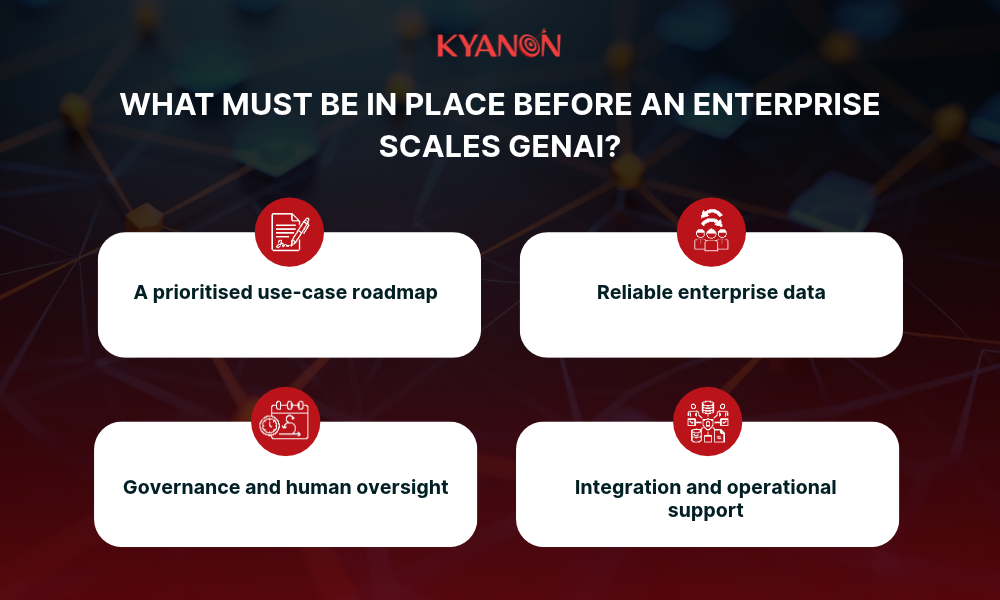
A successful pilot does not automatically translate into enterprise-wide value. Before scaling, organisations should establish four foundations:
- A prioritised use-case roadmap: Select applications based on business impact, feasibility, data readiness and risk. Define measurable success criteria before development begins.
- Reliable enterprise data: Consolidate relevant information, improve data quality and establish access permissions. Identify which sources the AI system can retrieve and use.
- Governance and human oversight: Define ownership, approval processes, audit trails and escalation procedures. Sensitive or high-impact decisions should retain appropriate human review.
- Integration and operational support: Connect GenAI applications to existing workflows and systems. Monitor response quality, latency, usage, security and operating costs after deployment.
Kyanon Digital approaches GenAI as an enterprise engineering challenge rather than simply a model implementation. Our Generative AI consulting services cover use-case definition, model and RAG architecture, secure data integration, deployment and continuous improvement.
Case study: Building an AI-powered Legaltech Platform with Kyanon Digital
Building an AI-powered Legaltech Platform
Business challenge
The client needed to overcome the high cost and complexity of traditional legal services while addressing the limitations of general-purpose AI. Key requirements included:
- Delivering reliable, context-aware legal guidance.
- Automating legal research and document workflows.
- Providing scalable, 24/7 access to legal information.
Kyanon Digital’s solution
Built a platform powered by LLMs, RAG and NLP, with key capabilities:
- Legal knowledge retrieval: Grounded responses in an updated EU legal knowledge base.
- Multi-model support: Integrated ChatGPT, Gemini, DeepSeek and Ollama for model flexibility.
- Workflow automation: Supported legal research, case classification, document drafting and verification.
- Operational reliability: Implemented role-based access, system monitoring and continuous optimisation.
Business outcomes
- Reduced manual workload: Automated repetitive legal research and document tasks.
- Scalable architecture: Enabled expansion into additional legal domains and markets.
- Flexible AI infrastructure: Reduced dependence on a single LLM provider.
Explore the full case study here: Building an AI-powered Legaltech Platform with Kyanon Digital
Conclusion
GenAI delivers business value when it moves beyond standalone tools and becomes part of core enterprise workflows. Success requires the right use cases, trusted data, scalable architecture and strong governance.
Ready to turn GenAI opportunities into business outcomes? Contact Kyanon Digital to design, integrate and scale enterprise-ready AI solutions tailored to your business needs.
References
- Adoption of Artificial Intelligence Among Firms – Ministry of Manpower (MOM)
- Business Technology Report 2026 – CPA Australia / The Business Times
- National AI Strategy 2.0 – Smart Nation Singapore
- Refreshed Industry Digital Plan to Support Retailers – Infocomm Media Development Authority (IMDA)
- AI Verify: Testing Framework and Toolkit – AI Verify Foundation
- Project Moonshot – Infocomm Media Development Authority (IMDA)
- Enterprise Innovation Scheme – Singapore Budget 2026
- Generative AI Consulting Services – Kyanon Digital
- Building an AI-powered Legaltech Platform – Kyanon Digital



 Create project brief with AI