


Platform modernization for commerce helps enterprise retailers and distributors remove technology constraints that have become operational bottlenecks. When marketing campaigns are delayed by rigid page templates, or new omnichannel workflows require extensive custom coding, outdated commerce architecture can limit how quickly a business adapts to market demands.
The primary decision for technical and business leaders is not simply whether to upgrade, but how to modernize without disrupting existing operations. The choice between replacing the entire platform and incrementally decoupling its components directly affects execution risk, upfront cost, and time-to-value.
Key Takeaways
- Assess existing technical debt to determine whether to rehost, decouple, or fully replatform the commerce architecture.
- Integrate local payment gateways natively only when checkout friction and reliance on third-party redirects actively limit conversion rates.
- Evaluate the Productivity Solutions Grant (PSG) to potentially offset costs for eligible, pre-approved digital commerce solutions in Singapore.
- Kyanon Digital perspective: Choose incremental decoupling when backend data logic (like ERP or PIM) is highly customized and stable, but frontend performance is holding back user experience.
- Unify real-time inventory and fulfillment APIs to help prevent overselling across omnichannel touchpoints.
Further reading:
- Enterprise Digital Commerce Transformation in Singapore
- Shopify vs Magento for Singapore Ecommerce: Which to Choose?
- Custom ECommerce Systems for Complex Retail Ops
Why does the Singapore commerce platform need modernization?
The trigger for modernization usually emerges when legacy monolithic systems tightly bind the user interface to the backend database, making routine updates reliant on full-system deployments. This rigidity prevents teams from quickly adapting to localized consumer behaviors.
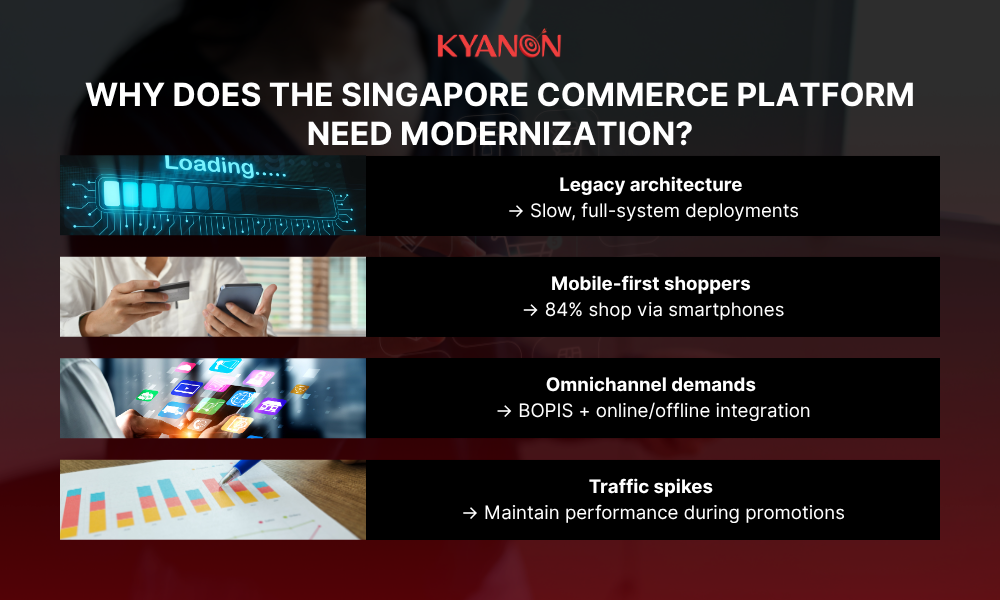
In Singapore, where 84% of local shoppers purchase via smartphones, an architecture that cannot deliver a fast, responsive mobile experience directly impacts sales. Furthermore, if a system struggles to integrate buy-online-pick-up-in-store (BOPIS) workflows or handle high-traffic promotional events without downtime, digital modernization becomes a prerequisite for operational continuity, not just an IT refresh.

What are the core pillars of enterprise platform modernization in Singapore?
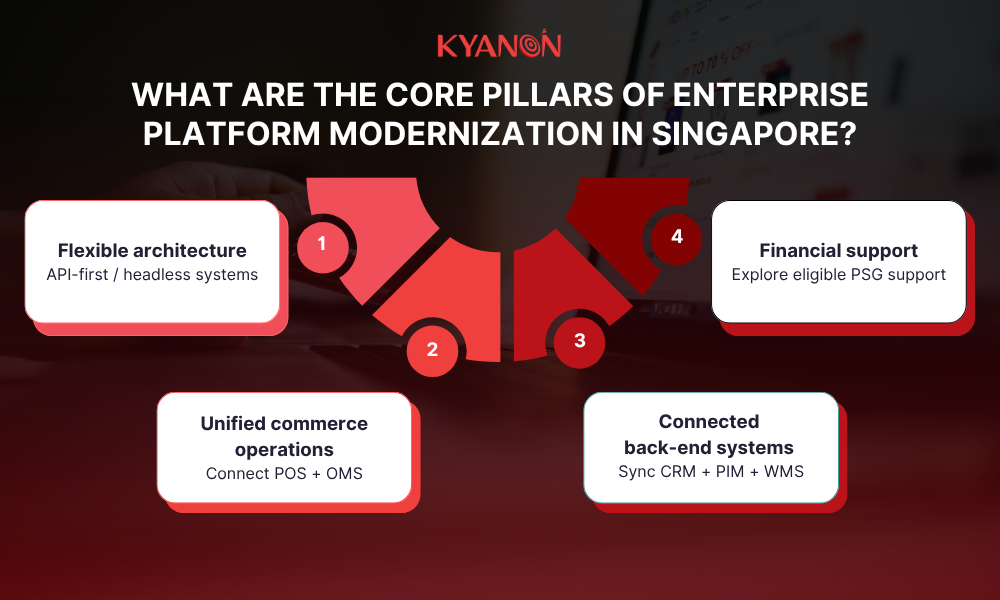
Modernization requires shifting from closed, rigid systems to architectures that support integration. The core pillars depend on the specific bottlenecks within your business:
- Flexible Architecture Alignment: Transitioning to a headless or API-first architecture decouples the frontend presentation layer from the backend commerce engine. This approach is highly suitable for organizations that require continuous mobile optimization without risking backend stability.
- Unified Online and Offline Operations: Connecting mobile Point of Sale (POS) and Order Management Systems (OMS) bridges physical retail and digital touchpoints, enabling localized click-and-collect workflows.
- Connected Back-End Systems: Establishing real-time data synchronization across CRM, Product Information Management (PIM), and Warehouse Management Systems (WMS) prevents stock discrepancies and supports accurate cross-channel fulfillment.
- Leveraged Financial Support: Eligible SMEs adopting pre-approved digital solutions can utilize national support schemes like the Productivity Solutions Grant (PSG) to offset transformation expenses.
How do you solve localized payment and fulfillment friction in Singapore?
Checkout abandonment often occurs when users encounter opaque delivery timelines or a lack of preferred local payment methods. A modern commerce platform treats payment and fulfillment as pluggable services rather than hardcoded core logic.
To reduce localized friction, organizations can integrate gateways, such as PayNow, GrabPay, and NETS, directly into the checkout flow via API providers. This prevents redirecting users to external third-party screens. For fulfillment, connecting the commerce layer to local logistics aggregators enables dynamic shipping rates and accurate delivery windows.
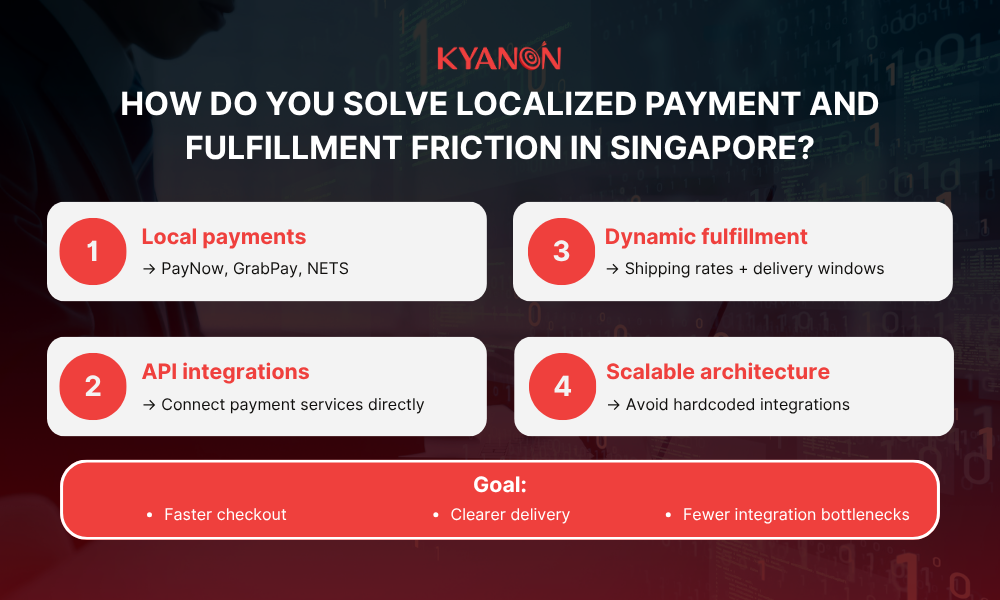
If your current architecture requires extensive custom development just to add a new digital wallet or adjust a shipping rule, your integration layer is likely the constraint. Assessing this bottleneck is a practical first step; you can discuss digital commerce transformation services with Kyanon Digital to evaluate your existing ecosystem and build the scalable API connections required.
How can enterprise leaders execute modernization without risking revenue or data loss?
Migrating an active e-commerce site carries inherent risks of data corruption, search ranking drops, and revenue interruption. To mitigate these risks, leaders must choose an approach based on their specific technical constraints and business urgency.
Comparison of commerce platform modernization approaches
Approach | Mechanism | Best Fit When… | Primary Execution Risk |
| Rehost (Lift and Shift) | Move the existing monolithic platform to the cloud without changing the underlying code. | Hardware is end-of-life, but the application logic and checkout flows still meet business needs. | Retains existing technical debt and frontend rigidity. |
Incremental Decoupling | Replace the frontend with a headless layer while temporarily keeping the legacy backend intact. | Frontend performance is poor, but backend data structures are highly customized and stable. | Requires managing and synchronizing two architectures during the transition phase. |
| Full Replatforming | Migrate entirely to a new composable or packaged SaaS commerce engine. | The current platform is unsupported, lacks basic APIs, or cannot scale to meet volume demands. | High initial cost, complex data migration, and longer time-to-value. |
Successful execution relies on phased rollouts. By decoupling a single domain, such as the product catalog, before transitioning the critical transactional checkout flow, teams can isolate risk and ensure that core revenue streams remain stable.
How Kyanon Digital modernized a digital platform for a leading travel corporation
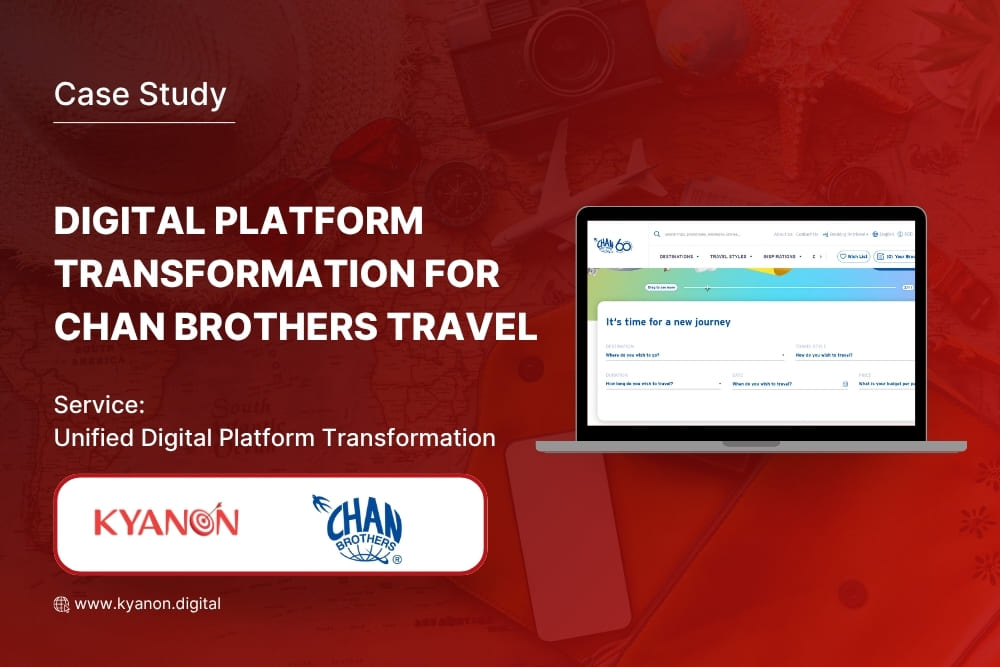
Kyanon Digital implemented a frontend digital experience and unified workspace solution for a travel enterprise in Singapore, providing a relevant example of decoupled architecture applied to a complex booking workflow.
Challenges
- Outdated user interfaces and rigid booking processes created friction across the digital customer journey.
- Disconnected internal workflows and separate tools prevented travel advisors from delivering rapid, personalized service.
- The legacy mobile experience constrained the ability to capture mobile-first transactions effectively.
Solution from Kyanon Digital
- Reimagined the frontend digital experience to decouple user interactions from legacy backend constraints.
- Engineered a unified digital workspace that allowed advisors to manage relationships, inquiries, and payments within a single interface.
- Deployed a flexible architecture that enabled product teams to launch new promotions and offerings without full-system redeployments.
Results and Impact
- Achieved measurable improvements in booking conversion rates across targeted customer segments by reducing checkout friction.
- Improved operational agility, enabling faster time-to-market for new feature adaptations and service offerings.
Explore the full case study here: Digital Platform Transformation for a Leading Travel Corporation
Conclusion
Platform modernization for commerce is fundamentally a risk-management decision. Whether an enterprise chooses to rehost, incrementally decouple, or fully replatform depends entirely on which technical constraints are actively limiting business growth. Before committing to a complete system overhaul, leaders must validate their backend data readiness and determine whether targeted API integrations, such as adding local payment methods, can deliver immediate value with lower migration risk.
Ready to evaluate your architecture and transition strategy? Discuss your modernization roadmap with Kyanon Digital.
References
- Singapore E-commerce Market Size, Share & 2031 Growth Trends — Mordor Intelligence, 2026.
- Productivity Solutions Grant — Enterprise Singapore, 2026.
- Digital Platform Transformation for a Leading Travel Corporation — Kyanon Digital, 2025.








 Create project brief with AI