


In today’s highly competitive and fast-changing business environment, strengthening leadership capabilities among management teams has become a strategic priority for every organization. Sustainable business growth no longer depends solely on executive vision. It also relies heavily on the ability of middle managers to lead teams effectively, drive collaboration, and maintain operational excellence.
During Leader’s Talk #10, themed “Strengthening Leadership Capabilities for Management Teams,” Kyanon Digital CEO Tai Huynh joined Squad Leads and emerging managers in an in-depth discussion about leadership responsibilities, organizational direction, and the future development of Squad Lead roles within the company.
The session provided practical insights into leadership development, team management, operational scalability, and sustainable organizational growth in a modern digital workplace.
The role of Squad Leads at Kyanon Digital
At Kyanon Digital, the organization is structured around Squads – cross-functional teams composed of professionals with diverse expertise working toward shared business goals. Each Squad is guided by a Squad Lead responsible for aligning execution with the company’s broader strategic objectives.
The Squad Lead role extends beyond project management. It involves developing people, improving productivity, ensuring profitability, and contributing to long-term organizational sustainability. These principles align closely with the company’s “5Ps” philosophy:
- Proposition
- People
- Productivity
- Profitability
- Purpose
Modern technology organizations increasingly adopt agile, squad-based operating models because they improve collaboration, speed, and innovation.
From a broader perspective, Squad Leads at Kyanon Digital are responsible for:
- Driving squad missions and objectives
- Ensuring project success and business efficiency
- Building high-performing collaborative teams
- Improving operational productivity
- Monitoring delivery quality and timelines
- Supporting sustainable business growth

The influence and responsibilities of Squad Leads
Squad Leads directly influence organizational success across four major dimensions:
- Company objectives
- Project performance and delivery outcomes
- Customer satisfaction
- Employee engagement and team morale
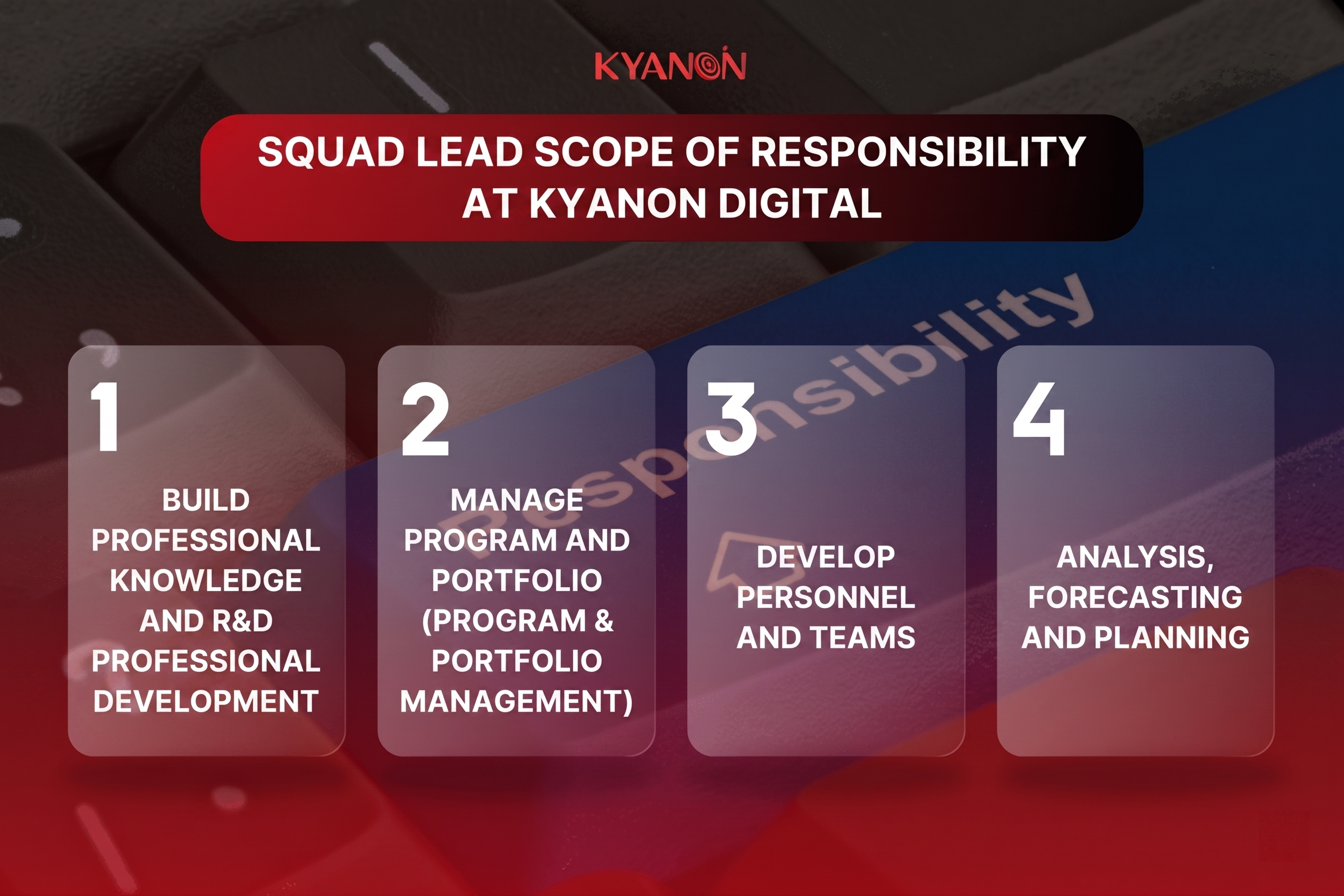
To fulfill these responsibilities effectively, the Squad Lead role is structured around four core capability areas.
1. Building expertise and driving R&D innovation
Strong technical and business expertise remains a foundational requirement for modern leadership.
Squad Leads are expected to:
- Continuously strengthen internal expertise in technology, business, and industry trends
- Explore emerging technologies and future opportunities
- Develop proofs of concept (PoCs), demos, and innovation showcases
- Contribute to go-to-market strategies for new solutions
- Design and implement innovative digital solutions
As AI, automation, cloud-native systems, and data-driven operations continue reshaping enterprises globally, leaders must balance operational execution with innovation readiness.
2. Program and portfolio management
Squad Leads also play a strategic role in resource allocation and delivery governance.
Key responsibilities include:
- Supporting Project Managers (PMs) and Product Owners (POs)
- Aligning project timelines with business goals
- Forecasting future resource demands
- Optimizing workforce utilization across projects
- Ensuring teams are staffed appropriately based on project requirements
In modern digital organizations, leadership increasingly requires balancing delivery performance with operational scalability. Effective portfolio management helps reduce delivery bottlenecks and improves organizational agility.
3. Team and talent development
People development
One of the most important responsibilities of a Squad Lead is developing future talent.
This includes:
- Hiring and preparing talent pipelines for future projects
- Coaching, mentoring, and upskilling team members
- Supporting workforce rotation strategies for scalability
- Identifying and nurturing future leaders
Team development
Squad Leads are also responsible for building healthy, high-performing teams by:
- Leading cross-functional collaboration
- Encouraging autonomy and innovation
- Creating alignment around organizational goals
- Maintaining motivation and engagement
- Managing distributed or multi-location teams effectively
In high-growth technology environments, leadership quality often becomes the key differentiator between scalable organizations and operationally fragmented teams.
4. Analysis, forecasting, and strategic planning
Squad Leads collaborate closely with Pre-Sales and business stakeholders to:
- Analyze business demand and forecast workloads
- Conduct market and competitive research
- Support sales enablement initiatives
- Identify new growth opportunities
Modern leadership increasingly depends on data-driven decision-making. Leaders must interpret operational data, customer feedback, project health metrics, and market signals to make informed strategic decisions.
Leadership requires both flexibility and long-term vision
Leadership development is rarely linear. Teams inevitably encounter operational obstacles, resource constraints, and changing business priorities.
An effective Squad Lead must remain adaptable while maintaining alignment with the organization’s long-term mission. Beyond solving immediate challenges, leaders must continuously improve systems, processes, and team structures to avoid operational stagnation.
Sustainable leadership requires:
- Strategic thinking
- Continuous improvement
- Reflection and learning
- Innovation-driven execution
- Long-term organizational mindset
Key leadership contributions
At Kyanon Digital, Squad Leads contribute to organizational success through three major dimensions:
1. Business effectiveness
Ensuring projects are delivered efficiently while maintaining profitability and scalability.
2. Customer impact
Improving customer satisfaction through strong delivery quality, responsiveness, and strategic alignment.
3. People development
Acting as the bridge between employees and the organization while enabling both team and individual growth.
Leadership expectations for Squad Leads
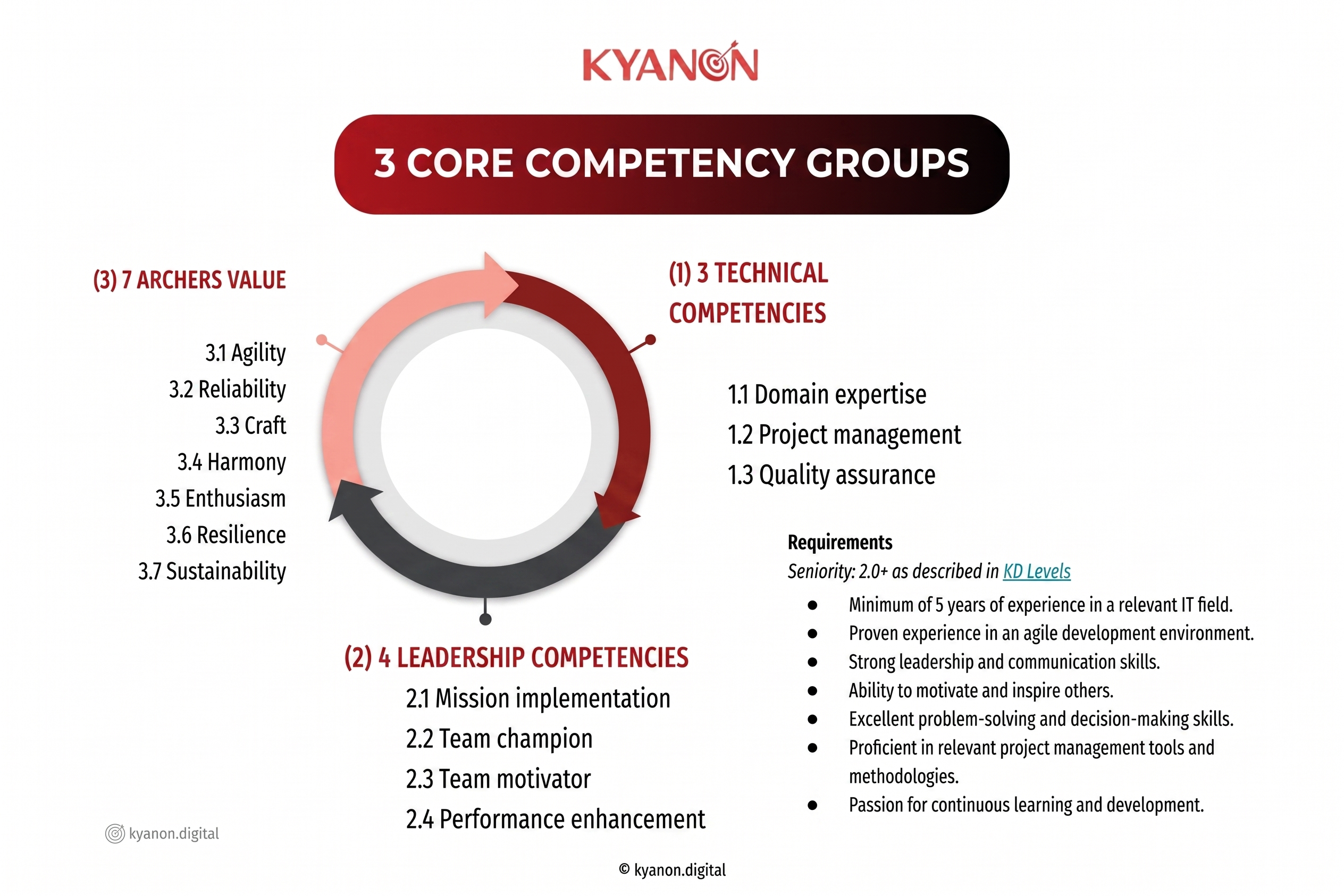
To grow successfully into leadership roles, Squad Leads must strengthen three essential capability groups.
Technical competencies
Technical leadership remains critical in digital organizations.
Core competencies include:
- Professional expertise
- Project management
- Quality assurance
Leadership competencies
Effective leadership requires more than technical knowledge.
Squad Leads must be capable of:
- Executing organizational missions
- Increasing team capability
- Improving team motivation
- Enhancing team productivity
The 7 core Archer values
Kyanon Digital also emphasizes seven foundational leadership values:
- Agility
- Reliability
- Craftsmanship
- Harmony
- Resilience
- Sustainability
- Ownership mindset
These values help create a culture focused on accountability, collaboration, adaptability, and long-term growth.

How to become an effective Squad Lead
Following group discussions during Leader’s Talk #10, Squad Leads and future managers identified several practical approaches for improving leadership effectiveness.
Define clear squad missions and OKRs
Teams perform better when goals are clearly aligned with organizational priorities.
Breaking down squad missions into measurable OKRs helps individuals understand:
- Their responsibilities
- Growth direction
- Contribution to larger company objectives
Use data to optimize resources
Project, workforce, and skill-related data should be collected and analyzed accurately to improve:
- Resource planning
- Productivity
- Workforce allocation
- Project forecasting
Data-driven leadership is becoming increasingly important in modern organizations adopting AI-assisted management and operational analytics.
Strengthen continuous learning and expertise development
Leadership growth requires structured improvement processes, including:
- Regular reviews
- Performance evaluations
- Knowledge-sharing sessions
- Continuous feedback loops
Improve time management
Squad Leads must balance multiple responsibilities simultaneously, including delivery oversight, team development, stakeholder communication, and strategic planning.
Effective scheduling and prioritization are essential leadership skills.
Standardize reporting and operational visibility
Organizations benefit significantly from transparent reporting systems that provide visibility into:
- Project health
- Team capacity
- Financial performance
- Operational risks
Build a strong learning culture
Training and knowledge-sharing initiatives should be integrated into OKRs and consistently maintained across teams.
A strong learning culture improves organizational resilience and long-term competitiveness.
Understand team capabilities and workforce allocation
Leaders must understand the strengths, growth potential, and utilization of team members to allocate resources effectively.
This becomes increasingly important in distributed and cross-functional work environments.
Develop financial and business awareness
Modern managers are expected to understand operational metrics such as:
- Profit & Loss (P&L)
- Project profitability
- Utilization rates
- Delivery efficiency
Strong business awareness helps leaders balance customer expectations with operational sustainability.
Leadership development roadmap for Squad Leads
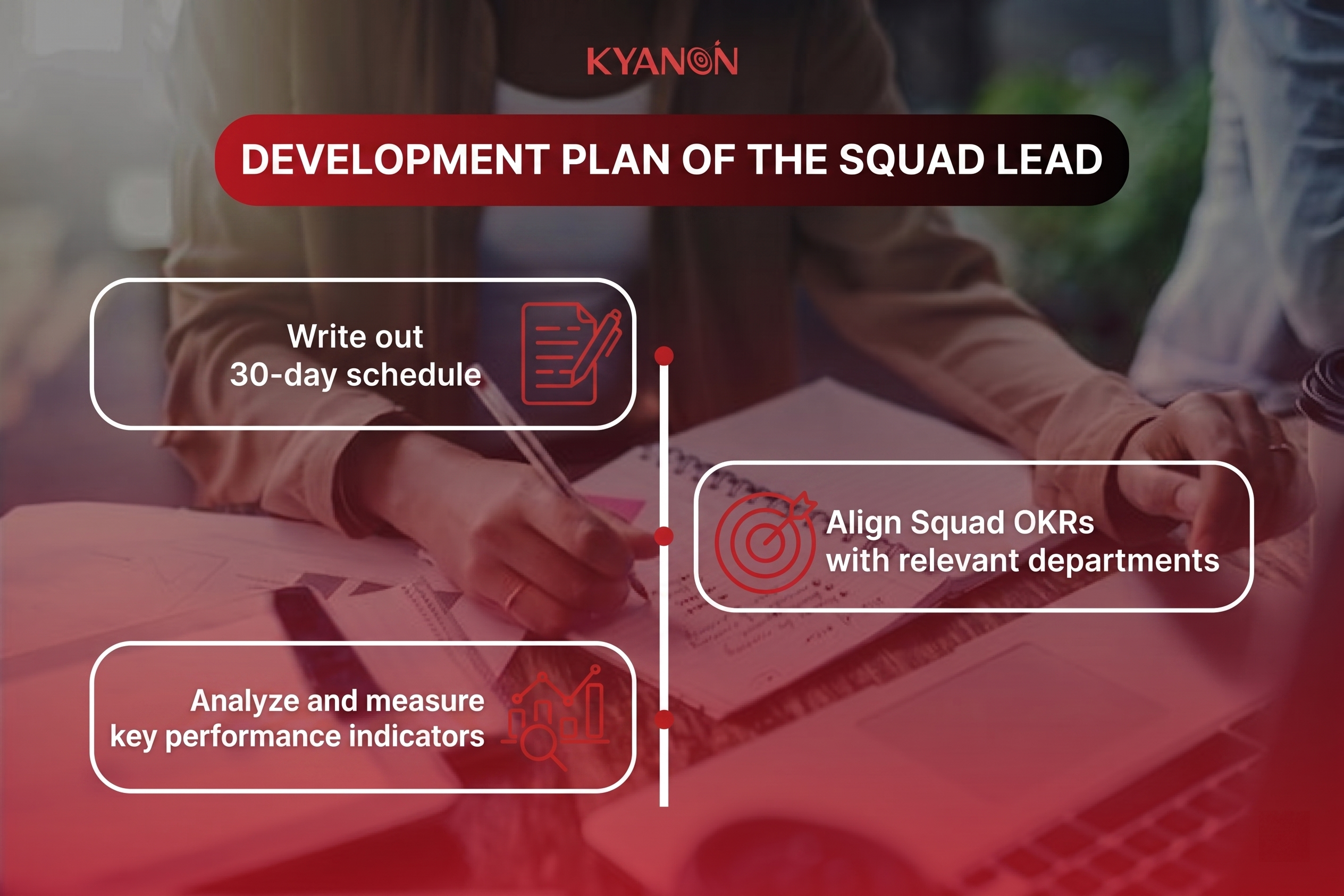
To sustain the value generated from Leader’s Talk #10, Squad Leads identified three key development priorities.
Create a 30-day leadership operating framework
Squad Leads should establish structured leadership routines, including:
- 1-on-1 meetings
- Customer communication schedules
- Team coaching sessions
- Performance tracking metrics
This improves leadership consistency and accountability.
Align OKRs across departments
Cross-functional alignment is essential for organizational efficiency.
Squad Leads should collaborate with related departments to ensure:
- Shared strategic direction
- Team alignment
- Clear contribution visibility for employees
Leaders should also identify areas where additional support or capability building is needed.
Reevaluate operational metrics
Organizations should continuously review which KPIs and operational metrics truly matter.
This includes evaluating:
- Project health indicators
- Team productivity metrics
- Customer satisfaction measurements
- Financial performance data
Modern leadership increasingly relies on measurable outcomes rather than intuition alone.
Conclusion
Leadership today extends far beyond task management. Modern leaders must act as strategic operators, mentors, problem-solvers, and culture builders.
Leader’s Talk #10 helped Squad Leads and emerging managers at Kyanon Digital better understand their mission, responsibilities, and long-term development direction. By strengthening leadership capabilities, organizations can build more resilient teams, improve delivery quality, and drive sustainable business growth.
As digital transformation accelerates globally, companies that invest in leadership development, cross-functional collaboration, and operational agility will be better positioned to navigate future challenges and opportunities.
Kyanon Digital’s Leader’s Talk series continues to provide practical leadership insights for management teams through recurring monthly discussions focused on organizational growth, innovation, and people development.








 Create project brief with AI