


AI fraud detection is becoming a claims-capacity priority. Insurers must process digital claims quickly while identifying fabricated evidence, coordinated fraud rings and subtle claim inflation without sending too many legitimate claims into manual review.
In March 2026, Insurance Europe warned that generative AI was making fabricated texts, reports and images more convincing. This widens the operational gap between fast digital settlement and slower evidence verification.
AI adoption is also moving faster than production readiness. In April 2026, EIOPA reported that 65% of surveyed European insurers were using generative AI, although most applications remained at the proof-of-concept stage or operated as assisted systems with human oversight. This figure covers insurance use cases broadly, rather than fraud detection alone, but it shows the growing need for production-level controls.
The practical response is a layered, human-governed fraud detection system, not a standalone AI model or an automated claim-denial engine. Rules can enforce known controls, machine learning can identify complex patterns, document and image analysis can expose evidence inconsistencies, and graph analytics can reveal connected claimants, devices, providers and accounts.
Applied at claim notification, evidence upload and pre-payment, the system should rank risk, show supporting reasons and route each claim to the appropriate workflow. Low-risk claims can move faster, while higher-risk cases receive targeted verification or specialist review. AI should support investigation decisions, not determine that a claimant is dishonest.
Governance must be built into the same workflow. Insurers need controls for data lineage, model validation, thresholds, explanations, human overrides and third-party changes. Performance should be measured through precision, recall, prevented loss, investigation cost, claim cycle time, complaints and total cost of ownership.
This article explains how AI claims fraud detection works, which techniques fit different fraud patterns, how to implement the system safely and how to evaluate its operational, financial and customer impact.
Key takeaways
- AI fraud detection prioritizes claims for review. A risk score is an investigation signal, not proof of fraud.
- Hybrid detection is usually stronger. Rules handle known conditions, while machine learning, content analysis and graphs identify complex patterns.
- Models must fit the insurance line. Fraud signals and thresholds differ across property, motor, health, travel and life claims.
- Data and workflow determine operational value. Reliable labels, traceable evidence and claims-system integration matter as much as model performance.
- Start with one measurable use case. Validate on recent claims, test in shadow mode and expand only after outcomes improve.
- Measure business impact, not accuracy alone. Track precision, recall, validated loss, investigation cost, claim delay, complaints and total cost.
- Accountability remains with the insurer. Governance must cover data, thresholds, explanations, overrides, vendors and human review.
- The 2026 direction is layered decisioning. Multimodal verification, network intelligence, real-time scoring and guarded automation will support earlier intervention.
Further reading:
- Digital Transformation in Insurance: A Complete Guide 2026
- Exploratory Data Analytics: From Raw Data to Business Insights
- How to Choose the Right AI Consulting Service Partner
- AI-Driven Software Development for Enterprises
What is AI fraud detection in insurance?
AI fraud detection uses machine learning and analytics to estimate whether a claim, claimant, provider, or network requires investigation. It evaluates evidence, produces a score or alert, and supplies reasons for the next action.
The role of data, algorithms, and automation
- Data provides context: claims, policies, payments, people, devices, content and providers.
- Algorithms estimate risk: models detect patterns, anomalies, similarity and relationships.
- Decision logic drives action: fast-track, request evidence or refer for investigation.
- Automation handles preparation: enrichment, extraction, duplicate search and routing.
- Human review controls material outcomes: staff verify evidence and decide under policy and law.
The NAIC’s April 2026 overview makes the same operational distinction: AI can support claims handling and fraud detection, but insurers remain accountable for fairness, accuracy, legal compliance, and human oversight.
Common insurance fraud AI can identify
AI can flag suspicious activity across claims, identities, providers, documents and connected networks.
Common examples include:
- Claim exaggeration: Inflated repair costs, medical expenses or property values.
- Duplicate claims: The same loss submitted across policies, insurers or channels.
- Synthetic identity fraud: Fabricated or combined personal, contact and payment details.
- Provider abuse: Upcoding, phantom billing, unbundling or unnecessary treatment.
- Coordinated fraud rings: Shared devices, addresses, vehicles, accounts or providers.
- Forged evidence: Altered receipts, invoices, reports, images or supporting documents.
- Staged losses: Deliberately arranged accidents, thefts, injuries or property damage.
- Misrepresentation: False information about ownership, loss circumstances or prior claims.
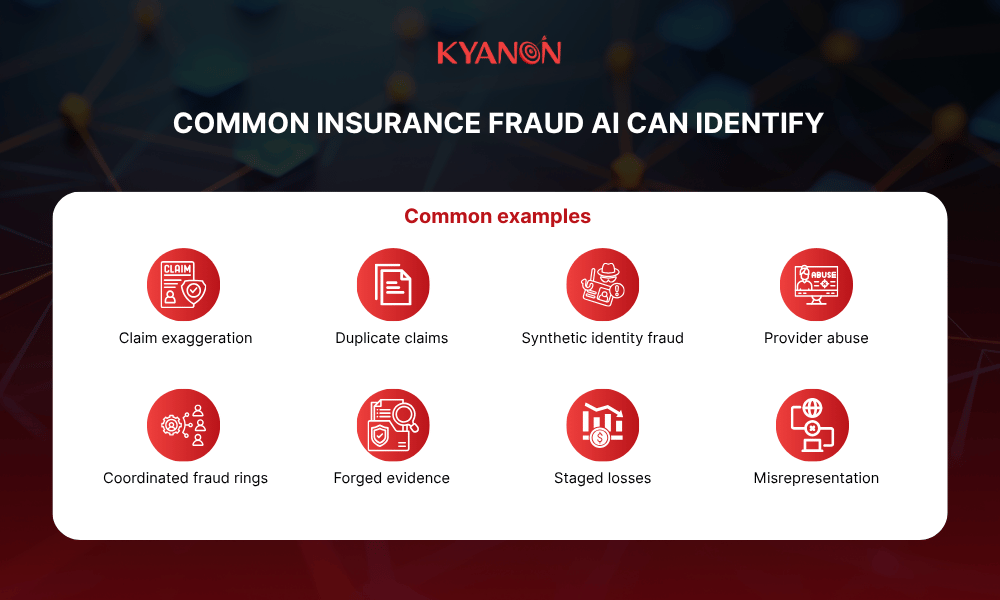
AI produces investigation signals, not proof. Models should be calibrated by insurance product, fraud pattern, jurisdiction, and available evidence.

How does AI fraud detection work in insurance?
A production system is a controlled workflow from evidence ingestion to investigation outcome. Each stage affects accuracy, explainability, and processing time.
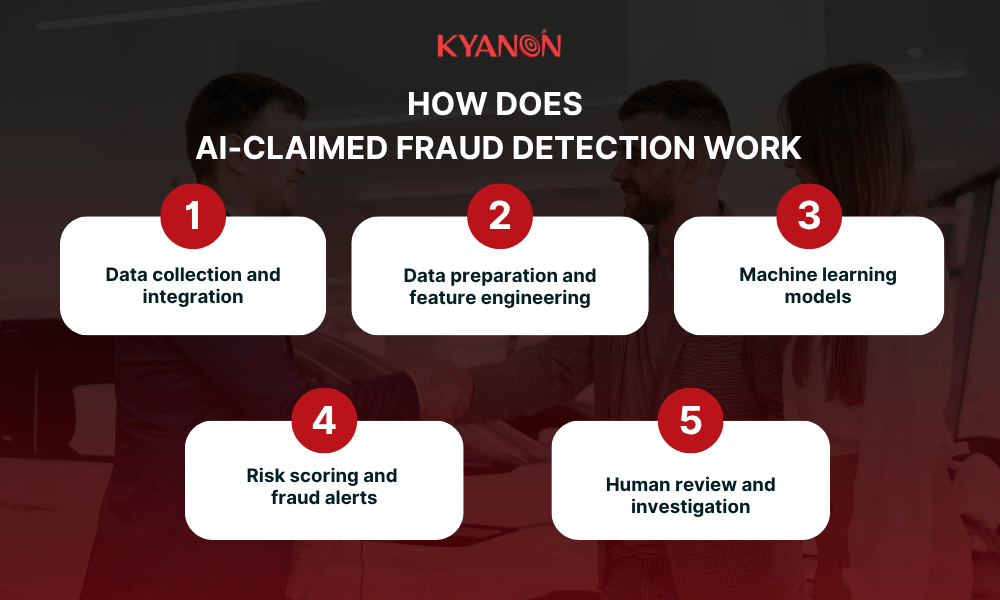
Data collection and integration
The system connects data available before and during claim handling:
- Claim, coverage, loss, amount and payment data
- Policyholder, beneficiary, insured asset and policy history
- Prior claims and connected entities across products and channels
- Notes, records, invoices, reports and receipts
- Images, video, audio, metadata, device signals and permitted external data
- Investigation outcomes and reason codes
Integration should preserve event time, source, legal basis, lineage and original evidence. Converting files or stripping metadata can remove forensic signals.
Data preparation and feature engineering
Names, dates, codes, repair items, addresses and provider identifiers require normalization before comparison.
Useful features can include:
- Time from policy start to loss or submission
- Claim amount relative to coverage, asset value or peers
- Reused bank account, device, address, image or invoice
- Conflicts across narrative, document, image and policy data
- Abnormal provider billing, timing or event sequences
- Links to confirmed cases
Features must exclude unlawful proxies and be tested for unintended discrimination. Derived variables need source-level lineage and controls.
Machine learning models
- Supervised learning predicts known fraud from labeled outcomes.
- Unsupervised learning finds outliers without complete labels, but needs interpretation.
- Semi-supervised learning combines a small labeled set with unresolved claims.
- Anomaly detection measures departure from expected peer behavior.
Ensembles commonly combine rules, classification, anomalies, content and network risk.
Risk scoring and fraud alerts
The system combines models and rules into an actionable score. Thresholds should reflect exposure, investigation capacity, urgency and false-alert cost.
A practical routing design has several bands:
- Low risk: continue normal processing under ordinary controls.
- Moderate risk: request targeted evidence or enhanced review.
- High risk: open a prioritized case with reasons and evidence.
- Critical breach: pause a defined action for authorized review.
Human review and investigation
The case view should show decisive signals, records, network links, comparable claims, confidence, and data limitations.
Controls should define overrides, approval, reason capture and feedback. An alert should never be presented as a confirmed allegation.
Fraud detection with machine learning: Key techniques
Fraud detection with machine learning is most reliable when the method matches the available evidence, label quality, and operational decision.
Technique | What it detects | Strong fit | Main limitation |
Classification models | Probability of known fraud patterns | Mature products with reliable labels | Repeats bias and blind spots in historical outcomes |
| Anomaly detection | Unusual claims, amounts or behavior | New schemes and sparse labels | Unusual does not necessarily mean fraudulent |
Clustering | Groups with similar hidden behavior | Provider patterns and claimant segments | Clusters require interpretation and monitoring |
| Natural language processing | Conflicts, entities and patterns in notes or documents | Medical reports, statements, invoices and adjuster notes | Extraction errors can distort downstream scoring |
Computer vision and media forensics | Duplicate, altered, synthetic or inconsistent media | Motor, property, travel and health evidence | Compression, poor capture and model evolution reduce certainty |
| Predictive analytics | Expected severity, timing or behavior | Claim triage and prioritization | Baselines can drift after product or process changes |
Graph-based analysis | Shared identities, devices, providers and coordinated rings | Organized fraud and cross-claim networks | Needs strong entity resolution and lawful data sharing |
Generative AI is better positioned as an investigator assistant than as the sole fraud classifier. It can extract entities, summarize files and draft a case chronology, but outputs need grounding in source evidence and review. NAIC materials published in August 2026 distinguish predictive AI that scores or flags claims from generative AI that creates content and agentic AI that can take workflow actions; permissions, logging and reversibility become more important as autonomy increases.
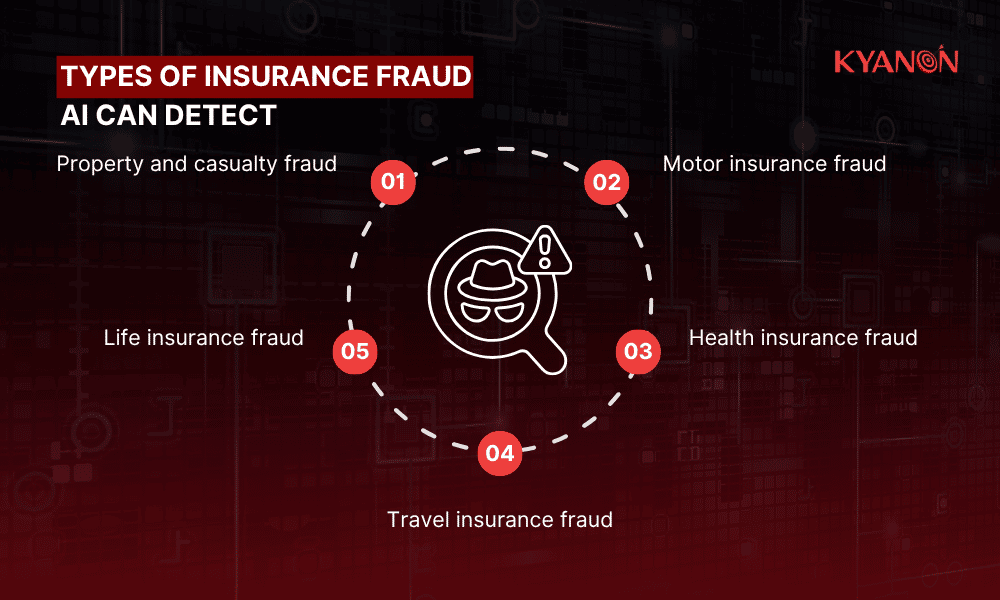
Types of insurance fraud AI can detect
AI fraud detection can flag suspicious claims, documents, identities, providers and connected networks. The output should support investigation, not serve as proof of fraud.
Property and casualty fraud
AI can identify fabricated damage, inflated repair costs, pre-existing losses, and repeated inventory. It compares images, invoices, event data and claim history.
Industry example: Allianz UK reported an £80,000 water-damage claim involving fake invoices and a manipulated flood image with inconsistent reflections and water patterns.
Motor insurance fraud
AI can flag staged accidents, phantom passengers, inflated repairs and connected collision rings. Useful methods include image forensics, telematics and graph analysis.
Industry example: Aviva reported that motor represented over 70% of the fraudulent claims it detected, while the value of detected motor fraud rose 39% in 2025. AI-generated accident images were also becoming more common.
Health insurance fraud
AI can detect phantom billing, upcoding, duplicate treatment and medically unnecessary services. It analyzes billing codes, provider behavior, patient history and network relationships.
Industry example: The 2026 US National Health Care Fraud Takedown charged 455 defendants in schemes involving over US$6.5 billion in alleged false claims. The investigation used data analytics to identify high-risk providers and billing networks.
Travel insurance fraud
AI can flag altered receipts, duplicate reimbursement, false cancellations and exaggerated medical or baggage claims. It checks documents, metadata, itineraries and claim timing.
Industry example: Aviva reported rising travel fraud involving exaggerated medical and cancellation claims, including documents submitted after the event that failed detailed verification.
Life insurance fraud
AI can identify synthetic identities, forged death evidence, beneficiary collusion and early-duration claims. It connects identity, policy, payment and relationship data.
Industry example: In July 2026, a US federal jury convicted two men who used stolen identities to obtain nine life and accidental-death policies worth US$4.325 million from eight insurers. One participant was named as the sole beneficiary across the policies. (US Department of Justice, 2026)
Because fraud signals differ by insurance line, models and thresholds should be calibrated by product, claim stage, jurisdiction and investigation capacity.
Benefits of an AI fraud detection system
An AI fraud detection system creates value by sending the right claim to the right review path at the right time. Benefits should be measured across fraud losses, claims speed, investigation capacity, customer impact and total cost.
| Benefit | Operational impact | Evidence to measure |
Faster claims processing | Low-risk claims avoid unnecessary manual review | Cycle time by risk tier |
| Higher fraud detection | Combined claim, content and network signals reveal complex patterns | Confirmed fraud and value detected per 1,000 claims |
Fewer false positives | Product-specific thresholds reduce weak referrals | Precision, referral acceptance and false-positive rate |
| Lower investigation cost | Automated checks and case preparation reduce manual effort | Cost per investigation, including AI lifecycle costs |
Higher productivity | Ranked queues, evidence and reason codes focus investigation time | Cases completed and time per case |
| Earlier intervention | Scoring at notification, upload or pre-payment flags risk before settlement | Prevented loss, scoring latency and payment-hold rate |
Better customer experience | Fewer legitimate claims enter avoidable investigation | Claim delay, complaints and decision overturns |
| Scalable fraud prevention | Automated scoring supports higher volumes across channels | Throughput, uptime and performance by insurance line |
Enterprise evaluation note
Overall model accuracy is not sufficient because fraudulent claims are relatively rare. A credible business case should demonstrate:
- Precision and recall at the proposed operating threshold
- Confirmed or prevented loss per 1,000 claims
- Investigation cost saved after full lifecycle costs
- Performance by product, channel and customer segment
- Impact on claim delays, complaints and legitimate customers
The strongest outcome is not the highest number of alerts. It is more confirmed fraud value with fewer unnecessary investigations and no unacceptable increase in customer harm.
AI fraud detection versus rules-based detection
Rules-based detection uses fixed conditions, while AI fraud detection compares claims, behavior, content and connected entities to uncover patterns that individual rules may miss.
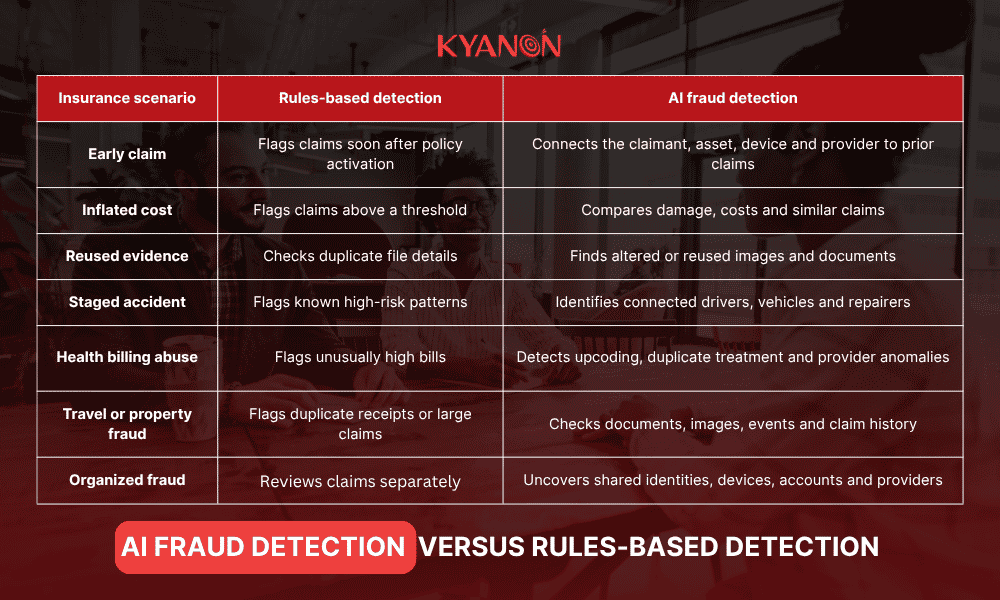
Enterprise implications of AI-enabled fraud detection
AI changes more than detection logic. It introduces new requirements for data, governance, infrastructure and human oversight.
- Hybrid detection: Keep rules for clear controls and use AI for complex or connected fraud patterns.
- Data integration: Combine claims, documents, images and entity relationships without weakening access controls.
- Explainability: Require reason codes and supporting evidence for every investigation referral.
- Model governance: Monitor drift, retraining, threshold changes and performance across customer segments.
- Operational scale: Test scoring latency, infrastructure cost and fallback processes before wider deployment.
- Human oversight: Use AI to prioritize investigation, not to determine that a claim is fraudulent.
Enterprise takeaway: Evaluate the complete operating model, rules, AI, workflow, and human review, not model accuracy alone.
How to implement AI fraud detection in an insurance organization
Implementing AI fraud detection requires more than training a model. Insurers need a controlled process covering business objectives, data, workflow integration, validation, human oversight and continuous monitoring.
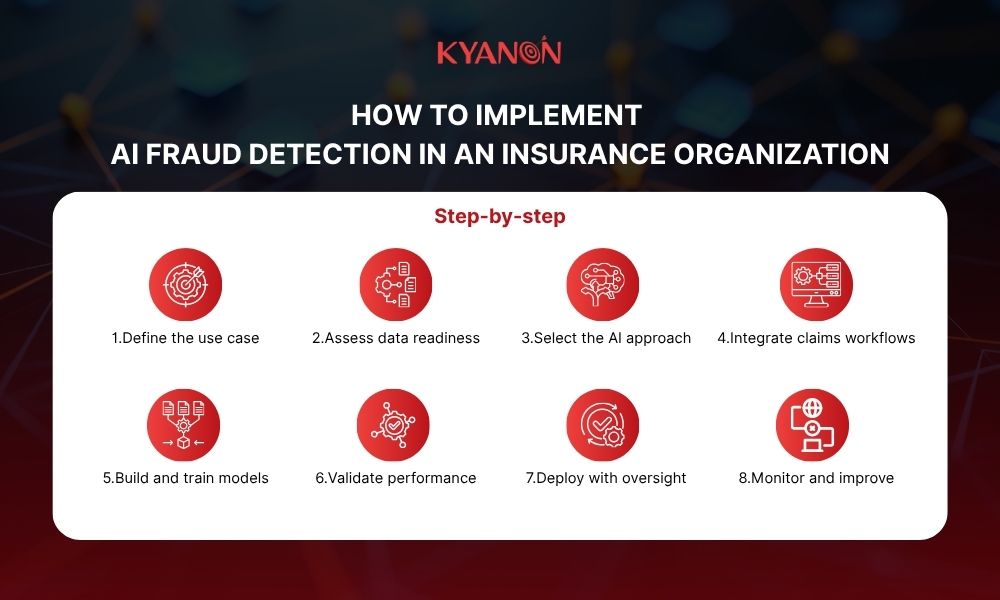
| Step | Key action | Evidence and controls |
| 1. Define the use case | Select one product, fraud pattern and decision point | Baseline fraud loss, alert quality, investigation cost, claim delay and complaints |
| 2. Assess data readiness | Review claims, documents, images, labels, lineage and access | Separate suspected, referred and confirmed fraud |
3. Select the AI approach | Use classification, anomaly detection, graph analytics, NLP or computer vision | Choose the simplest method that meets the objective |
| 4. Integrate claims workflows | Score claims at notification, document upload or pre-payment | Place risk reasons and evidence directly in investigation queues |
5. Build and train models | Use time-based data and prevent information leakage | Document features, assumptions, exclusions and ownership |
| 6. Validate performance | Test on recent, unseen claims and in shadow mode | Measure precision, recall, prevented loss, latency and segment performance |
7. Deploy with oversight | Begin with controlled decision support | Define reviews, overrides, audit records, complaints and shutdown controls |
| 8. Monitor and improve | Track drift, false alerts, outcomes and claim delays | Test and approve retrained models before production |
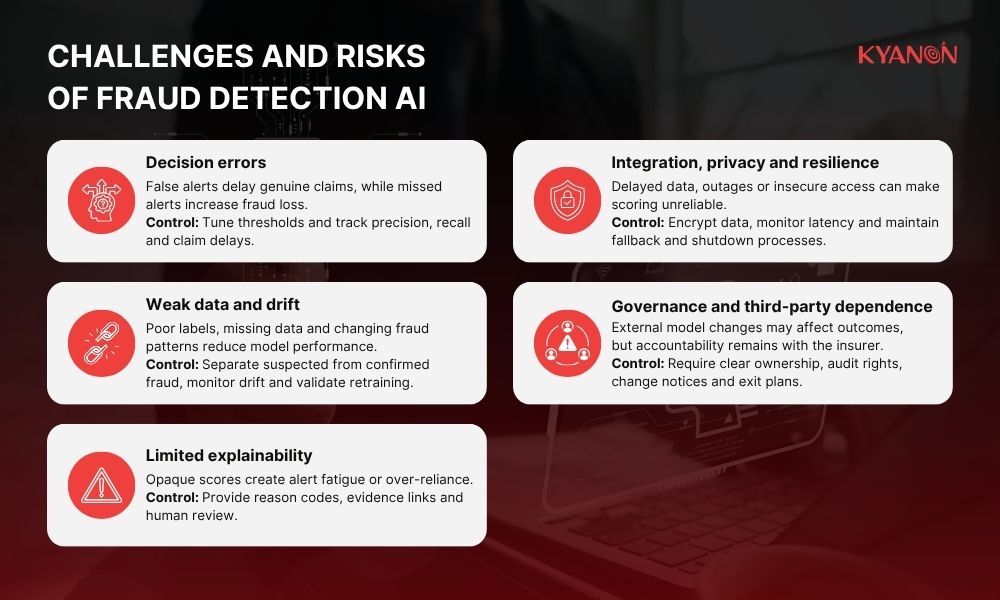
Challenges and risks of fraud detection AI
Fraud detection AI can improve claims triage, but weak controls can delay legitimate claims, miss fraud, expose sensitive data or create unfair outcomes. The main risks fall into five areas.
Decision quality
- False positives: Genuine claims enter investigation, increasing delays, complaints and operating costs.
- False negatives: Fraud passes through because the model misses new or weakly represented patterns.
- Uneven outcomes: Features or thresholds may affect customer groups differently.
Controls: Calibrate thresholds by product, channel and claim stage. Monitor precision, recall, claim delays and outcomes by segment. Sample low-risk claims to identify missed fraud.
Data and model integrity
- Weak labels: “Suspected,” “referred” and “confirmed” fraud are different outcomes. Combining them can teach the model historical investigation behavior instead of actual fraud.
- Incomplete data: Missing documents, disconnected identities or delayed provider data can make scores unreliable.
- Model drift: Fraudsters change their behavior after learning how controls work.
Controls: Define a consistent fraud-label taxonomy, maintain data lineage, validate on later unseen claims and approve retraining before production use.
Explainability and human behavior
- Opaque referrals: A risk score without supporting evidence is difficult to investigate, challenge or defend.
- Alert fatigue: Too many weak alerts cause important cases to be overlooked.
- Automation bias: Staff may accept model outputs without checking the underlying evidence.
Controls: Provide reason codes, evidence links and confidence levels. Record overrides and require human review for adverse or high-impact decisions.
Integration, privacy and resilience
Claims systems process sensitive identity, health, financial and loss information. Late data, system outages or insecure third-party access can affect both detection quality and regulatory exposure.
Controls:
- Minimize and encrypt sensitive data
- Apply role-based access and retention limits
- Monitor scoring latency and missing inputs
- Define fallback routing and reconciliation
- Maintain incident response and shutdown controls
- Restrict vendor reuse of claims data
A production audit trail should connect the input data, model version, score, referral reason, human action and final outcome.
Governance and third-party dependence
External models, data sources and platforms can change without sufficient visibility. Businesses remain accountable for claims outcomes even when technology is supplied by another party.
Controls: Maintain a use-case inventory, named ownership, model documentation, validation records and complaint routes. Vendor agreements should cover audit rights, model changes, data provenance, incidents, testing access and exit support.
Regulatory direction in 2026
- Europe: EIOPA warned in June 2026 that AI can amplify weaknesses in data quality, outsourcing and governance while creating new explainability and third-party risks.
- United States: AM Best presentation included in the NAIC’s August 2026 meeting materials distinguishes predictive, generative and agentic AI.
- European Union: Draft guidance published in May 2026 provides examples for determining whether an AI use case is high-risk. Classification depends on the system’s purpose and impact; fraud detection should not be classified by technology name alone (European Commission, 2026).
- Singapore: MAS published an operational toolkit in March 2026 covering traditional, generative and agentic AI across financial institutions. It emphasizes AI inventories, materiality assessment, lifecycle controls and clear oversight.
Enterprise decision rule
Start with AI-assisted prioritization rather than automatic claim denial. Expand automation only when the system demonstrates stable performance, traceable evidence, effective fallback processes and acceptable customer outcomes.
How to measure an AI fraud detection system
Model metrics and business metrics must be read together at the threshold used in production.
| Measure | Simple definition | Decision use |
Fraud detection rate/recall | Confirmed fraud flagged / all confirmed fraud | Shows how much known fraud the system captures |
| Precision | Confirmed fraud among flagged claims / all flagged claims | Shows the quality of the investigation queue |
False-positive rate | Legitimate claims flagged / all legitimate claims | Indicates unnecessary friction and workload |
| False-negative rate | Missed confirmed fraud / all confirmed fraud | Indicates loss exposure left undetected |
Investigation conversion rate | Referrals that produce a confirmed actionable outcome / completed referrals | Tests whether alerts create useful cases |
| Validated claims savings | Prevented, reduced or recovered loss supported by case evidence | Connects detection to financial value |
ROI | Net validated benefit / total program cost | Tests whether the operating model is economic |
| Average investigation time | Time from referral to investigation outcome | Measures workflow efficiency and customer delay |
Model drift | Change in inputs, scores and outcomes over time | Signals when investigation or retraining is needed |
Three measurement rules prevent misleading results:
- Use time-based validation. Random splits can leak patterns from the future or the same fraud ring into training and test data.
- Include delayed labels. Many investigations close weeks or months later; early precision figures are incomplete.
- Hold workload constant when comparing models. Compare value captured at the same referral capacity, not at arbitrary thresholds.
A defensible ROI model subtracts lifecycle and investigation costs from validated avoided loss, recovery and operating benefit. Use a counterfactual so existing-control savings are not counted twice.
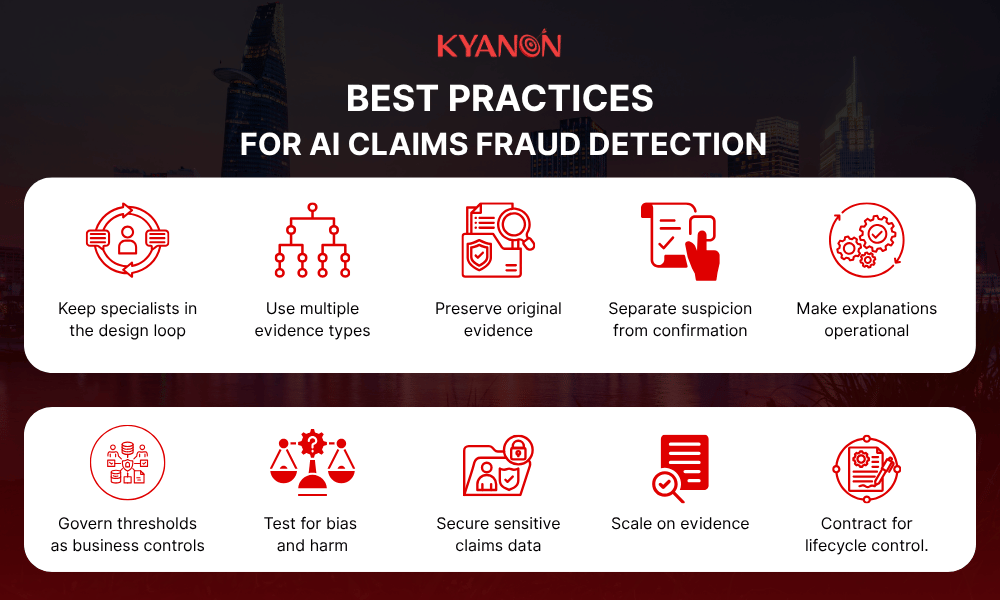
Best practices for AI claims fraud detection
- Keep specialists in the design loop. Investigator knowledge should shape labels, features, reasons and case workflow.
- Use multiple evidence types. Claims, policy, content, network and outcome data provide different signals.
- Preserve original evidence. Store source files and metadata before normalization or document conversion.
- Separate suspicion from confirmation. Distinguish alerts, referrals, adverse decisions, recoveries and confirmed fraud.
- Make explanations operational. Each alert should tell staff what changed, why it matters and which evidence to inspect.
- Govern thresholds as business controls. Approval, versioning and monitoring should cover thresholds as well as models.
- Test for bias and harm. Review performance, delay, overrides and complaints by segment.
- Secure sensitive claims data. Apply least privilege, purpose limitation, encryption, retention limits and third-party controls.
- Scale on evidence. Expand only after a defined outcome improves without unacceptable harm.
- Contract for lifecycle control. Require data rights, documentation, change notice, audit evidence, portability and exit support.
Kyanon Digital’s implementation perspective
From Kyanon Digital’s experience across enterprise data, AI, and system integration, treat fraud detection as an operating-model change, not a standalone model project. Even an accurate model creates limited value if it sits outside claims workflows, cannot trace source evidence, or lacks investigator feedback.
A practical approach is to start with one insurance product and decision point, integrate scoring into daily work, measure operational outcomes and scale only after the controls are proven.
→ Explore AI Integration Services
The future of AI fraud detection in insurance
AI claims fraud detection is moving from standalone scoring toward layered decision-making across the claims lifecycle.
In 2026, Fortune Business Insights estimated the global insurance fraud detection market at USD 7.90 billion and projected it to reach USD 46.61 billion by 2034, representing 24.9% annual growth. The forecast signals sustained investment in AI-enabled fraud controls, but it does not prove that any individual system will improve detection or ROI.
Trend | How fraud detection changes | Why it matters for claims | Control priority |
Multimodal verification | Compares text, images, video, audio and metadata | Detects manipulated or inconsistent evidence | Combine signals; never rely on one detector |
| Network intelligence | Connects claimants, devices, vehicles, providers and payments | Reveals fraud rings that appear legitimate individually | Verify identities and control data sharing |
Generative AI support | Builds timelines and summarizes case evidence | Reduces investigation preparation time | Link every statement to source evidence |
| Real-time intervention | Scores risk at notification, upload and pre-payment | Flags suspicious claims before settlement | Control latency, false alerts and fallback routing |
Guarded agentic workflows | Collects evidence, runs checks and routes cases | Automates repetitive investigation steps | Set permissions, limits, approvals, logs and rollback |
Enterprise takeaway: The future of AI fraud detection is not fully automated claim denial. It is a controlled decision system that integrates evidence verification, network analysis and investigator workflows with human oversight, clear explanations, and measurable outcomes.
Building a smarter claims fraud detection strategy
AI claims fraud detection creates value when it improves a real claims decision: which claims move quickly, which need more evidence and which justify specialist investigation. The strongest approach combines governed data, layered analytics, clear workflows and accountable human judgment.
Enterprises should begin with a defined fraud pattern and a baseline, then evaluate precision, recall, prevented loss, investigation capacity, claim delay and total cost together. Scale should follow verified outcomes – not model scores or automation volume.
If your organization is assessing the data foundation, architecture or workflow required for responsible AI fraud detection, contact Kyanon Digital to discuss a scoped assessment or implementation plan.










 Create project brief with AI