

For banks, KYC and AML are no longer only compliance functions. They are also operational and customer experience challenges. Manual verification, fragmented systems, and growing transaction volumes can increase compliance workload and slow customer onboarding. At the same time, banks need to strengthen financial crime controls without adding unnecessary operational risk.
KYC and AML compliance automation can help address this balance. By automating repetitive verification, screening, risk assessment, and monitoring tasks, banks can reduce manual effort and give compliance teams more time to focus on complex and higher-risk cases.
The challenge is not simply choosing an automation platform. Banks also need to consider data quality, integration with existing banking systems, workflow governance, human oversight, and the ability to adapt to changing regulatory requirements.
KYC and AML compliance automation connects customer data collection, identity verification, sanctions and PEP screening, risk assessment, transaction monitoring, and case management into governed digital workflows. Banks use it to reduce repetitive reviews, accelerate lower-risk onboarding, and give compliance teams more capacity for complex cases while retaining human oversight where required.
This guide explains where KYC/AML automation can create the most business value, what capabilities modern platforms should provide, how banks can approach implementation, and what to evaluate when selecting a technology partner.
Key takeaways
- Reduce manual work: Automate repetitive KYC and AML checks to free up compliance teams.
- Speed up onboarding: Verify customers faster while keeping the right compliance controls in place.
- Focus on higher-risk cases: Let automation handle routine cases and route complex cases to compliance teams.
- Connect existing systems: Use APIs and flexible workflows to integrate compliance tools with core banking systems and data sources.
- Scale with confidence: Combine automation and AI with human oversight, strong data, and clear governance.
Further reading:
- Digital Transformation in BFSI: A Framework for APAC Banks in 2026
- In-House vs Outsourced BFSI Software Development: Which Wins?
- Trends in Business Process Automation 2026
What is KYC AML compliance?
KYC AML compliance refers to the policies, processes, and controls banks use to verify customers, assess financial crime risk, and meet regulatory requirements. It provides the foundation for managing customer and transaction risks throughout the banking relationship.
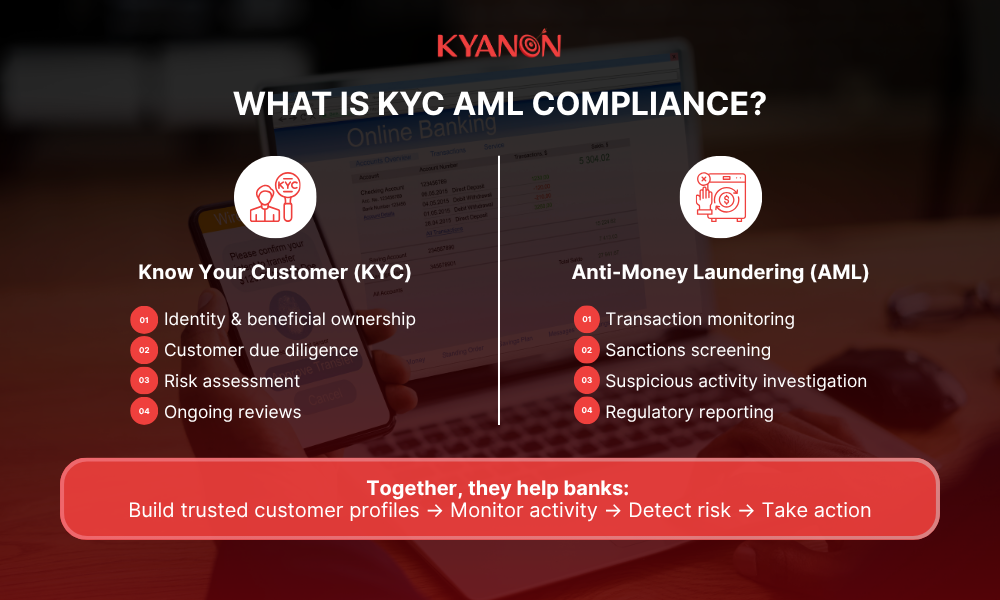
Know Your Customer (KYC) and Anti-Money Laundering (AML) fundamentals
Know Your Customer (KYC) and Anti-Money Laundering (AML) are core components of financial crime risk management in banking.
KYC focuses on understanding who the customer is. It covers identity verification, customer due diligence, beneficial ownership, risk assessment, and ongoing reviews.
KYC/AML compliance fundamentals
| Component | Primary role | Common activities |
| KYC | Establish who the customer is and their risk profile | Identity verification, CDD, beneficial ownership, risk rating, periodic/event-driven review |
| AML | Detect and manage financial-crime risk | Screening, transaction monitoring, investigation, escalation and regulatory reporting |
AML covers the broader controls banks use to prevent, detect, investigate, and report potential financial crime, including:
- Transaction monitoring
- Sanctions and watchlist screening
- Risk assessment
- Suspicious activity investigation
- Regulatory reporting
The two work together: KYC establishes the customer profile, while AML monitors activity against that profile to identify potential risks.
Regulatory governance frameworks and enforcement pressures
Banks must meet KYC/AML requirements across the jurisdictions where they operate. These typically include customer identification, beneficial ownership checks, risk assessment, ongoing monitoring, record keeping, and suspicious activity reporting.
Compliance is not a one-time exercise. Customer information changes, risks evolve, and regulatory expectations continue to develop. As banks adopt AI in compliance and risk processes, governance becomes increasingly important. AI governance and risk management are increasingly vital priorities for financial institutions.
For banking leaders, effective KYC/AML requires reliable data, connected processes, strong controls, and scalable technology, while minimizing unnecessary operational friction.

Challenges banks face with manual KYC and AML processes
Manual compliance processes can become difficult to scale as customer and transaction volumes increase. The challenge is not only the amount of work involved. Manual processes can also affect operating costs, customer experience, and the ability of compliance teams to focus on higher-risk cases.
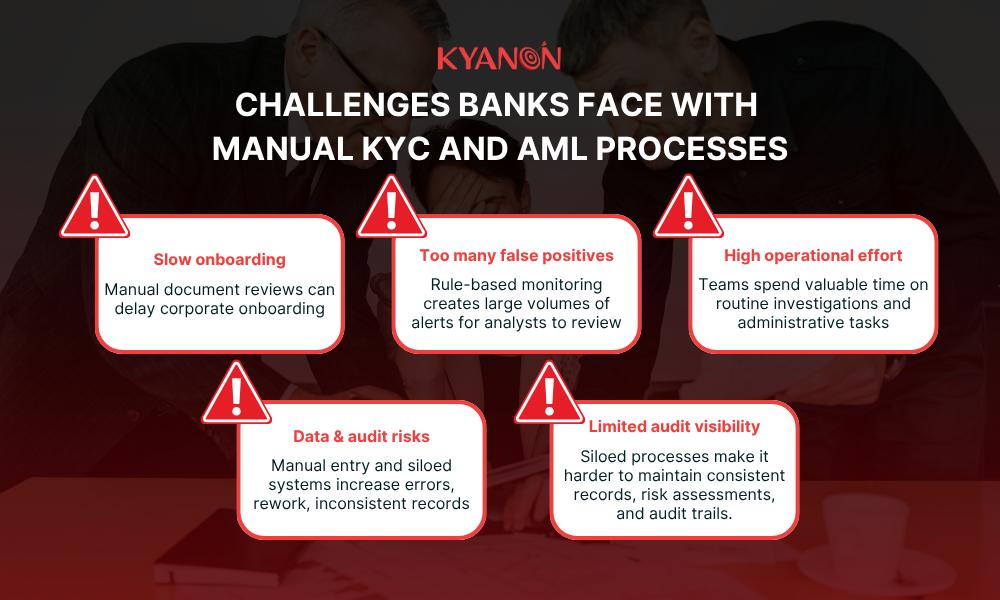
Manual compliance workflows create significant operational bottlenecks, data inconsistencies, and customer friction:
- High operational costs and personnel strain: Compliance teams spend significant time collecting documents, verifying customer information, checking ownership structures, and reconciling data across systems. As volumes grow, this increases resource requirements and reduces capacity for complex investigations.
- Alert overload and false positives: AML monitoring can generate large volumes of alerts, including legitimate activity. Excessive manual reviews can consume analyst capacity that would otherwise be directed toward higher-priority cases.
- Customer onboarding friction: Manual verification can slow account opening and require customers to submit multiple documents. This is particularly challenging for digital banking, where banks need to balance strong controls with a seamless onboarding experience.
- Fragmented customer and risk data: Customer information may sit across onboarding portals, CRM, core banking, transaction systems, and external data providers, forcing analysts to reconcile multiple sources before making risk decisions.
- Periodic reviews and stale profiles: Fixed review cycles can leave customer profiles outdated when ownership, geography, activity, or transaction behaviour changes between scheduled reviews.
What is KYC AML compliance automation?
KYC/AML compliance automation uses technology to connect customer data collection, identity verification, sanctions and PEP screening, risk assessment, transaction monitoring, and case management into a governed, rules-based workflow. Banks can automate repetitive checks, process straightforward lower-risk cases faster, and route higher-risk or unusual cases to compliance teams for human review.
Automated compliance workflows streamline data collection, verification, screening, and monitoring while improving consistency and giving compliance teams more capacity for complex cases.
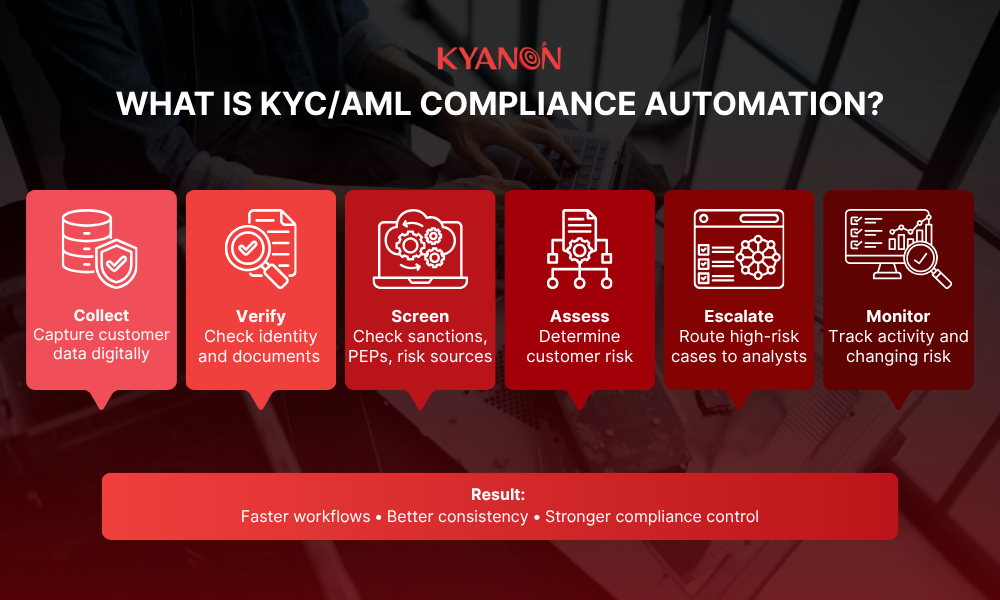
End-to-end operational pipeline execution
An automated KYC/AML process can support the customer journey from onboarding through ongoing monitoring:
- Data collection: Customer and business information is captured digitally.
- Identity Verification: Documents and identity information are checked automatically.
- Screening: Customers are screened against relevant sanctions, PEP, and other risk sources.
- Risk assessment: Customer information and risk factors are used to determine the appropriate risk level.
- Decision & escalation: Policy-approved lower-risk cases can follow straight-through workflows, while cases exceeding defined risk thresholds are escalated for review.
- Continuous monitoring: Customer activity and risk profiles are monitored over time, triggering reviews when relevant changes are detected.
The business outcome is a more consistent compliance process that reduces repetitive work, supports faster onboarding, and gives compliance teams more capacity for higher-risk cases.
How AML KYC Software Helps Banks
AML KYC software helps banks improve compliance efficiency by automating repetitive checks, connecting fragmented data, and applying risk-based workflows. The business impact extends beyond compliance operations, supporting faster onboarding, more consistent controls, and scalable financial crime management.
Business impact of AML KYC software
| Business area | How automation helps | Business outcome |
| Customer onboarding | Automates identity verification, document checks, screening, and risk assessment | Faster onboarding with less customer friction |
| Compliance accuracy | Standardizes checks, rules, and decision workflows | More consistent compliance processes and fewer manual errors |
| Manual workload | Automates repetitive verification, screening, and review tasks | Frees compliance teams to focus on complex cases |
| Fraud & financial crime detection | Connects customer, risk, screening, and transaction data | Helps identify and prioritize higher-risk activity |
| Compliance scalability | Supports automated, risk-based processing across growing volumes | Handles higher customer and transaction volumes more efficiently |
| Customer experience | Streamlines routine checks while escalating higher-risk cases | Reduces unnecessary friction while maintaining appropriate controls |
By combining automation with risk-based workflows and human oversight, AML KYC software can help banks reduce operational pressure without weakening compliance controls. The result is a more scalable compliance operating model that supports both regulatory effectiveness and better customer experiences.
Key features and modules of modern AML KYC software
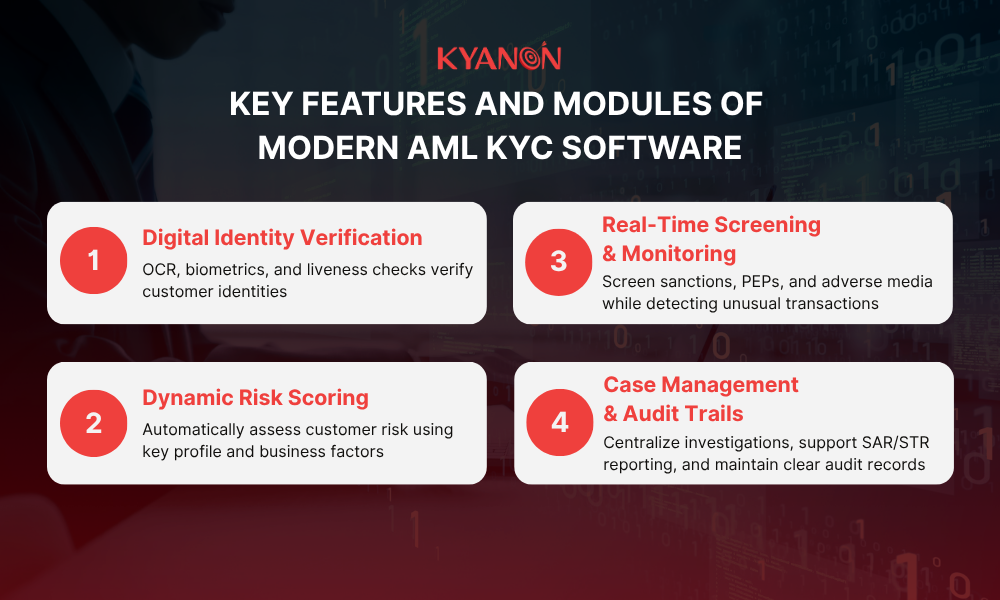
Modern AML KYC software can combine identity verification, screening, risk scoring, transaction monitoring, case management and audit evidence within a connected workflow. The required modules depend on the institution’s customer segments, regulatory obligations and existing technology environment.
Digital identity verification and biometrics
Faster identity verification can reduce manual onboarding effort while giving banks more consistent customer data.
Automated document recognition can extract information from identity documents, while biometric matching and liveness checks can support identity verification. These capabilities are particularly useful for high-volume digital onboarding, where manual verification can create unnecessary delays.
Dynamic customer risk scoring and categorization
Risk-based onboarding helps banks avoid applying the same level of review to every customer.
Automated risk assessment can consider factors such as customer profile, ownership structure, geography, and source of funds to determine the appropriate level of due diligence. Lower-risk cases can follow streamlined workflows, while higher-risk cases can be escalated for enhanced review.
Real-time screening and automated transaction monitoring
Better matching can help compliance teams spend less time reviewing irrelevant alerts.
Screening tools can account for variations in names and other customer information when checking sanctions, PEP, and other risk sources. Transaction monitoring can then assess activity against defined rules and risk patterns to identify cases that may require further investigation.
Case management, SAR automation, and audit trails
When an automated trigger identifies a high-risk transaction or screening match, the platform generates a centralized case file. The system pre-populates Suspicious Activity Reports (SARs) or Suspicious Transaction Reports (STRs) with extracted customer records, transaction histories, and rule violation details. An immutable digital audit trail captures every automated decision, system check, and investigator edit, ensuring complete transparency during regulatory examinations.
The strategic role of an AML KYC API in enterprise architecture
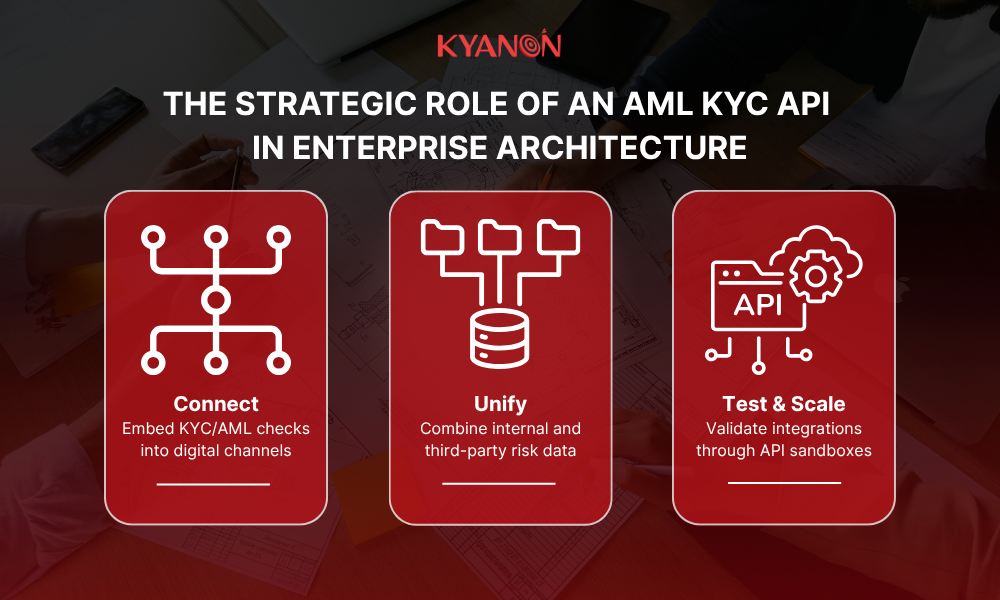
Modernizing enterprise architecture doesn’t require tearing down core banking platforms from scratch. By using powerful APIs as connective tissue, financial institutions can instantly link legacy databases with cutting-edge verification engines, bringing real-time compliance capabilities directly into customer-facing applications.
RESTful integration and sandbox deployments
An AML KYC API serves as the architectural bridge connecting internal core banking channels to specialized external data registries, identity verification engines, and screening databases. Built on RESTful microservices architecture, modern APIs allow engineering teams to embed verification capabilities directly into existing mobile application flows, web portals, and core ledger software. Vendor sandboxes allow developers to test API responses, evaluate schema compatibility, and simulate edge-case failure modes prior to production deployment.
Unifying legacy banking systems and third-party data registries
Legacy banking architectures frequently store customer data across separate business unit databases, resulting in fragmented views of customer risk.
API-driven integration layers solve this challenge by acting as an enterprise orchestration layer. An API-driven architecture queries primary source registers, watchlist updates, and internal transaction databases simultaneously, delivering unified risk intelligence directly to frontline business applications.
Evaluating and selecting the right KYC AML platform
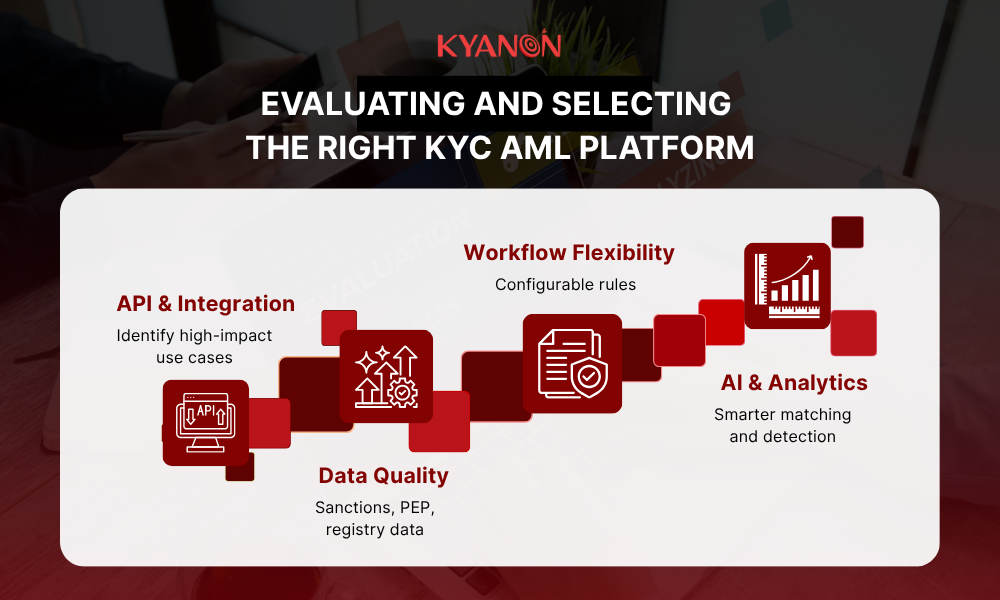
Selecting a KYC AML platform is not simply a technology decision. Banks should evaluate how well a solution supports their compliance priorities, customer experience goals, existing operating model, and ability to scale across products and markets.
The evaluation should focus on whether the platform can reduce manual effort, improve risk visibility, integrate with existing systems, and adapt as regulatory requirements change.
KYC AML platform evaluation criteria
| What to evaluate | What it should enable | What buyers should ask vendors |
| Integration & connectivity | Connect compliance workflows with existing banking systems and data sources | How easily can the platform integrate with our current systems and data? |
| Data coverage & quality | Provide reliable customer, sanctions, PEP, and risk information for decisions | How is data sourced, validated, updated, and monitored for quality? |
| Workflow flexibility | Adapt onboarding, screening, risk assessment, and escalation workflows as policies change | Can our compliance teams change rules and workflows without major development work? |
| Risk-based automation | Automate lower-risk cases while escalating higher-risk cases for human review | How does the platform determine what to automate and what requires human review? |
| AI & analytics | Improve risk detection, investigation efficiency, and alert prioritization | How are AI-driven decisions governed, tested, explained, and monitored? |
| Scalability & coverage | Support growing customer volumes, products, and geographic markets | Can the solution scale with our business and support future regulatory or market expansion? |
| Governance & auditability | Maintain oversight, traceability, and evidence for compliance decisions | Can we clearly track decisions, approvals, changes, and audit evidence? |
| Total cost & time to value | Deliver measurable efficiency gains without creating excessive implementation or operating costs | What are the full implementation, integration, licensing, and ongoing operating costs? |
For banking leaders, the right KYC AML platform should be evaluated on more than feature coverage. The stronger choice is the platform that fits the bank’s operating model, reduces meaningful compliance friction, supports appropriate human oversight, and can evolve with changing risks and regulations. A clear business case should also consider implementation effort, ongoing operating costs, expected efficiency gains, and time to value.
Tailoring KYC AML solutions across banking use cases
Different banking models have different KYC/AML risks, workflows, and operational priorities. Compliance automation should therefore be tailored to each use case rather than applied as a one-size-fits-all system.
KYC/AML challenges and automation priorities by banking use case
| Banking use case | Primary KYC/AML challenge | Automation priority |
| Retail banking | High onboarding volumes and customer friction | Automate identity verification, document processing, screening, and risk assessment |
| Business banking | Complex business structures and UBO verification | Automate corporate data collection, UBO checks, and risk profiling |
| Digital banking | Fast, remote onboarding at scale | Enable real-time verification, screening, and risk-based onboarding workflows |
| Private banking | High-value clients, complex ownership structures, and enhanced due diligence | Automate EDD, source-of-wealth checks, adverse media screening, and ongoing monitoring |
| Cross-border banking | Multiple jurisdictions, geographic risk, and complex transaction flows | Automate sanctions screening, geographic risk assessment, transaction monitoring, and regulatory checks |
| Fintech and banking partnerships | Shared responsibilities, fragmented data, and different compliance frameworks | Integrate KYC/AML workflows across platforms, standardize data exchange, and maintain auditable compliance controls |
Best practices for implementing KYC AML automation
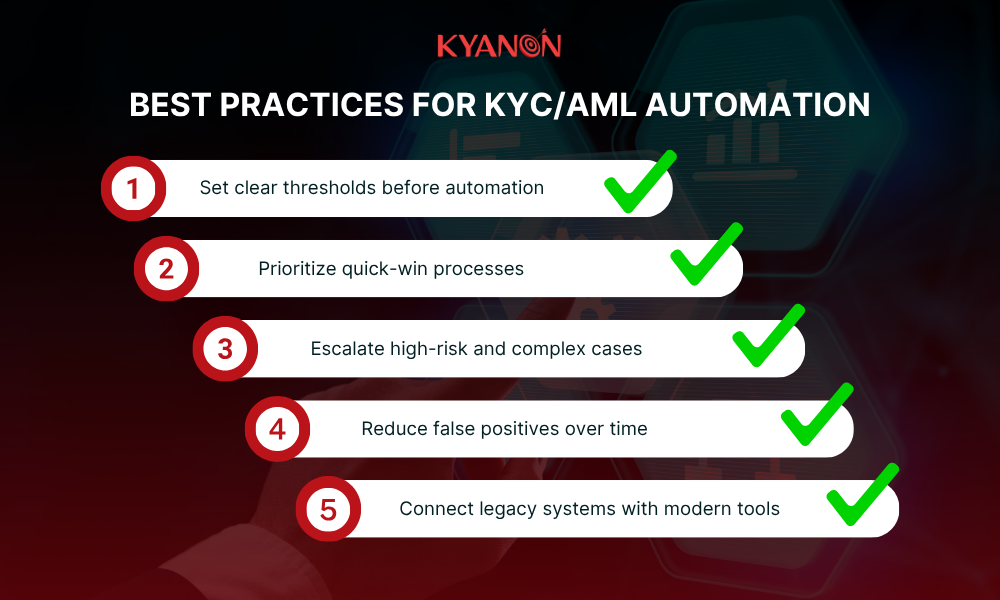
Implementing KYC/AML automation is not simply a software deployment. Banks need to decide what to automate, where human judgment remains necessary, and how automated workflows will be governed.
Execution sequencing and governance best practices
Successfully executing a compliance automation transformation requires a disciplined, phase-based implementation sequence:
- Define policy and risk rules
- Prioritise high-volume, repeatable workflows
- Define human-review and escalation boundaries
- Validate and tune automated rules/models
- Measure outcomes after launch
Enterprise integration observations and technical debt avoidance
Based on Kyanon Digital implementation experience, financial institutions frequently encounter severe project friction when attempting to overlay modern API integrations onto rigid, legacy core banking backbones. Legacy systems often lack the throughput needed to process concurrent real-time identity lookups, resulting in systemic latency.
Across enterprise implementations, Kyanon Digital has observed that the most successful transformations utilize a microservices-based API orchestration layer. This layer sits between front-end digital channels, legacy accounting ledgers, and third-party AML KYC engines. This architecture isolates legacy infrastructure from real-time transaction loads, prevents technical debt accumulation, and enables enterprise teams to swap out individual vendor modules without refactoring core business logic.
Comparative analysis: automated vs. manual compliance
The comparison matrix below evaluates operational performance across manual compliance baselines and modernized automated KYC AML platforms. Executives should use this framework to build business case justifications and quantify expected operational efficiency gains.
Operational matrix: Manual vs. automated compliance
| Operational dimension | Manual compliance | Automated KYC/AML | Business outcome |
| Customer onboarding | Document-heavy and often dependent on manual verification | Automated verification for standardized steps | Helps reduce onboarding friction and processing time |
| False positive alerts | Analysts manually review large numbers of alerts | Risk-based matching and screening support more targeted review | Helps focus analyst capacity on higher-priority cases |
| Compliance consistency | Processes can vary across teams and cases | Standardized workflows and automated checks | Supports more consistent compliance processes |
| Compliance personnel | Significant time spent on repetitive reviews | Analysts focus more on complex cases | Frees capacity for higher-value investigations |
| Customer reviews | Often scheduled at fixed intervals | Can support event-driven monitoring | Helps banks respond to relevant changes sooner |
Continuing to rely on manual compliance processes poses severe operational and competitive risks. As transaction volumes expand, banks relying on manual reviews face linearly growing operational expenditures and high customer churn. Automated compliance transforms risk management from a high-cost operational bottleneck into an agile competitive advantage that supports rapid digital expansion.
The future of KYC AML compliance automation
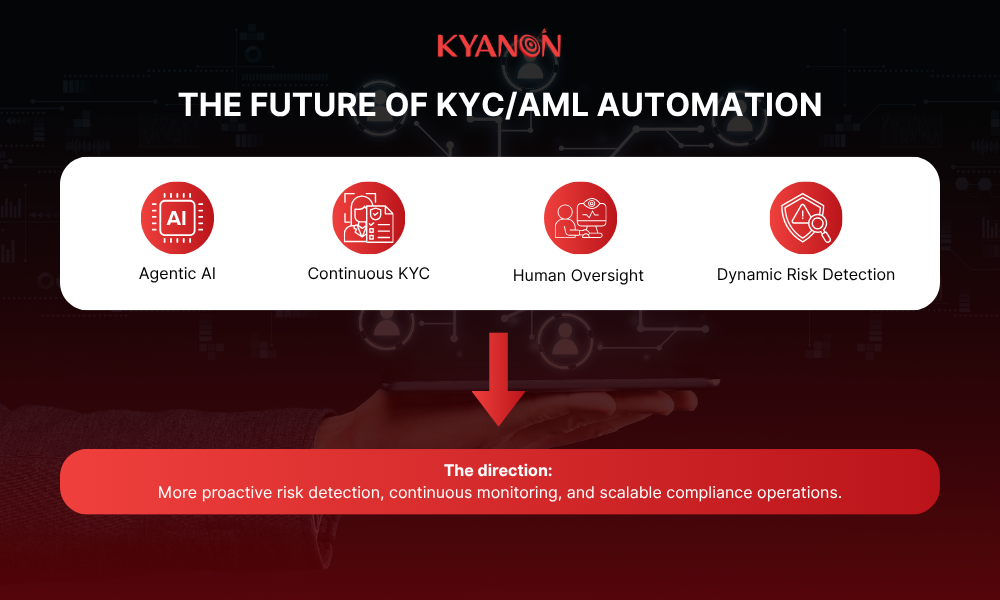
KYC and AML automation is moving beyond individual automated checks toward more connected workflows. AI can help compliance teams work with large volumes of structured and unstructured information, summarize relevant findings, identify patterns, and support investigation workflows. However, in banking, greater automation also increases the importance of governance and human oversight.
Agentic AI and autonomous compliance orchestration
The financial crime compliance sector is transitioning from basic analytical automation to agentic AI workflows. Unlike static rule engines or basic generative AI summaries, agentic AI systems utilize autonomous software agents capable of executing multi-step compliance tasks independently across data collection, validation, screening, and risk assessment.
The benchmark dataset below, published by IBM, outlines the quantifiable operational processing time reductions achieved across each stage of the KYC lifecycle when transitioning from manual baseline operations to agentic AI workflows.
Manual vs. automated compliance efficiency
| KYC lifecycle stage | Manual baseline time | Agentic AI processing time | Efficiency improvement |
| Pre-KYC preparation | 0.5 hours | 0.3 hours | ~40% reduction |
| Document validation | 1.0 hour | 0.5 hours | ~50% reduction |
| Screening & entity resolution | 1.0 hour | 0.5 hours | ~50% reduction |
| Client outreach management | 1.0 hour | 0.5 hours | ~50% reduction |
| Risk assessment formulation | 2.0 hours | 1.0 hour | ~50% reduction |
| Case closure & offboarding | 0.5 hours | 0.2 hours | ~60% reduction |
Source: IBM
Autonomous AI agents orchestrate multi-system data collection, parse complex corporate documentation, generate comprehensive risk narratives, and draft pre-populated SAR filings, leaving human compliance officers to act as final approval authorities. Implementing agentic AI enables financial institutions to scale case processing capacity dynamically while maintaining strict governance and regulatory auditability.
Continuous KYC (cKYC) and real-time risk detection
Traditional KYC reviews often occur at fixed intervals. Continuous or event-driven KYC uses changes in ownership, customer information, sanctions status, geography, transaction behaviour or other risk signals to trigger targeted reassessment when relevant events occur.
IBM’s 2026 article specifically describes the shift from periodic reviews toward continuous and context-aware KYC.
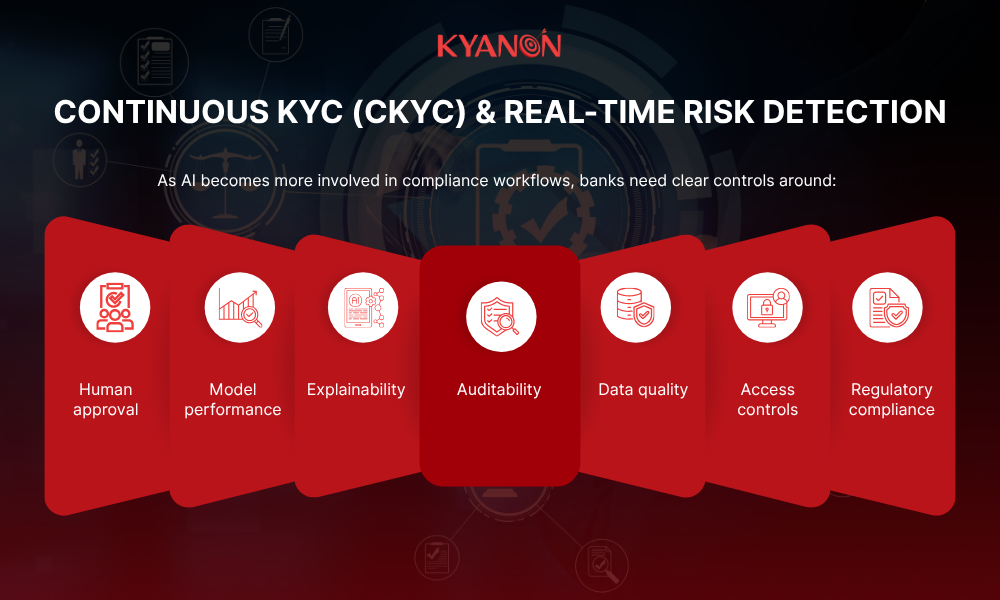
For banking leaders, the opportunity is not simply to make compliance more autonomous. It is to make compliance more scalable and responsive while keeping risk decisions appropriately governed.
Conclusion
KYC/AML modernization should ultimately focus on improving compliance efficiency without compromising risk controls or customer experience. Banks should prioritize high-volume workflows, maintain human oversight for higher-risk decisions, and build flexible systems that can adapt to changing requirements.
The right approach should not only automate processes. It should also work with existing banking systems, support reliable data, and strengthen long-term compliance operations.
Ready to modernize your KYC/AML operations?
Contact Kyanon Digital to discuss your next modernization initiative.










 Create project brief with AI