

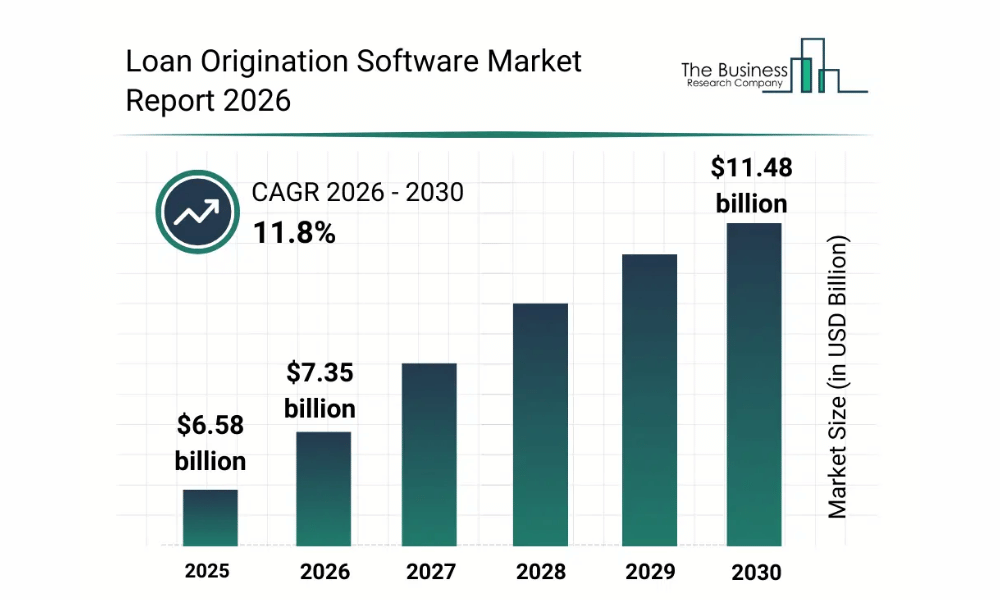
Loan origination systems now sit between digital lending growth and the credit, fraud, integration and compliance risks created by faster decisions. The Federal Reserve’s 2026 report found that the share of financing applicants seeking online fintech lenders rose from 17% in 2020 to 29% in 2025. Meanwhile, The Business Research Company values the global loan origination software market at USD 7.35 billion in 2026.
A modern LOS must connect trusted data, enforce credit policy, control exceptions, preserve decision evidence and transfer funded accounts to servicing without reconciliation gaps.
What is changing in 2026?
- Credit growth requires more precise controls: TransUnion reported that unsecured personal-loan originations grew by more than 20% year over year in Q1 2026, while affordability pressure increased among non-prime consumers.
- AI decisioning requires stronger governance: The European Commission’s May 2026 guidance identifies creditworthiness and credit-scoring systems as high-risk AI use cases. LOS evaluations should therefore cover data lineage, testing, reason codes and human oversight.
- Operational resilience extends to technology providers: APRA CPS 230, in force from 1 July 2026, requires regulated entities to maintain critical operations and manage service-provider risk.
This article compares loan origination systems by lending model, architecture, workflow, pricing and implementation risk. The platforms are not ranked from best to worst, and all capabilities should be confirmed through demonstrations and contracts.
Key takeaways
- A loan origination system manages the pre-funding lifecycle: application, verification, decisioning, underwriting, approval, documentation, funding and servicing handoff.
- There is no universal top platform. Consumer, commercial and mortgage lending require different data, workflows, controls and ecosystems.
- The strongest shortlist is based on lending model, jurisdiction, integration architecture, exception volume and five-year economics, not feature count.
- AI-assisted decisioning should be versioned, explainable, testable and subject to human review where policy or regulation requires it.
- API availability is not enough. Enterprises should test authentication, event delivery, idempotency, rate limits, sandboxes, data export and failure recovery.
- Loan origination software pricing commonly combines platform, volume, module, integration, data-provider, implementation, support and change costs.
- A proof of concept should run real exceptions and failure cases, not only a clean application path.
- Implementation succeeds when credit policy, operational workflow and system controls are designed together before configuration begins.
Further reading:
- Digital Transformation in BFSI: A Framework for APAC Banks in 2026
- In-House vs Outsourced BFSI Software Development
- Fintech IT Consulting in Singapore: Scale and Compliance

What is loan origination?
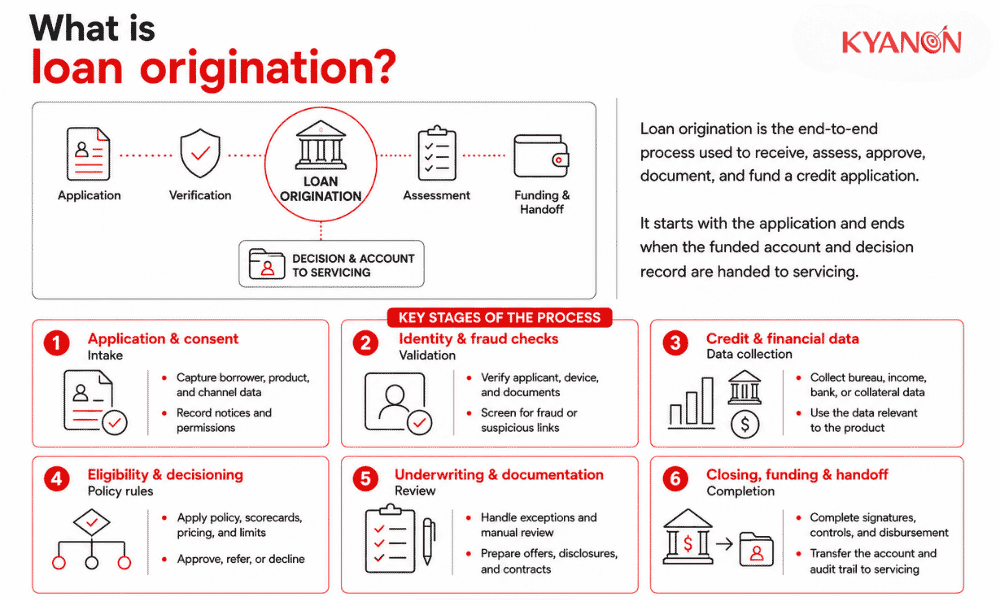
Loan origination is the end-to-end process of receiving, assessing, approving, documenting and funding a credit application. It starts with application intake and ends when the funded account, documents and decision history move to servicing.
Loan origination system workflow
| Stage | What happens |
Apply | Capture applicant data, product details, channel information and consent. |
| Verify | Run identity, KYC, AML, fraud, credit, income and asset checks. |
Decide | Apply eligibility, risk, pricing and exposure rules; route exceptions for review. |
| Document and fund | Generate offers, complete approvals and signatures, and issue funding instructions. |
Handoff and monitor | Transfer the account to servicing and retain audit and performance data. |
Traditional vs. digital loan origination
| Area | Traditional origination | Digital origination |
Intake and data | Paper, email and manual re-keying | Mobile, web or APIs with pre-filled data |
| Decisioning | Sequential manual review | Rules-driven processing with controlled exceptions |
Documents | Fragmented exchange and storage | Digital collection, generation and e-signature |
| Visibility and risk | Limited status visibility and human error | Real-time tracking, with greater integration and model-governance risk |
Digital origination does not require full automation. The objective is straight-through processing for predictable cases and faster, evidence-based review for exceptions.
What is a loan origination system?
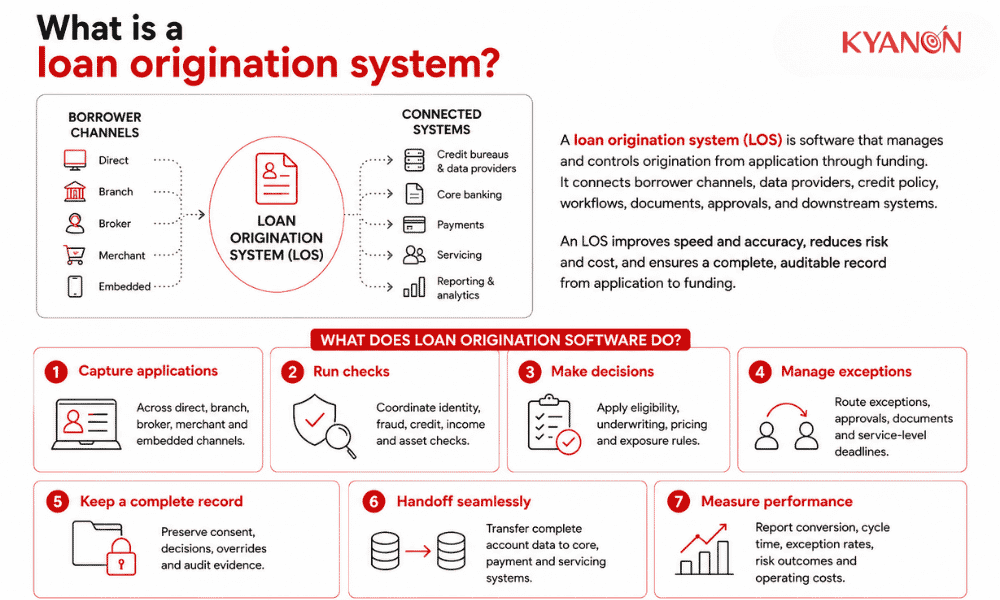
A loan origination system (LOS) is software that manages and controls origination from application through funding. It connects borrower channels, data providers, credit policy, workflows, documents, approvals, and downstream systems.
What does loan origination software do?
Loan origination software typically:
- Captures applications across channels.
- Verifies identity, fraud, credit and financial data.
- Automates eligibility, underwriting and pricing.
- Manages approvals, exceptions and audit evidence.
- Connects funding, core and servicing systems.
Core LOS capabilities to evaluate
| Capability | What businesses should validate |
Digital experience | Responsive applications, save-and-resume, accessibility, localization and status updates |
| Decisioning and workflow | Versioned rules, reason codes, exception queues, approval controls and rollback |
Integration | Documented APIs, webhooks, sandbox access, retries, idempotency and monitoring |
| Security and audit | Identity access management, encryption, immutable logs, retention and recovery controls |
Data and servicing handoff | Data lineage, exports, reconciliation, schedule validation and trace IDs |
Business value: A well-fitted LOS can reduce re-keying, standardize policy execution, increase appropriate straight-through processing, and shorten time to funding. These outcomes depend on workflow design and integration quality; digitizing a broken approval process usually preserves the delay.
Top loan origination systems for 2026
No single loan origination system is the strongest choice for every lending model. LoanPro, TurnKey Lender and HES LoanBox support configurable, full-lifecycle lending; nCino, Finastra, Newgen and SBS target broader banking environments; MeridianLink focuses on consumer lending; ICE Encompass and LendingPad are mortgage-specific.
The platforms below are credible starting points, not a performance ranking. Product scope, regional coverage, implementation requirements, and loan origination software pricing should be verified directly with each provider.
Quick comparison table
| System | Strongest fit | Distinguishing scope | Validate before shortlisting |
LoanPro Origination Suite | Digital consumer, auto and configurable credit products | API-first origination connected with servicing and payments | Regional compliance, decisioning scope, integration cost and volume economics |
| nCino Lending | Banks with commercial, consumer, small-business and mortgage lending | Shared platform and customer context across lending lines | Salesforce foundation, implementation ecosystem, license stack and governance |
ICE Encompass | U.S. residential mortgage lenders | End-to-end mortgage workflow with open APIs and a broad partner ecosystem | API fees, configuration complexity, upgrades and non-U.S. suitability |
| MeridianLink Consumer | Banks and credit unions with high-volume consumer lending | Cloud intake, underwriting automation and cross-sell workflows | Geographic coverage, rule depth, data export and servicing reconciliation |
TurnKey Lender | Fintech, alternative and embedded lenders | Decisioning, origination, servicing and collections in one platform | Model controls, localization, overrides and performance at forecast volume |
| Finastra Originate | Banks offering consumer, business, deposit or mortgage products | Unified digital origination within the wider Finastra portfolio | Required modules, country coverage, core dependencies and component pricing |
Newgen Loan Origination | Banks with complex retail, SME or commercial workflows | Low-code automation for document-heavy lending processes | Packaged scope, custom work, upgrade safety and local implementation depth |
| HES LoanBox | Alternative lenders and mid-sized financial institutions | Full lifecycle with cloud, on-premise and hybrid deployment options | Baseline scope, customization, code licensing and release management |
SBS Lending Suite | Banks modernizing retail or corporate lending by domain | Modular, cloud-native platform covering the credit lifecycle | Country packs, module boundaries, migration and non-SBS core integration |
| LendingPad | U.S. mortgage lenders, brokers, banks and credit unions | Cloud mortgage LOS with pipeline controls and enterprise APIs | Contract terms, channel support, integration charges and control requirements |
LoanPro Origination Suite
LoanPro Origination Suite is strongest for digital lenders that need configurable credit products and API-level control across origination, servicing, and payments.
- Core scope: Application processing, underwriting workflows, product configuration and third-party integrations through an API-first architecture.
- Selection signal: Consider when lending products or embedded channels require greater integration and workflow flexibility.
- Validate: Regional compliance support, built-in versus external decisioning, servicing dependencies, API costs and performance at peak volume.
nCino Lending
nCino supports commercial, consumer, small-business, and mortgage lending on a shared platform, making it relevant to banks seeking greater consistency across lending lines.
- Core scope: Customer onboarding, loan origination, workflow, document management, analytics and lending operations.
- Selection signal: Consider when the objective is to standardize processes and customer information across multiple banking products.
- Validate: Fundamental platform elements are built on Salesforce, according to nCino’s 2026 company filing. Assess the complete subscription stack, implementation services, configuration governance, and integration ownership.
ICE Encompass

ICE Encompass is a mortgage loan origination system designed primarily for U.S. residential mortgage operations.
- Core scope: Mortgage applications, processing, underwriting, documents, closing workflows and integrations through Encompass Developer Connect.
- Selection signal: Consider when broad U.S. mortgage workflow coverage and access to an established mortgage technology ecosystem are priorities.
- Validate: Partner and API charges, configuration complexity, upgrade management, channel coverage and suitability outside the U.S.
MeridianLink Consumer
MeridianLink Consumer is a cloud-based consumer loan origination system for banks and credit unions managing high application volumes.
- Core scope: Omnichannel application capture, underwriting automation, product configuration and cross-sell workflows.
- Selection signal: Consider when consumer lending speed and channel consistency are more important than complex commercial-credit workflows.
- Validate: Supported countries, policy-rule depth, integration limits, raw-data access and reconciliation with servicing systems.
TurnKey Lender
TurnKey Lender combines loan origination, credit decisioning, servicing and collections, making it relevant to fintech, alternative and embedded lenders.
- Core scope: Configurable applications, automated underwriting, credit scoring, servicing, collections and reporting.
- Selection signal: Consider when one platform is preferred over connecting separate origination, decisioning and servicing products.
- Validate: Model explainability, data sources, human overrides, local compliance, data portability and performance under forecast lending volumes.
Finastra Originate

Finastra Originate is a unified cloud platform for consumer and business loans, deposit accounts and mortgage origination.
- Core scope: Digital applications, onboarding, automated workflows and integration with Finastra or third-party core banking systems.
- Selection signal: Consider when a bank needs multiple origination journeys within a broader banking technology portfolio.
- Validate: The exact modules available in each country, required Finastra dependencies, third-party core integration, modernization path and component-level pricing.
Newgen Loan Origination
Newgen Loan Origination supports retail, SME, commercial and SBA lending through its low-code process automation platform.
- Core scope: Digital onboarding, queue-based workflow, document processing, credit decisioning, approval routing and operational reporting.
- Selection signal: Consider when lending involves complex documents, multiple approval levels and frequent exception handling.
- Validate: Packaged functionality versus custom development, upgrade-safe configuration, low-code governance, local compliance and implementation-partner capability.
HES LoanBox

HES LoanBox is a modular lending platform covering onboarding, origination, servicing, loan management and debt collection.
- Core scope: Configurable products and workflows, borrower portals, underwriting, servicing, collections and open integrations.
- Selection signal: Consider when deployment flexibility, data residency or greater control over platform customization is required.
- Validate: Standard functionality versus custom work, cloud or on-premise responsibilities, optional developer-license terms, source-code obligations and release management.
SBS Lending Suite

SBS Lending Suite is a modular, cloud-native platform covering retail and corporate credit processes across the lending lifecycle.
- Core scope: Origination, contracting, servicing, monitoring, collections and credit-management workflows through independently deployable modules.
- Selection signal: Consider when a bank wants to modernize lending by domain instead of replacing every credit system at once.
- Validate: Country-specific functionality, module boundaries, integration with non-SBS cores, data migration, operating-model changes and regional support.
LendingPad
LendingPad is a cloud-based mortgage LOS for U.S. lenders, brokers, banks and credit unions.
- Core scope: Mortgage applications, configurable workflows, automated underwriting, pipeline monitoring, document handling and enterprise APIs.
- Selection signal: Consider when mortgage-focused workflows and real-time pipeline coordination are the primary requirements.
- Validate: Current contract minimums, supported lending channels, API and integration charges, data migration, service levels and bank-grade audit controls.
How businesses should use this comparison
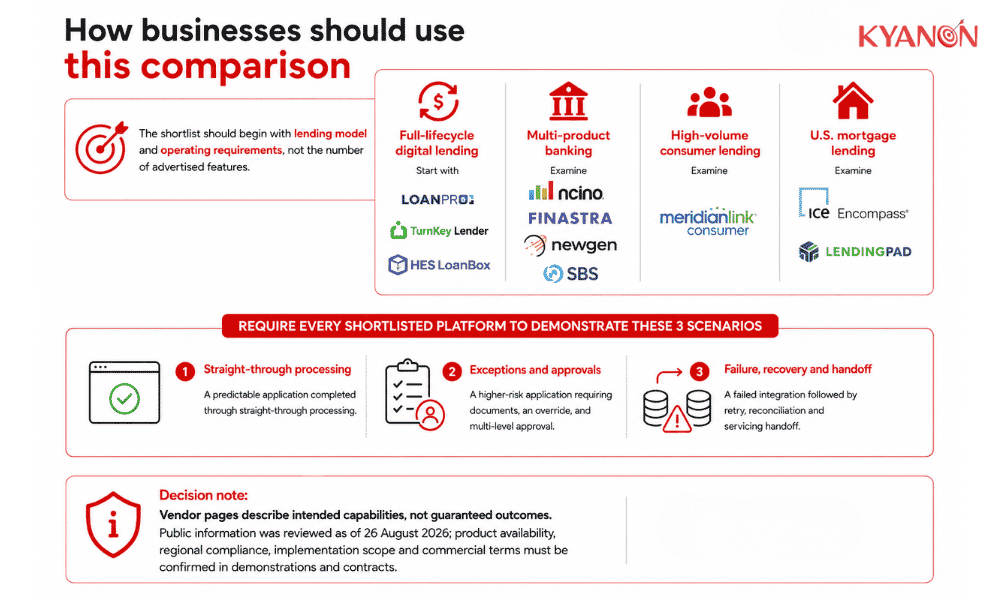
The shortlist should begin with lending model and operating requirements, not the number of advertised features.
- Full-lifecycle digital lending: Start with LoanPro, TurnKey Lender or HES LoanBox.
- Multi-product banking: Examine nCino, Finastra, Newgen or SBS.
- High-volume consumer lending: Examine MeridianLink Consumer.
- U.S. mortgage lending: Examine ICE Encompass or LendingPad.
Require every shortlisted platform to demonstrate the same three scenarios:
- A predictable application completed through straight-through processing.
- A higher-risk application requiring documents, an override, and multi-level approval.
- A failed integration followed by retry, reconciliation and servicing handoff.
Decision note: Vendor pages describe intended capabilities, not guaranteed outcomes. Public information was reviewed as of 26 August 2026; product availability, regional compliance, implementation scope and commercial terms must be confirmed in demonstrations and contracts.
Loan origination system comparison
Loan origination systems should be compared by lending model, decision complexity, integration requirements, and deployment responsibility. Consumer lenders prioritize straight-through processing, commercial lenders prioritize expert workflows, while mortgage lenders require stronger document and third-party coordination.
Best-fit shortlist by lender type
Lending model | Platforms to examine first | Why they enter the shortlist | Main caution |
High-volume consumer lending | MeridianLink Consumer, LoanPro, Newgen | Automated decisioning, configurable products and high-volume workflows | Test fraud controls, peak latency, exception queues and cost per application |
| Embedded and digital credit | LoanPro, TurnKey Lender, HES LoanBox | API connectivity, product flexibility and full-lifecycle options | Validate partner controls, multi-tenant support, data portability and integration costs |
Multi-product banking | nCino Lending, Finastra Originate, Newgen, SBS Lending Suite | Broader product coverage, governance and banking-system integration | Suite breadth can increase implementation, licensing and configuration complexity |
| Commercial and SME lending | nCino Lending, Newgen, Finastra Originate, SBS Lending Suite | Document, financial analysis, and multi-level approval workflows | Do not force complex judgment into consumer-style automation |
U.S. residential mortgage | ICE Encompass, LendingPad, nCino Lending, Finastra Originate | Mortgage workflows, documents, third-party services and closing coordination | Much of the ecosystem and compliance coverage is U.S.-specific |
| Alternative and specialty finance | LoanPro, TurnKey Lender, HES LoanBox | Configurable products, schedules, decisioning and servicing workflows | Test unusual fees, collateral, repayment schedules and accounting events |
Use this table to create an initial shortlist, then require each platform to demonstrate the same application, exception and servicing-handoff scenarios.
Consumer vs. commercial vs. mortgage loan origination systems
Consumer, commercial and mortgage lending require different data, workflows and automation levels. A platform supporting multiple products should demonstrate each lending model separately rather than applying one standard workflow across all products.
Dimension | Consumer lending | Commercial lending | Mortgage lending |
Typical volume | High | Lower-volume, higher-value cases | Variable and document-intensive |
| Decision pattern | Rules and scorecards with rapid exception handling | Analyst judgment, financial spreading and committees | Eligibility, underwriting, property and investor rules |
Data emphasis | Identity, bureau, income, cash flow and device data | Entity, owners, statements, collateral, cash flow and covenants | Borrower, property, title, appraisal, assets and income |
| Workflow priority | Low friction, fast decisions and low unit cost | Collaboration, structuring and traceable approvals | Document completeness, closing and third-party coordination |
Automation target | High straight-through processing for eligible cases | Assisted automation around expert judgment | Automated verification and documents with controlled reviews |
| Integration priority | KYC, fraud, bureau, open banking, payments and servicing | Core, CRM, spreading, collateral, documents and risk systems | POS, AUS, appraisal, title, eClosing, pricing and servicing |
Consumer loan origination systems optimize throughput, commercial systems support complex judgment, and mortgage loan origination systems coordinate documents and external parties. Product coverage should therefore be evaluated by workflow depth, not by the number of loan types listed.
Cloud vs. on-premises loan origination systems
The deployment decision determines who controls upgrades, infrastructure, security operations and recovery. Businesses should compare operating responsibilities rather than relying on a general “cloud” label.
| Decision area | Vendor-managed cloud SaaS | Customer-managed private cloud or on-premises |
Changes and upgrades | Frequent releases managed by the provider | Greater timing control with more internal ownership |
| Scaling | Elastic if the architecture and contract support it | Capacity must be planned, purchased and operated |
Security operations | Shared responsibility with the provider | Direct responsibility for patching, monitoring and recovery |
| Data residency | Depends on available regions and subprocessors | Greater location control, but not automatically stronger governance |
Customization | Usually configuration, APIs and supported extensions | Deeper code changes are possible but create higher upgrade risk |
| Resilience | Depends on provider architecture, recovery evidence and service commitments | Depends on internal architecture, specialist skills and recovery discipline |
Cost profile | Subscription, usage, integration and support charges | Infrastructure, licenses, operations, upgrades and specialist staffing |
| Exit and portability | Data export, APIs and exit support must be contractually defined | Greater technical control, but the internal team owns migration execution |
Kyanon Digital perspective: Cloud is not automatically faster, cheaper or more compliant. Evaluate hosting regions, subprocessors, encryption and key management, release controls, RTO/RPO evidence, observability, data export and contractual exit rights.
What is a loan origination system workflow?
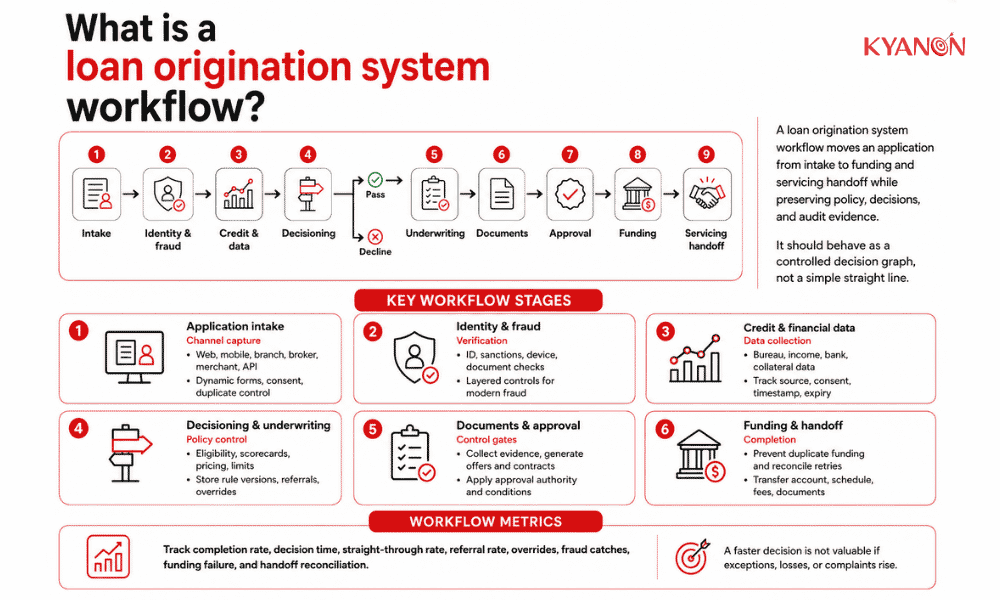
A loan origination system workflow is the controlled sequence that moves an application from intake through decisioning, funding and servicing handoff. It connects data, policy rules, human approvals, documents and audit evidence across the lending process.
Predictable cases should move automatically, while exceptions enter controlled review.
Stage | What happens | Critical control |
1. Application and consent | Capture applicant, product and channel data | Dynamic forms, consent records and duplicate detection |
| 2. Verification | Run identity, KYC, AML, fraud, credit, income and collateral checks | Data source, timestamp, consent and expiry tracking |
3. Decisioning | Apply eligibility, affordability, pricing and exposure rules | Rule versions, model versions and reason codes |
| 4. Underwriting and exceptions | Route referred cases for evidence-based review | Prioritized queues, authority limits, SLAs and override records |
5. Documents and approval | Generate offers, disclosures and contracts; confirm conditions | Template versions, approval authority and dual control |
| 6. Funding | Send verified disbursement instructions | Idempotency, retry controls and reconciliation |
7. Servicing handoff | Transfer account data, schedules, balances, documents and decision history | Field validation, trace IDs and account-creation confirmation |
Workflow metrics to monitor
Track completion rate, decision time, end-to-end time, straight-through processing, referral and override rates, rework, fraud detection, funding failures and servicing reconciliation.
A faster workflow creates value only when credit quality, operational control and customer outcomes remain stable.
Key features to look for in loan origination software
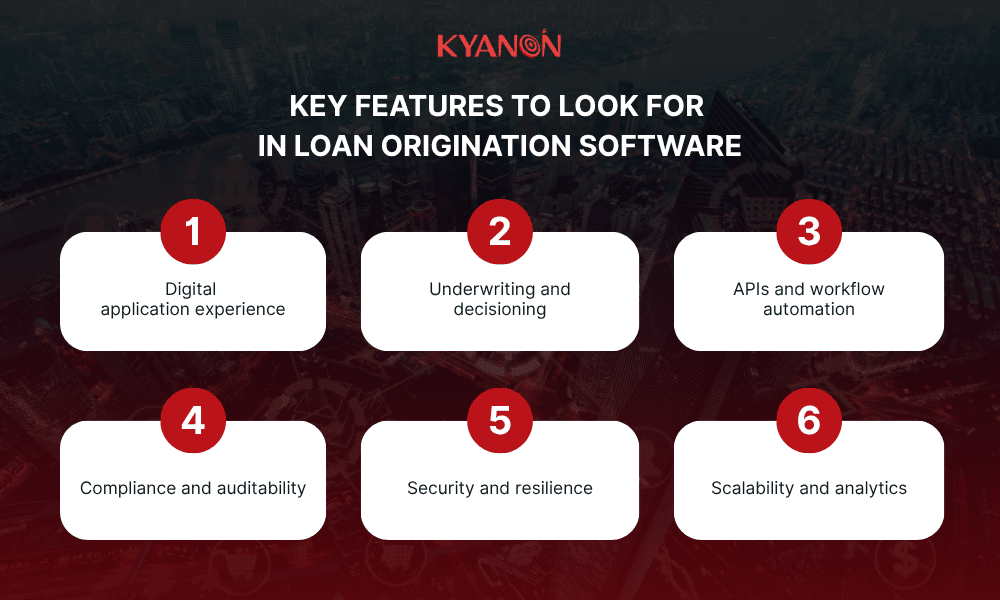
Loan origination software should provide six core capabilities: digital applications, controlled decisioning, workflow automation, open integration, auditable security and scalable data access.
- Digital application experience: Support responsive, accessible and localized forms with pre-fill, save-and-resume, document upload and status updates. Test completion, errors and abandonment using real application scenarios.
- Underwriting and decisioning: Separate policy rules, risk models, pricing and fraud logic. Require versioning, reason codes, simulation, rollback and human-review paths.
- APIs and workflow automation: Look for documented APIs, webhooks, retries, idempotency, queues, SLAs, escalations and approval controls. Test failed integrations and workflow changes without vendor coding.
- Compliance and auditability: Preserve consent, input data, rule and model versions, documents, decisions, overrides and user actions. The system should reconstruct any approval or decline from start to finish.
- Security and resilience: Validate encryption, access controls, tenant isolation, data residency, subprocessors, recovery targets, incident response and secure exit. Request evidence relevant to the proposed deployment.
- Scalability and analytics: Test concurrent applications, decision latency, document processing and event volumes. Reporting should cover conversion, cycle time, straight-through processing, exceptions, fraud, funding and unit cost.
2026 governance note: The European Commission’s May 2026 draft guidance identifies creditworthiness and credit-scoring systems among high-risk AI use cases. Platforms should therefore preserve data lineage, model versions, testing evidence, reason codes and human oversight.
The right system is not the one with the longest feature list. It is the one that proves these capabilities under real business, risk and integration conditions.
Loan origination software pricing
Loan origination software pricing rarely has one comparable public figure. Enterprise cost is usually a combination of platform access, usage, modules, data calls, implementation, integrations, support and change.
How LOS pricing works
| Cost layer | Common basis | Hidden exposure to check |
Platform | Annual subscription, instance or entity | Minimum commitment, environment and renewal uplift |
| Users | Named, concurrent or role-based seats | Read-only, service and external users |
Volume | Applications, decisions, funded loans or active accounts | Declined, duplicate, test and reprocessed transactions |
| Modules | Origination, decisioning, documents, servicing or analytics | Dependencies that make optional modules mandatory |
Third-party data | Per KYC, bureau, fraud, income or e-signature call | Retries, fallbacks, minimums and vendor margin |
| Implementation | Fixed scope or time and materials | Process design, configuration, testing and partner management |
Integration | Per connector or development effort | API access, middleware, change and certification fees |
| Operations | Support tier, hosting, monitoring and environments | After-hours support, incident work and non-production capacity |
Change | Configuration, release and custom development | Regression testing and upgrade remediation |
| Exit | Export, transition and termination assistance | Format, history, attachments, timing and provider cooperation |
Subscription vs. usage-based pricing
- Subscription pricing improves budget predictability but can create unused capacity or step changes when entities, modules, or users expand.
- Usage-based pricing follows volume more closely but can penalize retries, applications that do not fit, and seasonal peaks.
- Hybrid pricing is common: a minimum subscription plus per-application, decision, funded-loan or data-call charges.
- License plus services appear in private cloud, on-premise, or deeply customized deployments and shift more upgrade and operating responsibility to the institution
Implementation and integration costs
Implementation cost is driven by policy complexity, products, jurisdictions, channels, integrations, data migration, documents, security review and testing. A low subscription can still produce a high five-year cost if every policy change requires specialist development.
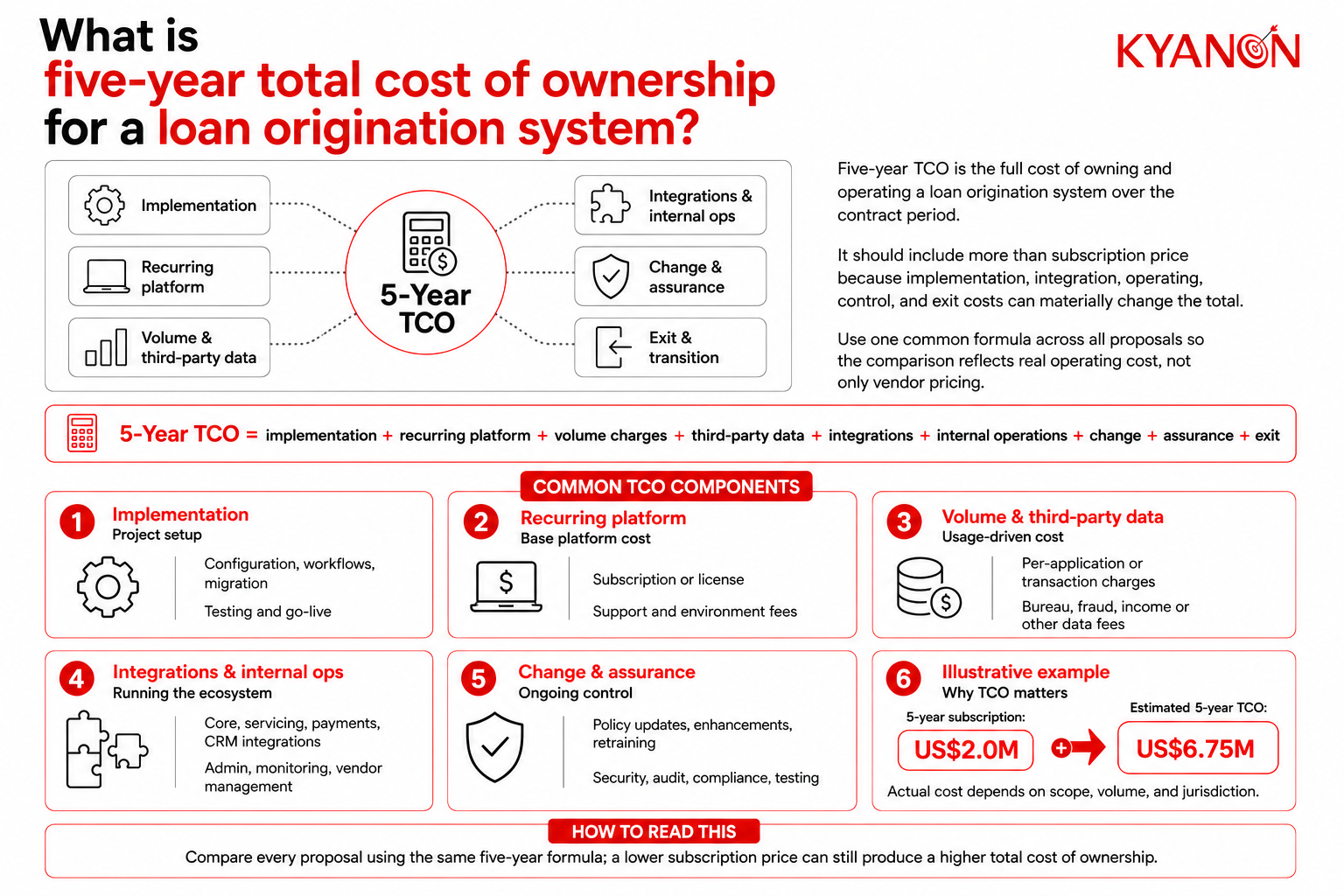
Five-year total cost of ownership
Use a common formula for every proposal:
Five-year TCO = implementation + recurring platform + volume charges + third-party data + integrations + internal operations + change + assurance + exit.
Illustrative example: A loan origination system with a five-year subscription cost of US$2 million could reach US$6.75 million in total cost after implementation, integrations, third-party data, internal operations, assurance and exit costs are included. Actual costs depend on scope, volume and jurisdiction.
Model at least three scenarios:
- Current volume and product scope.
- Expected growth, additional channels and planned products.
- Stress volume, regional expansion and higher exception rates.
Questions to ask vendors about pricing
Loan origination software pricing is best compared through a three-to-five-year TCO model aligned with expected lending volume, deployment scope and operating responsibility.
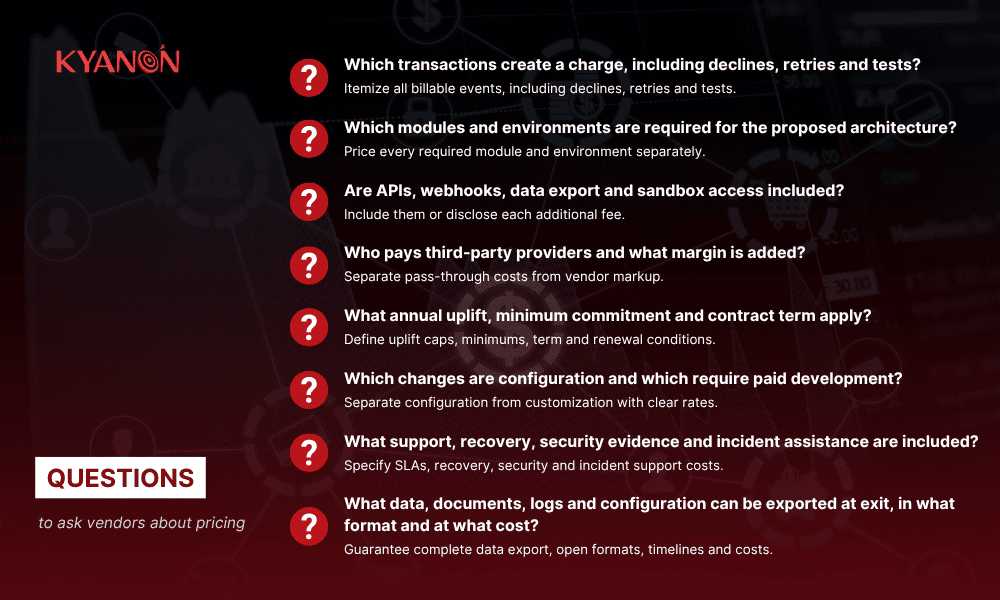
Kyanon Digital perspective: Businesses should assess loan origination software pricing by total contract exposure, including transactions, modules, APIs, third-party fees, customization, support, annual uplifts and exit costs, not the base subscription alone.
Consumer loan origination systems
Consumer loan origination systems are designed for high application volume, standardized products and rapid risk decisions. Their value comes from controlled automation, low-friction intake and low unit cost, not approval speed alone.
Platforms to examine for consumer lending
Platform | Relevant fit | Important validation |
MeridianLink Consumer | Bank and credit-union consumer products | Geographic fit, decision depth and core/servicing handoff |
| LoanPro | API-led consumer, auto and modern credit products | Scope of native decisioning and total platform economics |
TurnKey Lender | Digital, alternative and embedded lending | Model governance, localization and operating scale |
| HES LoanBox | Configurable consumer and specialty lending | Customization, upgrade path and deployment responsibility |
Newgen | Consumer lending inside broader bank workflows | Packaged product depth versus low-code implementation effort |
| nCino Consumer Lending | Banks seeking shared customer and lending workflows | Platform dependencies, rollout effort and channel fit |
Selection implication: Measure false positives, referrals, manual touches and early performance alongside decision time. A higher automated approval rate can be harmful if fraud, loss or conduct risk rises.
Mortgage loan origination systems
Mortgage loan origination systems manage a longer, document-heavy process involving the borrower, property, valuation, title, pricing, underwriting and closing. Platform fit is highly regional because forms, disclosures, investor rules and third-party networks differ by market.
What makes mortgage LOS platforms different?
- Property, appraisal, title, insurance and collateral workflows.
- Large document sets and repeated income, employment and asset verification.
- Product and pricing engines with lock and change controls.
- Automated underwriting-system connections.
- Closing, e-signature, eNote or registry processes where applicable.
- Secondary-market, correspondent or investor delivery requirements.
- Mortgage-specific reporting, disclosures and quality controls.
Mortgage platforms to examine
Platform | Primary fit | Distinguishing area |
ICE Encompass | U.S. mortgage lenders at broad scale | Extensive mortgage workflow, API and partner ecosystem |
| LendingPad | U.S. brokers, lenders and financial institutions | Cloud LOS editions across mortgage channels |
Calyx Path | U.S. banks, credit unions and mortgage lenders | Configurable cloud mortgage workflow |
| nCino Mortgage | Institutions seeking digital mortgage and broader nCino alignment | Localized mortgage experience and platform connection |
Finastra Mortgagebot | Banks and mortgage operations using Finastra origination products | Connected point-of-sale, origination and partner integrations |
| MeridianLink Mortgage | Banks, credit unions and independent mortgage lenders | Browser-based mortgage workflow, pricing and open APIs |
This shortlist is weighted toward the U.S. market because its mortgage technology ecosystem is highly specialized. For other jurisdictions, start with local legal documents, land and title processes, affordability rules, digital-signature validity, and downstream investor requirements before comparing interfaces.
Loan origination software for banks
Loan origination software for banks must operate inside a wider control and technology environment. Multi-product support, integration, identity, resilience, audit and data governance often matter more than a fast standalone implementation.
Bank-level requirements
- Multi-entity, multi-brand, multi-currency and jurisdiction-aware configuration where required.
- Integration with core banking, CRM, customer master, IAM, general ledger, payments, risk, document and data platforms.
- Segregation of duties, approval authority and privileged-access controls.
- Consistent customer and group exposure across products and channels.
- Complete decision lineage, retention, monitoring and regulatory reporting support.
- High availability, tested recovery, incident management and service-provider governance.
- Controlled product, policy and model releases across environments.
- Reliable data extraction for risk, finance, operations and enterprise analytics.
Platforms to examine for banks
- nCino: Broad commercial, consumer, mortgage and small-business lending on a shared platform; validate Salesforce and implementation dependencies.
- Finastra: Multiple origination products across consumer, business and mortgage lending; confirm the exact product architecture for the target market.
- Newgen: Strong process, content and low-code orientation for complex bank workflows; control customization and release management.
- SBS: Modular lending and open-banking options, particularly relevant to EMEA institutions; validate local coverage and non-SBS core integration.
- MeridianLink: Stronger relevance to North American banks and credit unions across consumer and mortgage products; validate enterprise data and operating-model fit.
- LoanPro or HES LoanBox: Relevant where an institution wants a configurable, API-first credit platform; validate bank-grade governance, accounting boundaries and regional obligations in detail.
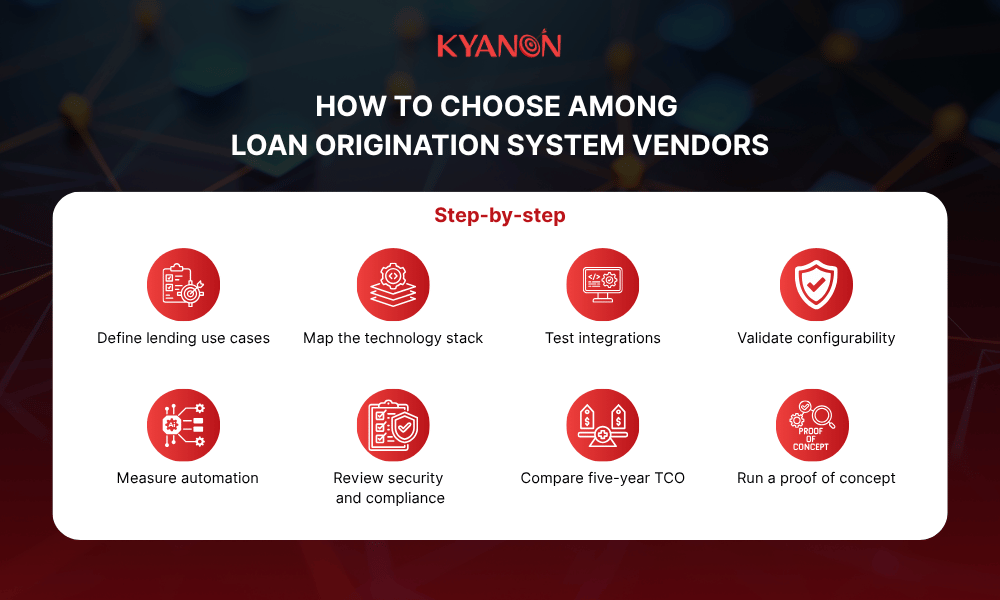
How to choose among loan origination system vendors
Choose among loan origination system vendors by scoring evidence against the target operating model, not by comparing demonstrations or feature counts alone.
- Define lending use cases: Document current and planned products, channels, markets, volumes, decision paths, and service targets.
- Map the technology stack: Identify integrations, systems of record, manual processes, and ownership of customer, application, decision, and account data.
- Test integrations: Validate APIs, events, and batch processes, including monitoring, retries, reconciliation, versioning, and failure recovery.
- Validate configurability: Ask vendors to change a product, policy rule, and workflow during evaluation. Check whether code or vendor support is required.
- Measure automation: Assess straight-through processing, referrals, overrides, and remaining manual work by case type.
- Review security and compliance: Examine data residency, access controls, audit trails, model governance, resilience, incident response, and exit support.
- Compare five-year TCO: Apply the same volume, integration, support and change assumptions to every proposal, including internal and transition costs.
- Run a proof of concept: Test clean applications, exceptions, duplicate events, provider outages, funding retries, decline reasons, servicing handoffs, and stress volumes.
Decision rule: Select the platform that proves the strongest fit across lending workflows, integrations, controls, scalability, and five-year cost, not the one with the longest feature list.
Suggested scoring model
| Evaluation dimension | Suggested weight |
Lending and product fit | 20% |
| Integration and architecture | 20% |
Credit, compliance and audit controls | 20% |
| Workflow and configuration | 15% |
Security and resilience | 10% |
| Five-year TCO and contract | 10% |
Implementation capability and viability | 5% |
Disclaimer: These weights are illustrative, not an industry standard. Adjust them to the lending model, regulatory scope, architecture, risk appetite, and business priorities before vendor demonstrations begin.
Loan origination system implementation
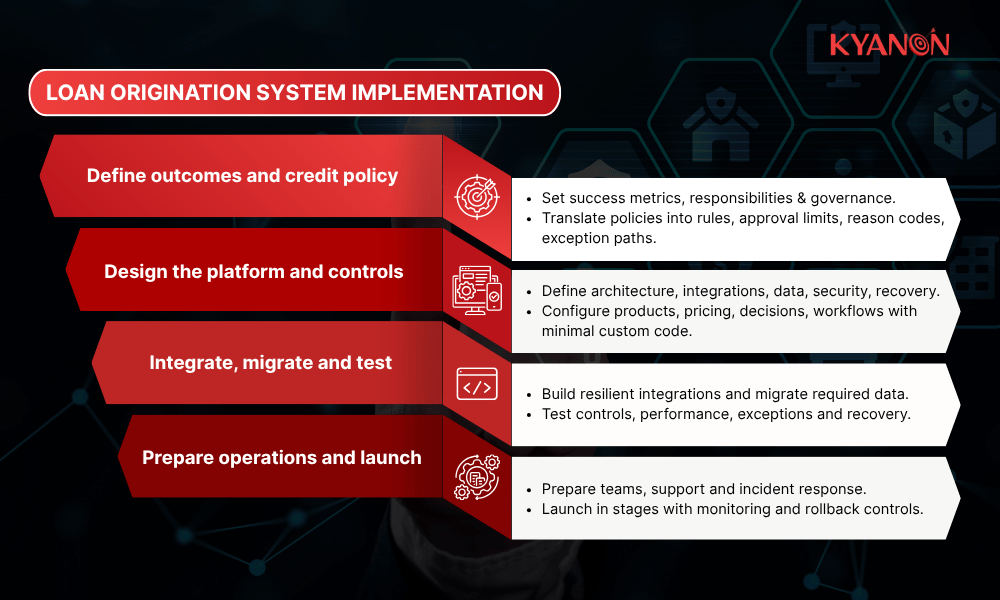
Loan origination system implementation is an operating-model change, not only a software deployment. Define credit policy, ownership, architecture, controls and success measures before configuring the platform.
- Set outcomes and governance: Establish baseline metrics and assign owners across lending, risk, operations, technology, security and data.
- Translate credit policy: Convert policies into testable rules, reason codes, approval limits, evidence requirements and exception paths.
- Design architecture and controls: Define systems of record, integrations, identity, data residency, encryption, logging, monitoring and recovery.
- Configure products and workflows: Build terms, eligibility, pricing, decisioning, queues, documents and approvals with version control and minimal custom code.
- Integrate and migrate data: Test interface failures and reconciliation. Migrate required operational and regulatory data while archiving the remainder securely.
- Test end to end: Cover policy, integrations, security, performance, recovery, accessibility, exceptions, retries and provider outages.
- Prepare operations: Complete role-based training, procedures, approval authorities, support routes, incident playbooks and service ownership.
- Launch in controlled stages: Start with a bounded product or channel, monitor daily controls and maintain clear rollback criteria.
Implementation principle: Scale only after workflows, integrations and reconciliation remain stable under production-like conditions.
Common LOS challenges and mistakes
| Mistake | Business consequence | Better control |
Choosing on feature count | Pays for breadth while critical workflows remain weak | Score real scenarios and evidence |
| Underestimating integration | Delays, re-keying and reconciliation persist | Map interfaces, failures and ownership early |
Rebuilding every legacy step | New platform reproduces old delay | Remove, simplify or redesign before configuration |
| Excessive customization | High change cost and upgrade friction | Prefer configuration and governed extensions |
Ignoring peak and exception volume | Queues and latency appear after launch | Test forecast, stress and adverse scenarios |
| Weak exit planning | Data and operations become difficult to move | Contract complete export, assistance and timing |
Treating UX as visual design | Applications remain confusing or inaccessible | Test real users, assisted channels and abandonment data |
| Testing only the happy path | Duplicate funding or incorrect decisions occur in failure states | Test outages, retries, mismatches and reversals |
Maximizing automation alone | Risk, complaints or overrides increase | Optimize risk-adjusted throughput and control quality |
| Assuming vendor compliance | Accountability and local gaps remain with the institution | Map controls to obligations and obtain evidence |
The most damaging mistake is selecting software before agreeing how credit should flow. When policy, process and data ownership are unclear, every platform appears configurable and every implementation becomes custom.
Conclusion
The right loan origination system is not the platform with the longest feature list. It is the platform that can execute the institution’s credit policy, integrate with its operating environment, control exceptions and scale at an acceptable five-year cost.
Start with lending use cases and architecture, reduce the market to a small fit-based shortlist, and require each finalist to prove the same workflows, failures and control evidence. That process turns a software comparison into a defensible operating decision.
For businesses assessing how a selected lending platform should connect with digital channels, enterprise data and existing banking systems, contact Kyanon Digital to discuss a bounded assessment across architecture, integration, data, automation and implementation readiness.








 Create project brief with AI