
What is QA (CX Quality Assurance)?
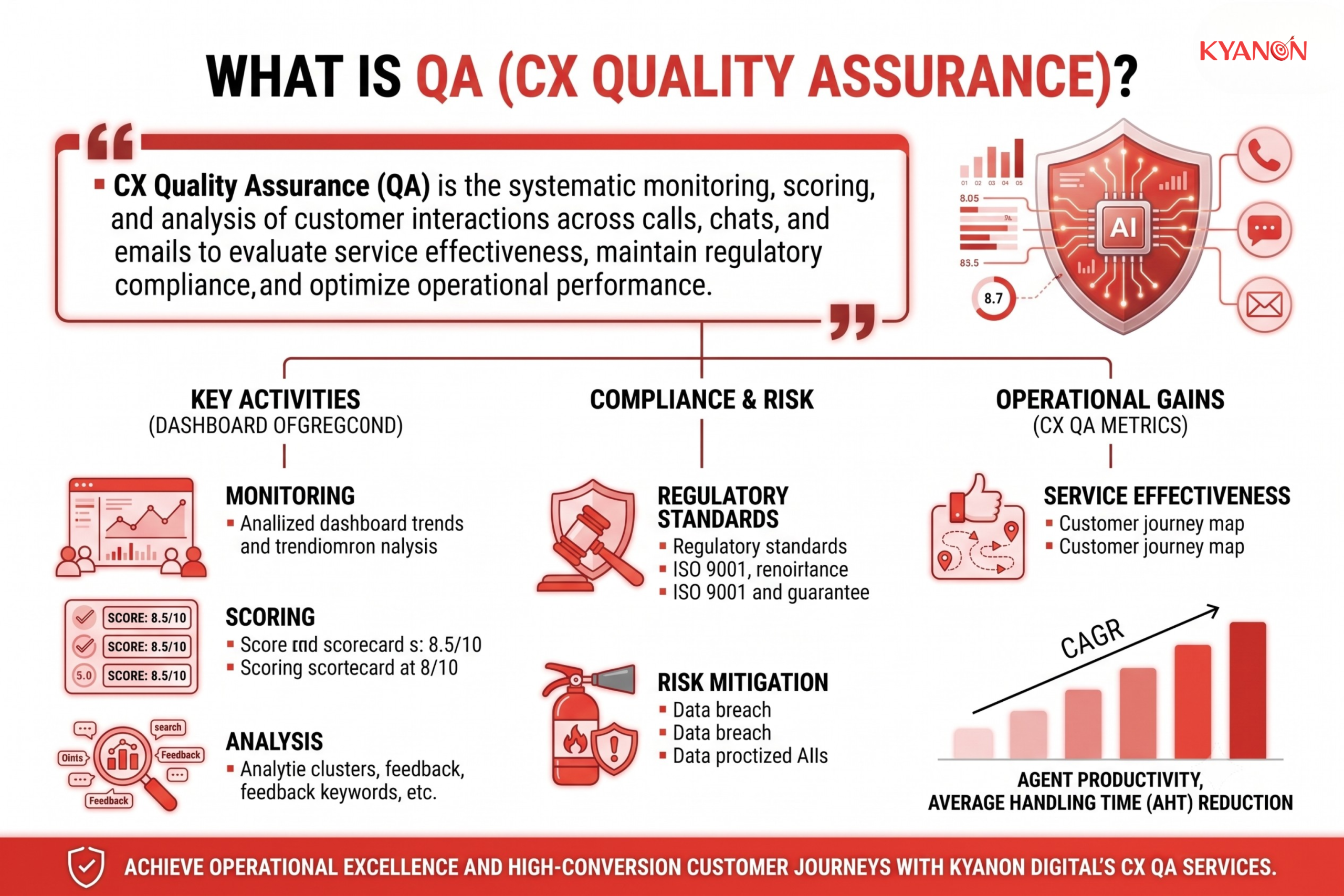
CX Quality Assurance (QA) is the systematic monitoring, scoring, and analysis of customer interactions across calls, chats, and emails to evaluate service effectiveness, maintain regulatory compliance, and optimize operational performance.
How QA (CX Quality Assurance) Works
Modern CX Quality Assurance (QA) combines continuous interaction monitoring with automated evaluation to assess customer experience and agent performance at scale.
Instead of relying on limited manual spot checks, organizations can use conversational analytics, AI-based scoring, and workflow automation to identify quality issues, compliance risks, and performance gaps across customer interactions.
The process typically moves through four connected stages.

Multi-Channel Interaction Ingestion
Customer interactions across voice, live chat, email, and social support channels can be continuously captured and processed through speech-to-text and Natural Language Processing (NLP) pipelines.
Speech-to-text converts voice conversations into searchable transcripts, while NLP helps systems understand the meaning, sentiment, and context of customer interactions.
This creates a unified interaction dataset covering:
- Conversation transcripts and metadata
- Response and silence duration
- Customer sentiment and escalation signals
- Resolution and transfer events
- Channel and journey context
By capturing interactions systematically, QA teams can move beyond reviewing a small sample of conversations toward broader interaction coverage.
Automated Quality and Sentiment Scoring
AI-based evaluation models assess customer interactions against predefined CX, performance, and compliance criteria.
This creates a consistent way to measure interaction quality without requiring supervisors to manually review every conversation.
Evaluation area | Key indicators |
| Customer experience | Sentiment, customer effort, resolution quality |
Agent performance | Response quality, conversational flow |
| Compliance | Required disclosures, policy adherence, script compliance |
Operational efficiency | Response delays, silence, unnecessary transfers |
From a business perspective, automated scoring helps organizations identify performance patterns across teams and channels rather than relying on individual supervisor judgment.
Exception Detection and Compliance Monitoring
Automated QA systems can continuously monitor interactions and identify exceptions or high-risk events that require human attention.
Instead of asking supervisors to review every conversation, the system flags interactions that exceed predefined risk thresholds.
Common triggers include:
- Compliance violations
- Script or policy deviations
- Significant sentiment deterioration
- Excessive customer effort
- Unusual escalation or friction patterns
These interactions can then be routed to supervisors for timely investigation and resolution.
The CX value is not simply detecting problems, but helping teams focus their attention on the interactions where intervention can have the greatest impact.
Closed-Loop Coaching and Workflow Integration
QA insights can be connected to training, performance management, and operational workflows to create a continuous improvement loop.
Evaluation → Performance gap → Targeted coaching → Re-evaluation
For example, if automated QA repeatedly identifies issues with policy adherence or communication quality, the organization can trigger targeted training or micro-learning programs for the relevant agents.
This transforms QA from a retrospective control mechanism into an ongoing improvement process that helps organizations:
- Improve agent performance
- Identify recurring CX issues
- Strengthen compliance
- Reduce manual QA effort
- Deliver more consistent customer experiences
The result is a QA model that connects interaction quality directly to customer experience, operational performance, and continuous improvement.

Comparative Analysis: Modern Automated CX QA vs. Legacy Manual QA
Dimension | Legacy Manual QA | Modern Automated CX QA | Business Impact |
| Audit Coverage | 1% to 2% randomized sample size | 100% cross-channel interaction auditing | Eliminates compliance blind spots and operational blinders |
Evaluation Speed | Retrospective analysis days or weeks post-interaction | Real-time and near-instantaneous automated evaluation | Allows immediate mitigation of service drops and risk events |
| Scoring Focus | Internal checklist compliance and script adherence | Customer sentiment, intent, resolution, and effort | Aligns service metrics directly with actual customer satisfaction |
Evaluator Bias | High subjective variance between human managers | Consistent, standardized AI scoring models | Ensures objective, equitable performance benchmarks |
| Operational Impact | Disconnected post-call policing and reactive scoring | Direct integration with adaptive coaching pipelines | Accelerates time-to-proficiency and lowers total cost-to-serve |
Why QA (CX Quality Assurance) Matters
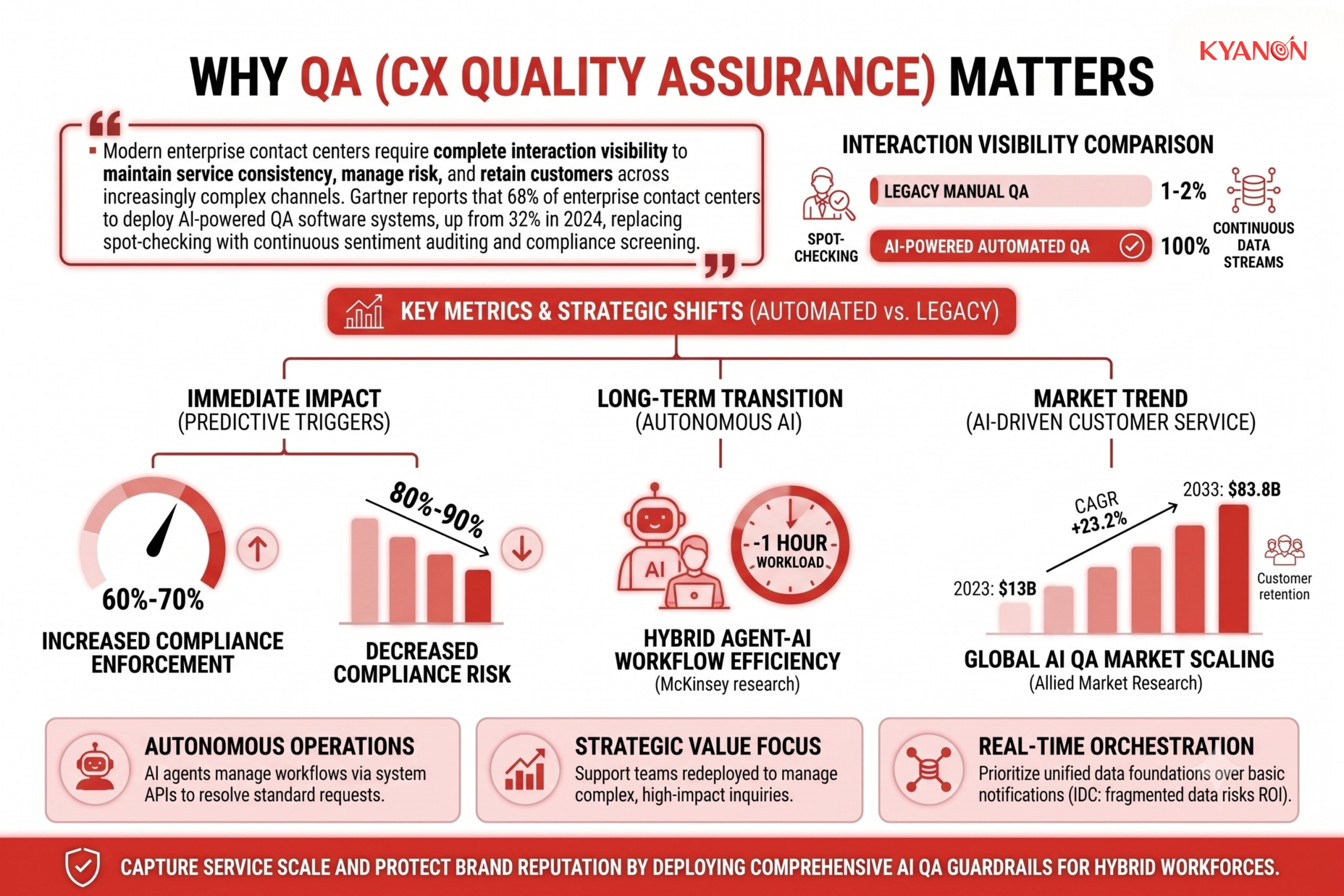
Modern enterprise contact centers require complete interaction visibility to maintain service consistency, manage risk, and retain customers across increasingly complex digital channels. Gartner reports that 68% of enterprise contact centers plan to deploy AI-powered QA software systems, up sharply from 32% in 2024, as organizations replace spot-checking with continuous sentiment auditing and compliance screening.
This rapid transition to automated oversight is driven by the operational complexity of managing hybrid human-AI service workflows. Forrester predicts that overall customer service quality will face pressure as companies manage the complexity of scaling AI pipelines, leading 30% of enterprises to build dedicated AI operation functions to onboard, coach, and unblock autonomous tools. At the same time, narrow automated systems relieve human agents of tedious background logging to shrink daily workloads by an average of 1 hour.
Establishing comprehensive quality guardrails is critical to protecting brand reputation during service scale. As automated tools handle routine interactions, human-to-AI handoffs and complex escalations require strict compliance enforcement. According to research from McKinsey & Company, 39% of organizations anticipate AI-driven headcount changes, yet two-thirds report flat or minor employment shifts, highlighting a widespread pivot toward hybrid, augmented worker models that require continuous evaluation to maintain policy compliance.
Ultimately, continuous quality auditing directly influences customer retention and operational efficiency. Deploying comprehensive interaction analytics enables organizations to resolve service friction before it impacts customer satisfaction. However, execution requires tight integration between evaluation metrics and operational workflows. Symtrain highlights that automated QA systems currently identify employee performance friction and compliance anomalies faster than traditional training frameworks can resolve them, demonstrating that continuous auditing must be paired with adaptive coaching pipelines to drive measurable business outcomes.
Common Misconceptions
Adhering to internal compliance checklists guarantees customer satisfaction
Traditional call monitoring that relies on internal checkboxes often shows minimal correlation with actual customer satisfaction or first-contact resolution. Evaluation scorecards frequently measure internal operational preferences rather than whether the customer felt understood, helped, and efficiently served.
Quality assurance is strictly an agent policing tool
Viewing quality processes solely as a mechanism to catch mistakes or enforce penalties severely limits business value. Modern quality frameworks act as continuous business intelligence engines that identify broken processes, drive targeted coaching, and inform enterprise product strategy.
Sampling small interaction batches provides an accurate operational pulse
Reviewing a tiny fraction of interactions leaves 98% or more of customer communications unexamined, creating massive compliance blind spots. Enterprise operations require full interaction coverage to capture low-frequency, high-risk anomalies and maintain accurate sentiment metrics.
Quality processes slow down service delivery
Integrating automated evaluation pipelines speeds up operational workflows rather than impeding them. Real-time scoring and automated transcript logging remove manual administrative burden from agents and supervisors, enabling faster resolution times and streamlined coaching loops.
How Kyanon Digital Applies QA (CX Quality Assurance)

Kyanon Digital implements comprehensive CX quality assurance programs for enterprise clients by deploying custom conversational analytics platforms, AI-powered interaction scoring engines, and real-time compliance monitoring frameworks. We integrate automated quality auditing directly into client contact center workflows to eliminate blind spots, protect brand compliance, and elevate customer satisfaction across all service touchpoints.
Explore our services:

 Create project brief with AI