
What is QR Commerce?
QR Commerce is a commerce model that uses Quick Response (QR) codes to connect physical products, locations, or marketing materials with digital shopping experiences. By scanning a QR code using a smartphone, customers can instantly access product information, make payments, redeem promotions, place orders, or complete self-service transactions without manually entering URLs or interacting with traditional checkout infrastructure.
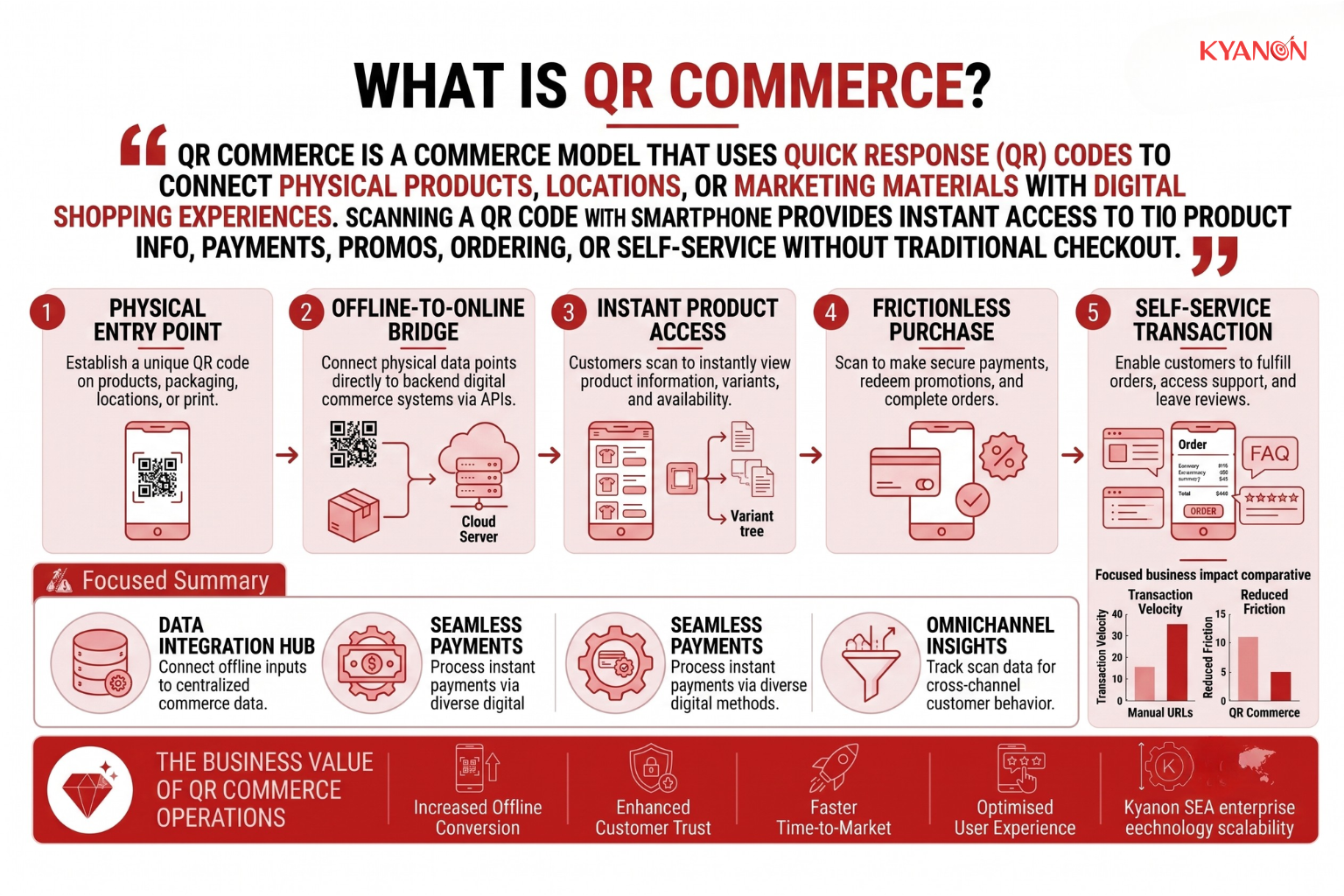
At its core, QR Commerce bridges the gap between offline and online commerce. Each QR code serves as a unique digital entry point that links customers to backend commerce systems, allowing businesses to deliver seamless purchasing experiences across retail stores, restaurants, events, packaging, print media, and outdoor advertising.
How QR Commerce Works
QR Commerce connects optical scanning interfaces with cloud-based commerce services through dynamically generated QR codes, secure payment tokens, and event-driven APIs. Instead of processing transactions entirely on a physical Point-of-Sale (POS) terminal, the customer’s mobile device initiates the transaction while backend services handle payment authorization, inventory updates, and order processing in real time.
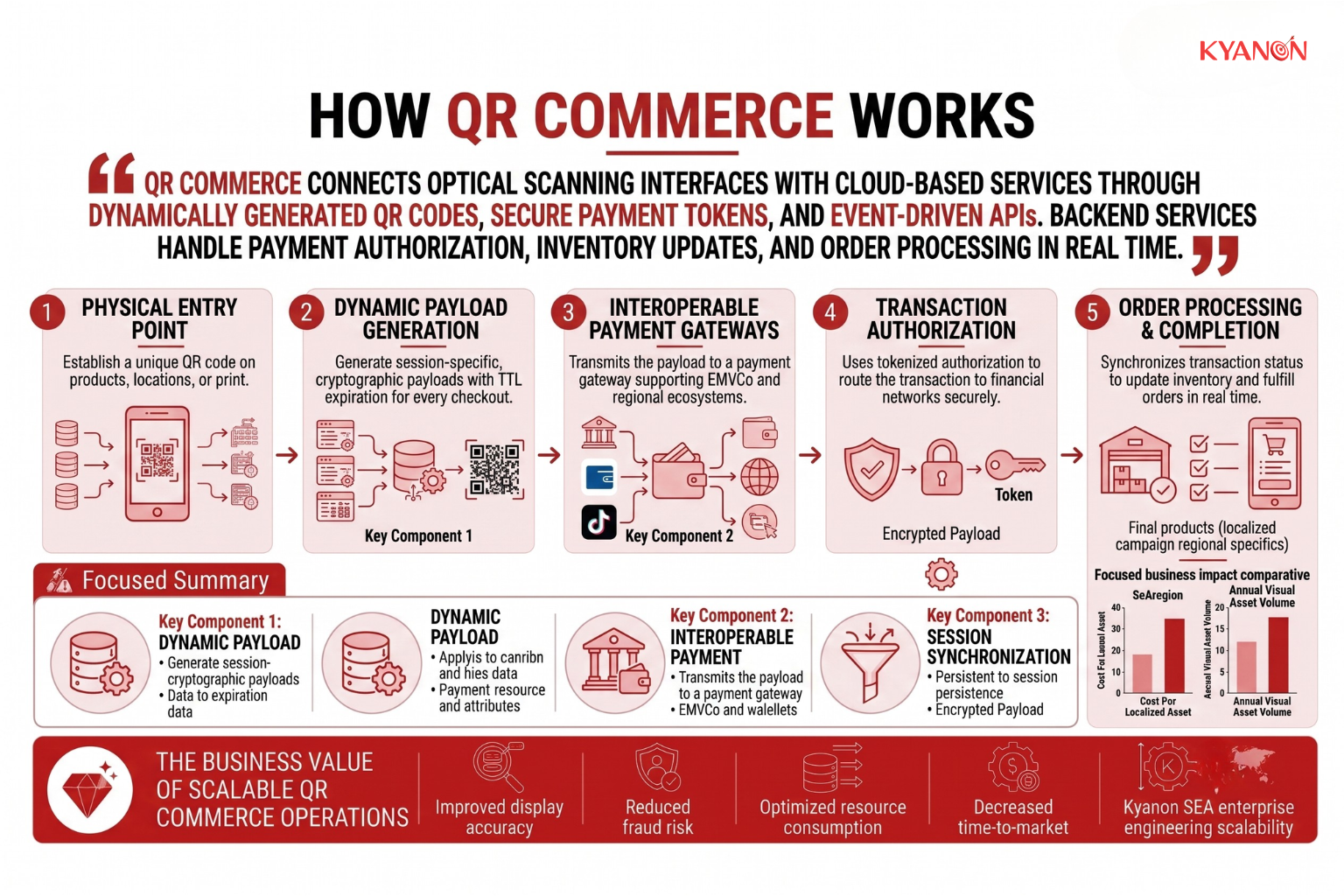
Dynamic Payload Generation
Unlike static QR codes that permanently encode a fixed URL or merchant ID, QR Commerce generates dynamic, transaction-specific payloads for every checkout session. This improves both security and flexibility by embedding contextual information directly into the QR code.
Typical payload elements include:
- Session-specific data, such as session ID, terminal ID, subtotal, tax amount, currency, and routing information.
- Cryptographic signatures and tokens, which protect transaction data from tampering and prevent unauthorized modification.
- Time-to-Live (TTL) expiration, typically ranging from 60–180 seconds, ensuring expired QR codes cannot be reused for replay attacks or fraudulent transactions.
Because each QR code is generated dynamically, merchants can support changing prices, personalized promotions, and one-time payment requests without reprinting physical codes.
Interoperable Payment Gateways
After a customer scans the QR code, the encoded payload is securely transmitted to a payment gateway that routes the transaction to the appropriate financial network.
Modern QR Commerce platforms support:
- EMVCo-compliant QR standards, enabling interoperability across banks, payment processors, and digital wallets.
- Integration with regional payment ecosystems, such as mobile banking applications and digital wallet platforms.
- Tokenized payment authorization, replacing sensitive card or bank account information with short-lived payment tokens to reduce data exposure and improve security.
This standardized architecture allows a single QR code format to support multiple payment providers while simplifying merchant integration.
Session Synchronization
Because payment is completed on the customer’s mobile device, the merchant’s backend must synchronize transaction status with physical systems in real time.
This synchronization is typically achieved through an event-driven architecture using:
- Persistent WebSocket connections between the POS terminal and commerce backend to monitor active checkout sessions.
- Payment webhooks that notify the merchant immediately after payment authorization.
- Automated order state management, updating transactions from Pending to Paid, triggering receipt generation, reducing inventory, and initiating fulfillment workflows.
By combining dynamic QR generation, interoperable payment routing, and real-time event synchronization, QR Commerce delivers fast, secure, and contactless transactions while seamlessly connecting physical retail environments with modern cloud-based commerce platforms.

QR Commerce vs NFC/Tap-to-Pay
Both protocols facilitate contactless transactions, but they diverge significantly in hardware dependency and deployment flexibility.
Comparison of QR Commerce and NFC/Tap-to-Pay
Dimension | QR Commerce | NFC/Tap-to-Pay |
| Hardware dependency | Zero (Printable onto any surface or screen) | High (Requires active NFC chips and POS terminals) |
Implementation cost | Low | High |
| Data payload capacity | High (Deep links, complex tokens, URLs) | Low (Primary account numbers, basic IDs) |
Action initiation | Merchant-presented or Customer-presented | Customer-presented only |
| Cross-channel utility | High (Print, television, out-of-home to mobile) | Low (Strictly physical proximity-based) |
When to Consider QR Commerce
Consider deploying QR Commerce if:
- Your retail operation experiences high cart abandonment at physical checkout lines and requires an immediate, self-hosted checkout alternative.
- You are deploying offline-to-online (O2O) campaigns and need to attribute physical store foot traffic directly to digital conversion metrics.
- Your enterprise operates in Southeast Asian markets where interoperable mobile wallet networks handle a higher volume of transactions than traditional credit card terminals.
It may not be the right priority if:
- Your operational model is exclusively direct-to-consumer (D2C) web-based, lacking physical storefronts, pop-ups, or print-based fulfillment touchpoints.
Why QR Commerce Matters for Retail and F&B
QR Commerce has become a key enabler of modern retail and restaurant operations by connecting physical customer interactions with cloud-based commerce systems. By shifting payment and ordering workflows to customers’ mobile devices, businesses can reduce hardware costs, accelerate checkout, and deliver seamless self-service experiences across stores, restaurants, and hospitality venues.
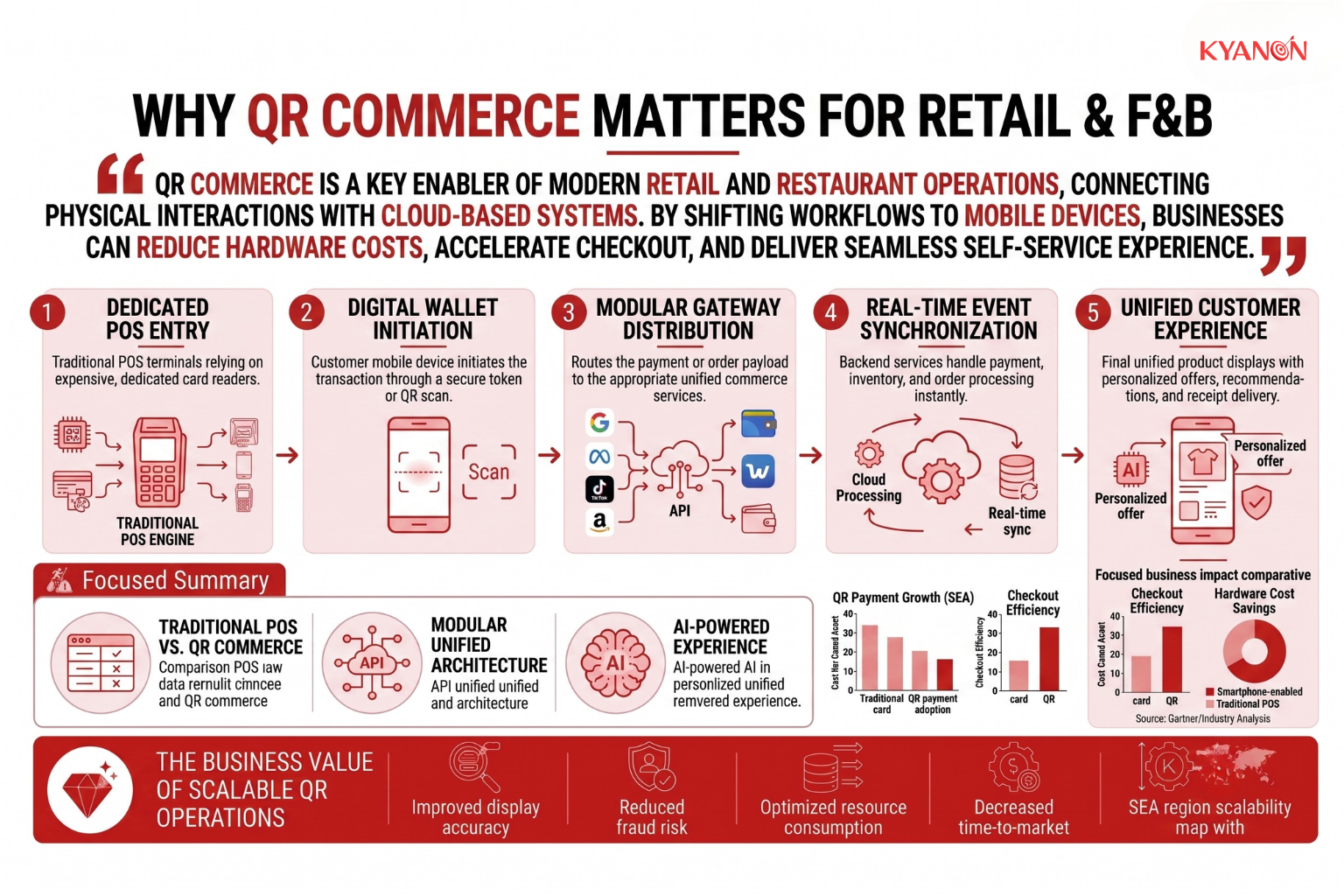
As consumers increasingly adopt digital wallets and contactless payments, QR Commerce helps retailers modernize the in-store experience while simplifying operations.
- Lower hardware investment: Unlike traditional POS terminals that rely on dedicated card readers and proprietary hardware, QR Commerce enables customers to complete transactions using their own smartphones. This reduces hardware deployment and maintenance costs while making it easier to scale checkout capacity.
- Supports unified commerce: QR codes act as a bridge between physical stores and digital commerce, allowing shoppers to access online product information, promotions, loyalty programs, and payment services through a single mobile interaction.
- Built for AI-powered customer experiences: As retailers increasingly adopt AI to personalize shopping journeys, QR Commerce provides a digital touchpoint that can connect customers with personalized offers, loyalty rewards, product recommendations, and automated checkout experiences in real time.
Common Misconceptions
QR Codes are only good for marketing links
Dynamic QR codes can route to different destinations based on the user’s location, time of day, or application state. They actively execute “scan-and-go” retail logic, smart packaging inventory routing, and dynamic pricing models to reduce waste, moving far beyond static URL redirection.
They are unsafe and easily hijacked
A printed matrix code itself is merely an image and cannot be digitally hacked. While physical phishing occurs via fraudulent sticker overlays, the underlying digital architecture mitigates this by embedding strict payment verification APIs and requiring users to authenticate store credentials natively within secure banking applications.
How Kyanon Digital Applies QR Commerce
Rather than requiring separate QR codes for different functions, Kyanon Digital combines multiple retail services into a single scanning experience.
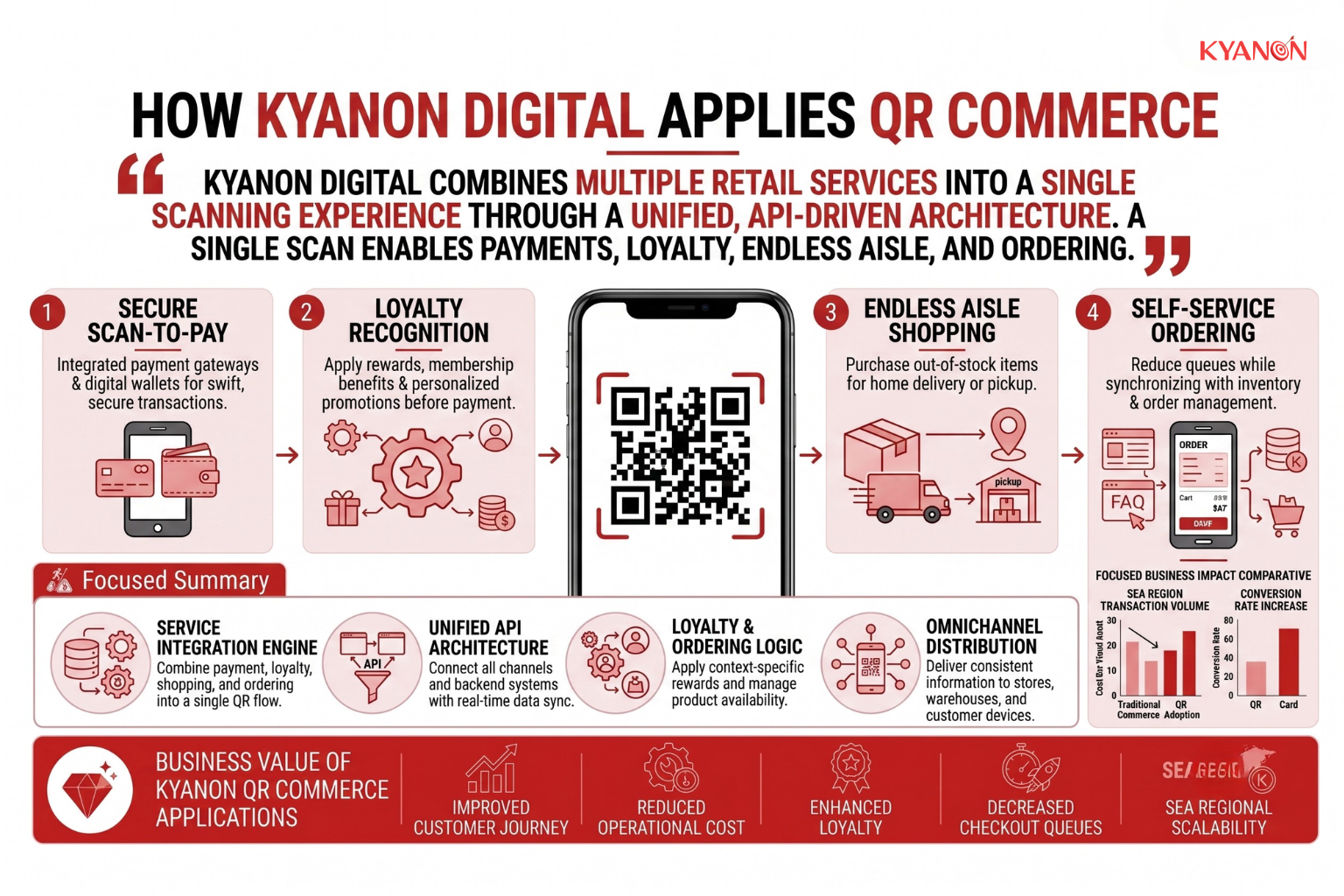
Depending on the business scenario, a single scan can enable:
- Secure scan-to-pay using integrated payment gateways and digital wallets.
- Automatic loyalty recognition, applying customer rewards, membership benefits, and personalized promotions before payment.
- Endless aisle shopping, allowing customers to purchase out-of-stock products for home delivery or pickup directly from the store.
- Self-service ordering, reducing checkout queues while maintaining real-time synchronization with inventory and order management systems.
By integrating QR Commerce into a unified, API-driven architecture, Kyanon Digital enables retailers to modernize customer experiences, extend the value of existing store infrastructure, and support scalable omnichannel commerce across Southeast Asia.
Explore our services:

 Create project brief with AI