
What is Win-Back Campaign Architecture?
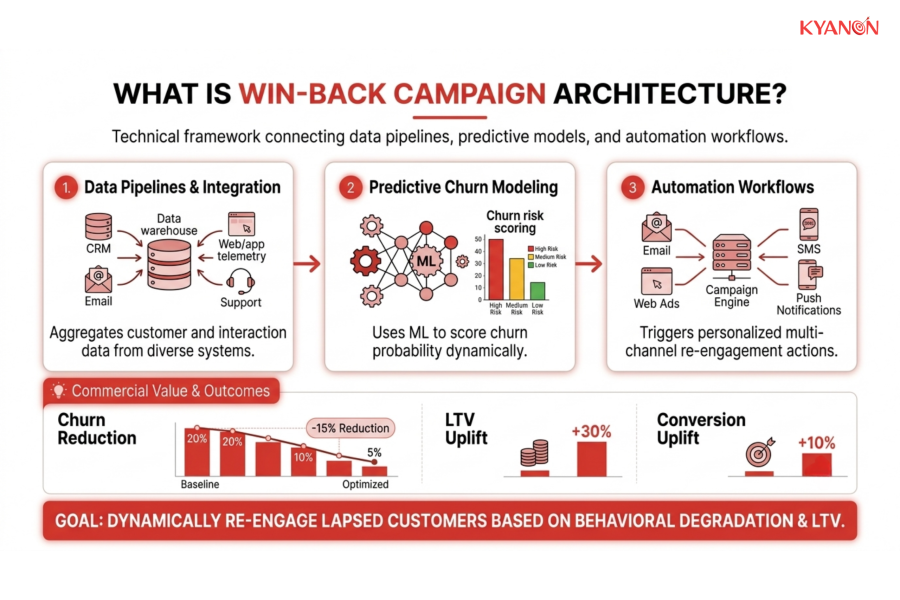
Win-back campaign architecture is the technical framework of data pipelines, predictive models, and automation workflows engineered to dynamically identify and re-engage lapsed customers based on their individual behavioral degradation and historical lifetime value.
How Win-Back Campaign Architecture Works
Modern win-back frameworks replace static, calendar-based email blasts with real-time, event-driven pipelines. By constantly ingesting behavioral inputs from transactional databases and web analytics, the architecture calculates a live health score for each user. When an account crosses a predefined degradation threshold, the system autonomously triggers personalized value restoration sequences across the most effective channels before the relationship permanently fractures.
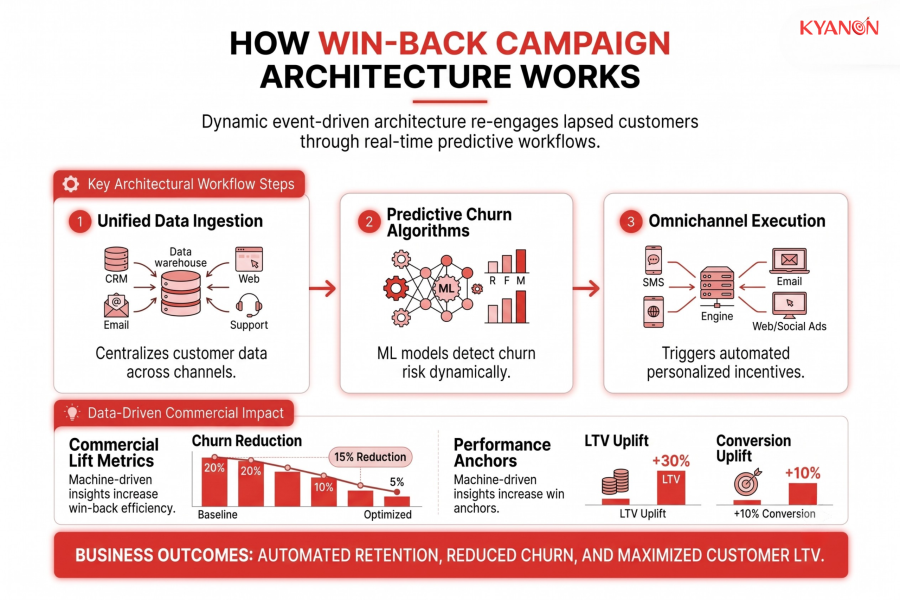
Unified Data Ingestion
The foundation relies on centralizing scattered behavioral, transactional, and customer service data into a single repository. Breaking down these silos ensures the predictive engine receives a complete picture of customer activity, preventing false positive churn alerts and enabling highly specific segmentation.
Predictive Churn Algorithms
Instead of waiting for an arbitrary 90-day inactivity mark, machine learning models continuously analyze recency, frequency, and monetary (RFM) shifts alongside behavioral metrics. These algorithms flag at-risk accounts the moment their unique engagement patterns deviate from their historical baselines.
Omnichannel Orchestration & Execution
Once a lapsed state is confirmed, the architecture pushes real-time payloads to marketing automation platforms. This orchestration layer dynamically selects the optimal channel, such as SMS, paid retargeting, or email, and personalizes the incentive based on the user’s past margin contribution, avoiding blanket discounts.

Comparative Analysis: Win-Back Campaign Architecture vs. Traditional Batch-and-Blast
Dimension | Modern Win-Back Architecture | Traditional Batch-and-Blast |
| Trigger Mechanism | Real-time, event-driven ML thresholds | Static calendar milestones (e.g., 90 days inactive) |
Incentive Strategy | Dynamic margin optimization & value restoration | Flat, universal deep discounts (e.g., 50% off) |
| Data Synchronization | Low-latency API/webhook pipelines | Manual CSV uploads or high-latency batch syncs |
Channel Approach | Cross-channel (Email, SMS, Retargeting) | Single channel reliance (primarily email) |
| Measurement Focus | 60-90 day LTV retention tracking | Immediate open rates and single first-purchase |
Why Win-Back Campaign Architecture Matters
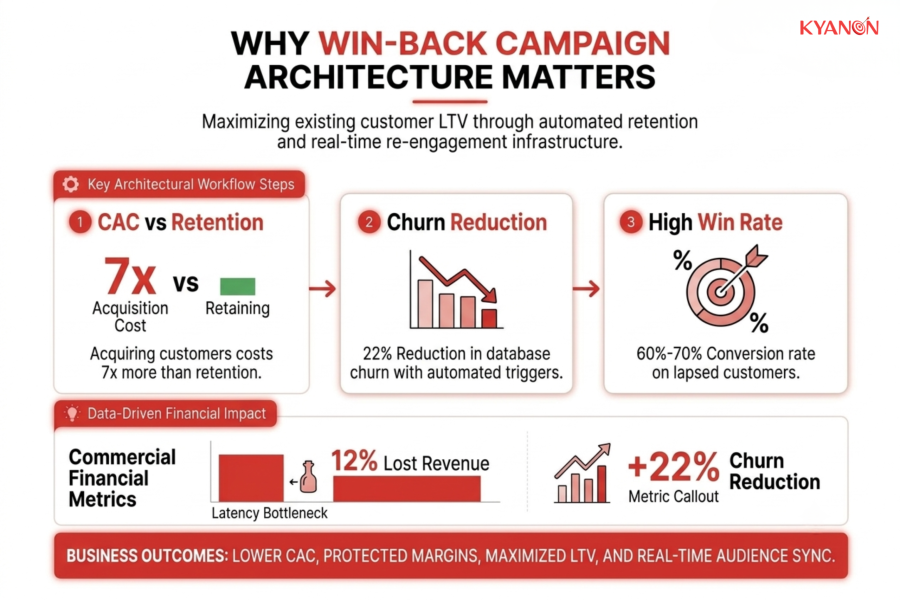
As organizations grapple with rising acquisition costs and the deprecation of third-party tracking, engineering resources are heavily pivoting toward retention infrastructure. Deploying predictive health triggers directly into automated outreach platforms allows enterprise leaders to realize up to a 22% reduction in overall database churn rates. Furthermore, re-engaging a lapsed customer carries a 60% to 70% probability of a successful sale, establishing a highly efficient revenue stream compared to the single-digit conversion rates typical of cold prospects.
However, realizing these metrics requires solving underlying latency and integration bottlenecks. Technical delays between analytical data warehouses and operational messaging systems result in missing narrow re-engagement windows. By consolidating customer data repositories and deploying composable architectures, IT and engineering leaders can sync audience states in near real-time.
Common Misconceptions
The One-Size-Fits-All Sequence
A blind broadcast wastes margin and annoys users. Effective architecture requires root-cause segmentation. A customer who left because of a poor customer support experience needs a customer service escalation or product update message; a customer who left due to pricing needs an incentive or alternative tier.
Confusing a Churn Mitigation Plan with a Win-Back Campaign
If a user is still active but fading, or has initiated a cancellation request, you need a churn prevention/save campaign. True win-back architecture applies only after a customer has officially lapsed, broken their contract, or completely ceased transactions for a sustained period. Attempting to “win back” someone who hasn’t fully left yet breaks the customer experience context.
Assuming Discounts Are the Only Lever
Relying solely on price drops destroys profit margins and trains customers to intentionally lapse just to get a discount. Superior win-back frameworks focus on value restoration, highlighting new product features, fixed bugs, expanded catalogs, or alternative subscription tiers that didn’t exist when they originally departed.
Overlooking Data Decay and Deliverability Risks
Unmonitored data decay leads to high hard-bounce rates and spam complaints, which can ruin your domain’s overall sender reputation. A robust win-back architecture always begins with a data hygiene step (suppressing dead addresses, running list-cleaning tools) and uses channels outside of email, such as paid retargeting or SMS, if email permissions have decayed.
Defining Success Solely by the First Re-purchase
True success is defined by long-term lifetime value (LTV) retention. Many won-back customers buy once via a steep discount and immediately churn again (referred to as “serial churners”). The architectural funnel must track these users for 60 to 90 days post-activation to ensure they successfully reintegrate into the standard customer journey.
How Kyanon Digital Applies Win-Back Campaign Architecture
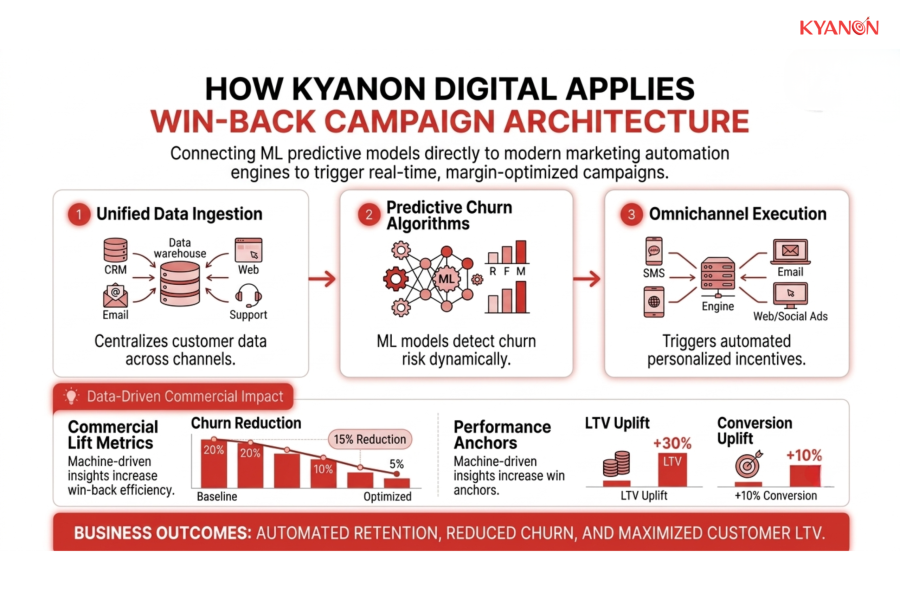
Kyanon Digital builds robust win-back campaign architectures for enterprise retail and e-commerce clients by connecting custom machine learning predictive models directly to modern marketing automation engines. Our engineering approach eliminates data latency between data warehouses and execution platforms, ensuring that contextual, margin-optimized campaigns are triggered at the precise moment of maximum recapture probability.
Explore our services:

 Create project brief with AI