

According to Bain & Company’s 2026 Retail Executive Agenda, while industry leaders are three times more likely to deploy AI at scale, the vast majority of organizations are held back by foundational gaps. Bain emphasizes that AI cannot be viewed merely as a plug-and-play tool; it requires the “surrounding data, improved merchandising processes, and well-trained merchants” to be effective. This proves that failing to scale AI is not just a technology issue; it is a fundamental business transformation challenge.
This article addresses the five most significant challenges of AI in retail, dissecting the root causes of failure and providing a practical, engineering-led path to overcoming each bottleneck. If you want your AI initiatives to drive real growth rather than just hype, the following frameworks are essential.
Key Takeaways
- The core problem: Most retail AI pilots fail due to unstructured data lakes, siloed legacy systems, organizational aversion to algorithms, and a lack of MLOps governance.
- The foundation: Treat data as a governed product and resolve customer identities across omnichannel touchpoints.
- Step 1: Normalize data at the source (POS, web, app, ERP) before deploying models.
- Step 2: Build a unified Customer Data Platform (CDP) to bridge fragmented systems.
- The outcome: Moving from costly experiments to scalable AI that improves demand forecasting, dynamic pricing, and operational efficiency.
Further Reading
- Building AI-Driven Pricing Systems for Retail
- Generative AI for Retail: 7 Real Use Cases
- AI in Ecommerce and Retail: Trends, Use Cases, and Business Impact
Why AI in retail is harder than the vendor deck suggests
The AI vendor landscape promises transformational results, including hyper-personalization at scale and absolute demand forecasting accuracy. From a rigorous engineering perspective, however, the enterprise reality is much harsher: the core challenges of AI in retail are not algorithmic failures, but systemic breakdowns of legacy infrastructure and upstream data governance.
- The reality gap: Initiatives take longer, cost more, and deliver less than projected in the first cycle.
- The root cause: As noted by Bain & Company, realizing early ROI requires more than just deploying tech; jobs need to be completely redesigned, and leaders heavily underestimate change management.
- The prerequisites: Clean data, governed IT systems, and aligned merchandising teams must be established before AI deployment.
Challenge 1: Poor data quality at the source
Artificial intelligence is only as intelligent as the data it consumes. Before addressing complex machine learning algorithms, retail leaders must confront the harsh reality that their predictive models are often built on a foundation of flawed, unstructured input.
Why it happens
Data originates from disparate touchpoints (POS, apps, websites) with different validation rules. According to Kearney, systems struggle heavily with variety and unstructured data. Confined to predefined logic or fed by unstructured inputs, these systems often overlook nuances, leading to misinterpretations and flawed risk assessments. Free-text fields and nullable attributes create inconsistent “garbage” data, causing models to learn the wrong patterns.
What it looks like in practice
- Systematic over/under-forecasting for specific stores due to bad POS data.
- Failed personalization (e.g., repeating the same product recommendation).
- Supply chain “anomalies” that are actually just human data entry errors.
How to overcome it
- Audit data at the collection point (UI layer). According to Kearney (2026), accelerating AI at scale requires ensuring that “data quality is embedded from the outset rather than corrected after the fact”.
- Make field-level data completeness an operational KPI for business units.
- Set strict data quality thresholds before allowing new AI use cases into production.
Challenge 2: Fragmented data across systems
The modern retail ecosystem is inherently omnichannel, but the IT infrastructure supporting it rarely is. When historical data is trapped in disconnected legacy systems, achieving a unified, 360-degree view of the customer becomes an architectural impossibility.
Why it happens
Retailers accumulate overlapping, siloed legacy systems (POS, eCommerce, CRM) without a Master Data Management (MDM) strategy. This causes blind spots between digital and physical customer behaviors.
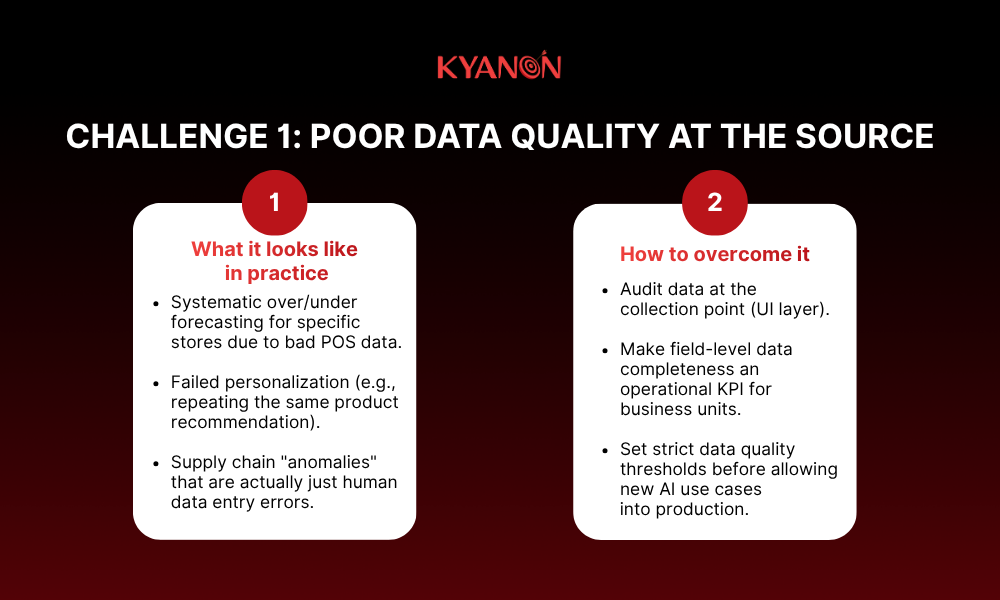
What it looks like in practice
- Personalization engines use only web data, ignoring legacy POS data.
- Omnichannel marketing ROI is mathematically impossible to calculate.
- Forecasting ignores physical stores (which still dominate retail transactions), guaranteeing flawed insights.
How to overcome it
- Map all data sources and assign an authoritative system owner for each domain.
- Implement a Customer Data Platform (CDP) for robust omnichannel identity resolution.
- Invest in integration infrastructure and APIs before selecting AI tools.
Challenge 3: Unclear AI use case prioritisation
Innovation should never be driven purely by vendor hype or competitor fear. Retailers often exhaust their budgets by attempting to deploy highly complex AI initiatives without first establishing the necessary data architecture and commercial baselines to support them.
Why it happens
Investments are often driven by vendor hype rather than internal data readiness. According to Bain & Company (2024), while over 60% of surveyed companies see generative AI as a top priority, only about 35% have a clearly defined vision for how they will actually create business value. Companies attempt complex use cases without a foundational architecture, causing internal silos to compete for resources.
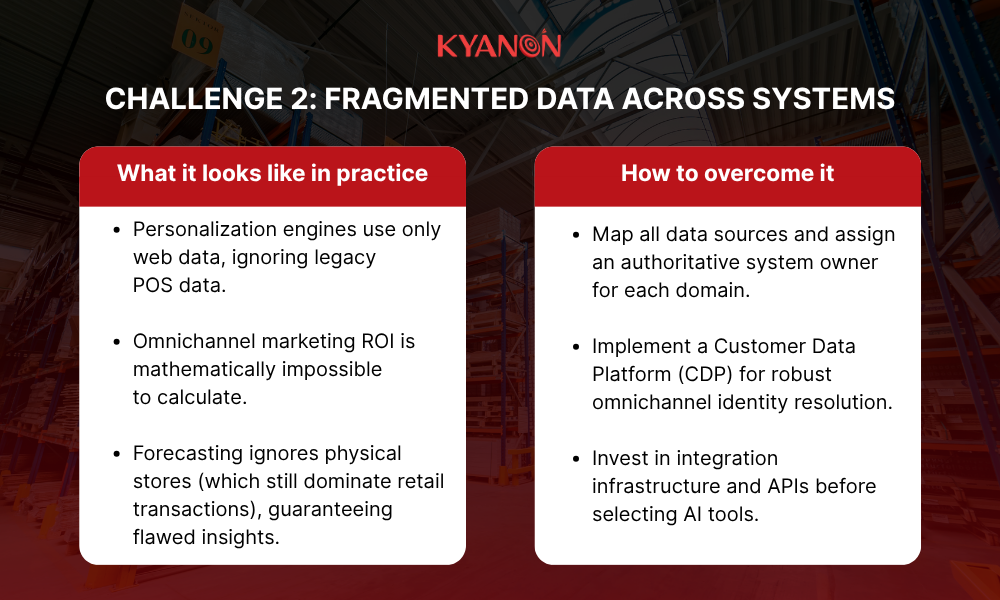
What it looks like in practice
- Launching Gen AI without a standardised product catalogue tags.
- Demand forecasting using unadjusted historical data (e.g., pandemic supply shocks).
- Approving projects without mathematically rigorous ROI measurement frameworks.
How to overcome it
- Strictly gate-check projects against their granular data dependencies.
- Sequence initiatives based on data maturity, not marketing appeal.
- Define absolute commercial KPIs, baselines, and exact ROI timeframes upfront.
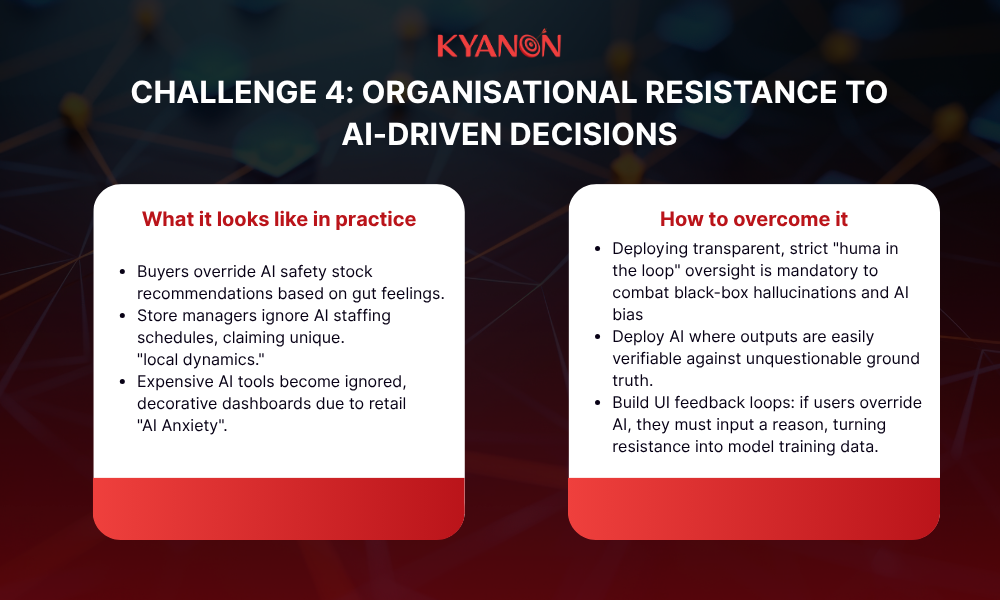
Challenge 4: Organizational resistance to AI-Driven decisions
Even the most mathematically flawless algorithm will fail to generate ROI if the merchandising and frontline operations teams refuse to use it. Transitioning from intuition-based heuristics to AI-driven insights requires overcoming deep-rooted cultural resistance and building systemic trust.
Why it happens
Experienced staff favor intuition over algorithms (“algorithm aversion”). This worsens if early pilots fail due to bad data, and there is no formal process in place to resolve human-AI disagreements.
What it looks like in practice
- Buyers override AI safety stock recommendations based on gut feelings.
- Store managers ignore AI staffing schedules, claiming unique “local dynamics.”
- According to Kearney, expensive AI tools become ignored, decorative dashboards due to retail “AI Anxiety”.
How to overcome it
- Deploy transparent, Explainable AI (XAI). According to Kearney (2024), strict “human-in-the-loop” oversight is mandatory to combat black-box hallucinations and AI bias
- Deploy AI where outputs are easily verifiable against unquestionable ground truth.
- Build UI feedback loops: If users override AI, they must provide a reason, thereby turning resistance into model training data.
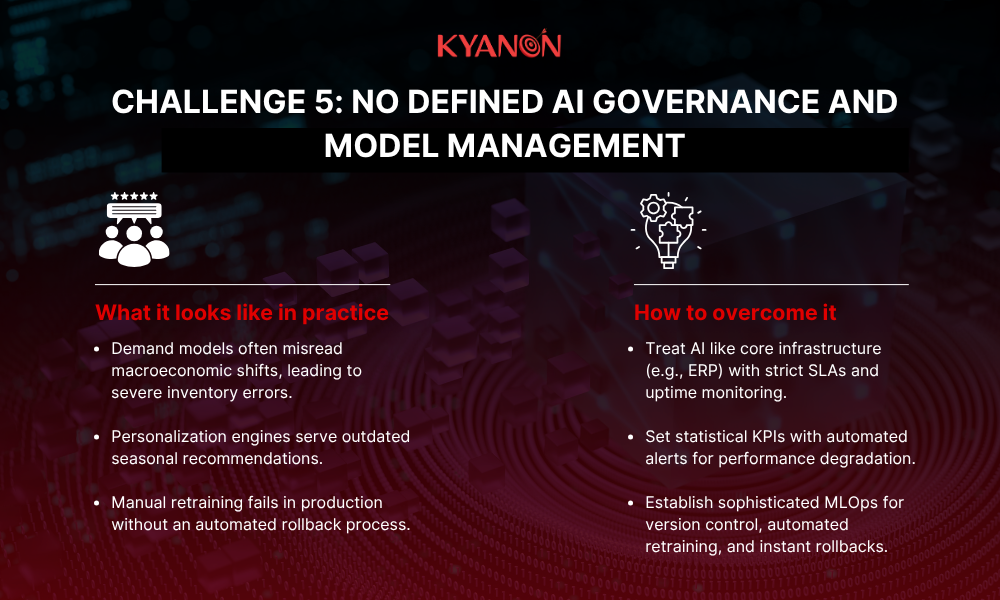
Challenge 5: No defined AI governance and model management
Deploying an AI model into production is not the finish line; it is merely the starting point. Without a rigorous operational framework to monitor, maintain, and retrain algorithms over time, retail AI assets will rapidly degrade as market dynamics change.
Why it happens
Organizations focus on building models but neglect MLOps (ongoing lifecycle management). Models degrade as consumer behavior shifts (model drift). According to the Kearney AI Trends Report (2026), as access to AI models becomes more democratized, competitive differentiation shifts entirely to data quality, domain expertise, and the ability to operationalize insights at scale.
What it looks like in practice
- Demand models often misread macroeconomic shifts, leading to severe inventory errors.
- Personalization engines serve outdated seasonal recommendations.
- Manual retraining fails in production without an automated rollback process.
How to overcome it
- Treat AI like core infrastructure (e.g., ERP) with strict SLAs and uptime monitoring.
- Set statistical KPIs with automated alerts for performance degradation.
- Establish sophisticated MLOps for version control, automated retraining, and instant rollbacks.
How to build a retail AI readiness foundation
A structured, engineering-led approach to addressing the challenges of AI in retail is the only reliable way to ensure scalable success. The following strategic matrix outlines the foundational stages and technical baselines that separate resilient enterprise architectures from failed, expensive pilots.
|
AI Readiness Stage |
Common Bottleneck | Strategic Solution | Business Impact |
| Data Ingestion | Unstructured, error-prone data from legacy POS. | Enforce UI-level validation & automated data cleansing pipelines. | Creates a reliable baseline for all predictive modeling. |
| Data Integration | Siloed systems prevent omnichannel views. | Deploy a unified CDP with an identity resolution architecture. | Enables accurate, hyper-personalized customer experiences. |
| Model Deployment | Model drift is causing degraded forecast accuracy. | Implement rigorous MLOps for automated monitoring & retraining. |
Ensures sustained ROI and prevents costly inventory errors. |
Source: Synthesized from practical enterprise AI deployments and recent industry analyses (Bain & Company, Kearney, RAND Corporation).Disclaimer: Strategic frameworks developed from industry analyses by McKinsey and Kearney. Actual timelines and results may vary based on existing infrastructure maturity and market volatility.
How Kyanon Digital helps retailers overcome AI challenges
At Kyanon Digital, we understand that realizing the full potential of AI requires a disciplined technical roadmap that prioritizes data accuracy and system readiness. Instead of focusing solely on pure machine learning models, we partner with enterprises to build robust foundational infrastructure, helping to bridge the gap between algorithmic logic and real-world operational efficiency. The following case study demonstrates our “engineering-first” approach to solving large-scale data problems and optimizing execution velocity for enterprises.
Case study: AI-Driven BI & Data Warehouse For A Leading Retail Corporation

Challenges
- Manual reporting bottlenecks: The operational dependency on siloed, manual reporting processes across nearly 200 locations restricted execution velocity and introduced high risks of data inconsistency and human error.
- Fragmented data infrastructure: The absence of a centralized data repository created immense operational latency, causing prolonged delays in cross-store data retrieval, multi-system reconciliation, and real-time performance tracking.
Solutions
- Centralized ingestion and automated workflows: Implementation of a standardized, cloud-accessible report submission framework utilizing uniform templates and an automated, multi-tiered hierarchical approval engine to ensure immediate upstream data validation.
- Power BI data warehouse integration: Construction of an enterprise-grade data warehouse seamlessly integrated with Microsoft Power BI, converting static operational reports into dynamic, real-time analytics dashboards for executive-level tracking.
Results and Impact
- Elimination of operational execution latency: Automated submission and approval cycles dramatically compressed the retail reporting lifecycle, eliminating manual follow-ups and driving rapid cross-departmental coordination.
- Unified, data-driven executive oversight: The deployment provided the leadership team with absolute visibility into cross-store performance KPIs, moving enterprise decision-making from reactive troubleshooting to proactive, real-time strategic growth.
Explore the full case study here: AI-Driven BI & Data Warehouse For A Leading Retail Corporation
Building retail AI that actually performs
The strategic challenges of AI in retail are immense but fundamentally solvable through a disciplined, engineering-first approach. AI is not a plug-and-play tool; unlocking its true commercial potential requires prioritizing data quality at the source, adopting integration architectures like CDPs, and enforcing rigorous MLOps governance. When these foundational elements are in place, retail leaders can confidently shift from reactive problem-solving to a proactive, intelligent ecosystem that actively protects profit margins, optimizes supply chains, and drives hyper-personalized customer experiences.
In modern omnichannel commerce, relying on legacy systems is no longer a viable strategy. As market dynamics continue to evolve in 2026, the competitive gap between organizations stuck in endless, isolated pilots and those successfully scaling AI is rapidly widening. To bridge the gap between algorithmic ambition and technical reality, enterprises must treat AI as a core operational capability rather than a temporary science experiment.
Are you ready to architect a scalable, future-proof retail ecosystem? Contact Kyanon Digital today to schedule an in-depth technical consultation and turn your AI investments into real business value.




















 Create project brief with AI