

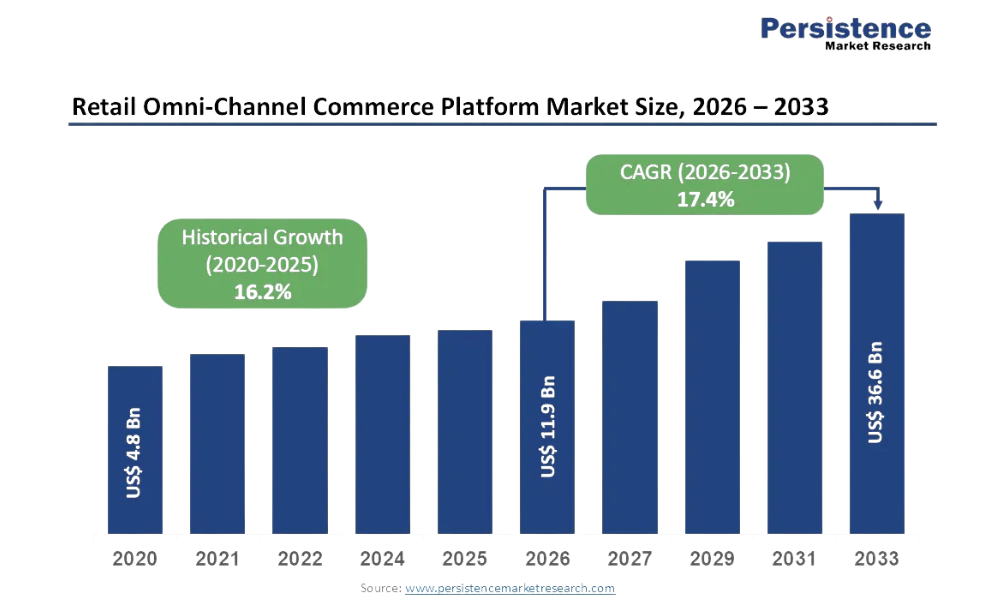
Retail order management systems are becoming more important as stores, eCommerce platforms, marketplaces, and fulfillment networks operate as one retail ecosystem. Persistence Market Research estimates the global retail omnichannel commerce platform market at US$11.9 billion in 2026, with demand increasingly driven by unified inventory, order management, and real-time data integration across physical and digital channels.
Yet the operational problem remains difficult: inventory must stay accurate across locations, orders must be routed to the right fulfillment node, and returns must move cleanly between online and physical channels. This makes OMS selection less about managing orders in one system and more about coordinating how inventory and fulfillment decisions are executed across the retail network.
The main problem is no longer capturing orders. It is maintaining accurate available inventory, deciding where each order should be fulfilled, keeping delivery promises, and recovering when inventory or fulfillment conditions change.
That makes retail order management software increasingly important for businesses moving from separate channels toward unified commerce.
In this article, Kyanon Digital compares leading retail order management systems for omnichannel brands, examines where each platform fits, and outlines the capabilities, integration risks, and selection criteria businesses should assess before making a decision.
Key takeaways
Quick comparison table of best retail order management systems
|
Retail order management system |
Best fit | Main strength |
Key evaluation point |
|
Manhattan Active Order Management |
Large omnichannel retailers | Advanced distributed-order orchestration | Enterprise implementation complexity |
| IBM Sterling Order Management | Complex global B2C/B2B operations | Multi-node orchestration and inventory visibility |
Configuration and integration scope |
|
Fluent Commerce |
Composable enterprise retail | Flexible distributed order management | Requires mature architecture governance |
| Kibo Order Management | Modular B2C/B2B commerce | Real-time inventory and intelligent routing |
Integration with existing ecosystem |
|
Blue Yonder Order Management |
Supply-chain-intensive retailers | AI-enabled sourcing and fulfillment | Best value requires meaningful network complexity |
| NetSuite | ERP-led retail environments | ERP, inventory, finance and orders together |
Broader suite implementation scope |
|
Brightpearl by Sage |
Mid-market omnichannel brands | Retail operations and workflow automation | Less suited to highly complex global DOM |
| Cin7 Omni | Growing retail, wholesale and B2B operations | Inventory plus broad integration ecosystem |
Test orchestration depth separately |
|
Shopify Plus / POS |
Shopify-first retail businesses | Native digital and store commerce integration | External network complexity may require a dedicated OMS |
| Linnworks | Marketplace-heavy sellers | Marketplace, inventory and order automation |
Less focused on store-heavy enterprise DOM |
Business fit:
- For enterprise distributed fulfillment, Manhattan, IBM Sterling, Fluent Commerce, Kibo, and Blue Yonder deserve early consideration.
- For mid-market or ecosystem-led environments, NetSuite, Brightpearl, Cin7 Omni, Shopify, and Linnworks can offer a better balance of capability and implementation complexity.
How we evaluated the best retail order management systems
The platforms were evaluated based on how well they support real omnichannel operations, not simply on feature count or market visibility.
Incisiv reported in 2026 that 64% of retailers acknowledge critical gaps in core unified commerce capabilities, reinforcing the importance of evaluating inventory, fulfillment, integration, and operational readiness together.
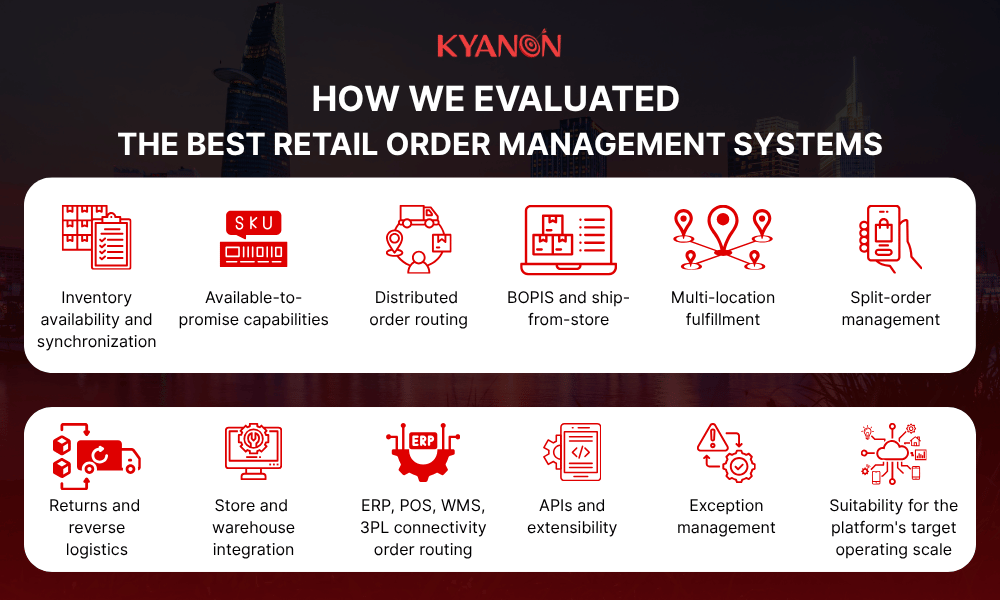
We focused on four areas:
- Inventory control: Real-time availability, synchronization, reservations, and available-to-promise.
- Fulfillment execution: Distributed routing, BOPIS, ship-from-store, split orders, returns, and exception handling.
- Integration fit: Connectivity with ERP, POS, WMS, 3PLs, stores, and commerce platforms, including API extensibility.
- Operating fit: Ability to support order volume, fulfillment locations, channel complexity, and future growth.
Methodology note: Platforms are evaluated within their intended operating scale. A mid-market OMS is not expected to provide the same orchestration depth as a global enterprise platform if it offers a better fit with lower implementation complexity. Vendor documentation is used to verify capabilities, not to establish vendor superiority.
Manhattan Active Order Management

Manhattan Active Order Management is designed for enterprise omnichannel orchestration, combining real-time inventory visibility, order promising, fulfillment sourcing, and post-purchase order management on a cloud-native microservices platform.
Best fit for: Large retailers managing complex distributed fulfillment across stores, distribution centers, countries and sales channels.
Key capabilities
- Enterprise inventory visibility.
- Global order orchestration.
- Order promising.
- BOPIS.
- Ship-from-store.
- Order modification.
- Fulfillment sourcing.
- Configurable workflows and business rules.
- Store fulfillment.
- Exception management.
Why it stands out
Manhattan is strongest where fulfillment decisions involve multiple operational constraints, not just the nearest available location.
Its sourcing logic can consider factors such as inventory availability, facility workload, historical rejection rates, fulfillment accuracy, and location priorities when determining where an order should be fulfilled.
Architecture and integration fit
The platform is built on a cloud-native, microservices architecture and is designed to operate alongside existing commerce, ERP, store, and fulfillment systems. Manhattan also documents REST API and middleware-based integration patterns for enterprise order environments.
Business implication: This makes it more suitable when the OMS must act as an orchestration layer across an existing enterprise stack rather than replace every surrounding system.
Main consideration
The same orchestration depth can introduce unnecessary implementation and governance complexity for businesses with only a few fulfillment nodes or straightforward routing rules.
Best selection scenario: Large store and distribution networks where fulfillment decisions must continuously balance inventory, delivery promises, capacity, and operational cost.
IBM Sterling Order Management

IBM Sterling Order Management provides visibility across orders and inventory while supporting real-time omnichannel fulfillment workflows such as ship-from-store, curbside pickup and BOPIS.
Best fit for: Global enterprises managing complex B2C and B2B order networks.
Key capabilities
- Multi-node inventory visibility.
- B2C and B2B order management.
- Inventory allocation.
- Order promising.
- Ship-from-store.
- BOPIS.
- Order modification.
- Enterprise integrations.
- Store engagement extensions.
Why it stands out
Sterling is strongest when the order lifecycle must coordinate multiple systems and complex fulfillment processes, rather than simply route an order between a small number of stores and warehouses.
IBM documents support for complex fulfillment processes spanning multiple child orders, while operational users can monitor orders in real time and respond to alerts and execution issues.
Business implication: It becomes more relevant as order complexity grows across channels, fulfillment nodes, B2B/B2C processes, and enterprise systems.
Architecture and integration fit
Sterling provides extensibility and integration capabilities for connecting with surrounding enterprise applications. IBM recommends REST APIs for external-system integration, while IBM App Connect can connect through REST APIs or IBM MQ for synchronous and asynchronous workflows.
Business implication: This makes Sterling suitable when the OMS needs to sit between existing commerce, inventory, fulfillment, and enterprise systems rather than operate as an isolated order application.
Main consideration
Sterling’s flexibility also means businesses should validate configuration, integration, and operating complexity against actual requirements before implementation.
In particular, advanced inventory and promising capabilities can involve additional Sterling components and integration patterns, so requirements should be mapped carefully rather than assuming every capability sits within one standard OMS configuration.
Best selection scenario: Complex international or multi-entity order networks where orders frequently require cross-system coordination, modification, exception handling, or fulfillment across multiple nodes.
Fluent Commerce
Fluent Commerce is a distributed order management platform focused on inventory availability, order orchestration, and configurable fulfillment logic. Its modules cover inventory, sourcing, order lifecycle management, and in-store fulfillment.
Best fit for: Enterprises adopting composable commerce or modernizing order management without replacing the wider commerce, ERP, POS, or fulfillment stack.
Key capabilities
- Distributed order management.
- Unified inventory availability.
- Ordering and sourcing.
- Order orchestration.
- BOPIS and store fulfillment.
- Split-order management.
- Dropshipping.
- Configurable fulfillment rules.
- API-led extensibility.
Why it stands out
Fluent Commerce is particularly relevant when businesses want order orchestration to evolve independently from the storefront and other enterprise platforms.
Its architecture supports configurable business rules and modular deployment, allowing fulfillment logic to change without requiring a broader commerce-platform replacement.
Business implication: This can reduce dependency on a monolithic commerce stack when businesses expect to add channels, regions, fulfillment models, or new enterprise systems over time.
Architecture and integration fit
Fluent Commerce is positioned as a cloud-native, modular, API-first platform designed to integrate into existing technology ecosystems. Its documentation also supports APIs, webhooks, and configurable workflows for inventory and order orchestration.
Business implication: It is a stronger fit where the OMS needs to act as an independent orchestration layer between commerce, ERP, POS, warehouses, stores, and other fulfillment systems.
Main consideration
Fluent Commerce offers high flexibility, but businesses need clear governance over sourcing, safety stock, capacity, split shipments, and exceptions to avoid added operational complexity.
In 2026, Fluent Commerce introduced AI-powered order-sourcing A/B testing to compare fulfillment strategies by margin, cost, speed, and sustainability.
Best selection scenario: Enterprises using composable or API-first architecture that need fulfillment logic to evolve independently.
Kibo Order Management

Kibo Order Management combines real-time inventory visibility, order promising, and intelligent routing across stores, distribution centers, and other fulfillment locations. Its inventory layer supports location selection, routing rules, and estimated delivery dates.
Best fit for: Businesses seeking a modular enterprise OMS that can support both B2C and B2B commerce.
Key capabilities
- Real-time inventory visibility.
- Order orchestration and routing.
- Inventory promising.
- BOPIS and store fulfillment.
- Reverse logistics.
- B2B and B2C workflows.
- API-driven integration.
- Configurable fulfillment rules.
Why it stands out
Kibo is a strong fit when businesses need a dedicated OMS without replacing the wider commerce or ERP environment.
Its modular approach allows inventory, promising, routing, and fulfillment capabilities to operate as part of a broader enterprise stack.
Architecture and integration fit
Kibo provides APIs across orders, inventory, fulfillment, returns, and locations, making it suitable for connecting existing commerce, ERP, warehouse, and store systems.
Business implication: This supports incremental OMS modernization where businesses want to improve fulfillment orchestration without a full replatforming program.
Main consideration and 2026 development
Kibo’s configurable routing requires clear ownership of inventory rules, fulfillment priorities, and exceptions.
In Q1 2026, Kibo introduced its Order Routing Explain Agent, which shows which locations and rules influenced a fulfillment decision, making routing logic easier for operations teams to investigate.
Best selection scenario: Businesses needing modular B2B/B2C order orchestration with transparent, configurable routing across multiple fulfillment locations.
Blue Yonder Order Management

Blue Yonder Order Management combines real-time inventory availability, order sourcing, orchestration, store fulfillment, returns, and intelligent rebalancing within its broader supply-chain platform.
Best fit for: Large retailers where order fulfillment must coordinate closely with inventory, warehouses, stores, and wider supply-chain constraints.
Key capabilities
- Real-time inventory availability.
- Order sourcing and orchestration.
- Fulfillment optimization.
- Store fulfillment.
- Returns management.
- Intelligent inventory rebalancing.
- AI/ML-driven order decisioning.
- Composable, API-first order services.
Why it stands out
Blue Yonder is strongest when fulfillment decisions need to reflect wider supply-chain conditions, not just order and inventory data.
Its platform connects order management with broader planning and execution workflows, making it relevant where warehouse constraints, inventory positioning, and fulfillment performance influence how orders should be sourced.
Business implication: This can provide more coordinated decision-making across inventory and fulfillment, particularly for large or operationally complex retail networks.
Architecture and integration fit
Blue Yonder provides cloud-native, API-first order services covering order capture, promising, and orchestration, supporting integration with existing commerce and enterprise systems.
Business implication: It fits businesses that want OMS capabilities to operate as part of a wider supply-chain architecture rather than as a standalone order application.
Main consideration
Blue Yonder is most valuable where supply-chain complexity justifies deeper orchestration; simpler retail networks may not need that breadth.
Its 2026.1 release added performance intelligence, predictive simulation, and unified service capabilities to improve sourcing and fulfillment decisions.
Best selection scenario: Large retail networks where inventory, stores, warehouses, and fulfillment decisions need to be coordinated through one broader execution model.
NetSuite

NetSuite Multichannel Order Management provides a shared view of inventory, pricing, orders, payments, and returns across channels. It supports inventory across stores, warehouses, 3PLs, and dropship partners, including available-to-promise capabilities.
Best fit for: Businesses that want omnichannel order management tightly integrated with ERP, finance, inventory, and supply-chain operations.
Key capabilities
- Cross-channel order orchestration.
- Inventory visibility and ATP.
- Store and warehouse fulfillment.
- Split shipments.
- Drop shipping and endless aisle.
- Returns management.
- ERP and financial integration.
- Order lifecycle monitoring.
- Configurable fulfillment workflows.
Why it stands out
NetSuite is strongest when order management is part of a broader ERP-led operating model.
Because orders, inventory, fulfillment, and financial data sit within the same business platform, businesses can reduce the number of separate systems and reconciliation points required across the order-to-cash process.
Architecture and integration fit
NetSuite supports fulfillment across stores, warehouses, 3PLs, and dropship partners, while REST web services can connect order and fulfillment records with surrounding applications.
Business implication: It is particularly suitable when the goal is to consolidate ERP, inventory, and order processes rather than introduce a standalone orchestration layer.
Main consideration
If the existing ERP already works well and the main requirement is advanced distributed-order routing, adopting a broader ERP suite may add unnecessary transformation scope.
NetSuite’s ATP and supply-allocation capabilities also require the relevant features and configuration, so businesses should validate which functions are included in the planned deployment.
Best selection scenario: Businesses modernizing ERP and omnichannel order management together and prioritizing a more unified operating platform over highly specialized distributed-order orchestration.
Brightpearl by Sage

Brightpearl by Sage combines order management, multi-location inventory, fulfillment automation, shipping, and retail accounting within a retail-focused operating platform. Its automation engine supports partial fulfillment, dropshipping, order routing, invoicing, and multi-location inventory allocation.
Best fit for: Growing and mid-market retailers that need to centralize orders, inventory, fulfillment, and back-office retail operations without adopting enterprise-scale distributed order management.
Key capabilities
- Multichannel order management.
- Multi-location inventory.
- Rules-based order routing.
- Partial fulfillment and order splitting.
- Dropshipping.
- Shipping and carrier integration.
- Workflow automation.
- Retail accounting.
- Returns integration.
Why it stands out
Brightpearl is broader than a standalone OMS. It brings order, inventory, fulfillment, automation, and accounting workflows into one retail-oriented environment.
Business implication: This can reduce application fragmentation for growing retailers that need stronger operational automation but do not require highly sophisticated global fulfillment orchestration.
Architecture and integration fit
Brightpearl provides pre-built integrations with major eCommerce platforms and marketplaces, alongside API access for connecting custom applications and other systems.
Business implication: It fits businesses that want to retain their commerce channels while centralizing inventory, order, and operational processes behind them.
Main consideration
Brightpearl is best aligned with mid-market retail operations. Businesses with hundreds of fulfillment nodes, complex capacity-aware sourcing, or global distributed-order requirements should compare its routing depth with dedicated enterprise DOM platforms.
Best selection scenario: Growing omnichannel retailers that need stronger inventory and fulfillment automation with less implementation complexity than a heavyweight enterprise OMS.
Cin7 Omni

Cin7 Omni centralizes inventory and order operations across multiple channels and fulfillment partners. Cin7 currently lists 700+ integrations, including commerce platforms, marketplaces, accounting systems, EDI, and 3PL services.
Best fit for: Growing and mid-market businesses combining retail, eCommerce, wholesale, marketplace, and 3PL operations.
Key capabilities
- Multichannel inventory and order management.
- B2B and wholesale workflows.
- Built-in EDI support.
- 3PL integration.
- Marketplace connectivity.
- Multi-location inventory visibility.
- Fulfillment automation.
- Workflow configuration.
Why it stands out
Cin7 Omni sits between basic inventory software and heavyweight enterprise OMS platforms.
Its strength is connecting inventory, orders, wholesale, marketplaces, and fulfillment partners within one operational environment, making it particularly relevant where complexity comes from channel proliferation rather than sophisticated global order orchestration.
Architecture and integration fit
Cin7 supports more than 700 integrations and connects directly with EDI and 3PL providers; its newer 3PL Connect capability supports connections with 125+ 3PLs and warehouse systems.
Business implication: This can reduce custom integration work for businesses operating across several commerce, wholesale, marketplace, and logistics partners.
Main consideration
A broad integration ecosystem should not be confused with advanced distributed-order orchestration.
Businesses with complex requirements should still test:
- Multi-node routing priorities.
- Capacity constraints.
- Safety-stock rules.
- Split fulfillment.
- Automatic reallocation.
- Fulfillment exceptions.
Best selection scenario: Mid-market businesses that need stronger coordination across retail, eCommerce, B2B, marketplaces, and 3PL operations without moving to enterprise-scale DOM complexity.
Shopify Plus and Shopify POS

Shopify Plus and Shopify POS support shared inventory, order processing, store fulfillment, pickup, and cross-channel returns across online and physical retail. Shopify also supports multi-location inventory and in-store pickup workflows.
Best fit for: Businesses where Shopify already owns most of the online and physical commerce environment.
Key capabilities
- Unified online and store orders.
- Multi-location inventory.
- Shopify POS.
- BOPIS and store pickup.
- Store fulfillment.
- Cross-channel returns and exchanges.
- Order and inventory automation.
- App and integration ecosystem.
Why it stands out
Shopify’s main advantage is operational simplicity when commerce, POS, inventory, and order data already sit within the same ecosystem.
Business implication: Retailers can support common omnichannel journeys without introducing a separate OMS layer for every use case, reducing integration and reconciliation points across online and store operations.
Architecture and integration fit
Shopify supports multi-location inventory, fulfillment services, and an extensive app ecosystem, making it suitable where Shopify remains the core commerce layer while external logistics or business systems connect around it. In 2026, Shopify also migrated fulfillment services toward broader multi-location inventory support.
Business implication: It fits businesses prioritizing a unified commerce stack over highly customized distributed-order architecture.
Main consideration
Shopify should not be treated as equivalent to a dedicated enterprise DOM platform.
Businesses with multiple ERPs, independent 3PLs, complex marketplace networks, country-specific systems, or advanced capacity-aware sourcing should test whether Shopify’s native capabilities are sufficient or whether an additional OMS is required.
Best selection scenario: Shopify-first omnichannel retailers that need connected online and store fulfillment without the complexity of a heavyweight enterprise OMS.
Linnworks

Linnworks centralizes orders, inventory, listings, warehouse operations, and shipping across 100+ marketplaces. Its rules engine can automatically route orders based on stock availability, marketplace, item type, location, and other operational conditions.
Best fit for: Marketplace-heavy and multichannel eCommerce businesses managing high order volumes across multiple sales channels, warehouses, and shipping partners.
Key capabilities
- Marketplace order consolidation.
- Real-time inventory synchronization.
- Rule-based order routing.
- Order splitting and assignment.
- Multi-location inventory.
- Warehouse management.
- Shipping and carrier integration.
- Multichannel listing management.
- Workflow automation.
Why it stands out
Linnworks is strongest when operational complexity comes from managing many marketplaces and sales channels rather than sophisticated store-led fulfillment.
Its combination of centralized inventory, orders, listings, and shipping can reduce manual coordination as marketplace volume grows.
Business implication: It can be a practical fit for businesses that need to scale multichannel eCommerce without adding separate tools for every marketplace and fulfillment workflow.
Architecture and integration fit
Linnworks connects with marketplaces, D2C platforms, shipping providers, 3PLs, and other commerce services, while its multi-location inventory capabilities support separate stock levels across warehouses, stores, and distribution centers.
Business implication: This is most useful where the OMS needs to coordinate a broad external commerce ecosystem rather than act as a highly customized enterprise DOM layer.
Main consideration
Linnworks should be evaluated carefully for store-heavy environments requiring advanced BOPIS, ship-from-store, capacity-aware sourcing, or complex global order orchestration.
In Q2 2026, Linnworks expanded its automation capabilities to support automated movement of orders between locations and fulfillment-network routing through its Rules Engine.
Best selection scenario: Marketplace-led and multichannel eCommerce businesses that need centralized inventory, automated routing, and fulfillment coordination across a growing number of channels and locations.
Retail OMS comparison by business type
The right shortlist depends on where operational complexity sits in the retail model, whether in stores, marketplaces, ERP, supply chain, or distributed fulfillment.
|
Business situation |
Platforms to evaluate first |
Why they fit |
|
Mid-market omnichannel retail |
Brightpearl, Cin7 Omni | Strong inventory, order, and workflow coordination without enterprise-scale DOM complexity |
| Shopify-centered retail | Shopify Plus / POS |
Best when commerce, POS, inventory, and store operations already sit within Shopify |
|
Marketplace-heavy eCommerce |
Linnworks, Cin7 Omni | Strong marketplace connectivity, inventory synchronization, and multichannel automation |
| ERP-led transformation | NetSuite |
Combines order management with ERP, finance, inventory, and fulfillment processes |
|
Large store and warehouse network |
Manhattan, IBM Sterling | Built for complex multi-node inventory, routing, fulfillment, and exception management |
| Complex global B2C and B2B | IBM Sterling, Kibo |
Supports cross-system orchestration, multiple fulfillment models, and configurable enterprise workflows |
|
Composable or API-first architecture |
Fluent Commerce, Kibo | Modular OMS capabilities that can operate independently from the broader commerce stack |
| Supply-chain-intensive fulfillment | Blue Yonder, Manhattan |
Stronger fit where sourcing decisions must reflect inventory, capacity, cost, and wider supply-chain constraints |
|
Advanced ship-from-store operations |
Manhattan, Fluent Commerce, Blue Yonder |
Supports sophisticated store sourcing, inventory availability, fulfillment rules, and reallocation |
Selection implication: These categories are starting points, not fixed rankings. Businesses should validate shortlisted platforms against their actual order volume, fulfillment nodes, integration landscape, routing rules, exception scenarios, and future expansion plans.
Retail OMS vs ERP and WMS
A retail order management system coordinates orders across sales and fulfillment channels, but it does not replace ERP, WMS, POS or store-management systems.
The OMS sits between commerce and fulfillment, deciding where an order should be fulfilled while ERP, WMS, stores and logistics systems execute the supporting processes.
| System |
Primary role |
|
OMS |
Promises, allocates and routes customer orders |
| ERP |
Manages finance, procurement and enterprise records |
|
WMS |
Executes warehouse receiving, picking and packing |
| POS / store system |
Manages in-store sales and store operations |
|
eCommerce platform |
Captures digital orders and checkout |
| TMS |
Manages transportation and delivery execution |
What features matter most in a retail order management system?
A strong retail order management system should provide accurate inventory, intelligent fulfillment, reliable integrations, and clear exception handling across channels.
| Capability | What businesses should evaluate |
Practical check |
|
Real-time inventory |
Available-to-promise, reservations, safety stock, update latency | Test whether the OMS prevents overselling when the last unit is sold across two channels |
| Distributed order routing | Inventory, shipping cost, capacity, SLA, split-shipment cost |
Ask why the OMS selected one fulfillment location over another |
|
BOPIS & ship-from-store |
Reservation, store picking, rerouting, customer updates | Test what happens when the assigned store cannot find the item |
| Returns & reverse logistics | Cross-channel returns, inventory disposition, refunds |
Test an online order returned to a different physical store |
|
Integration architecture |
ERP, POS, WMS, 3PL, marketplaces, carriers | Count how many critical connections require custom development |
| Exception management | Shortages, failed allocation, SLA risk, integration failures |
Check whether teams can see what failed, why, and what action is required |
Retail reality: Target reported in 2026 that its stores fulfilled 97.6% of merchandise sales, including digitally originated ship-from-store, pickup, Drive Up, and same-day delivery, showing how important store inventory and fulfillment coordination have become in omnichannel retail.
Selection takeaway: Prioritize the OMS that can maintain trustworthy inventory, make appropriate fulfillment decisions, integrate with the existing retail stack, and recover quickly when fulfillment conditions change.
Retail order management trends shaping 2026
The OMS market is moving from channel synchronization toward intelligent execution.
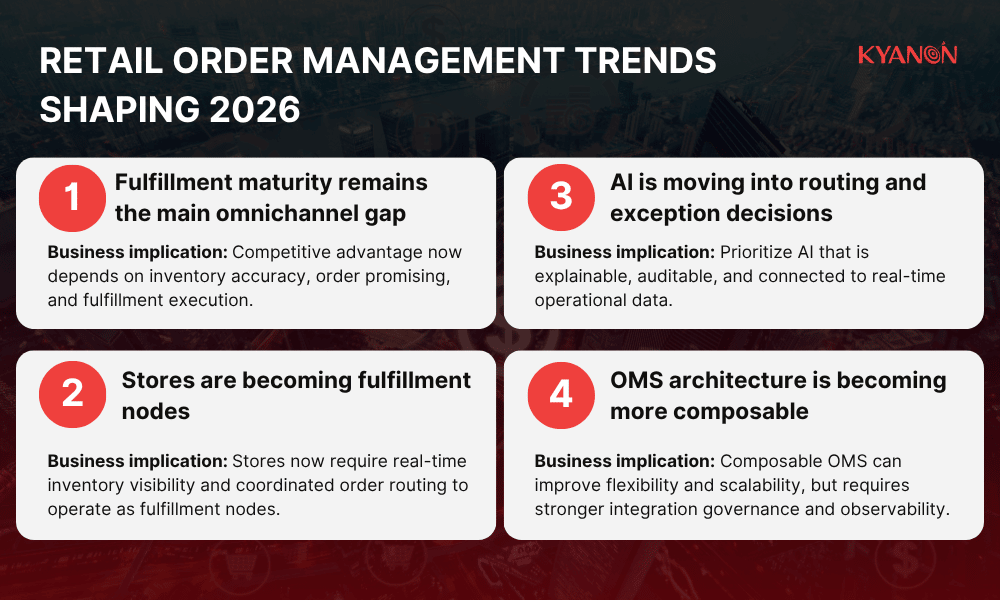
Fulfillment maturity remains the main omnichannel gap
The 2026 Unified Commerce Benchmark found that fulfillment reached only 48% overall maturity among 400 specialty retailers and that just 7% reached the leading fulfillment level.
Business implication: Building digital channels is not enough. The competitive gap increasingly sits in inventory availability, order promising, and fulfillment execution.
Stores are becoming fulfillment nodes
NRF’s 2026 retail outlook highlights continued investment in inventory management and supply-chain capabilities as retailers connect physical and digital operations.
Business implication: Stores are no longer only sales locations. They are becoming active fulfillment nodes that require accurate inventory visibility and coordinated order routing.
AI is moving into routing and exception decisions
AI is increasingly used for inventory allocation, order sourcing, network rebalancing, and exception management.
Kibo’s 2026 Order Routing Explain Agent reflects this shift by showing which rules and fulfillment locations influenced a routing decision.
Business implication: Prioritize AI that is explainable, auditable, and connected to real-time operational data.
OMS architecture is becoming more composable
Retailers are increasingly adopting cloud-based, API-first, and composable architectures so order management can evolve without replacing the entire ERP, commerce, POS or fulfillment stack.
Persistence Market Research’s 2026 retail omnichannel report identifies accelerating adoption of API-first and composable platforms, while noting that legacy-system integration remains a major implementation challenge.
Business implication: Composable OMS can improve flexibility and scalability but requires stronger integration governance and observability.
How to choose a retail order management system
The best retail order management system should be tested against real fulfillment conditions, not selected on features alone.
| Step |
What businesses should evaluate |
|
1. Map the order network |
List channels, stores, warehouses, 3PLs, marketplaces, ERP, POS, WMS, carriers, and return locations. |
| 2. Define fulfillment rules |
Clarify inventory reservation, order splitting, store eligibility, sourcing priorities, and rerouting rules. |
|
3. Assess integration risk |
Identify which connections are native, middleware-based, or require custom development. |
| 4. Test real scenarios |
Run last-unit conflicts, split orders, failed ship-from-store, cross-channel returns, and peak disruptions. |
|
5. Calculate total cost |
Include software, implementation, integrations, middleware, migration, testing, support, upgrades, and internal operations. |
Practical OMS tests
Shortlisted platforms should demonstrate:
- Last-unit conflict: Can the OMS prevent overselling?
- Split order: Can it balance fulfillment cost and delivery promises?
- Failed ship-from-store: Can it reroute automatically?
- Cross-channel return: Can inventory, refund, ERP, and loyalty records stay synchronized?
- Peak disruption: Can the network reallocate orders when a fulfillment node fails?
Business decision: Choose an OMS that fits the real order network, integrates with existing systems, handles fulfillment exceptions, and delivers acceptable total cost of ownership—not simply the platform with the most features.
Retail OMS selection scorecard
Kyanon Digital perspective: The suggested weights reflect a practical enterprise evaluation framework and should be adjusted based on each retailer’s operating model, fulfillment complexity, integration landscape, and growth priorities.
| Selection criterion |
Suggested weight |
|
Inventory availability and promising |
20% |
| Distributed order routing |
20% |
|
Store fulfillment and returns |
15% |
| Integration architecture |
15% |
|
Scalability and performance |
10% |
| Exception management |
10% |
|
Total cost of ownership |
5% |
| Regional/channel fit |
5% |
Weights should change according to the operating model.
For example:
- Marketplace-heavy retailers should increase integration weighting.
- Store-heavy retailers should increase fulfillment and inventory weighting.
- Global businesses should increase orchestration and scalability weighting.
- ERP transformation programs should increase architecture and TCO weighting.
Common mistakes when choosing retail order management software
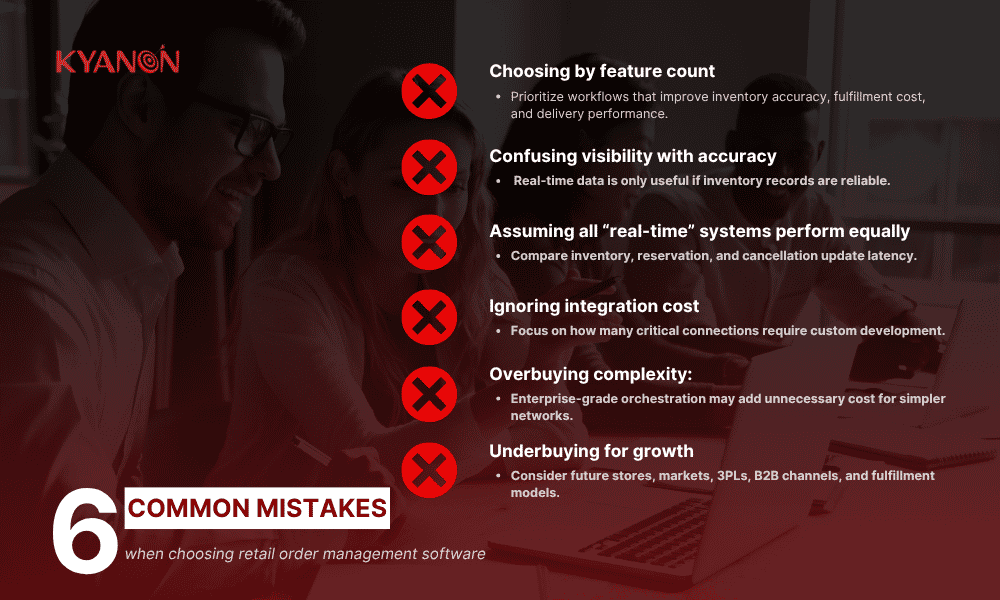
Businesses should avoid these common OMS selection mistakes:
- Choosing by feature count: Prioritize workflows that improve inventory accuracy, fulfillment cost, and delivery performance.
- Confusing visibility with accuracy: Real-time data is only useful if inventory records are reliable.
- Assuming all “real-time” systems perform equally: Compare inventory, reservation, and cancellation update latency.
- Ignoring integration cost: Focus on how many critical connections require custom development.
- Overbuying complexity: Enterprise-grade orchestration may add unnecessary cost for simpler networks.
- Underbuying for growth: Consider future stores, markets, 3PLs, B2B channels, and fulfillment models.
Selection takeaway: The right OMS should match both current operational complexity and future expansion needs.
In conclusion
The best retail order management system is the one that can maintain accurate inventory, route orders efficiently, and recover quickly when fulfillment conditions change.
Enterprise platforms such as Manhattan, IBM Sterling, Fluent Commerce, Kibo, and Blue Yonder suit more complex distributed networks, while NetSuite, Brightpearl, Cin7 Omni, Shopify, and Linnworks fit different ERP-led, mid-market, and ecosystem-specific needs.
The right choice depends on the retailer’s fulfillment model, integration landscape, and growth plans.
For businesses deciding how an OMS should fit into their existing commerce, POS, ERP, warehouse, and fulfillment stack, Kyanon Digital can help assess the architecture, identify integration risks, and define a practical implementation roadmap. Talk to Kyanon Digital.

















 Create project brief with AI