

This guide examines how enterprise organizations are turning fragmented customer data into revenue intelligence using AI. Designed for CEOs, CIOs, CTOs, and leaders across Digital, Data, and Commerce, it explores how predictive analytics, personalization, customer intelligence platforms, and AI agents are improving acquisition, retention, and growth performance. It also outlines practical approaches to identifying high-value AI use cases, scaling adoption, and establishing effective governance.
For many organizations, the challenge is no longer collecting data. The challenge is converting data into decisions before opportunities are lost. Enterprises now generate customer signals across commerce platforms, CRM systems, loyalty programs, contact centers, mobile apps, and digital channels, yet many leadership teams still struggle to determine which customers to prioritize, what actions to take, and where growth opportunities exist.
The stakes are rising. IBM reports that 79% of executives expect AI to contribute significantly to revenue growth by 2030, while 68% believe AI initiatives may fail if they remain disconnected from core business processes. Organizations leading in AI-driven personalization are already achieving stronger customer growth and lifetime value than their competitors.
The next generation of enterprise leaders will not win through larger marketing budgets alone. They will win by building intelligent systems that continuously transform customer data into growth opportunities, predict customer intent, and optimize decisions in real time.
Key Takeaways
- Shift to Predictive Systems: Marketing must transition from analyzing historical dashboard metrics to deploying predictive models that forecast customer intent and automate the next best action.
- Agentic Execution: By 2026, Gartner forecasts that 40% of enterprise applications will embed task-specific AI agents, replacing static automation rules with goal-seeking autonomous workflows.
- Cost Efficiency: McKinsey data demonstrates that implementing AI-driven hyper-personalization can reduce customer acquisition costs by up to 50% and lift revenues by 5 to 15%.
- Infrastructure Prerequisite: Successful AI scaling requires resolving data fragmentation; leaders must unify CRM, eCommerce, and behavioral data into a centralized intelligence layer before purchasing advanced activation software.
Further Reading
- AI Predictive Analytics in Ecommerce in the SEA
- Application of Generative AI in Sales and Marketing
- AI-powered Marketing and Sales Reach New Heights with Generative AI
Marketing teams have more data than ever, yet less clarity
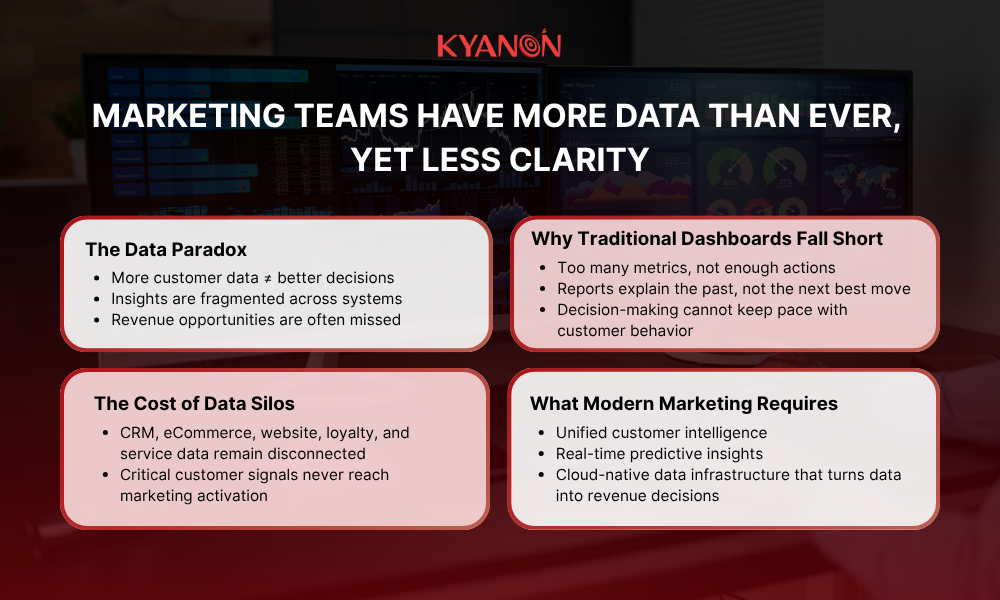
Data abundance has created a paradox: while enterprises possess more customer signals than ever, strategic clarity remains elusive. Persistent fragmentation between data silos and execution channels prevents organizations from capturing critical revenue opportunities. To secure a competitive advantage, enterprise leaders must prioritize the conversion of raw data into decisive, high-velocity business intelligence.
Why dashboards do not solve modern marketing problems
Too many metrics, not enough decisions. The prevailing approach to digital marketing relies heavily on static dashboards that aggregate past performance metrics. While these tools successfully catalog data, they fail to provide prescriptive commercial direction. Enterprise marketing teams find themselves surrounded by metrics such as click-through rates, bounce rates, and impression shares, but they lack the contextual intelligence needed to make immediate decisions.
The reporting trap: insights arrive after opportunities disappear. Traditional reporting models inherently look backward. By the time an analyst identifies a segment of users demonstrating high churn risk, those users have likely already migrated to a competitor. Real-time consumer behavior moves faster than human processing speed, rendering manual analytical workflows structurally obsolete in high-velocity markets.
Enterprise marketing departments frequently operate with decentralized technology stacks. According to the IBM Institute for Business Value, 82% of C-suite executives state that functional silos actively block the value of AI investments. This fragmentation isolates critical data pools across disparate systems:
- CRM data: Contains rich sales histories and account structures but often lacks real-time digital engagement signals.
- eCommerce data: Tracks cart abandonment and transactional histories but remains disconnected from top-of-funnel brand interactions.
- Website behavior: Captures session lengths and navigation paths without consistently tying them to persistent customer identities.
- Loyalty data: Holds deep preference profiles that rarely inform programmatic advertising bidding algorithms.
- Customer service interactions: Houses critical sentiment and frustration signals that marketing teams miss entirely when triggering automated retention campaigns.
Why traditional marketing analytics cannot keep up with real-time customer behavior
Traditional analytics platforms rely on batch processing and manual querying. Human analysts must extract data, normalize it, and run historical models to find correlations. When consumer preferences shift overnight due to a viral social media trend or a competitor’s aggressive pricing change, legacy systems cannot pivot fast enough. Marketing leaders require an infrastructure that bridges the gap between raw data collection and immediate market activation.
To bridge the gap between data collection and market activation, marketing leaders must audit existing data silos to uncover lost interaction signals, consolidate fragmented reporting into a unified source of predictive truth, and modernize legacy infrastructure by partnering with specialists like Kyanon Digital to build scalable, cloud-native data pipelines.
Explore our Automation and Integration Services.

How AI creates a continuous marketing intelligence layer
Reactive marketing models are rapidly losing viability in a high-velocity digital economy. Transitioning to a continuous intelligence architecture allows enterprises to move beyond lagging historical reports toward real-time decision-making. This technological shift converts isolated customer signals into an active engine for compounding commercial growth.
Moving from historical reporting to predictive intelligence
The primary value proposition of marketing AI is the shift from descriptive analytics to predictive intelligence. Instead of merely answering “What happened?”, artificial intelligence continuously analyzes live data streams to answer three critical questions. First, what will happen next? Second, why is this specific pattern occurring? Third, what precise action should the enterprise take right now to maximize commercial outcomes?
Predicting customer intent before customers take action
Market leadership increasingly depends on the ability to anticipate customer needs before they are explicitly expressed, rather than reacting to historical behavior. Advanced predictive models decode subtle behavioral signals to identify high-value intent at its earliest stage. This shift from reactive marketing to predictive decision-making enables brands to engage customers at critical moments, improving conversion rates, retention, and long-term revenue growth.
Purchase intent prediction
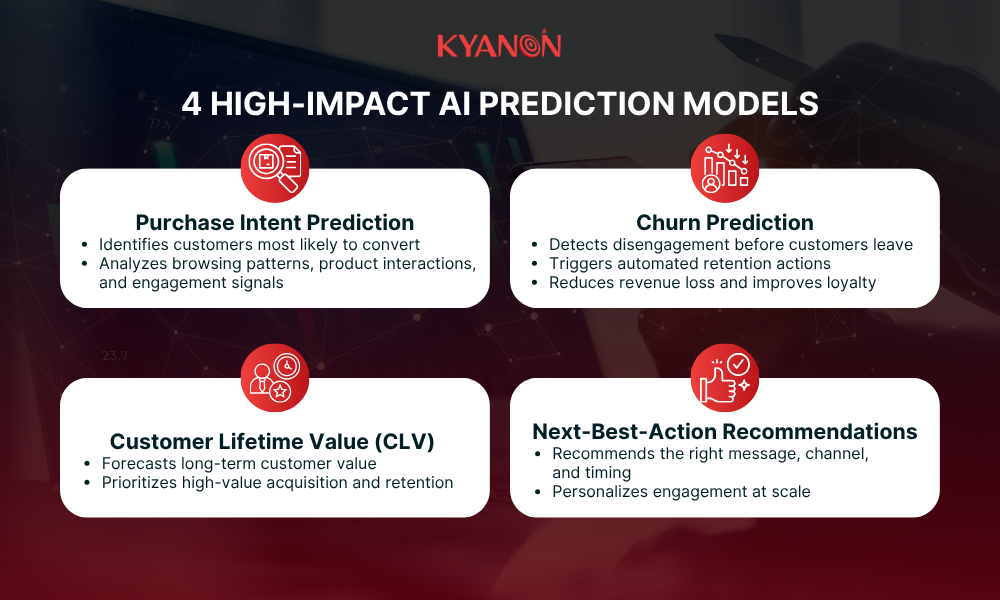
Artificial intelligence excels at identifying the interconnected behavioral patterns that precede a transaction. By analyzing factors such as browsing frequency, product page sequences, content engagement, and technical specification reviews, AI can determine which customers are most likely to convert.
According to McKinsey’s research on next-generation personalization, companies that excel at personalization generate 40% more revenue from those activities than average players, while personalization can lift revenues by 5 to 15% and improve marketing spend efficiency by 10 to 30%. Propensity models can predict not only whether a customer is likely to buy, but also which offer, message, or content experience is most likely to drive conversion. This enables companies to personalize incentives while protecting margins and reducing unnecessary discounting.
Churn prediction
Preventing customer defection is significantly more cost-effective than acquiring new users. AI algorithms detect customer disengagement before the revenue is actually lost. A drop in login frequency, a change in email open rates, or a prolonged customer service ticket can trigger an automated, highly personalized retention workflow designed to repair the relationship preemptively.
According to Bain & Company, increasing customer retention by just 5% can lead to profit growth of 25% to 95%. In addition, churn prediction systems typically reduce attrition by 15%–35%, depending on industry and maturity of implementation.
Customer lifetime value forecasting
Not all customers generate equal long-term value. AI-powered Customer Lifetime Value (CLV) forecasting allows organizations to move beyond short-term metrics such as clicks and immediate conversions, focusing instead on long-term profitability.
By combining machine learning techniques with behavioral and transactional data, enterprises can estimate the future economic contribution of newly acquired customers early in their lifecycle. This enables marketing and finance teams to direct acquisition budgets toward audiences with the highest long-term value potential.
According to Bain & Company, leading organizations are 1.9 times more likely than their peers to adapt strategies based on evolving customer needs and long-term value indicators rather than short-term campaign metrics. Bain’s research also demonstrates that CLV-driven segmentation enables companies to concentrate spending on the most profitable customer cohorts while reducing investment in low-value prospects.
Next-best-action recommendations
Modern customer engagement requires delivering the right message, through the right channel, at precisely the right moment. Next-Best-Action (NBA) models evaluate millions of historical interactions to determine the most relevant action for each customer in real time. Organizations using AI-driven decision engines achieve stronger outcomes across conversion, retention, and cross-selling because they can identify customer needs before customers explicitly communicate them.
Gartner’s 2026 data and analytics predictions indicate that AI-driven decision models will increase decision reliability by as much as five times while accelerating decision-making speed by approximately 80%. Gartner also forecasts that Agentic AI will autonomously handle up to 80% of common customer-service interactions, making Next-Best-Action capabilities a foundational component of future customer engagement strategies.
Hyper-personalization beyond segmentation
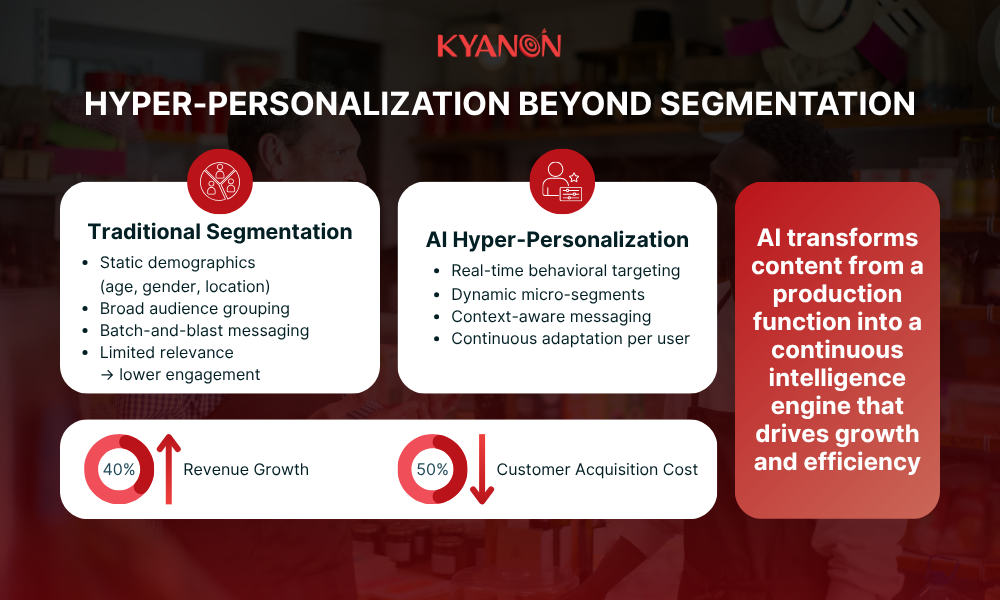
Traditional demographic segmentation creates generic messaging that leads to margin erosion and customer fatigue. Modernizing the engagement strategy through AI-powered hyper-personalization is now an economic imperative. Individualized, scalable experiences protect profit margins and drive sustainable growth by delivering unparalleled relevance to high-value cohorts.
Why demographic segmentation is becoming obsolete
Traditional marketing relies on static demographic segments such as age, gender, and physical location. These broad categories are no longer sufficient for modern commerce. Grouping millions of users into a single demographic bucket assumes they share identical purchasing triggers, which inevitably leads to generic messaging, wasted advertising spend, and high consumer fatigue.
AI-powered micro-segmentation
Artificial intelligence replaces static demographics with dynamic micro-segmentation. Audiences are created and dissolved in real time based on live behavioral data. A user might briefly belong to a “weekend traveler exploring winter gear” segment, receiving highly specific messaging for 48 hours, before the system automatically shifts their profile as their browsing intent changes to everyday apparel.
Real-time personalization across every touchpoint
Hyper-personalization must extend across the entire digital ecosystem. Examples include dynamic website experiences where homepage banners change based on the viewer, customized product recommendations inside mobile applications, and email journeys that rewrite subject lines based on the recipient’s past open behaviors. Furthermore, loyalty programs can offer tailored rewards that reflect individual consumption habits, fostering deeper brand equity.
Building one-to-one customer experiences at enterprise scale
Achieving this level of intimacy requires automation. According to McKinsey, fast-growing companies generate 40% more revenue from personalization than their slower-growing counterparts. When enterprises automate the delivery of customized content, they can sustain one-to-one customer relationships with millions of users simultaneously. McKinsey notes that this approach can reduce customer acquisition costs by as much as 50% while lifting revenues by 5 to 15%.
The following comparison illustrates the strategic differences between traditional segmentation and AI-powered hyper-personalization. This table matters because it provides digital transformation leaders with the exact metrics and trade-offs required to build a business case for investing in personalization engines.
Comparison of segmentation and hyper-personalization
Capability | Traditional Demographic Segmentation | AI-Powered Hyper-Personalization | Financial & Performance Impact |
| Audience Grouping | Static demographics mapped manually over weeks. | Dynamic behavioral clustering executed in real time. | Generates up to 30% higher marketing ROI. (McKinsey) |
Content Delivery | Scheduled batch email and advertisement deployments. | Triggered next-best-action messaging based on live context. | Reduces customer acquisition costs by up to 50%. (McKinsey) |
| Optimization | Post-campaign A/B testing requiring manual statistical review. | Continuous multivariate testing managed autonomously by AI. | Eliminates budget waste on underperforming creative variants instantly. |
The business implication of ignoring hyper-personalization is severe margin compression. Enterprises relying on batch-and-blast communications will be forced to spend increasingly more to acquire the same number of customers. The competitive implication is that brands utilizing AI will monopolize consumer attention by providing superior relevance. Action is necessary now because training machine learning models on consumer behavior takes time; organizations that start immediately will possess a distinct data advantage over late adopters.
Enterprises should begin by acquiring personalization engines capable of updating product recommendations based on real-time behavior. Simultaneously, companies must modernize loyalty programs by shifting from static point systems to dynamic, AI-curated reward tiers. Finally, auditing current email workflows is essential to replace batch-and-blast tactics with behaviorally triggered communication sequences.
How AI is transforming content operations
Content production is evolving from a creative cost center into a strategic, data-driven revenue generator. By adopting content intelligence, enterprises can ensure that every asset is engineered to maximize commercial impact. This approach minimizes operational waste while reinforcing brand consistency across global markets.
From content creation to content intelligence
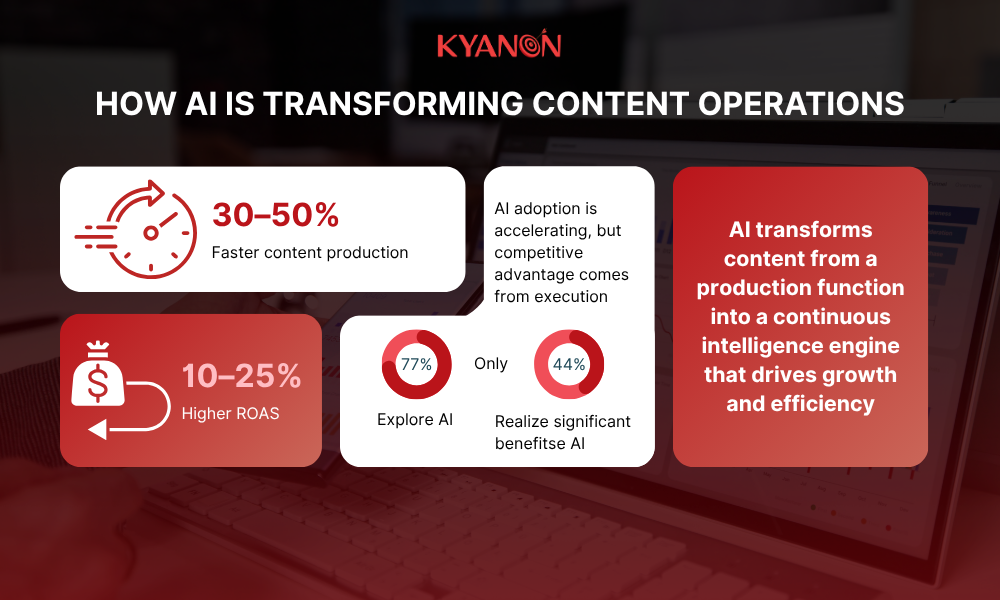
The commoditization of text and image generation means that content creation alone is no longer a competitive advantage. The focus has shifted toward content intelligence. Enterprises must use AI to determine precisely what content needs to be produced, which formats will perform best, and how that content should be distributed to maximize revenue. Gartner research indicates that while 77% of marketers explore generative AI, only 44% realize significant benefits, highlighting a massive execution gap.
AI-driven content planning
Artificial intelligence evaluates search demand, live customer intent signals, and macroeconomic market trends to output highly structured content roadmaps. Instead of relying on editorial intuition, marketing departments can utilize AI tools to identify exact topical gaps where consumer demand heavily outweighs existing brand content.
Automated content production workflows
Generative AI deeply accelerates the drafting phase for blog articles, landing pages, product descriptions, paid advertisements, and social media content. Research from Bain & Company indicates that structured AI workflows cut content creation time by 30 to 50%. Furthermore, campaigns grounded securely in proprietary brand assets achieve 10 to 25% higher returns on ad spend due to improved consistency and relevance.
Continuous content optimization using performance data
AI systems do not stop working once content is published. They continuously ingest performance data to recommend structural optimizations. If an AI agent detects that a landing page is experiencing high bounce rates on mobile devices, it can instantly suggest alternative headlines or automatically adjust the placement of call-to-action buttons to recover conversion rates.
Successful content operations rely on three strategic pillars: developing custom generative AI models that maintain brand voice consistency, integrating fragmented tools into a unified performance-tracking platform, and upskilling staff to evolve from copywriters into AI-focused strategists.
AI-powered customer journey orchestration
The modern customer path has fractured into an unpredictable, multi-channel landscape where traditional linear funnels no longer apply. Success demands intelligent orchestration to eliminate friction at every touchpoint. Agile journey management is essential for maintaining a cohesive presence that maximizes conversion rates throughout the lifecycle.
Why customer journeys are no longer linear
The reality of modern consumer behavior is an omnichannel maze. A customer might discover a brand on a social media application, browse products on a mobile browser, abandon a digital cart, visit a physical retail location, and finally convert through an email link on a desktop computer. Traditional linear marketing funnels completely fail to map or monetize this complexity.
Identifying journey friction points using AI
Machine learning algorithms excel at mapping complex, multi-touch attribution paths. They identify hidden friction points that cause journey drop-offs, track persistent cart abandonment trends, and highlight structural conversion bottlenecks. By analyzing millions of user paths, AI highlights exactly where the user experience is failing, allowing product teams to intervene precisely.
Delivering the next best experience in real time
Once friction is identified, journey orchestration engines intervene. If an enterprise software buyer stalls on a pricing page for three consecutive visits, the AI orchestrator can automatically trigger a customized intervention, such as prompting a sales representative to reach out via a live chat interface equipped with a targeted discount code.
The rise of AI agents in marketing operations
Marketing operations are undergoing a structural shift toward autonomous, goal-oriented systems. Deploying intelligent agents to manage tactical objectives provides massive operational leverage, allowing human capital to focus on high-level strategy and market expansion. This transition effectively decouples revenue growth from linear headcount scaling.
What makes AI agents different from marketing automation
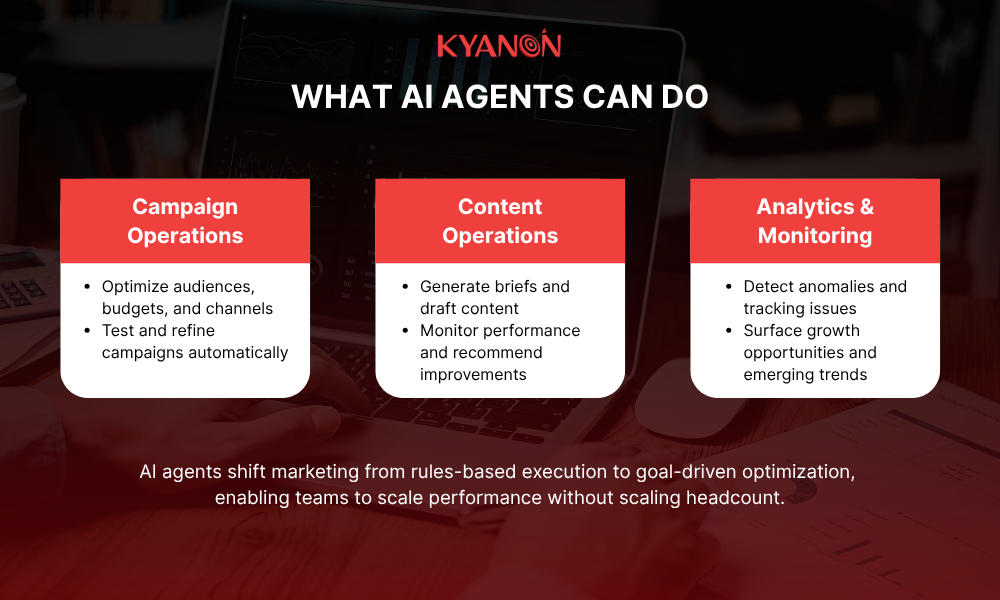
The distinction between traditional automation and agentic AI lies in the profound difference between rules and goals. Traditional marketing automation executes rigid, human-authored tasks based strictly on “if/then” logic. In contrast, AI agents pursue defined business outcomes. Given a budget and a target cost-per-acquisition, an agentic system will autonomously design, launch, test, and refine strategies to reach that goal.
Optimizing operations with AI agents
Intelligent agents handle the heavy quantitative lifting of campaign design. They analyze historical data for optimal audience selection, generate predictive budget recommendations, and suggest the most efficient channel allocation. This technological leverage frees strategic marketing directors to focus entirely on creative positioning, brand building, and market expansion.
In content operations, agents assemble comprehensive content briefs, draft initial copy, and monitor post-publication performance. According to McKinsey, 62% of organizations are already experimenting with AI agents, with high-performing companies redesigning entire workflows around them. The key to success is utilizing agents to automate multi-step tasks referencing structured company data rather than relying on isolated chat interfaces.
Analytical agents continuously monitor data pipelines for anomaly detection. If a tracking pixel breaks or a specific advertisement begins suffering from audience fatigue, the agent instantly alerts the operations team. Furthermore, these agents handle opportunity discovery by forecasting revenue trends and highlighting niche audience segments that human analysts might overlook.
What an AI-native marketing team looks like
An AI-native marketing department features a significantly compressed organizational structure. Strategy directors set the commercial parameters, AI agents execute the tactical variations, and creative specialists oversee the final output quality. The team operates with exponentially higher velocity, capable of managing thousands of personalized campaigns with a fraction of the historical headcount. LinkedIn data reveals that marketing job postings requiring AI skills increased 113% year-over-year, signaling a rapid shift in desired capabilities.
The following table contrasts legacy marketing automation with emerging agentic AI systems. This table matters because it helps technology decision-makers understand why upgrading to agentic frameworks is necessary to scale operations without proportionally scaling headcount.
Comparison of marketing automation and agentic AI systems
Operational Feature | Rules-Based Marketing Automation | Goal-Oriented AI Agents | Operational Implications |
| Execution Logic | Static “If X, then Y” human programming. | Autonomous pursuit of defined KPIs (e.g., Target ROAS). | Eliminates hundreds of hours spent building and fixing broken workflow trees. |
Adaptability | Fails or stops when encountering edge cases not programmed. | Learns from edge cases and autonomously adjusts pathways. | Ensures campaigns remain active and optimized during sudden market shifts. |
| Scope of Work | Executes single, isolated tasks (e.g., sending an email). | Manages multi-step workflows (e.g., drafting, testing, sending, and analyzing). | Requires a fundamental redesign of departmental roles and responsibilities. |
The business implication of failing to adopt AI agents is a severe bottleneck in execution speed. Organizations relying on rules-based automation will be outmaneuvered by competitors whose systems optimize campaigns while human teams are asleep. The risk of inaction is essentially organizational paralysis. Action is necessary now to begin redesigning workflows, as integrating agentic AI is not a simple software upgrade, but a fundamental transformation of how enterprise work is accomplished.
Building an AI-driven marketing operating model
Artificial intelligence serves as the foundation for the next generation of marketing operating models. Achieving this requires moving beyond fragmented operations toward a unified, data-centric culture that prioritizes system integration and transparency. Structural transformation in this area is a prerequisite for achieving long-term organizational agility.
Creating a unified customer data foundation
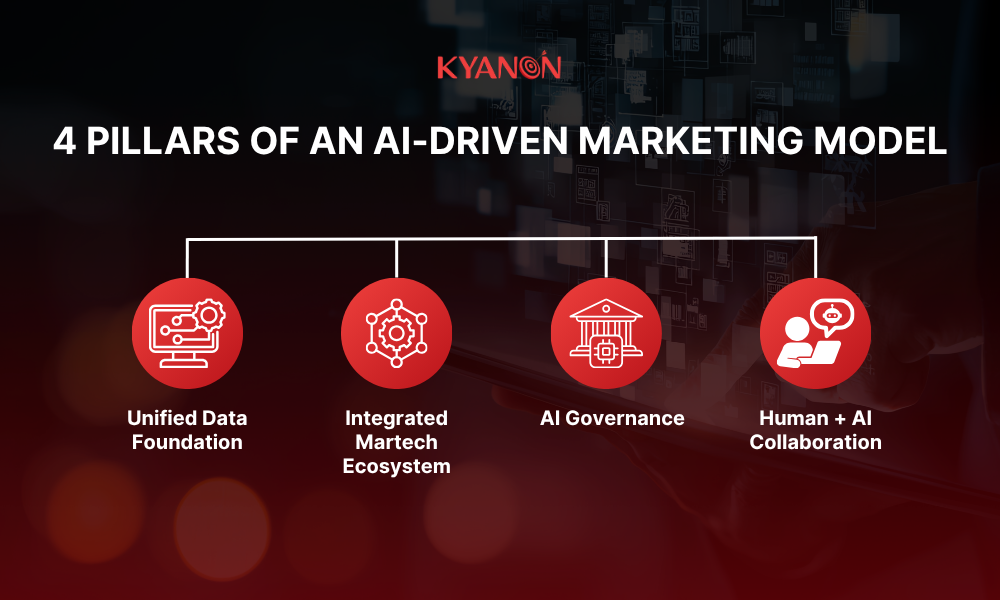
Artificial intelligence is entirely dependent upon the quality of its training data. Enterprises must establish a unified data foundation that securely houses cleaned, compliant customer information. Without an integrated data layer, AI agents will hallucinate, generate inaccurate personalizations, and ultimately damage consumer trust. Adobe research indicates that 74% of organizations cite data integration and data quality as the primary barriers to scaling agentic AI.
Integrating AI into existing martech stacks
Enterprises rarely have the luxury of building systems entirely from scratch. AI must be integrated into existing marketing technology stacks. Organizations utilizing platforms like Salesforce, HubSpot, or Adobe Experience Cloud must architect middleware solutions and Customer Data Platforms that allow predictive intelligence to flow seamlessly into these execution layers. This composable architecture ensures that legacy systems do not throttle modern AI capabilities.
Establishing AI governance for marketing
With autonomous execution comes the absolute necessity of strict governance. Enterprises must establish protocols for algorithmic fairness, data privacy compliance, and brand safety. Governance frameworks ensure that marketing agents do not inadvertently generate offensive content, violate international data protection regulations, or execute unauthorized budget allocations.
Defining the role of humans in AI-assisted decision making
As AI assumes responsibility for tactical execution, the human role elevates to orchestration and ethical oversight. Marketing leaders must shift from managing daily tasks to managing complex systems. Humans are required to train the models, set the ethical boundaries, define the overarching brand narrative, and intervene when agentic systems encounter strategic edge cases they cannot resolve.
Conclusion: Building revenue intelligence for the next decade
The path forward for enterprise leadership involves bridging the gap between complex data and actionable, revenue-driving intelligence. Key priorities include unifying customer data, modernizing technology ecosystems, strengthening governance, and building internal capabilities to operationalize AI at scale.
For CEOs, CMOs, CTOs, and Heads of Digital, the priority is clear: unify customer data, modernize technology ecosystems, strengthen governance, and build the capabilities needed to operationalize AI at scale.
Kyanon Digital helps enterprises turn customer data into measurable business outcomes through data platforms, AI-powered analytics, marketing automation, and decision intelligence. If you are evaluating how to operationalize revenue intelligence at scale, start with an AI and data readiness assessment to identify gaps, prioritize opportunities, and build a practical roadmap from data to growth. Contact Kyanon Digital.







 Create project brief with AI