Budgeting for AI after the pilot stage in Singapore requires moving from a temporary project/innovation fund to a product-style operational budget. More than 80% of enterprise AI spending shifts outside traditional IT budgets once systems go live. (Alibaba Cloud)
A successful proof of concept (PoC) demonstrates that an AI application can work under controlled conditions. However, moving it into production introduces new technical, operational and financial responsibilities. For business leaders, the next decision is not simply how much more to spend, but which costs are necessary to create sustainable business value and how to justify the investment.
Key takeaways
- Budget for production, not just development. Data preparation, enterprise integration, security and ongoing maintenance can create substantial costs beyond the initial AI pilot.
- Calculate total cost of ownership. Include technology, infrastructure, people, operational support and contingency costs in a 12–24-month financial forecast.
- Choose the right delivery model. Off-the-shelf platforms suit standard requirements, while custom AI development is more appropriate when proprietary data, complex workflows or enterprise integration are involved.
- Use Singapore’s AI incentives strategically. Evaluate the Enterprise Innovation Scheme (EIS) and EDGE Grant, but confirm eligibility and supported expenditure before committing to a project.
- Scale based on measurable outcomes. Do not expand an AI deployment until adoption, cost per outcome, operational reliability and business benefits justify the next investment.
Further reading:
- How Much Does AI Development Cost in Singapore Healthcare?
- What Is the True Cost of AI in Manufacturing in Singapore?
- LLM Development Cost: What Enterprises Budget
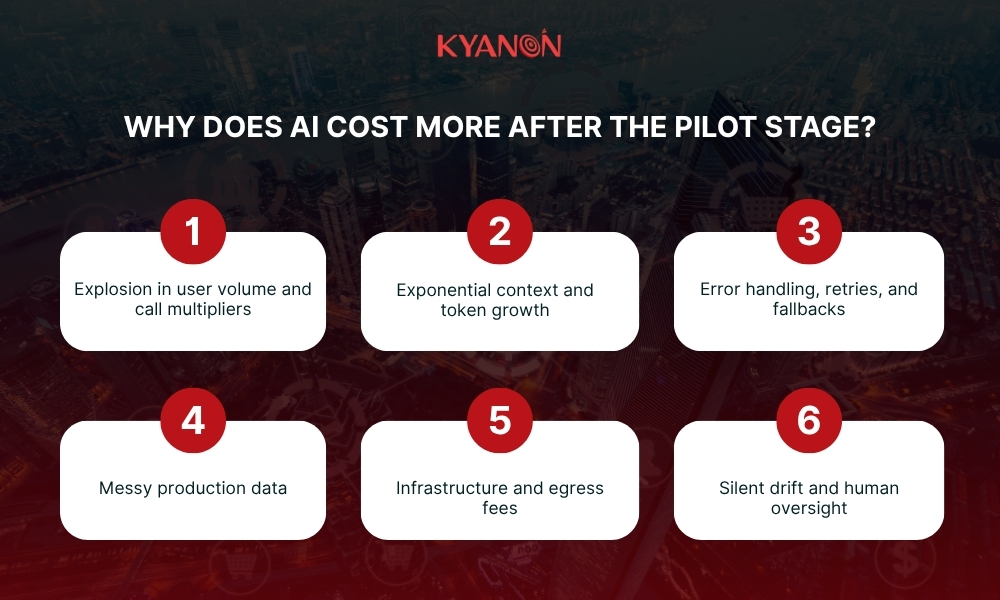
Why does AI cost more after the pilot stage?
AI costs dramatically more after the pilot stage because moving from a small, controlled test to a live production environment transforms the volume, complexity, and hidden overhead of the system.
- Explosion in user volume and call multipliers: Pilots typically run with a handful of internal testers on a single feature. In production, real users generate massive traffic, and multi-step “agentic” workflows mean a single user request can trigger dozens of underlying API or model calls instead of just one.
- Exponential context and token growth: In multi-turn or agent-driven tasks, context doesn’t grow in a straight line; it accumulates exponentially like a triangle. An agent running 30 unsupervised steps carries and re-processes massive context files repeatedly, driving up token bills.
- Error handling, retries, and fallbacks: Controlled pilots rarely account for messy real-world edge cases. In production, automated retries, validation checks, and fallback mechanisms multiply the number of paid model calls.
- Messy production data: Pilot data is usually clean, small, and curated. Production requires continuous data cleaning, enrichment, retrieval, and re-processing before and after the AI model runs.
- Infrastructure and egress fees: Moving massive data packets between cloud services, memory banks, and GPUs incurs heavy bandwidth and data-transfer fees that are virtually invisible in a sandbox.
- Silent drift and human oversight: AI is probabilistic, meaning it slowly drifts and makes errors over time due to shifting user behavior or data changes. Managing this requires continuous monitoring, observability, and costly human-in-the-loop escalations that inflate the true cost per successful outcome.

What costs should Singapore enterprises include in an AI scale-up budget?
Singapore enterprises should account for three cost areas: initial development and implementation, ongoing operational expenses, and workforce adoption. Government grants and tax incentives may help offset eligible investments, but businesses should assess their eligibility and funding conditions before factoring them into the budget.
AI development and implementation costs
The initial investment depends on the complexity of the solution, data readiness, integration requirements, and deployment scale. Based on the Singapore market estimates in the sources, indicative development costs include:
|
AI project type |
Estimated cost (USD) |
| Basic chatbots and automation |
8,000 – 35,000 |
|
Predictive analytics and computer vision |
40,000 – 180,000 |
| Custom AI platforms |
120,000 – 350,000 |
|
Full enterprise AI transformation |
Up to $1.5 million+ |
Note: Cost figures are indicative estimates reported by the cited sources, not official pricing benchmarks. Grant and tax incentive eligibility, caps, and conditions should be confirmed against the latest government guidance.
Beyond software development, enterprises should budget for three supporting activities:
- Data engineering: Data cleaning, labeling, pipeline integration, and governance can account for an estimated 30%–40% of total project costs.
- AI consulting and advisory: Strategy development and readiness assessments may cost $15,000–$600,000. Fractional AI leadership and ongoing advisory retainers can range from S$5,000 to S$150,000 per month.
- System integration: Connecting AI solutions with existing enterprise applications, databases, and workflows adds to implementation costs.
These estimates are indicative rather than fixed market rates. Actual costs depend on project scope, technical complexity, and delivery requirements. (EDB Singapore)
An AI solution requires continuous investment after deployment. Industry estimates suggest that maintenance and other operational expenses can add another 30%–50% to the initial build cost over the first two years.Enterprises should account for:
- Cloud infrastructure and inference: GPU capacity, cloud hosting, and API token consumption may cost approximately $2,000 – $50,000 per month, depending on model selection and usage volume.
- Model maintenance and updates: Budget for monitoring data drift, model retraining, fine-tuning, and performance optimization.
- Security and compliance: Include data privacy assessments, PDPA alignment, security reviews, and relevant industry-specific compliance requirements.
- Employee training and change management: Workforce upskilling, adoption programs, and post-implementation support are essential to achieving business value. The cited consulting estimates place these costs at approximately 15%–25% annually of base consulting or software fees.
The key consideration is total cost of ownership (TCO), not just the initial development price. Enterprises should forecast infrastructure consumption, maintenance, compliance, and support costs over the expected operating life of the solution.
Singapore government support and funding schemes
Singapore enterprises may reduce their net AI investment through eligible government incentives and support programs. Relevant initiatives include:
- Enterprise Innovation Scheme (EIS): Provides a 400% tax deduction on qualifying expenditure, subject to applicable caps and eligibility conditions. The cited sources indicate a S$50,000 expenditure cap per Year of Assessment for YA 2027 and YA 2028.
- Enterprise Development Grant (EDG) and Productivity Solutions Grant (PSG): May support eligible business transformation and technology adoption projects. Funding levels depend on the scheme, project scope, and applicant eligibility.
- Enterprise Compute Initiative (ECI): Supports eligible businesses in accessing AI capabilities and compute resources.
- Champions of AI and Enterprise Workforce Transformation Package: Provide structured support for AI adoption, business transformation, and workforce development.
How should you calculate the total cost of ownership of enterprise AI?
Calculate enterprise AI’s total cost of ownership (TCO) over 12–24 months by including four cost categories:
- Initial investment: Development, data preparation, integration, testing, and deployment.
- Recurring operating costs: Model consumption, hosting, monitoring, support, maintenance, and licences.
- People and change costs: Internal staff time, specialist expertise, training, and workflow redesign.
- Risk and contingency: Additional integration, demand fluctuations, remediation, and changing requirements.
Build three forecast scenarios to account for different adoption levels:
- Base case: Expected adoption, workload, and operating costs.
- Growth case: Higher usage, more users, or additional workflows.
- Stress case: Slower adoption, cost overruns, performance issues, or unexpected remediation.
Kyanon Digital recommends starting budgeting with the target business process and expected demand, then translate them into a realistic technical and operating model.
What should you evaluate before choosing an AI partner?
Choosing an AI partner requires evaluating more than technical expertise. Consider whether the partner can:
- Connect AI to business outcomes: Align AI strategy with business KPIs and financial objectives.
- Deliver at enterprise scale: Demonstrate experience in data engineering, system integration, and production deployment.
- Define clear delivery terms: Establish scope, assumptions, dependencies, and change-control processes.
- Support long-term operations: Provide monitoring, maintenance, knowledge transfer, and cost optimisation.
- Work with existing systems: Integrate AI into current enterprise infrastructure without unnecessary system replacement.
Kyanon Digital is an enterprise digital transformation and AI engineering partner, helping businesses turn validated use cases into production-ready AI solutions through data, integration, engineering, and ongoing optimisation.
Case study: Scaling Banking Customer Service with an AI-Powered Copilot
Kyanon Digital introduced an AI-enabled service layer combining enterprise knowledge retrieval, agent assistance, workflow automation and system integration. The solution helped service teams access trusted information faster, automate routine work and escalate complex cases with relevant context preserved, creating a more scalable operating model for digital customer service.
Challenges
A Singapore-based commercial bank needed to scale customer service without increasing headcount proportionally. Key challenges included:
- Rising service costs: Increasing digital interactions created higher workloads and staffing pressure.
- Fragmented knowledge: Product information, policies, and service procedures were scattered across multiple sources.
- Repetitive manual work: Agents spent significant time handling routine enquiries, searching for information, and routing requests.
- Limited chatbot capabilities: Rule-based chatbots struggled with natural-language enquiries and complex requests.
- Inconsistent responses: Fragmented knowledge led to variations in customer service.
- Integration complexity: AI needed to work within existing systems while preserving human oversight for complex cases.
Solutions
Kyanon Digital implemented an AI-enabled customer service layer built around four capabilities:
- Enterprise knowledge foundation: Centralized approved service information and enabled contextual retrieval through RAG and semantic search.
- AI-powered agent copilot: Helped agents retrieve information, summarize context, generate responses, and identify next steps.
- Workflow automation: Automated request classification, routing, and routine processes while preserving contextual handoff to human agents.
- System integration and monitoring: Connected AI with existing enterprise applications and used analytics to monitor performance and support continuous improvement.
Key results
- 25% reduction in average handling time.
- 40% less effort spent searching for knowledge.
- 20% higher service capacity.
- 30% less repetitive manual work.
Explore the full case study here: Scaling Banking Customer Service with an AI-Powered Copilot
Conclusion
Scaling AI beyond the pilot stage requires a clear view of the full investment, from development and data preparation to infrastructure, maintenance, and workforce adoption. For Singapore enterprises, a realistic 12–24-month budget should also account for changing demand, operational risks, and available government support.
The goal is not simply to reduce AI costs, but to build a sustainable investment that delivers measurable business value. Kyanon Digital helps enterprises turn validated AI use cases into production-ready solutions through AI engineering, data integration, and ongoing optimisation. Discuss your AI scale-up roadmap and production budget with Kyanon Digital or explore our Generative AI consulting services in Singapore.
References
- AI Development Cost in Singapore: 2026 Pricing Guide – Kaopiz
- AI Transformation Cost in Singapore: What Enterprises Actually Pay in 2026 – Samta
- AI Consulting Pricing Guide – Pertama Partners
- Singapore’s Next Growth Chapter: What International Businesses Should Know from Budget 2026 – Singapore Economic Development Board (EDB)
- Enterprise Innovation Scheme (EIS) – Inland Revenue Authority of Singapore (IRAS)
- AI Transformation Singapore – Artificial Intelligence Singapore
- Banking Customer Service with AI-Powered Copilot – Kyanon Digital

 Create project brief with AI