

To integrate AI agents into an enterprise workflow in Singapore, businesses should identify suitable processes, connect agents securely with existing systems, and establish governance aligned with Singapore’s PDPA. The right approach depends on workflow complexity, data readiness, and human oversight requirements. Kyanon Digital supports enterprises in designing and implementing AI-powered workflow automation.
For Singapore enterprises, integrating AI agents into existing ERP, CRM, and operational systems presents challenges beyond deploying AI technology. Disconnected data, legacy infrastructure, and compliance requirements can make enterprise workflow automation difficult to implement and scale.
Choosing the right integration approach is therefore critical to improving operational efficiency without introducing unnecessary complexity or risk. This guide explores the key steps, integration options, and governance considerations for implementing AI agents in enterprise workflows, including how Kyanon Digital can support the process.
Key takeaways
- Start with measurable bottlenecks: Prioritize workflows with high manual effort, clear ownership, and accessible data before introducing autonomous AI agents.
- Choose the right architecture: Off-the-shelf solutions suit standardized processes, while custom or hybrid approaches better support complex enterprise integrations.
- Build governance into execution: Singapore enterprises must address PDPA obligations, agent permissions, human oversight, and auditability before production deployment.
- Validate before scaling: Measure processing time, exception rates, and human intervention against existing workflow performance.
- Consider integration readiness: Kyanon Digital’s enterprise integration and AI engineering capabilities are relevant when organizations need agents connected to multiple business systems rather than isolated AI tools.
Further reading:
- Agentic Workflow Development for Enterprise Software
- LLM Integration Services for Enterprise Systems
- AI CRM and ERP Solutions for Singapore Enterprises
- Generative AI Adoption Trends for Enterprises in Singapore
How should enterprises prepare their existing workflows for AI agent integration?
Enterprises should assess workflow readiness before selecting AI tools. Effective integration requires clearly defined processes, reliable data, secure system connectivity, and human oversight to avoid automating existing inefficiencies.
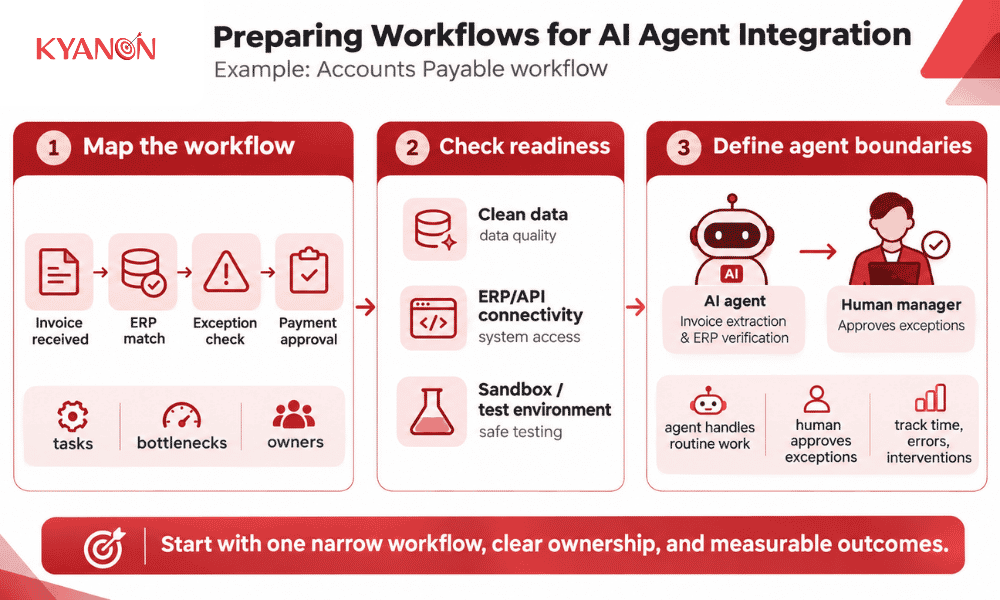
Map existing workflows and identify automation opportunities
Begin by documenting how tasks move between employees, applications, and approval stages. For example, an accounts payable workflow may involve invoice extraction, ERP verification, exception handling, and payment approval.
- Map process dependencies: Identify manual tasks, bottlenecks, decision points, and undocumented procedures.
- Break down complex workflows: Define smaller tasks with clear inputs, outputs, and validation requirements.
- Prioritize suitable automation: Use rules-based automation for predictable tasks and AI agents for variable inputs, contextual reasoning, or multi-step actions.
Assess data quality and system readiness
AI agents require reliable information and secure access to enterprise applications.
- Improve data quality: Standardize records, resolve inconsistencies, and identify authoritative data sources.
- Evaluate system connectivity: Assess existing ERP, CRM, and HRMS integrations through APIs, middleware, or secure connectors.
- Prepare testing environments: Validate agent actions in sandbox environments before production deployment.
Define agent responsibilities and performance metrics
Enterprises must establish clear boundaries between autonomous execution and employee intervention.
- Set approval and escalation rules: Define which actions agents can execute independently and which require human authorization.
- Apply access controls: Restrict agent permissions based on business roles, data sensitivity, and applicable PDPA requirements.
- Establish baseline KPIs: Track processing time, error rates, manual interventions, and operational costs to measure performance improvements.
The recommended starting point is a narrowly scoped workflow with accessible data, clear ownership, and measurable outcomes. Address critical data or integration gaps before expanding automation.

How can enterprises integrate AI agents with existing business systems?
Enterprises can integrate AI agents into ERP, CRM, HRMS, and legacy applications through APIs, middleware, and workflow orchestration platforms. The key decision is whether existing platforms can support the required automation or whether custom integration is necessary to meet business, security, and scalability requirements.
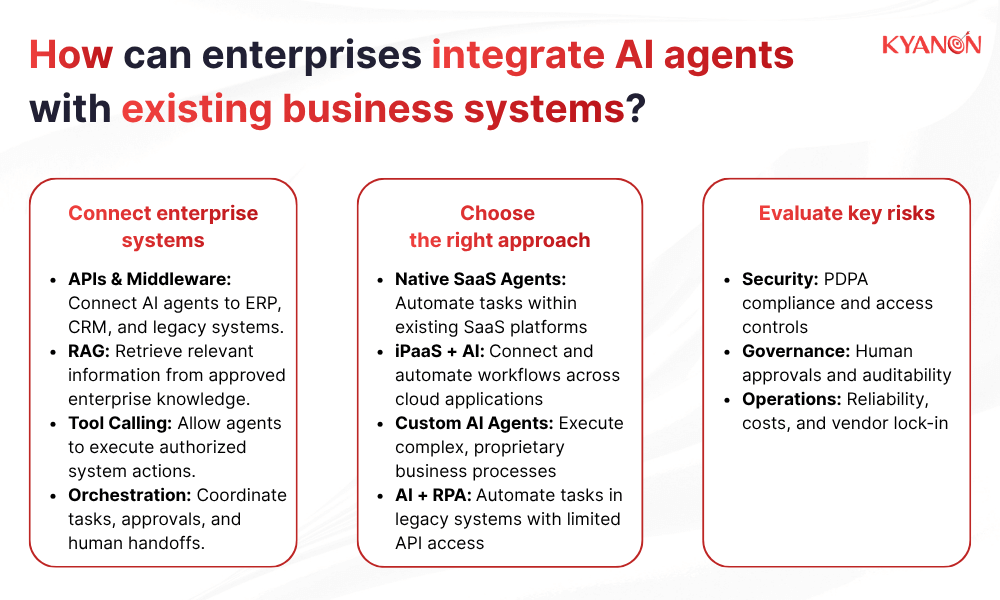
Connect AI agents to enterprise applications
A reliable integration architecture should allow AI agents to access enterprise information, execute authorized tasks, and escalate exceptions without compromising existing business controls.
Key components include:
- APIs and secure connectors: Connect agents to ERP, CRM, and other systems while enforcing authentication and access permissions.
- RAG and enterprise knowledge: Ground AI responses in approved business documents and data sources.
- Tool calling and orchestration: Coordinate multi-step processes, validate outputs, and manage human approval requirements.
- Monitoring and rollback controls: Track execution, detect failures, and support recovery from incorrect actions where technically feasible.
Before implementation, enterprises should confirm whether their existing applications expose suitable APIs, which transactions agents may execute, and where human authorization is mandatory.
Choose the right enterprise workflow solutions
The most suitable integration approach depends on system compatibility, implementation effort, total cost of ownership, and governance requirements.
|
Approach |
Best suited for | Cost and implementation considerations |
Key trade-off |
|
Native SaaS agents |
Workflows concentrated within Microsoft, Salesforce, or another enterprise platform | Existing connectors and licensing may reduce custom engineering | Limited flexibility across external systems and potential vendor lock-in |
| iPaaS + AI orchestration | Workflows spanning multiple cloud applications with supported APIs | Middleware licensing, integration configuration, and usage costs |
Connector dependencies and growing operational costs |
|
Custom AI agents |
Proprietary workflows, complex business logic, or specialized deployment requirements | Greater upfront engineering, testing, and maintenance responsibility | Higher technical ownership and delivery complexity |
| AI + RPA integration | Legacy applications without suitable APIs | Can preserve existing systems but adds bot maintenance and integration costs |
UI-based automation may break when applications change |
Decision rule: Choose native SaaS agents when workflows operate primarily within one platform. Prioritize iPaaS for connected cloud applications, custom engineering for proprietary workflows, and AI-assisted RPA when legacy systems lack reliable APIs.
Evaluate integration risks before committing
Before selecting an enterprise workflow automation solution or implementation partner, evaluate five decision-critical requirements:
- Security and PDPA: Can the architecture meet applicable personal data protection, access, retention, and cross-border transfer requirements?
- Governance: Does it support human approvals, role-based permissions, audit trails, and escalation procedures?
- Integration reliability: Can agents handle API failures, duplicate transactions, and recovery without compromising business records?
- Total cost of ownership: Are licensing, model usage, integration, infrastructure, and ongoing support costs transparent?
- Vendor portability: Can workflow logic, data, and integrations be maintained or migrated without excessive switching costs?
For organizations operating fragmented ERP, CRM, or legacy environments, replacing existing platforms is not always necessary. A targeted integration layer may provide a more practical path to automation.
Where fragmented ERP, CRM, or legacy systems make AI agent deployment complex, businesses should assess integration dependencies before committing to an architecture. Kyanon Digital’s AI Integration Services help enterprises evaluate existing workflows, connect AI capabilities with business systems, and establish a phased implementation approach.
How can Singapore enterprises ensure secure and compliant AI agent operations?
Singapore enterprises should establish security, accountability, and data governance controls before granting AI agents access to production systems.
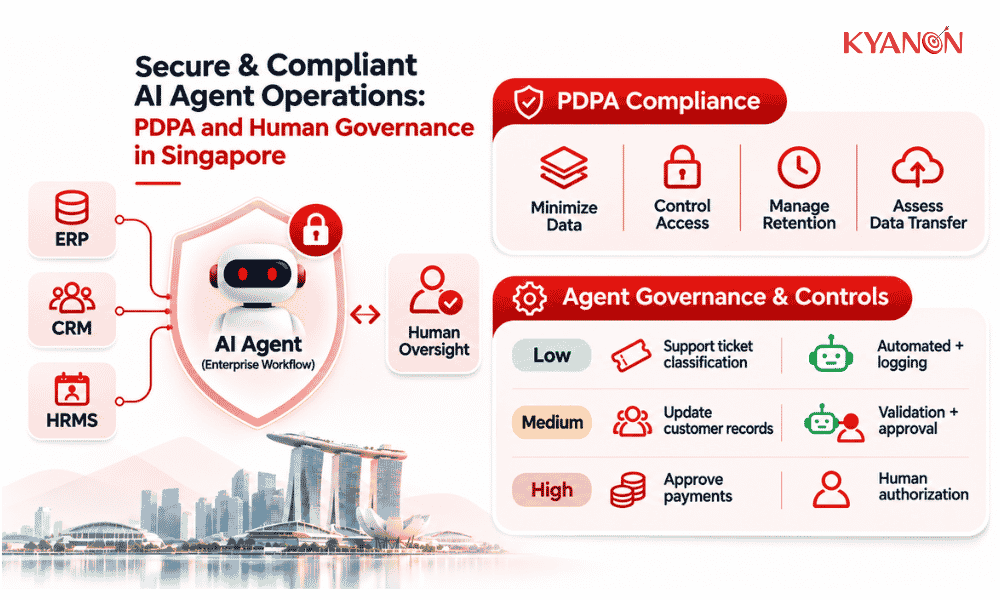
Align AI operations with Singapore’s PDPA
The Personal Data Protection Act (PDPA) governs the collection, use, disclosure, protection, and retention of personal data.
For AI-powered enterprise workflow solutions, organizations should assess what personal data agents access, why it is processed, and whether external model providers or infrastructure vendors receive it.
Important controls include:
- Data minimization: Limit personal data exposure to what the workflow requires.
- Access management: Apply least-privilege permissions to enterprise systems.
- Retention controls: Define how long prompts, retrieved information, and execution logs are retained.
- Cross-border transfers: Evaluate overseas processing arrangements against PDPA transfer requirements.
Importantly, the PDPA does not impose a blanket requirement to host all personal data in Singapore. Overseas transfers may be permitted when the applicable requirements, including comparable protection, are satisfied. Sector-specific obligations may impose additional restrictions.
Implement human oversight and agent governance
Singapore’s Model AI Governance Framework for Agentic AI, updated in May 2026, recommends risk boundaries, meaningful human accountability, technical safeguards, and responsible end-user practices.
The framework provides guidance rather than a standalone statutory compliance regime. Enterprises can translate these principles into different levels of agent autonomy:
| Risk level | Example workflow |
Recommended control |
|
Low |
Classifying internal support tickets | Automated execution with logging and review |
| Medium | Updating customer records |
Validation and conditional human approval |
|
High |
Approving payments or sensitive HR decisions |
Mandatory human authorization before execution |
IMDA’s 2026 guidance also highlights phased deployment, continuous monitoring, and controls against automation bias. Before expanding autonomy, organizations should test failure scenarios, unauthorized tool calls, incorrect outputs, and escalation procedures.
How can Kyanon Digital support enterprise AI agent integration?
Kyanon Digital supports enterprises integrating AI capabilities into existing workflows through AI-Driven Product Engineering Services, AI Integration Services, and enterprise integration and automation. These capabilities help businesses connect AI agents with ERP, CRM, and legacy systems to automate complex workflows rather than operate as standalone AI applications.
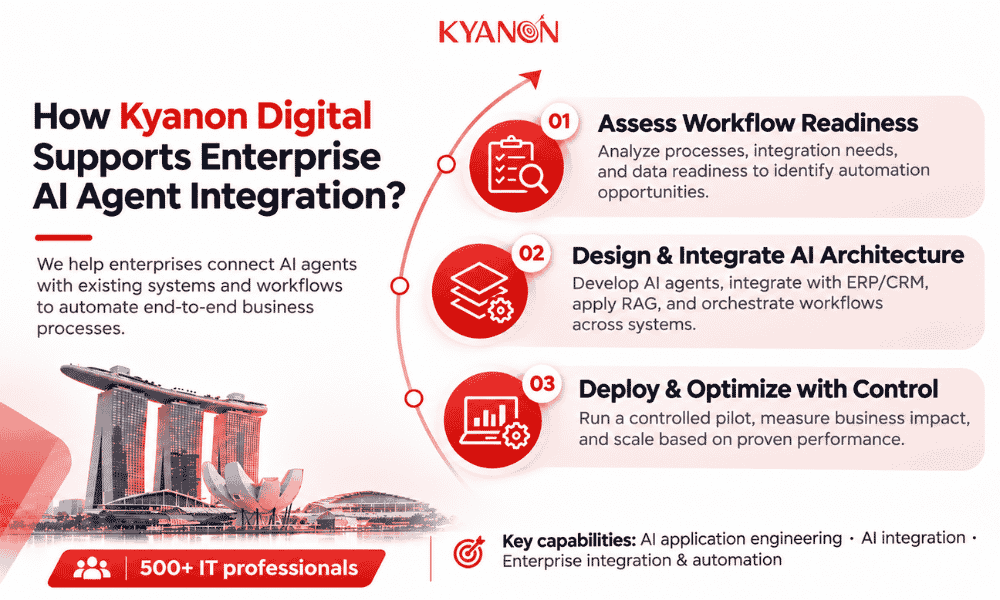
Assess enterprise workflow readiness
Kyanon Digital can help organizations examine workflow dependencies, integration requirements, and data readiness to identify practical automation opportunities. The initial assessment should establish the business outcome, technical constraints, and human approval requirements before selecting an implementation architecture.
Design and integrate enterprise AI architecture
Through enterprise engineering and AI capabilities, Kyanon Digital supports:
- AI-powered application and agent development.
- Enterprise API and system integration.
- RAG-based knowledge retrieval and data connectivity.
- Workflow orchestration and automation.
- Application deployment, optimization, and ongoing engineering support.
For complex environments, the implementation priority is to connect AI agents to existing systems while maintaining clear authorization boundaries and operational accountability.
Support controlled deployment and optimization
Kyanon Digital’s application engineering and integration capabilities can support phased implementation, from initial workflow validation to production integration and ongoing optimization.
A controlled pilot should evaluate task completion, processing time, exception handling, and intervention requirements against the original baseline. Expansion should depend on demonstrated operational performance rather than AI functionality alone.
How Kyanon Digital integrated AI-powered workflows for a Singapore bank
Kyanon Digital supported a Singapore-based commercial bank in modernizing customer service operations by connecting AI-powered assistance, enterprise knowledge retrieval, and workflow automation with existing business systems.
Challenges
- Fragmented enterprise knowledge made it difficult for service teams to retrieve accurate information quickly.
- Repetitive customer inquiries and manual request routing increased operational workload.
- The bank needed to improve service capacity while maintaining human oversight for complex interactions.
Solution from Kyanon Digital
- Implemented an AI-powered copilot using LLMs and Retrieval-Augmented Generation (RAG) to support knowledge retrieval, contextual responses, and agent assistance.
- Integrated AI capabilities with existing enterprise applications through APIs and workflow automation.
- Automated eligible request classification and routing while preserving human escalation for complex cases.
- Established monitoring and analytics to track workflow performance and identify improvement opportunities.
Results and impact
- Improved access to approved enterprise knowledge for customer-service teams.
- Reduced repetitive manual coordination through automated request classification and routing.
- Supported faster handling of routine inquiries and more efficient escalation of complex cases.
- Established an integrated AI-enabled service architecture that could support additional use cases.
Key takeaway: This case demonstrates how enterprises can integrate AI capabilities into existing workflows without replacing core systems while retaining operational visibility and human control.
Explore the full case study: Scaling Banking Customer Service with an AI-Powered Copilot.
Conclusion
Integrating AI agents into enterprise workflows requires more than choosing an AI platform. Singapore enterprises need to establish workflow readiness, secure system connectivity, appropriate governance, and measurable operational outcomes.
The most practical starting point is one clearly bounded workflow with accessible data, an accountable process owner, and defined approval controls. Broader deployment becomes defensible when the pilot demonstrates reliable execution and measurable improvements without unacceptable operational risk.
For organizations evaluating enterprise workflow automation across ERP, CRM, or legacy environments, discuss your enterprise AI integration roadmap with Kyanon Digital to explore the technical scope, integration dependencies, and priorities for an initial implementation.
References
- Artificial Intelligence in Singapore — Infocomm Media Development Authority (IMDA), 2026.
- Updated Model AI Governance Framework for Agentic AI — IMDA, May 2026.
- AI Agents: Insights from the Singapore Government and Google Sandbox — IMDA, May 2026.
- Advisory Guidelines on Key Concepts in the PDPA — Personal Data Protection Commission (PDPC), revised 2022; official guidance on the PDPA’s transfer limitation and other obligations.


 Create project brief with AI