Choosing AI agent retail chatbots for customer service requires selecting a platform that executes multi-step actions across your tech stack rather than just answering static FAQs. True AI agents integrate directly with your e-commerce backend to handle refunds, order modifications, and product recommendations autonomously. (IBM)
Key takeaways
- Clarifies the operational gap between basic generative bots and true AI agents by emphasizing the need for multi-step backend execution. Real-world implementations show this capability only transforms customer service workflows if the retailer has seamlessly connected their core e-commerce and CRM systems.
- Warns against deploying fully autonomous systems prematurely without first assessing your organization’s transaction complexity and risk tolerance. The Kyanon Digital team sees that scaling these tools successfully requires that retailers first establish strict data guardrails and clear human escalation paths.
- Explains how to evaluate platforms beyond base licensing fees to uncover the true total cost of ownership during high-traffic retail events. Field deployments consistently prove this evaluation method maintains a positive ROI provided merchants precisely account for API token usage alongside their seasonal volume spikes.
- Highlights the necessity of aligning AI adoption with local compliance frameworks to ensure responsible governance and protect consumer trust. Field experience from the team at Kyanon Digital indicates these safeguards are effective only when the chatbot platform restricts its knowledge retrieval entirely to approved internal databases.
Further reading:
- Generative AI for Retail: 7 Real Use Cases
- Best AI Chatbot & Virtual Assistant Companies in Singapore
- Building The Next Generation AI-Powered Chatbots & Generative AI
- Low Code Development Platforms: Chatbots Driving CX!
- What Are Top AI Chatbot Use Cases for Service in Singapore?
What makes an AI agent chatbot different from a traditional retail chatbot?
Not all retail chatbots offer the same level of intelligence or automation. Traditional chatbots follow predefined rules to answer common questions, while generative AI chatbots understand natural language and generate contextual responses. AI agent retail chatbots go further by planning multi-step tasks, interacting with enterprise systems and executing authorised actions to resolve customer requests.
Understanding these differences helps retailers identify the right level of AI capabilities for their customer service operations.
Traditional Chatbots vs. Generative AI Chatbots vs. AI Agent Retail Chatbots
|
Evaluation criteria |
Traditional retail chatbot | Generative AI chatbot | AI agent retail chatbot |
| Primary function | Answers predefined questions and directs customers to support resources | Understands natural language and generates contextual responses |
Resolves customer requests through autonomous, multi-step workflows |
|
Interaction model |
Rule-based scripts and decision trees | Context-aware conversational interactions | Goal-oriented interactions with dynamic task planning |
| Information access | Static FAQs and predefined knowledge bases | Retrieves information from connected knowledge sources |
Accesses relevant information across authorised enterprise systems |
|
Task execution |
Redirects customers to relevant pages | Provides answers and recommendations | Executes authorised actions through APIs and connected applications |
| Retail application | Displays return policies and store information | Explains return procedures and product features |
Checks return eligibility, initiates returns and updates order records |
Kyanon Digital sees that not every retail business needs a fully autonomous AI agent. The required level of autonomy should depend on transaction complexity, customer service volume, integration maturity and risk tolerance.

How is AI agent adoption changing retail customer service in Singapore?
Singapore’s retail sector is moving towards broader AI adoption. The refreshed Retail Industry Digital Plan, launched in May 2026, highlights AI applications such as AI concierge solutions and GenAI customer engagement chatbots across front-of-house, back-of-house and corporate operations. Retailers should therefore evaluate AI customer service as part of their wider digital transformation strategy.
However, adoption must be supported by responsible governance. IMDA’s Model AI Governance Framework for Agentic AI highlights risk assessment, human accountability, technical controls and transparency. Retailers should assess these safeguards when selecting an AI agent vendor.
Customer trust is equally important. Singapore’s enhanced TR 76 e-commerce standard reinforces the importance of reliable transactions and transparent customer interactions. AI agents handling orders, returns and post-purchase support must deliver accurate information and clear escalation paths to protect consumer trust.
What are the 6 key criteria for choosing an AI agent retail chatbot?
Selecting an effective AI agent retail chatbot requires evaluating its ability to move beyond scripted answers and autonomously resolve customer requests. While specific industry frameworks vary slightly, evaluation guides from platforms like Zendesk, Salesforce, and QuickBlox consistently highlight six core criteria for retail deployments.
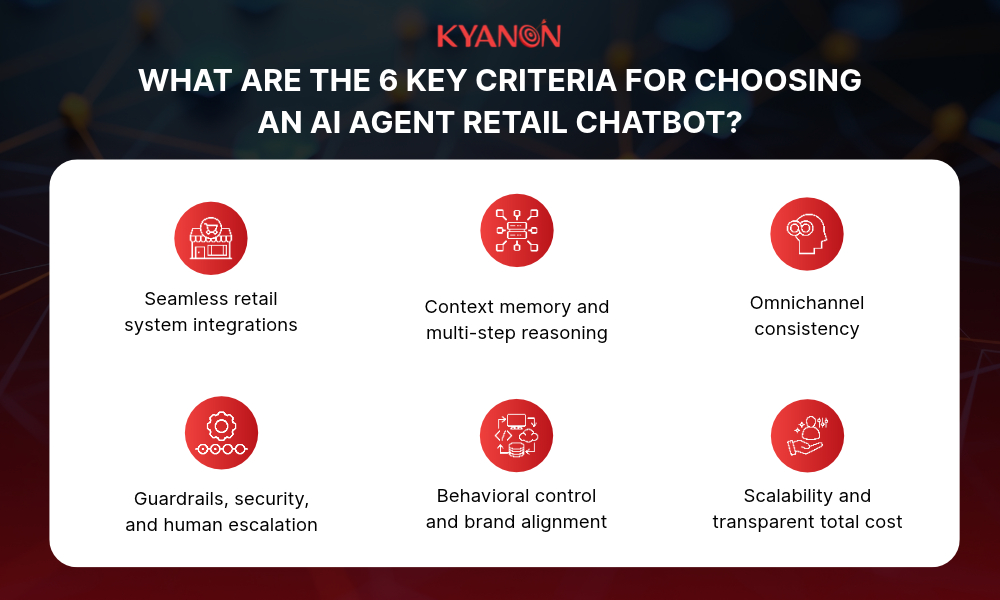
Seamless retail system integrations
An AI agent must connect directly to your existing tech stack to take real-time actions rather than just answering FAQs.
- Core Software Connections. Ensure the platform integrates smoothly with your e-commerce engine, Customer Relationship Management (CRM), Enterprise Resource Planning (ERP), and order management systems.
- Autonomous Task Execution. Verify that the agent can use APIs to check live inventory, process returns, update shipping addresses, and issue refunds without human intervention.
Context memory and multi-step reasoning
Unlike traditional rule-based bots, an agentic chatbot must understand complex buyer intent and carry out multi-step workflows.
- Persistent Session Memory. Look for short-term and long-term memory capabilities so the agent recalls past purchases, browsing history, and conversation context across sessions.
- Accurate Knowledge Retrieval. Prioritize platforms with strong Retrieval-Augmented Generation (RAG) that pull product specs and store policies exclusively from your approved internal databases to prevent hallucinations.
Omnichannel consistency
Retail shoppers frequently switch between devices and communication platforms during a single buying journey.
- Cross-Platform Deployment. Choose a solution that operates consistently across your website, mobile app, SMS, social media, and voice channels.
- Unified Customer Identity. Confirm the agent recognizes the same shopper across different channels and transfers full conversation history seamlessly.
Guardrails, security, and human escalation
Handling retail transactions requires strict data protection and clear boundaries on what the AI is permitted to do.
- Compliance and Data Privacy. Check that the platform complies with regulations like GDPR and protects payment details and personally identifiable information (PII).
- Smooth Human Handoffs. Ensure the agent can detect frustration or edge cases and escalate complex issues to live support staff with the full chat transcript attached.
Behavioral control and brand alignment
Your retail chatbot acts as a frontline brand ambassador and needs to match your store’s tone and operational rules.
- Workflow Customization. Evaluate how easily your team can set custom business logic, return eligibility rules, and discount limits.
- Usability for Non-Technical Teams. Look for intuitive no-code or low-code builders that allow merchandising and support managers to update prompts and product catalogs quickly.
Scalability and transparent total cost
Retail traffic fluctuates dramatically during holidays and flash sales, which impacts both performance and software billing.
- Peak Load Resilience. Verify that the infrastructure handles sudden spikes in simultaneous customer chats without slowing down response times.
- Predictable Pricing Models. Look beyond base licensing fees to evaluate per-resolution costs, API token usage, and ongoing maintenance expenses so your return on investment remains positive as volume grows.
Choosing an AI agent chatbot is not just about selecting an AI platform; it is about integrating AI into the broader retail technology ecosystem. As an integration technology partner, Kyanon Digital helps retailers connect AI agents with existing systems, unify data and workflows, and build secure, scalable solutions that deliver measurable improvements in customer experience and operational efficiency.
How can Kyanon Digital help retailers build AI-powered customer service solutions?
Kyanon Digital helps retailers move from AI experimentation to production-ready customer service solutions through enterprise AI engineering and digital integration.
Case study: Scaling Customer Service with an AI Chatbot for Healthcare

Kyanon Digital helped a Singapore healthcare provider automate routine customer enquiries using Azure OpenAI and Retrieval-Augmented Generation (RAG). The solution integrated approved knowledge, customer-service workflows and human escalation to improve service efficiency while maintaining clear AI boundaries.
Challenges
- Growing volumes of routine customer enquiries.
- Fragmented service information across documents and teams.
- Manual enquiry classification and routing.
- Inconsistent responses across channels.
- Limited self-service and rising customer service costs.
- Need to prevent AI from handling sensitive medical enquiries without human oversight.
Solutions
Kyanon Digital developed an AI-powered customer service chatbot using Azure OpenAI, Azure AI Search and Retrieval-Augmented Generation (RAG).
- Centralised approved service knowledge for accurate responses.
- Automated routine enquiries about appointments, services, locations and administrative procedures.
- Integrated APIs and workflows to classify enquiries, create service requests and route complex cases to human agents.
- Implemented response guardrails, conversation monitoring, escalation tracking and role-based access controls.
Impact
- Reduced routine manual enquiries by 38%.
- Improved customer response times by 32%.
- Resolved 28% of eligible enquiries through self-service.
- Reduced repetitive customer service workload by 24%.
Explore the full case study here: Scaling Customer Service with an AI Chatbot for Healthcare
References
- A Guide to AI Customer Service Chatbots – IBM
- Chatbots for Customer Experience – IBM
- Refreshed Industry Digital Plan to Support Retailers – IMDA
- Updated Model AI Governance Framework for Agentic AI – IMDA
- TR 76:2025 – Guidelines for Electronic Commerce Transactions – Singapore Standards
- Enhanced E-commerce Guidelines to Safeguard Consumer Trust and Foster Competitive E-commerce Market – Ministry of Home Affairs, Singapore
- Scaling Customer Service with an AI Chatbot for Healthcare – Kyanon Digital


 Create project brief with AI