


The Build Operate Transfer (BOT) model in IT outsourcing allows a company to establish an offshore software development team or delivery center through a third-party provider, operate it under agreed governance, and eventually transfer control in-house. BOT suits enterprises seeking long-term ownership, but success depends on transparent transfer costs, workforce continuity, intellectual property protection, and operational readiness.
For CTOs and business leaders planning offshore expansion, the challenge is not simply finding developers. It is building a sustainable engineering operation without losing control over talent, intellectual property, costs, or delivery continuity.
Traditional outsourcing offers flexibility, while establishing an in-house offshore center provides greater direct control but requires local infrastructure and management capabilities. The Build Operate Transfer model offers another path, although the eventual handover introduces financial, contractual, and workforce risks.
This guide examines how BOT works, when it is preferable to conventional outsourcing, and what enterprises should validate before committing to a long-term engagement.
Key takeaways
- Choose BOT for long-term ownership. The model fits enterprises planning to internalize strategic engineering capabilities rather than outsource temporary workloads.
- Define the transfer before building. Agree on ownership structures, employee transition arrangements, IP rights, transfer fees, and acceptance criteria before signing.
- Evaluate total ownership costs. Compare setup, operation, transition, and post-transfer expenses against traditional outsourcing and establishing a captive center directly.
- Protect workforce continuity. Retention, management readiness, documentation, and knowledge transfer are critical to sustaining operations after handover.
- Validate partner capabilities. Kyanon Digital’s dedicated engineering and outsourcing capabilities are relevant to team-building and delivery evaluation; formal BOT transfer arrangements require separate contractual confirmation.
Further reading:
- Build Your Offshore Development Team in Vietnam
- Hire a Dedicated Development Team in Vietnam: The Guide for Australian, US, and EU Clients
- How Hong Kong Leaders Build Offshore Teams
- Staff Augmentation Best Practices for High ROI and Project Success
What is the build-operate-transfer model in IT outsourcing?
The Build-Operate-Transfer model is a contractual outsourcing arrangement in which a service provider establishes and manages a dedicated operation before transferring agreed ownership and responsibilities to the client.
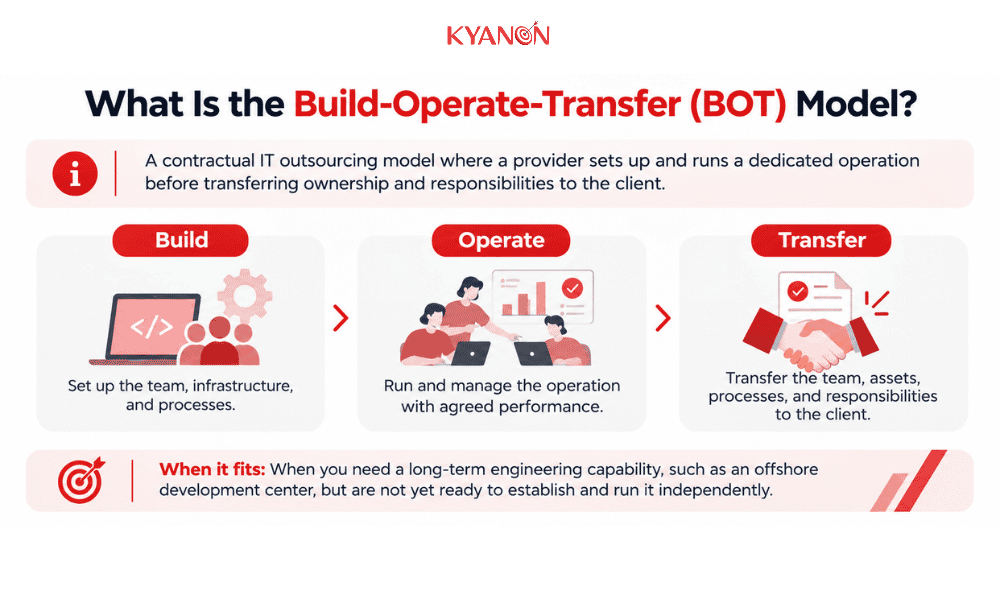
Unlike conventional project outsourcing, BOT is designed around eventual operational independence. The transferred operation may include an engineering team, infrastructure, processes, documentation, contracts, and other assets, depending on the agreement.
For enterprises considering an offshore development center, the distinction is important: BOT is not merely hiring an external engineering team with the option to manage it later. It requires a defined legal, financial, and operational mechanism for transfer.
BOT may be appropriate when an organization needs a permanent software engineering capability but is not yet ready to establish and operate a foreign subsidiary independently.

How does the build operation transfer model work?
The BOT outsourcing model comprises three phases. Each should have measurable deliverables and approval criteria rather than relying only on a fixed timeline.
| Phase | Provider responsibilities |
Client decision & deliverable |
|
1. Build |
Establish the team, infrastructure, operating processes, and agreed legal arrangements | Approve staffing, governance, security, and transfer architecture |
| 2. Operate | Manage delivery, workforce administration, performance, and capability development |
Validate KPIs, retention, costs, and operational maturity |
|
3. Transfer |
Execute the agreed handover of people, assets, knowledge, access, and responsibilities |
Confirm legal transfer requirements and operational independence |
Build: Establish the operation for future ownership
The provider recruits talent, configures infrastructure, and establishes delivery governance.
Before approving the build, enterprises should determine whether the operation will transfer through an entity acquisition, asset transfer, employee transition, or another permitted structure.
The appropriate method depends on the jurisdiction, existing corporate structure, contracts, and employment arrangements.
Operate: Stabilize delivery and reduce provider dependency
The provider manages daily operations while the client establishes technical standards, performance expectations, and management oversight.
Beyond measuring sprint velocity or service delivery, businesses should assess employee retention, documentation completeness, security controls, and the ability of internal leaders to assume responsibility.
Transfer: Validate readiness before handover
The final phase transfers the agreed operation under the contractual structure.
Handover should not occur simply because the scheduled transfer date has arrived. Enterprises need evidence that responsibilities, systems, personnel arrangements, and operational knowledge can transition without unacceptable disruption.
The critical principle is to plan backward from the intended ownership model, not treat transfer as a separate activity at the end.
Build operation transfer vs. traditional outsourcing: which is better?
BOT is generally more suitable for strategic capabilities requiring eventual internal ownership, while traditional outsourcing is often preferable when businesses primarily need external delivery capacity. The choice also depends on whether the organization can establish an offshore captive center directly.
|
Decision factor |
Traditional outsourcing | Build operate transfer |
Direct captive center |
|
Long-term ownership |
Provider-managed delivery | Agreed transfer to client | Client-owned from establishment |
| Initial setup responsibility | Primarily provider | Primarily BOT partner |
Client |
|
Operational control |
Contract-dependent | Shared during operation; greater control after transfer | Direct client management |
| Financial commitment | Recurring service fees | Setup, operation, transfer, and post-transfer costs |
Establishment and ongoing internal costs |
|
Workforce transition |
Usually not required | Critical handover dependency | Primarily direct hiring |
| Best suited for | Flexible projects and specialist capacity | Permanent offshore capabilities with staged ownership |
Organizations ready to operate locally |
When should enterprises choose BOT?
Consider BOT when:
- Engineering or R&D capabilities are strategically important and expected to remain in-house long-term.
- The company wants eventual operational ownership but lacks local setup or recruitment capacity.
- Leadership can commit resources to managing the transferred operation.
- A financially and legally viable transfer structure can be established upfront.
BOT may not be the best choice for short-term projects, uncertain hiring demand, or organizations unwilling to assume local employment, compliance, and management responsibilities.
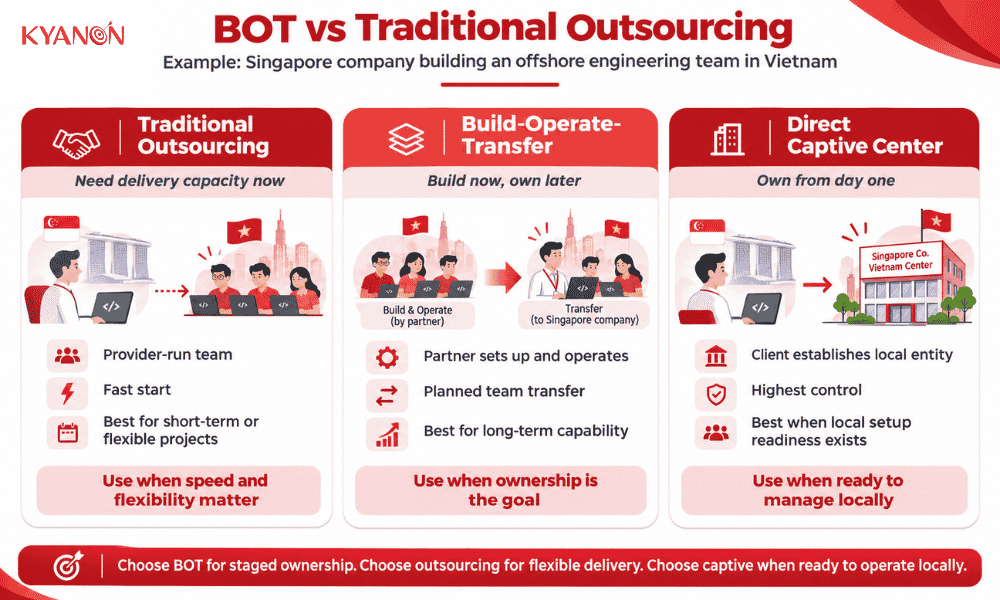
For these requirements, a dedicated development team or staff augmentation arrangement may offer sufficient flexibility without the additional transfer obligations.
What are the benefits and risks of build operate transfer outsourcing?
BOT can reduce the burden of establishing a new offshore operation, but it also creates dependencies that must be managed contractually.
|
Potential benefit |
Associated risk |
What buyers should validate |
|
Faster access to local talent |
Recruitment delays or attrition | Hiring plan, retention obligations, replacement arrangements |
| Reduced initial setup burden | Higher total cost after transfer |
Full lifecycle cost and transfer fees |
|
Eventual operational control |
Incomplete asset or contract transfer | Ownership schedule and third-party consent requirements |
| Dedicated engineering capability | Vendor dependency during operation |
Knowledge transfer and internal leadership development |
|
Long-term capability building |
Disruption during handover |
Transfer acceptance tests and continuity arrangements |
The principal risk is not necessarily poor software delivery. It is inheriting an operation that cannot function independently of the provider.
A useful 2026 perspective comes from the International Council of Management Consulting Institutes (ICMCI), which emphasizes explicit knowledge-transfer obligations, dependency-reduction targets, and contractual acceptance criteria when organizations seek to internalize externally supported capabilities.
For businesses evaluating engineering delivery arrangements, Kyanon Digital’s Dedicated Development Team services provide a relevant comparison for long-term engineering capacity, team integration, and delivery governance. Organizations requiring formal BOT ownership transfer should separately validate the proposed legal and commercial structure.
How much does a build operation transfer model cost?
BOT costs should be evaluated across the entire engagement lifecycle, not against outsourcing hourly rates alone. A financially sound comparison should include:
|
Cost category |
Budget considerations |
|
Build |
Recruitment, facilities, equipment, legal establishment, technology setup |
| Operate |
Salaries, benefits, provider fees, infrastructure, management, security |
|
Transfer |
Contractual transfer fees, legal expenses, employee transition, asset migration |
| Post-transfer |
Internal leadership, HR, payroll, compliance, IT operations, ongoing retention |
The key financial calculation is:
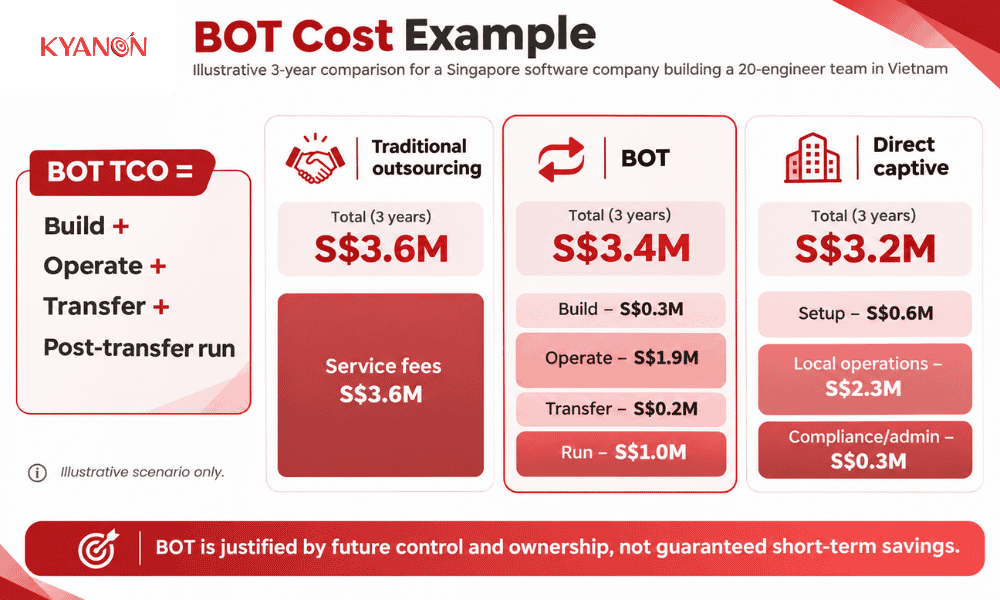
BOT total cost of ownership = Build costs + Operate costs + Transfer costs + Post-transfer operating costs
Enterprises should compare this against the cost of continuing outsourcing or building a captive center directly over the same planning horizon. Before signing, request an itemized cost model showing management markups, inflation adjustments, minimum commitments, termination charges, and the transfer pricing mechanism.
A fixed transfer fee or pre-agreed formula may improve predictability, but the appropriate structure depends on the transaction and legal arrangements. Do not assume BOT automatically delivers lower costs. Its financial justification may depend on longer-term control and strategic capability ownership rather than immediate savings.
What should a build operate transfer contract include?
For decision-makers, the BOT contract is one of the most important risk-control mechanisms.
A strong agreement should address six areas:
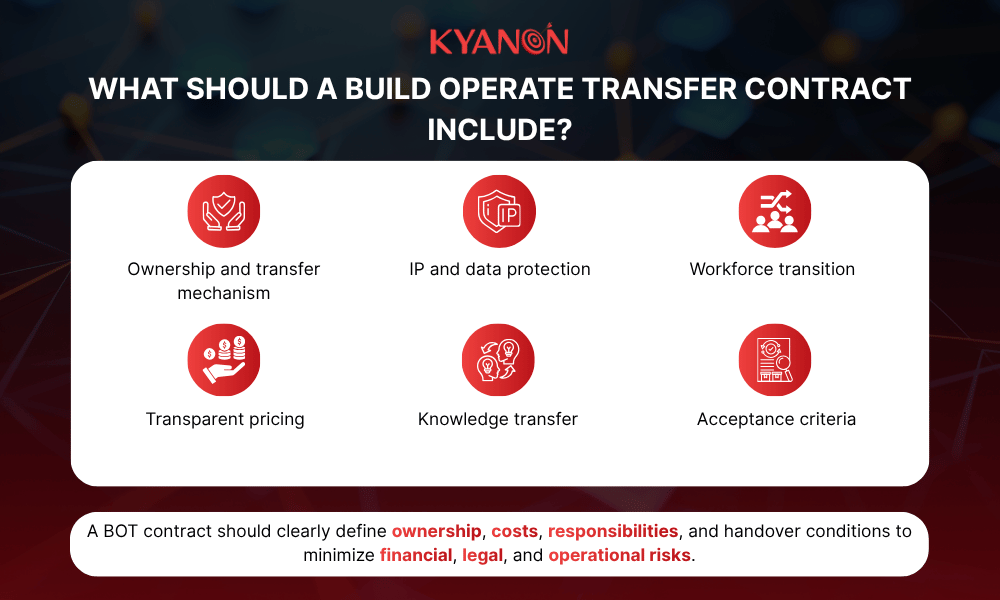
- Ownership and transfer mechanism: Identify the legal entity, assets, contracts, and obligations that will transfer.
- IP and data protection: Define ownership, confidentiality, permitted access, subcontractor obligations, and continuity of system access.
- Workforce transition: Establish employment arrangements, retention planning, required consents, and responsibility for transition costs.
- Transparent pricing: Specify operating fees, transfer charges, adjustment mechanisms, and termination consequences.
- Knowledge transfer: Require current documentation, training, operational runbooks, and management handover.
- Acceptance criteria: Define the evidence necessary for transfer approval and post-transfer support obligations.
For cross-border operations, local legal advice is essential. Employment transfers, corporate transactions, tax treatment, intellectual property rights, and data protection obligations depend on the country and transaction structure.
Research on global capability centers also identifies employment arrangements, IP ownership, cybersecurity, and transition rights as important considerations when selecting and structuring BOT operations.
How can enterprises ensure a successful BOT handover?
Transfer readiness should be measured throughout the Operate phase, not only during the final handover. Before approving the transfer, leadership should verify:
| Readiness area |
Acceptance evidence |
|
Workforce |
Confirmed employment transition arrangements and retention plan |
| Technology & security |
Validated access, asset inventory, security controls, and system ownership |
|
Knowledge transfer |
Approved documentation, runbooks, and completed operational training |
| Governance |
Named internal owners for delivery, HR, finance, compliance, and infrastructure |
|
Delivery continuity |
Demonstrated ability to maintain agreed service and engineering performance |
| Financial readiness |
Approved post-transfer budget and responsibility for ongoing liabilities |
A practical safeguard is to introduce progressive management handover, where client-appointed leaders assume responsibilities before the legal transfer is completed.
For software development centers, this may include internal ownership of architecture decisions, backlog prioritization, release governance, and incident management.
These checks help determine whether the operation is genuinely transferable rather than simply functioning under the provider’s management.
How should businesses evaluate a build-operate-transfer partner?
Partner selection should focus on the provider’s ability to build an operation that the client can eventually manage, not just supply engineering talent.
Evaluate candidates against:
- Engineering capability: Can they recruit and manage the required software, data, cloud, security, and AI specialists?
- Operational governance: Are delivery KPIs, management responsibilities, and reporting transparent?
- Transfer capability: Can they demonstrate completed handovers of comparable scale and structure?
- Financial transparency: Are ongoing charges, transfer fees, and exit obligations documented?
- Workforce continuity: How will compensation, retention, and employee transitions be handled?
- Legal and security readiness: Can the proposed transfer comply with applicable local requirements?
Ask prospective providers for evidence of completed transfers, retention outcomes, sample handover deliverables, and contractual transition mechanisms. Where evidence is unavailable, treat the proposal as unvalidated.
Why choose Kyanon Digital for Build, Operate, Transfer, and Outsourcing?
Kyanon Digital brings enterprise software engineering expertise and flexible delivery capabilities to help businesses establish and scale offshore development operations.
- Experienced engineering teams: Access software development, architecture, QA, DevOps, cloud, and AI expertise.
- Flexible outsourcing models: Software Development Outsourcing and dedicated development teams support different staffing and operational requirements.
- Regional delivery capabilities: With 500+ professionals and a presence across Vietnam, Singapore, Thailand, Australia, and Malaysia, Kyanon Digital supports businesses scaling engineering operations across APAC.
For enterprises considering a BOT arrangement, Kyanon Digital can discuss the engineering setup, operational governance, and delivery requirements, while formal ownership transfer, workforce transition, and handover obligations must be explicitly agreed upon.
Conclusion
The Build-Operate-Transfer model is most appropriate when an organization wants to establish a permanent offshore engineering capability while using an external partner to manage its initial setup and operations.
Its value depends on more than recruitment speed or operating cost. Enterprises must evaluate the full ownership structure, transfer obligations, workforce continuity, and their own ability to run the operation independently.
Before committing, compare BOT against traditional outsourcing and direct captive-center establishment, define transfer acceptance criteria, and obtain a full lifecycle cost model.
Planning a long-term offshore engineering operation? Discuss your development team and operating-model requirements with Kyanon Digital to assess technical scope, governance needs, staffing, and which contractual arrangements require further validation.
References
- Global Capability Center: NCR 2026 — Dun & Bradstreet India, 2026.
- Dedicated Development Team — Kyanon Digital.
- Software Development Outsourcing — Kyanon Digital.


 Create project brief with AI