

An AI-driven dedicated team helps enterprises move from MVP development to production by combining AI-assisted engineering with experienced developers, structured Agile delivery, automated testing, and security controls. Unlike pure vibe coding, this model maintains human accountability for architecture, code quality, and releases, supporting faster development without sacrificing scalability or long-term maintainability.
As AI coding tools become more accessible, enterprises may assume that faster code generation translates directly into lower software development costs. According to Gartner’s 2026 Enterprise AI Coding Agents Market Analysis, 90% of engineering leaders report productivity improvements, with an average net gain of 19.3%. However, Gartner’s July 2026 research also warns that AI consumption, code verification, rework, security, and compliance can introduce additional delivery costs.
Drawing on its enterprise software engineering and AI-assisted delivery experience, Kyanon Digital recognizes that faster coding alone does not guarantee production readiness or cost efficiency. Sustainable delivery requires experienced engineers, consistent quality controls, and measurable outcomes.
This article explores how an AI-driven dedicated team addresses these challenges and supports enterprise software development from MVP validation through production and beyond.
Key takeaways
- AI productivity is not the same as cost savings: Enterprises should measure completed, reliable software against total development and maintenance costs.
- Vibe coding and AI-driven teams serve different needs: Rapid prototypes benefit from lightweight tools, while production applications need stronger engineering accountability.
- Production readiness begins with MVP architecture: Modular design, automated testing, and CI/CD reduce avoidable rework during scaling.
- Kyanon Digital’s AI-Driven Agile Team Services combine AI-assisted engineering, human-led quality governance, and committed sprint outcomes to support enterprise delivery.
How is an AI-driven dedicated team different from vibe coding?
The key difference is engineering accountability, production readiness, and long-term maintainability. While vibe coding can accelerate early prototypes through AI-generated code, an AI-driven dedicated team combines AI-assisted development with experienced engineers, structured quality controls, and continuous delivery governance.
For enterprises planning to move an MVP into production, the decision is not simply which approach generates code faster but which can support complex integrations, security requirements, and future product development without excessive rework
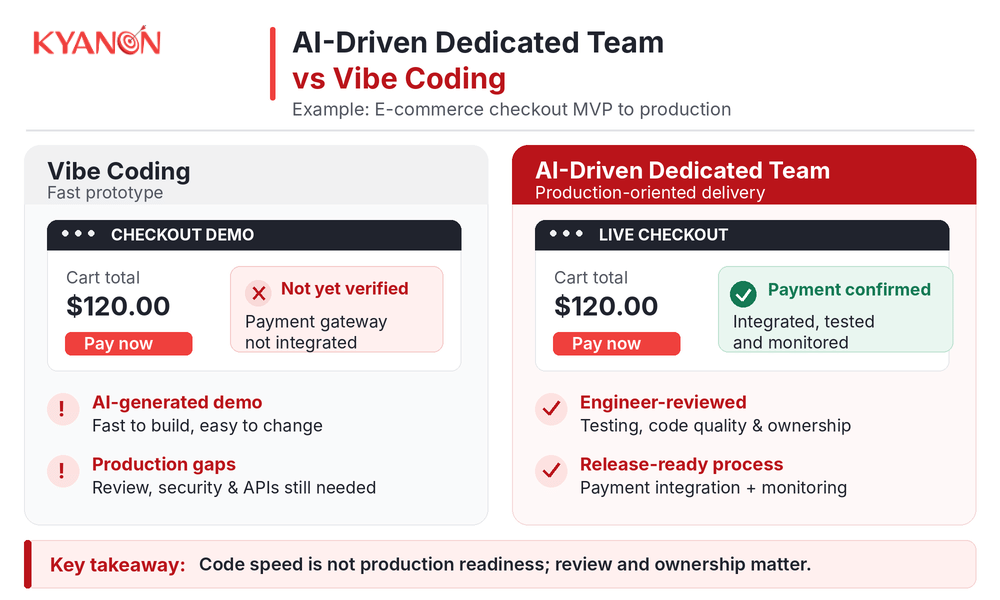
AI-driven dedicated team vs. vibe coding: Which fits your project?
Evaluation criteria | Vibe coding | AI-driven dedicated team |
Best fit | Early prototypes, simple applications, concept validation | Enterprise MVPs, production systems, evolving software products |
| Engineering ownership | May rely heavily on AI-generated implementation | Human engineers own architecture, implementation, and release decisions |
Complex integrations | Require additional technical review and engineering | Structured development across APIs, databases, and enterprise systems |
| Quality and security | Depend on the review practices applied | Code reviews, automated testing, security checks, and QA gates |
Maintenance | May require refactoring before production | Version control, documented architecture, and ongoing engineering ownership |
The distinction matters because coding productivity does not automatically translate into overall development efficiency. Gartner‘s research: AI’s Impact on Developer Productivity Across the SDLC, notes that organizations struggle to consistently realize high productivity gains throughout the software development lifecycle.
Can AI coding really reduce software development costs by 80%?
Claims of dramatic cost reductions often confuse code-generation productivity with total software development cost. AI can reduce effort on repetitive implementation tasks. However, production software still requires requirements validation, architecture, integration, QA, security reviews, deployment, and ongoing support.
For example, generating an MVP interface more quickly does not eliminate the engineering required to connect it to enterprise systems, validate business logic, and maintain reliable operations.
Enterprises should therefore compare total cost of ownership (TCO) and delivered outcomes, rather than assuming faster code generation produces proportional project savings.
How AI-driven teams maintain engineering quality
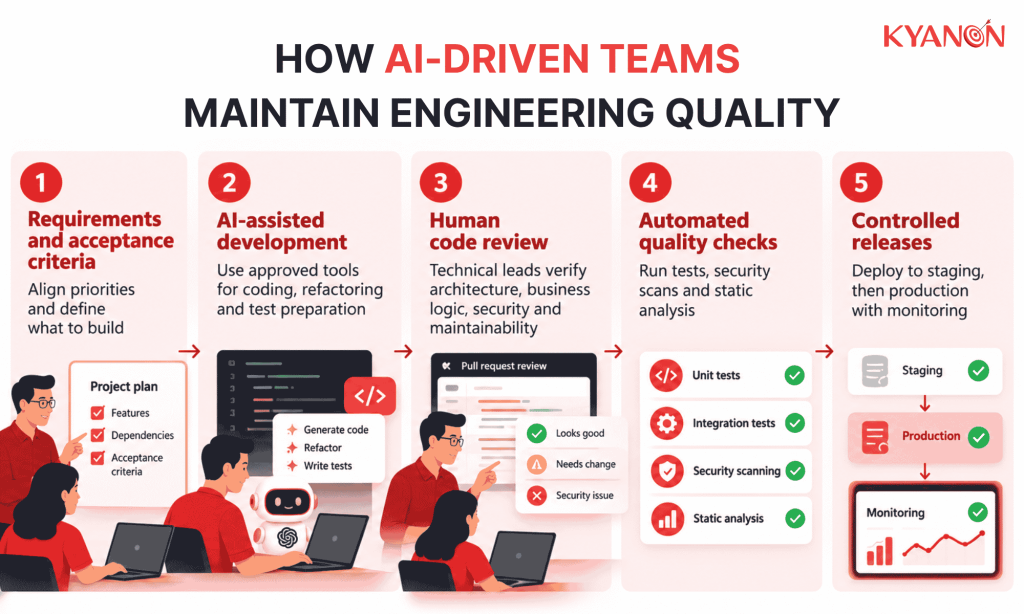
A structured AI-assisted delivery workflow follows five checkpoints:
- Requirements and acceptance criteria: Engineers and business analysts clarify priorities, dependencies, and the Definition of Done.
- AI-assisted development: Approved tools support coding, refactoring, documentation, and test preparation.
- Human code review: Technical leads verify architecture, business logic, security, and maintainability.
- Automated quality checks: Unit tests, integration tests, static analysis, and relevant security scans validate changes.
- Controlled releases: Approved deliverables progress through staging, deployment, and monitoring
These controls align with OWASP’s guidance on AI-assisted software development, which emphasizes organizational accountability, independent review, restricted AI-agent permissions, and secure development practices.

How does an AI-driven dedicated team take an MVP to production?
A production-ready MVP does not need every enterprise capability immediately. It needs an architecture that can evolve without unnecessary reconstruction.
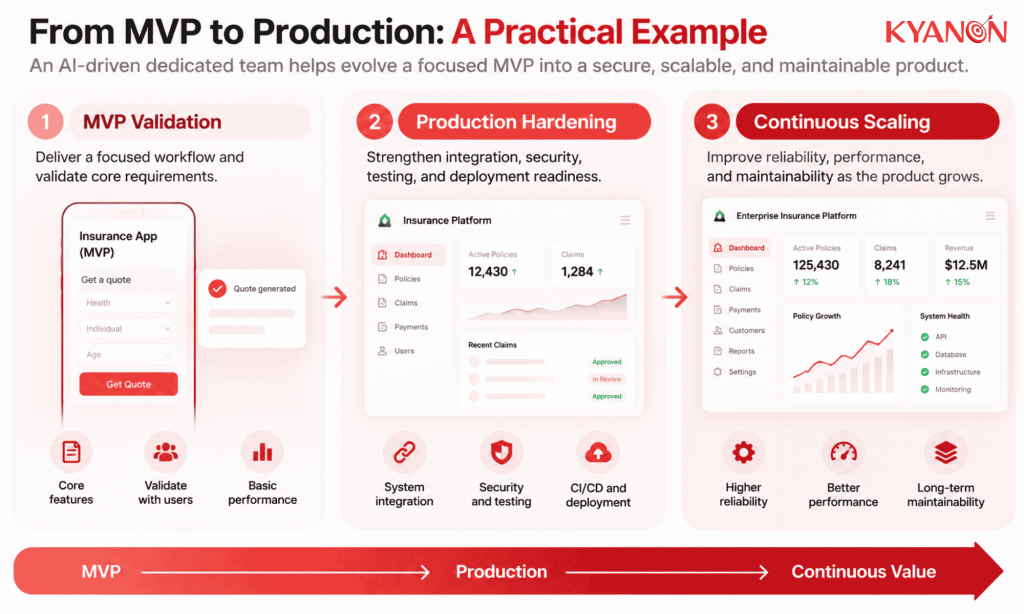
The transition should follow three stages:
- MVP validation: Deliver a focused business workflow, validate core requirements, and establish baseline performance and quality criteria.
- Production hardening: Strengthen system integration, automated testing, access controls, CI/CD, monitoring, and deployment readiness.
- Continuous scaling: Improve reliability, performance, and maintainability as workloads and product requirements increase.
The team composition should evolve alongside the product:
| Specialization | MVP validation | Production and scale |
Software engineering | Core features, APIs, modular architecture | Performance, resilience, enterprise integration |
| AI/ML engineering, if applicable | Model/API evaluation, RAG prototypes | Model evaluation, latency optimization, MLOps |
DevOps | Initial CI/CD, deployment environments | Monitoring, rollback, infrastructure reliability |
| Product and QA | Acceptance criteria, functional testing | Regression automation, release quality, support readiness |
The team’s composition should evolve with the product. MVP validation may require a lean group of software engineers, a technical lead, and QA support. Production scaling may require additional DevOps, security, integration, or AI/ML specialists.
Kyanon Digital’s delivery perspective: Scaling should follow demonstrated product readiness rather than code-generation speed alone. When enterprises lack the cross-functional engineering capacity to manage this transition, Kyanon Digital’s AI-Driven Agile Team Services combine AI-assisted execution with committed sprint deliverables and human-led quality governance.
What roles and governance keep AI-driven development accountable?
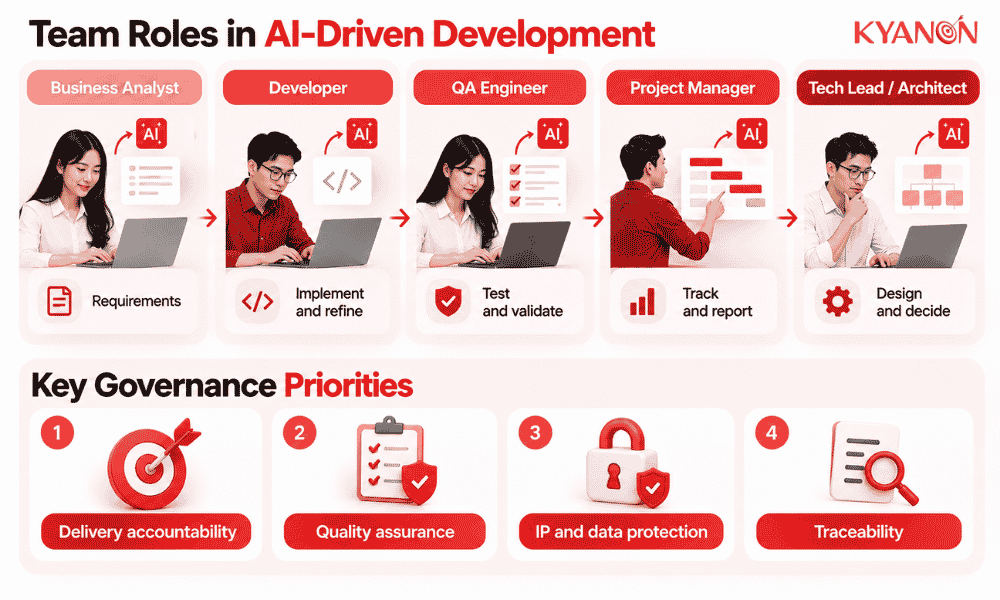
An AI-driven dedicated team must clearly distinguish where automation supports engineering activities and where humans retain decision-making responsibility.
AI can assist analysts with requirements, developers with implementation, QA engineers with test preparation, and project managers with reporting. However, architecture approval, security decisions, business logic validation, and production releases remain human responsibilities.
Enterprise governance should address four priorities:
- Delivery accountability: Track sprint commitments, completed deliverables, unresolved blockers, and defects.
- Quality assurance: Maintain code reviews, automated tests, acceptance criteria, and release approvals.
- IP and data protection: Define contractual ownership, approved AI tools, source-code confidentiality, retention policies, and access controls.
- Traceability: Maintain version history, review records, testing evidence, and relevant audit trails.
For AI-powered products, additional controls may include model evaluation, data access restrictions, output monitoring, and escalation procedures. The decision criterion is whether these controls can be demonstrated consistently, not merely described in a development proposal.
How Kyanon Digital improved launch readiness for a digital insurer
Kyanon Digital’s digital insurance application project demonstrates how AI-assisted engineering and Agile governance supported production-oriented release preparation.
Challenges
- Inconsistent mobile experiences and unresolved frontend defects.
- Limited visibility into sprint progress and launch blockers.
- Internal Tech Lead overload, alongside testing and security hygiene gaps.
Solution from Kyanon Digital
- Introduced structured sprint planning, acceptance criteria, and delivery reporting.
- Applied AI-assisted coding, refactoring, and test preparation under human review.
- Strengthened code review, static checks, smoke testing, and repository access controls.
Results and impact
- Pilot readiness improved from 62% to 91%.
- Open launch blockers decreased by 72%.
- High-priority frontend defects declined by 46%.
- Repetitive frontend fix turnaround improved by approximately 25%.
These outcomes relate to a specific mobile stabilization and pilot-readiness engagement, rather than a complete MVP-to-production transformation. They demonstrate the value of combining AI acceleration with engineering discipline and measurable delivery governance.
The expertise behind the delivery model
Kyanon Digital combines enterprise software engineering, QA, DevOps, and Agile governance through its AI-Driven Agile Team Services, where AI supports development efficiency while experienced engineers remain accountable for quality and delivery outcomes.
At InnoEx 2026, Dr. Tai Huynh, Founder & CEO of Kyanon Digital and Co-President of the CIO Vietnam Community, highlighted an important shift in enterprise AI adoption:
The key trend in AI adoption is moving from Content to Context. Businesses should focus not only on how fast AI creates content, but on how quickly it understands the right context to produce better outcomes.
— Dr. Tai Huynh, translated from his remarks at InnoEx 2026.
Applied to AI-assisted software engineering, this perspective reinforces why generating code faster is not enough. Development teams must understand business requirements, enterprise architecture, and operational constraints to deliver software that creates measurable value.
This principle aligns with Kyanon Digital’s approach: using AI to accelerate engineering execution while retaining human expertise, structured governance, and accountability throughout the software development lifecycle.
For more insights, read Dr. Tai Huynh’s full perspective on turning AI into measurable operational impact.
Which AI-driven dedicated team engagement model fits your roadmap?
Enterprises should select an engagement model based on delivery ownership, internal engineering maturity, and product complexity.
Engagement model | Best suited for |
In-house AI-assisted development | Established internal engineering teams with adequate capacity and governance |
| AI-enabled staff augmentation | Specific skills shortages with existing client-side delivery leadership |
AI-driven dedicated Agile team | Continuous product development requiring cross-functional capacity and committed sprint outcomes |
| Full software outsourcing | Defined projects requiring external end-to-end ownership |
Kyanon Digital’s AI-Driven Agile Team Services operate through an Agile Contract model, connecting agreed sprint deliverables with Tech Lead oversight, quality reviews, and structured reporting.
What should enterprises prepare before onboarding?
Before engaging a dedicated team, enterprises should establish their product roadmap, current architecture, integration dependencies, initial backlog, security expectations, and acceptance criteria.
Following initial scope alignment, Kyanon Digital typically targets first-sprint scope commitment within one week. Actual onboarding depends on backlog readiness, team composition, and the complexity of the existing product environment.
The first engagement should establish clear deliverables and baseline quality metrics, allowing stakeholders to evaluate whether scaling the team is justified.
Why choose Kyanon Digital for AI-dedicated team development?
An engineering partner, not a recruitment provider
Kyanon Digital builds dedicated development teams around your product roadmap, backlog, technology stack, and delivery objectives, rather than simply filling individual roles. Our AI-driven Dedicated Agile Team model provides Singapore enterprises with stable engineering capacity, sprint-based delivery, and clear accountability aligned with backlog readiness and team capacity.
AI-enabled engineering with human accountability
Kyanon Digital integrates AI-assisted practices across requirements analysis, user-story preparation, software development, QA preparation, documentation, and delivery reporting. AI helps teams improve productivity and accelerate engineering workflows, while experienced engineers remain accountable for technical decisions, quality, and delivery outcomes.
Kyanon Digital talent ecosystem encompasses over 50,000 technology professionals
- 500+ internal technology professionals
- Talent pipeline across 18 Vietnamese universities through K-Fresh Program
- 15,000+ external candidates
- 1,000+ ecosystem partners
Delivery support beyond team assembly
Kyanon Digital supports dedicated teams throughout the engagement, including onboarding, account management, professional development, technical support, and access to its Centers of Excellence. This enables Singapore enterprises to build long-term engineering capabilities while maintaining knowledge continuity, delivery consistency, and alignment with their internal teams.
Conclusion: AI should accelerate engineering, not replace it
The decision is not whether AI can generate software. It is whether the delivery approach can produce secure, maintainable functionality that continues to create business value after the MVP.
Vibe coding may be sufficient for early experimentation. For enterprises requiring ongoing development, integrated systems, and accountable releases, an AI-driven dedicated team offers a more structured operating model.
Considering an AI-driven approach to your enterprise software roadmap? Book a consultation with Kyanon Digital to discuss your MVP readiness, engineering capacity, delivery governance, and the first measurable sprint outcomes.
References
- Enterprise AI Coding Agents: 2026 Market Guide & Trends — Gartner, 2026.
- How to Plan for the Impact of AI Costs in Software Engineering — Gartner, July 2026.
- Secure Coding with AI Cheat Sheet — OWASP Cheat Sheet Series, 2026.
- AI-Driven Agile Team Services — Kyanon Digital, accessed 2026.
- Accelerating Singapore Digital Insurance App Launch Readiness with an AI-Driven Agile Team — Kyanon Digital, 2026.
- Dr. Tai Huynh at InnoEx 2026 – Turning AI into Measurable Operational Impact — Kyanon Digital, 2026.


 Create project brief with AI