Pure vibe coding can turn a natural-language prompt into a working interface or application in a remarkably short development cycle. For enterprise teams, however, a working demonstration is not the same as software that can safely support customers, employees, or critical business operations.
The distinction matters when a prototype begins handling sensitive data, connecting to internal systems, or becoming part of an established business workflow. At that point, decisions about access control, reliability, ownership, and future maintenance become as important as the speed of initial development.
The goal is not to reject AI-assisted development. It is to understand where rapid experimentation ends and production engineering begins.
Key takeaways
- Use pure vibe coding for exploration: It is suitable for disposable prototypes and low-risk experiments when production data and critical systems are out of scope.
- Validate before deployment: Security, performance, integration, and maintainability must be tested rather than inferred from a successful demonstration.
- Treat compliance as a design requirement: SOC 2, ISO 27001, and GDPR have different scopes; generating code does not establish compliance.
- Retain engineering accountability: AI can accelerate implementation, but people must own architecture, testing, release decisions, and operational support.
- Scale through a controlled process: Kyanon Digital’s application development services provide a relevant route for organizations that need to turn a validated concept into a maintainable application.
Further reading:
- AI-Driven Software Development for Enterprises
- AI CRM and ERP Solutions for Singapore Enterprises
- AI-Driven Dedicated Team: MVP to Production
What pure vibe coding is, and where it shines
Pure vibe coding is an approach to software creation in which a person describes an outcome in natural language, asks an AI tool to generate code, and iteratively refines the result through prompts. The emphasis is on obtaining a working result quickly rather than following a structured software engineering process from the beginning.
The term does not describe a standardized engineering method. In practice, the amount of human review varies. For this article, pure vibe coding refers to a workflow with minimal systematic review, testing, documentation, and architectural oversight.
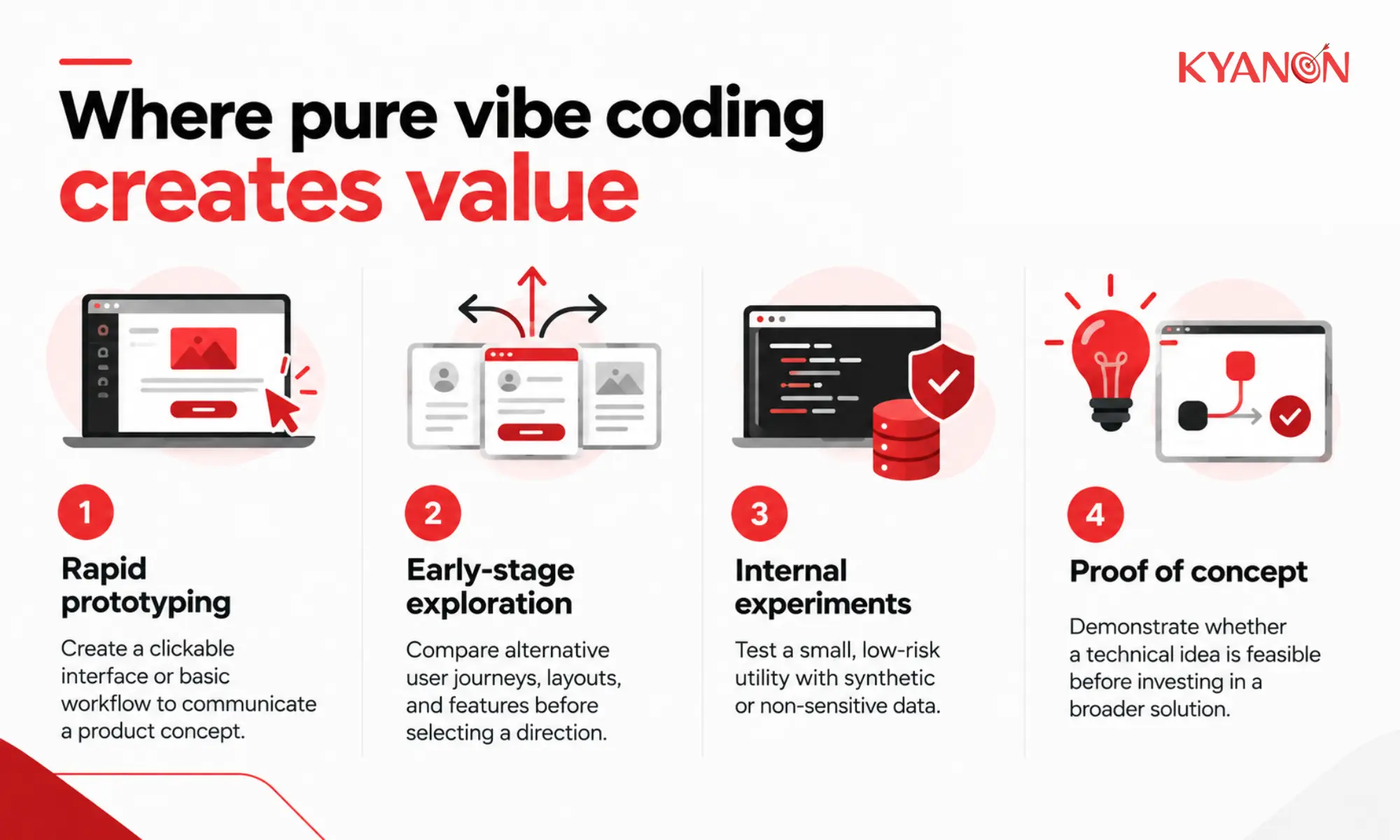
Where pure vibe coding creates value
Its main advantage is reducing the effort required to explore an idea. A business stakeholder can test a workflow or demonstrate a concept before committing to a full development project.
Typical use cases include:
- Rapid prototyping: Creating a clickable interface or basic workflow to communicate a product concept.
- Early-stage exploration: Comparing alternative user journeys, layouts, and features before selecting a direction.
- Internal experiments: Testing a small, low-risk utility with synthetic or non-sensitive data.
- Proof of concept: Demonstrating whether a technical idea is feasible before investing in a broader solution.
For example, a retail operations manager might use an AI coding tool to create a dashboard mock-up that illustrates how inventory exceptions could be presented. The prototype helps stakeholders agree on requirements without requiring a complete connection to warehouse or enterprise resource planning systems.
The appropriate next step is to validate the concept with users and define the requirements for a production implementation. The prototype should not automatically become the production application simply because stakeholders approve its appearance.
Where the approach reaches its limits
The risk increases when an application handles real customer information, financial transactions, employee records, or business-critical operations. A generated application may appear functional while lacking adequate authorization checks, robust error handling, secure configuration, or recovery mechanisms.
The issue is not that AI-generated code is inherently insecure. It is that a successful demonstration provides limited evidence of production readiness.
Teams should also consider the cost of maintaining code that was generated without a clear architecture or consistent conventions. If nobody understands how its components interact, a small change may introduce unexpected defects. Rapid initial generation can therefore shift effort into debugging, refactoring, and operational support later.
Pure vibe coding is most appropriate when the cost of failure is low, the scope is temporary, and the output can be discarded without disrupting business operations.

What an enterprise application requires?
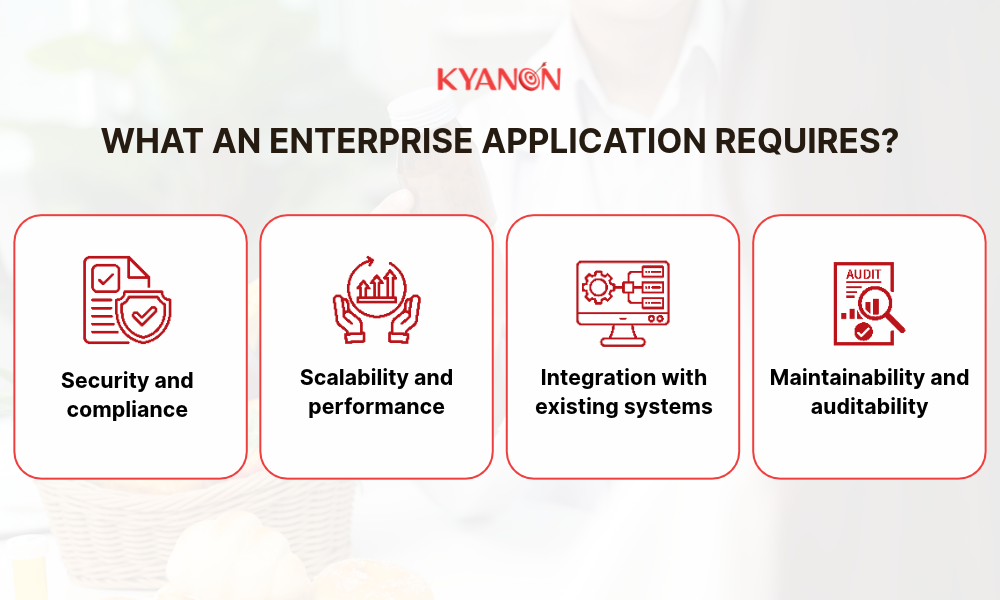
A production-ready enterprise application must meet four requirements beyond basic functionality: security, reliability, integration, and maintainability. These determine whether the application can support real business operations without creating unacceptable risks or long-term costs.
Security and compliance
Protect sensitive data with appropriate access controls, encryption, vulnerability testing, and audit logging. Assess applicable requirements, including SOC 2, ISO 27001, and GDPR. AI-generated code does not guarantee security or compliance.
Scalability and performance
Test the application under realistic workloads. Define acceptable response times, concurrent-user capacity, availability, and recovery requirements before deployment.
Integration with existing systems
Confirm that the application connects securely with enterprise systems such as ERP and CRM. Validate data consistency, permissions, error handling, and compatibility with existing architecture.
Maintainability and auditability
Ensure teams can understand, test, update, and support the application. Version control, code reviews, automated tests, documentation, and clear ownership reduce maintenance risks and make changes traceable.
The gap: pure vibe coding output vs. an enterprise-grade application
The difference is not whether AI was used to create the software. It is whether the application has passed the engineering, security, and operational checks required for its intended use.
|
Factor |
Pure Vibe Coding | Production-Ready Enterprise Apps |
| Core Method | Generating functional code via natural-language AI prompts and intuition |
Structured requirements, architectural design, and engineering governance |
|
Primary Speed |
Extremely fast (minutes to hours for MVPs and screen demos) | Slower upfront planning, phased rollouts, and thorough testing |
| Architecture & State | Often relies on chat logs, fragile backends, or missing database constraints |
Hardened backends, data coherence over years, transaction safety, and scaling |
|
Security & Auth |
Common risks include unhashed passwords, token bypass, SQL injection, and data leaks | Comprehensive security reviews, strict session management, and access controls |
| Maintenance | High technical debt; difficult to update if no one understands the generated code |
Predictable maintenance, automated tests, version control discipline, and clear ownership |
|
Best Used For |
Weekend projects, personal experiments, early mockups, and simple CRUD MVPs |
Mission-critical systems, fintech platforms, healthcare data, and customer-facing scale |
These categories describe two ends of a spectrum, not two mutually exclusive technologies. An AI-generated application can become enterprise-grade, while traditionally written software can also fail production requirements if its engineering controls are inadequate.
How to move from prototype to production?
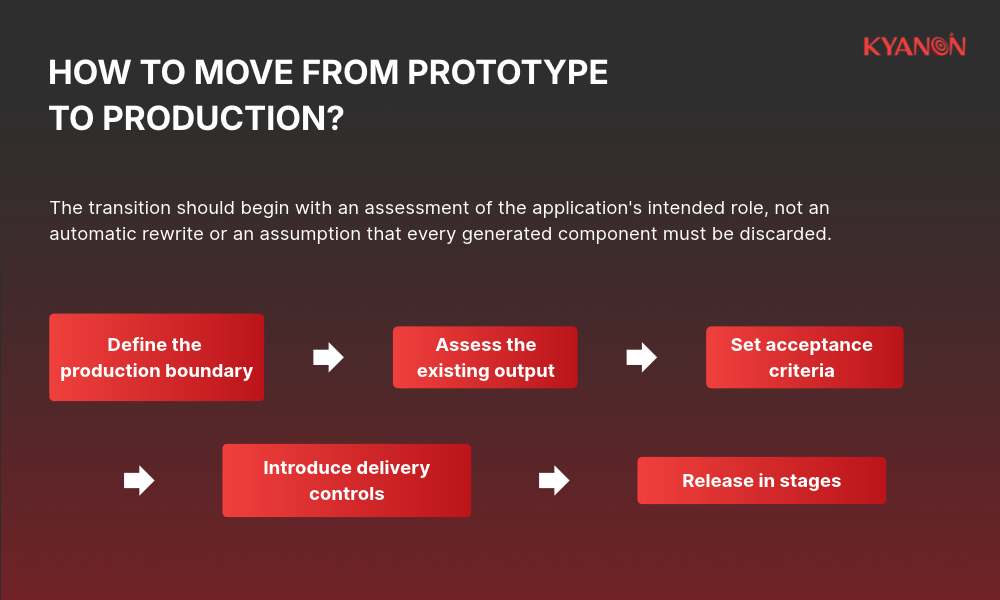
The transition should begin with an assessment of the application’s intended role, not an automatic rewrite or an assumption that every generated component must be discarded.
- Define the production boundary. Establish which users, data, workflows, and systems the application will handle. Identify the consequences of unauthorized access, incorrect outputs, downtime, or data loss.
- Assess the existing output. Review the codebase, dependencies, permissions, data handling, architecture, and test coverage. Determine what can be retained, what needs refactoring, and what must be rebuilt.
- Set acceptance criteria. Define measurable requirements for security, performance, reliability, integration, and maintainability. Specify which tests and approvals are necessary before release.
- Introduce delivery controls. Apply version control, peer review, automated testing, security checks, controlled deployment, monitoring, and documented ownership in proportion to the application’s risk.
- Release in stages. Where feasible, use a limited pilot or controlled rollout before expanding access. Monitor real-world behavior, resolve defects, and verify that the application meets its acceptance criteria.
This process allows teams to preserve the speed of AI-assisted development without confusing code generation with delivery assurance.
For organizations that lack the internal capacity to assess or industrialize a promising prototype, Kyanon Digital’s software development services offer a relevant starting point for discussing architecture, engineering, testing, and ongoing support. The right engagement depends on the gaps identified, the complexity of the application, and the organization’s existing technical capabilities.
Conclusion: The process around AI makes the difference
Pure vibe coding is valuable when the objective is to learn quickly and the consequences of failure are limited. It becomes a different proposition when software handles sensitive information, connects to enterprise systems, or supports business-critical operations. Enterprises do not need to choose between AI-assisted development and engineering discipline. They need a clear transition from experimentation to production, with requirements, controls, tests, and accountable ownership appropriate to the application’s risk.
Start by selecting one promising prototype and assessing its security, integration, performance, and maintenance gaps. Use the results to decide whether to retain, refactor, or rebuild it, and define the evidence required before release.
Planning to turn an AI-generated prototype into a production application? Partner with Kyanon Digital to explore the engineering scope, integration needs, quality controls, and ongoing support required for your use case.
References
- SP 800-218, Secure Software Development Framework (SSDF) Version 1.1 – National Institute of Standards and Technology (NIST)
- OWASP GenAI Security Project: Improper Output Handling – OWASP Foundation
- Obligations under the GDPR – European Commission.
- SOC 2 reporting on an examination of controls at a service organization – AICPA & CIMA
- Application development services – Kyanon Digital
- Enterprise software development services – Kyanon Digital
- Software development services – Kyanon Digital


 Create project brief with AI