

When unreviewed AI-generated code reaches production, enterprises risk security vulnerabilities, service outages, data exposure, and growing technical debt. AI-generated code may function correctly in basic tests while containing flaws that emerge under real-world conditions. Human code review, automated security testing, and controlled deployment are essential to managing these risks.
AI-assisted coding is becoming part of enterprise software development, but faster code generation does not automatically mean safer releases. As engineering teams use AI to write, refactor, and test software, traditional quality controls must keep pace with the growing volume of changes.
For enterprises, the decision is not whether to prohibit AI-generated code. It is how to capture productivity benefits without weakening software governance, security, or operational resilience.
This article examines the main production failure patterns, their enterprise impact, and the governance controls technology leaders should validate before expanding AI-generated code across engineering teams.
Key takeaways
- Working code is not necessarily secure: AI-generated changes still require independent review and testing.
- Production risks extend beyond vulnerabilities: Architecture inconsistencies, licensing uncertainty, and untested logic can increase long-term costs.
- Governance should match risk: Authentication, financial transactions, and sensitive-data workflows need stronger release controls.
- Kyanon Digital recommends retaining human release accountability, supported by automated testing, DevSecOps, and traceable approvals.
Further reading:
- Singapore’s Shortcut to Reliable Software Delivery
- AI-Driven Software Development for Enterprises
- How to Build an AI-Driven Development Team in Vietnam and Pricing Guide
What does industry research reveal about AI-generated code risks?
Research published in 2026 highlights a persistent gap between generating functional code and ensuring its security and maintainability.
Veracode’s 2026 GenAI Code Security Report found that approximately 44% of evaluated AI code-generation tasks produced code containing a detectable security vulnerability. The results come from controlled model testing, not observed vulnerability rates across production applications.
A separate 2026 empirical study of AI-generated code examined approximately 302,600 AI-authored commits across 6,299 GitHub repositories. Researchers found that 22.7% of tracked AI-introduced issues remained in the latest repository revisions examined.
These findings do not establish that AI-generated code is universally less secure than human-written code. They show why enterprises should not treat code generation, successful compilation, or passing basic tests as sufficient release assurance.

Four failure patterns when AI-generated code reaches production
The following scenarios illustrate common failure mechanisms and their business implications.
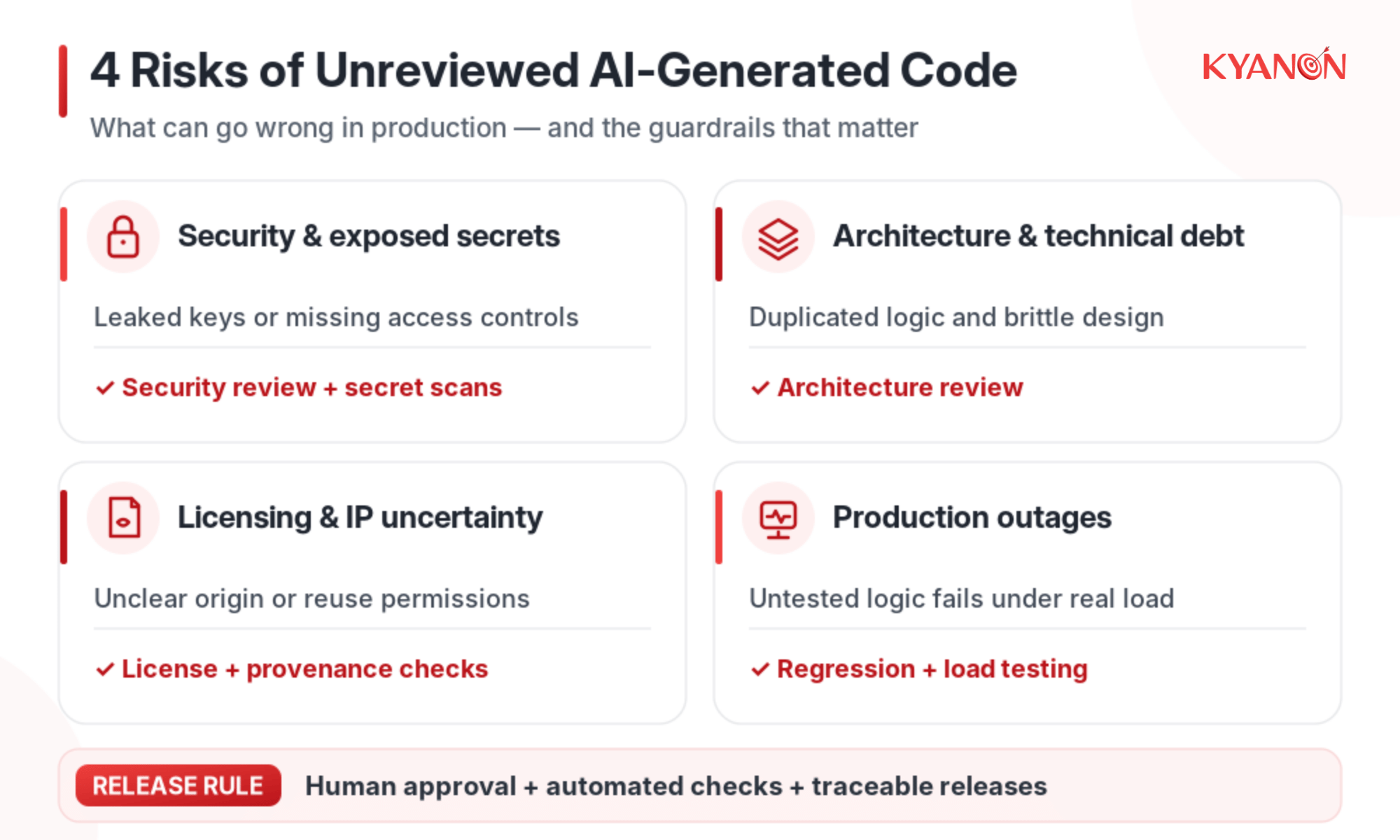
Security vulnerabilities and exposed secrets
AI-generated code may contain weak authentication, missing authorization checks, SQL injection vulnerabilities, or hardcoded credentials. For example, an AI-generated API endpoint might process customer information correctly while failing to verify whether the requesting user is authorized to access it.
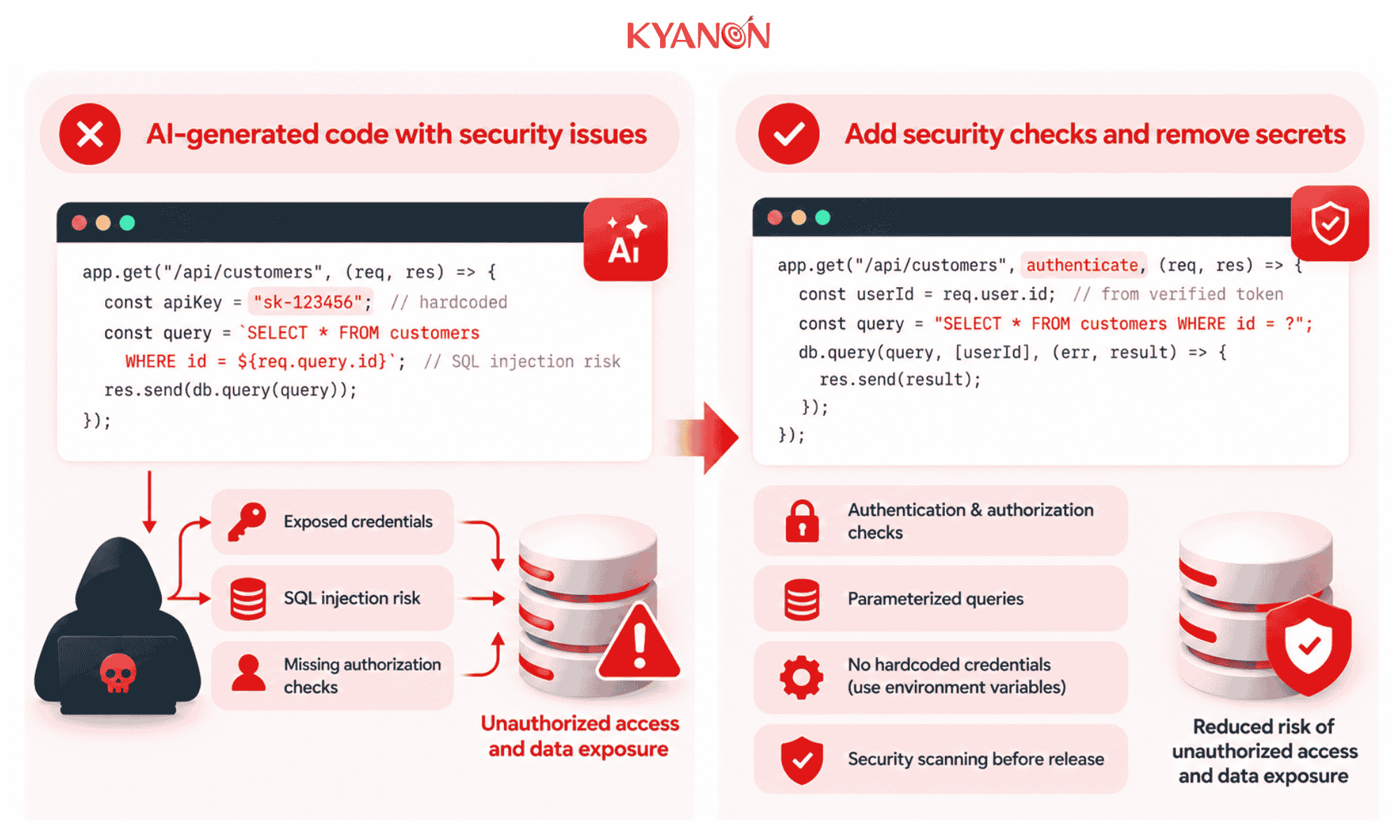
Business impact: Unauthorized access, potential data exposure, incident response costs, and regulatory scrutiny.
Singapore’s Cyber Security Agency (CSA) specifically recommends protecting credentials, validating dependencies, and applying security checks throughout software development.
Decision implication: Changes involving authentication, sensitive data, payment flows, or production infrastructure should require stronger security review and automated scanning before release.
Inconsistent architecture and technical debt
AI-generated changes can solve an immediate task while ignoring the wider architecture. Common problems include duplicated business logic, inconsistent coding patterns, unnecessary dependencies, and components that bypass established abstractions. The code may work today but become expensive to modify or debug as the system evolves.
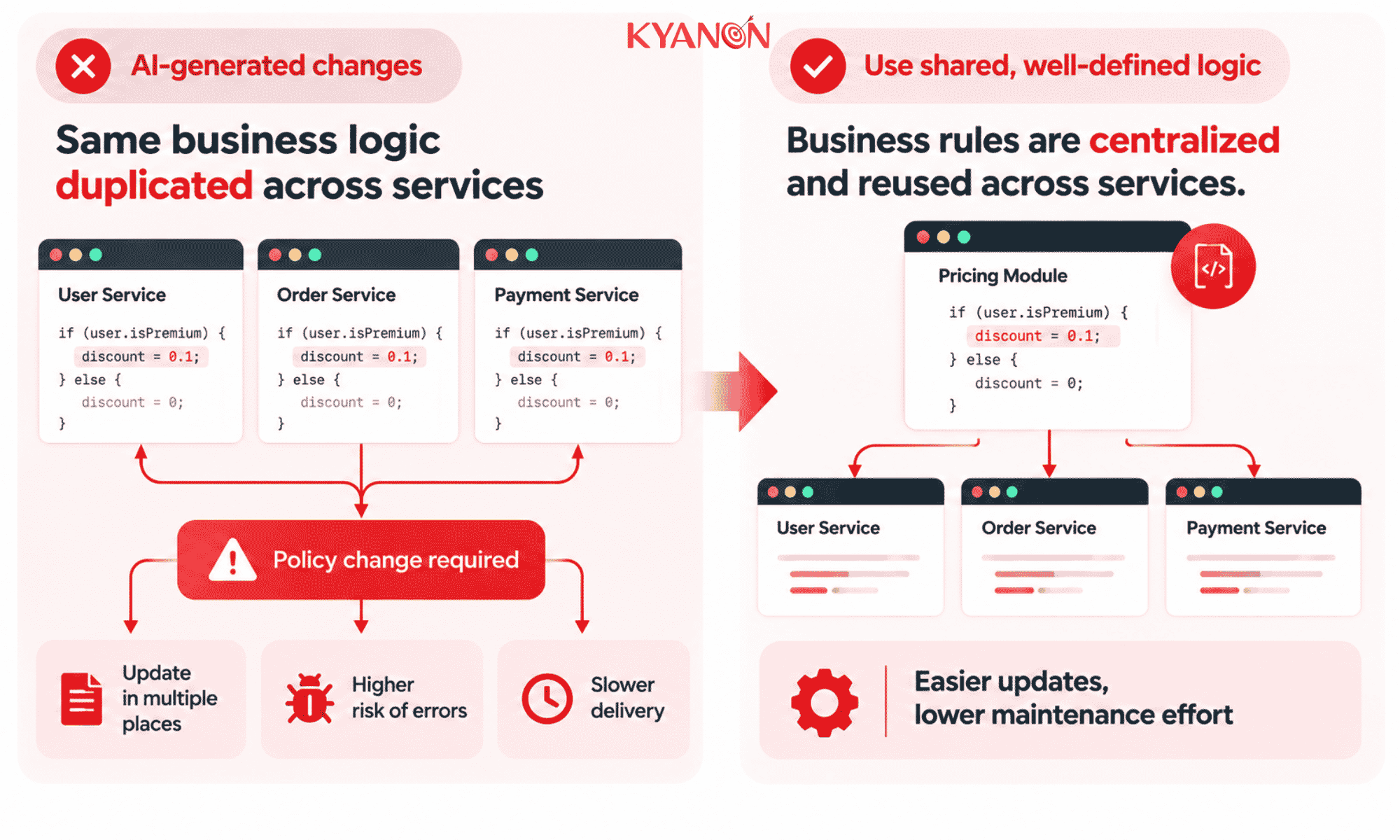
Business impact: Higher maintenance effort, slower onboarding, greater defect risk, and less predictable delivery.
Kyanon Digital’s engineering perspective is to evaluate AI-generated changes against existing architecture, reusable components, and ownership boundaries, not only whether the requested function works.
Decision implication: If AI-generated code frequently requires architectural rework during review, teams may need stronger design standards or architecture checks before expanding usage.
Licensing and intellectual property uncertainty
AI-assisted development can introduce uncertainty when generated code resembles publicly available implementations. GitHub’s Copilot code-referencing documentation explains how matching public code and associated licensing information may be identified.
However, code-matching tools do not establish ownership or resolve every licensing question.
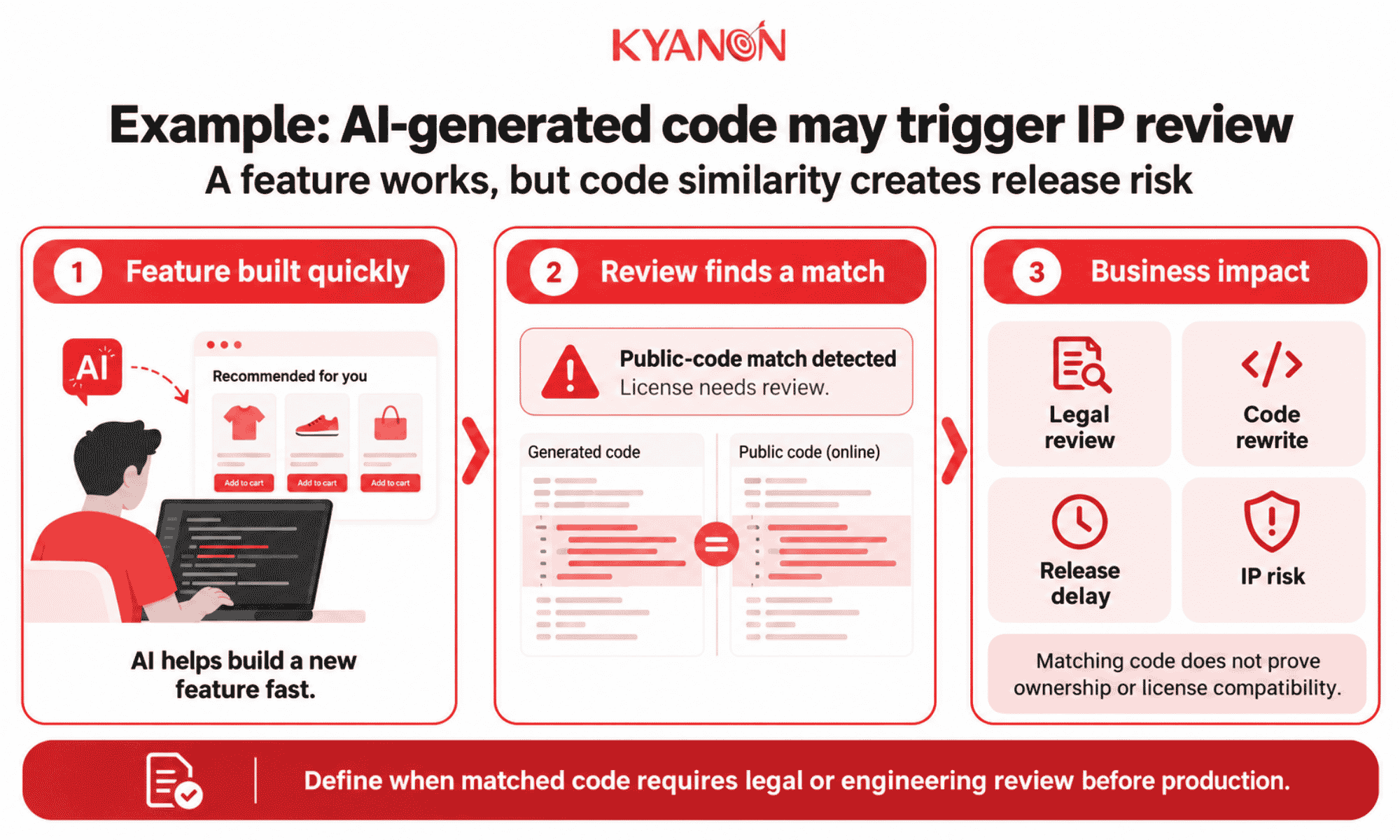
Business impact: Additional legal review, code replacement, delayed delivery, and potential intellectual property disputes.
Decision implication: Organizations with strict IP, contractual, or regulatory obligations should define when matched code requires legal or engineering review before it can enter production.
Production outages from untested logic
AI-generated code may appear correct in development while failing under realistic traffic, data volumes, concurrency, or edge cases. For example, an inefficient database query may perform adequately against test data but create severe latency when processing production transaction volumes.
Other risks include unhandled exceptions, race conditions, resource exhaustion, and incorrect business calculations.
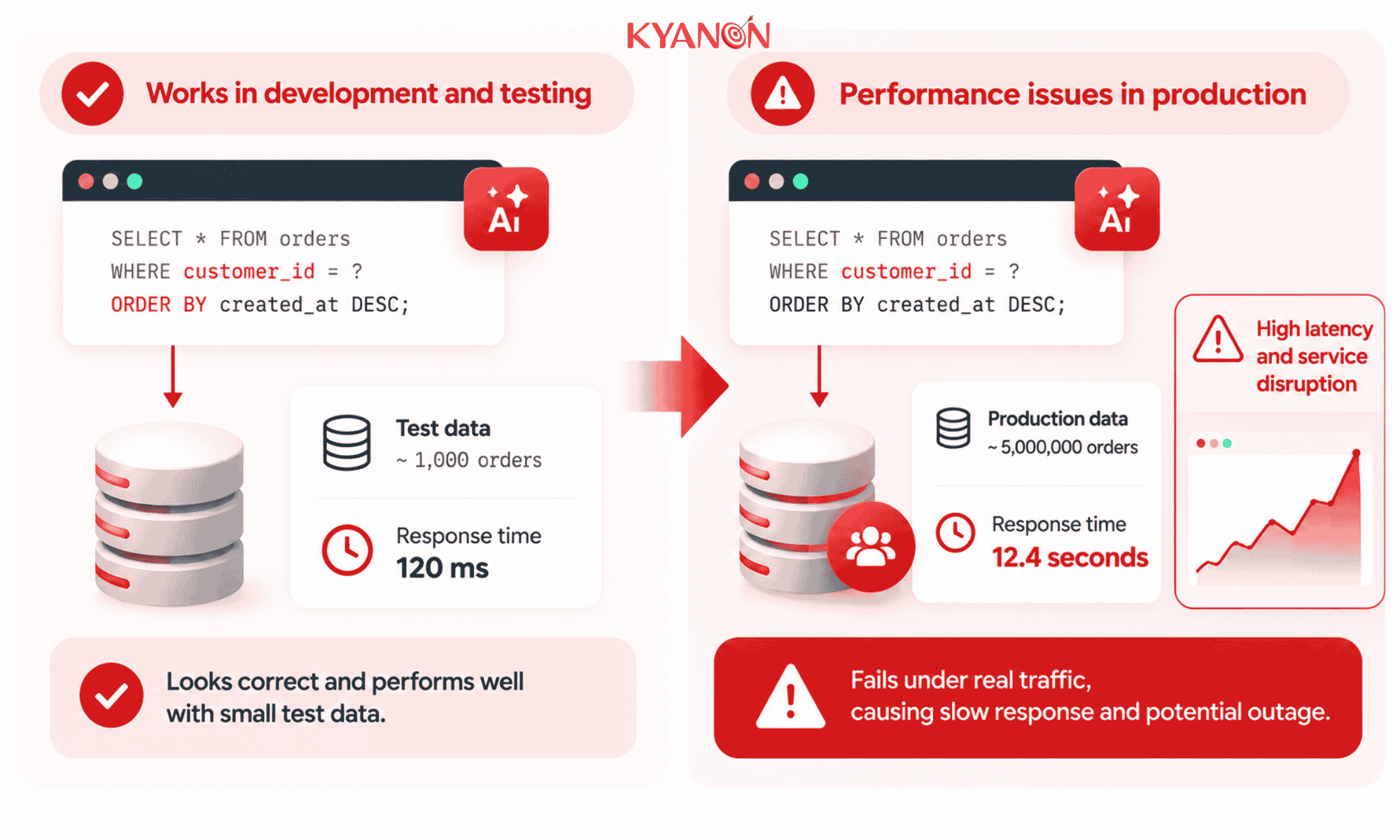
Business impact: Service disruption, emergency remediation, rollback costs, lost productivity, and customer dissatisfaction.
Decision implication: AI-generated changes affecting high-volume, business-critical, or stateful workflows should be validated through realistic performance, regression, and failure testing before deployment.
The broader decision rule is simple: the closer AI-generated code gets to sensitive data, critical workflows, or production infrastructure, the stronger the required review, testing, and release controls should become.
If AI-assisted development is moving beyond individual developer experiments into production workflows, the next step is to establish an implementation model that combines AI capability with engineering controls, human review, and integration into the existing SDLC. Kyanon Digital’s AI & Machine Learning Development Services can support organizations building or integrating AI capabilities where custom engineering, model integration, and production readiness are required.
What is the enterprise impact for Singapore businesses?
The consequences of unreviewed code depend on the affected application, the sensitivity of its data, and the criticality of its business workflows.
| Risk area | Potential enterprise impact |
Security | Unauthorized access and incident response costs |
| Compliance | Regulatory investigation or contractual exposure |
Operations | Downtime, failed transactions, and recovery effort |
| Engineering | Increased technical debt and defect remediation |
Business delivery | Delayed releases and diverted engineering capacity |
Under Singapore’s Personal Data Protection Act (PDPA), Section 24, organizations must implement reasonable security arrangements to protect personal data. Deploying AI-generated code is not itself a PDPA violation. However, inadequate security controls that compromise personal data may create regulatory exposure.
If unreviewed code is already in production, engineering leaders should identify affected changes, assess security and operational exposure, and determine whether targeted remediation, credential rotation, or rollback is necessary.
As AI-assisted development moves from individual experimentation into production engineering, organizations need more than access to coding tools. They need an implementation approach that combines AI capabilities with existing architecture, security controls, human review, and software delivery processes.
Kyanon Digital’s AI & Machine Learning Development Services can support organizations designing and integrating production-ready AI capabilities where custom engineering, system integration, and governance are required.
What does effective AI-generated code governance look like?
Effective governance should allow organizations to increase development velocity without increasing unacceptable security, quality, or production risk. AI-generated code should pass the same engineering controls as human-written code, with stronger oversight where AI touches sensitive data, critical systems, infrastructure, or production environments.
The following checklist can help CTOs, engineering leaders, and security teams assess whether existing controls can support wider AI-assisted development.
| Governance control | Minimum requirement | Decision implication |
Human code review | Named developer approval before merging | Maintains accountability for defects and maintainability |
| Security scanning | SAST, dependency scanning, and secret detection | Reduces the chance that faster code generation introduces exploitable weaknesses |
Test coverage | Unit, integration, regression, and relevant security tests | Determines whether increased code volume can be validated reliably |
| Architecture review | Validation against approved design and coding standards | Prevents AI-generated changes from creating architectural inconsistency or technical debt |
Traceability | Pull-request history, approvals, and deployment records | Supports investigation, audit, rollback, and ownership |
| Release control | CI/CD quality gates, rollback procedures, and monitoring | Limits the operational impact of defective changes reaching production |
Not every AI-generated change requires the same level of scrutiny. Documentation, test scaffolding, or low-risk internal utilities may remain within existing review processes. Changes involving authentication, payments, customer data, production infrastructure, or regulated systems justify stricter review, access, and release controls.
The practical test is whether governance can keep pace with AI-enabled development. If code throughput increases while review backlogs, escaped defects, security findings, or failed deployments also rise, the organization should strengthen its engineering controls before expanding AI-assisted development further.
When existing pipelines lack enforceable review gates, automated security checks, or reliable release controls, Kyanon Digital’s DevOps Managed Services can support CI/CD management, DevSecOps, test automation, and production monitoring before AI coding is scaled across engineering teams.
How Kyanon Digital strengthened AI-assisted software delivery for a Singapore insurance provider
Kyanon Digital’s Singapore digital insurance application project demonstrates how AI-assisted engineering can operate alongside human review and release governance.
This case demonstrates how AI-assisted engineering can be combined with defined ownership, security controls, and measurable release-readiness criteria.
Challenges
- Inconsistent mobile application components and critical frontend defects.
- Limited regression and smoke-testing readiness.
- Repository access, credential management, and release-governance gaps.
Solution from Kyanon Digital
- Introduced code review, static checks, and quality gates before release.
- Strengthened repository permissions, security hygiene, and priority workflow testing.
- Used AI-assisted coding and refactoring while retaining human approval over business logic and releases.
Results and impact
- 46% reduction in high-priority frontend defects.
- 100% smoke-test coverage across priority launch journeys.
- Pilot readiness improved from 62% to 91%.
- Approximately 25% faster turnaround for repetitive frontend fixes.
For the business, the impact was clearer launch readiness, fewer high-priority defects, and faster issue resolution, showing how governed AI-assisted development can improve delivery speed without increasing production risk.
Conclusion
AI-generated code can accelerate enterprise software development, but speed creates value only when accompanied by appropriate engineering controls. Singapore enterprises should prioritize risk-based code review, security automation, test coverage, and release traceability. Success should be measured through escaped defects change-failure rates, remediation effort, and production stability, not code-generation speed alone.
For organizations strengthening AI-assisted delivery practices, discuss your DevSecOps and software governance requirements with Kyanon Digital to identify control gaps, integration needs, and appropriate next steps.
References
- GenAI Code Security Report 2026 — Veracode, 2026.
- Debt Behind the AI Boom: A Large-Scale Empirical Study of AI-Generated Code in the Wild — Liu et al., arXiv preprint, 2026.
- Advisory on Securing the Software Supply Chain and Development Workflows — Cyber Security Agency of Singapore, 2026.
- GitHub Copilot Code Referencing — GitHub Documentation, accessed 2026.
- Personal Data Protection Act 2012 — Singapore Statutes Online, current legislation.
- DevOps Managed Services — Kyanon Digital.
- AI & Machine Learning Development Services — Kyanon Digital.
- Accelerating Singapore Digital Insurance App Launch Readiness with an AI-Driven Agile Team — Kyanon Digital.



 Create project brief with AI