AI workflow automation can reduce healthcare operating costs by streamlining repetitive administrative tasks, routing requests automatically, and connecting information across existing systems. Singapore providers should start with high-volume, rule-based workflows, establish a baseline cost per transaction, and retain human oversight for exceptions and sensitive decisions. The business case depends on measurable savings, integration effort, and ongoing operating costs.
Healthcare providers in Singapore face a practical challenge: increasing administrative demand does not automatically come with more staff capacity. Manual documentation, appointment coordination, billing checks, and referral follow-ups can absorb time that teams could spend on higher-value work.
The goal of automation should be to increase operational capacity without compromising care, data security, or service quality. That means identifying the right workflow before selecting a technology or engaging workflow automation companies.
Key takeaways
- Start with measurable friction: Prioritise repetitive workflows with high transaction volumes, visible rework, and accessible data.
- Prove financial value: Track cost per transaction, processing time, error rates, and staff hours released rather than automation rates alone.
- Match technology to complexity: Traditional robotic process automation (RPA) fits predictable tasks; intelligent workflow automation is more useful when documents, language, or variable requests require interpretation.
- Treat integration and governance as core costs: Legacy systems, access controls, exception handling, and ongoing monitoring can materially affect total cost.
- Pilot before scaling: Expand only when the workflow demonstrates reliable performance and a measurable operational improvement.
Further reading:
- How To Implement AI in Singapore Healthcare?
- How Automation Changes Healthcare Operations in Singapore?
- How Much Does AI Development Cost in Singapore Healthcare?
Which healthcare workflows should Singapore providers automate first?
The strongest starting point is a repeatable administrative process that consumes staff time but does not require autonomous clinical judgement. Singapore General Hospital (SGH) provides a local example: its reported RPA programme has saved more than 84,000 man-hours since 2020, demonstrating the potential of automating repetitive digital work. These are RPA results, not evidence that every AI workflow automation project will deliver comparable savings.
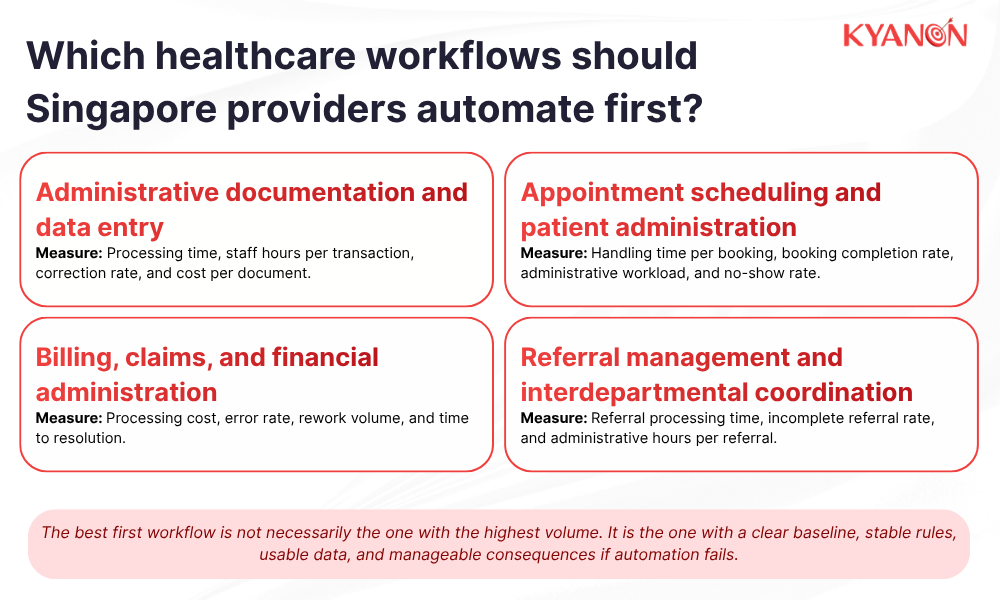
Administrative documentation and data entry
Automate extracting information from forms, classifying documents, validating required fields, and routing records to the correct team. Staff should review uncertain or conflicting information rather than allowing automation to silently alter patient records.
Measure: Processing time, staff hours per transaction, correction rate, and cost per document.
Appointment scheduling and patient administration
Automate appointment requests, reminders, cancellations, rescheduling, and routine status updates. Integration with scheduling systems is essential; otherwise, staff may still need to reconcile changes manually.
Measure: Handling time per booking, booking completion rate, administrative workload, and no-show rate.
Billing, claims, and financial administration
Use workflow automation to check document completeness, reconcile routine records, and route discrepancies for review. Keep financial exceptions and disputed claims under appropriate human control.
Measure: Processing cost, error rate, rework volume, and time to resolution.
Referral management and interdepartmental coordination
Automate referral intake, missing-information checks, status notifications, and routing to the appropriate department. The system should flag incomplete referrals instead of treating them as ready for processing.
Measure: Referral processing time, incomplete referral rate, and administrative hours per referral.
The best first workflow is not necessarily the one with the highest volume. It is the one with a clear baseline, stable rules, usable data, and manageable consequences if automation fails. If the process itself is inconsistent, redesign it before automating it.

How can healthcare providers prove the ROI of AI workflow automation?
Healthcare providers should calculate the cost of the current process, include the full cost of automation, and measure financial savings separately from capacity gains.
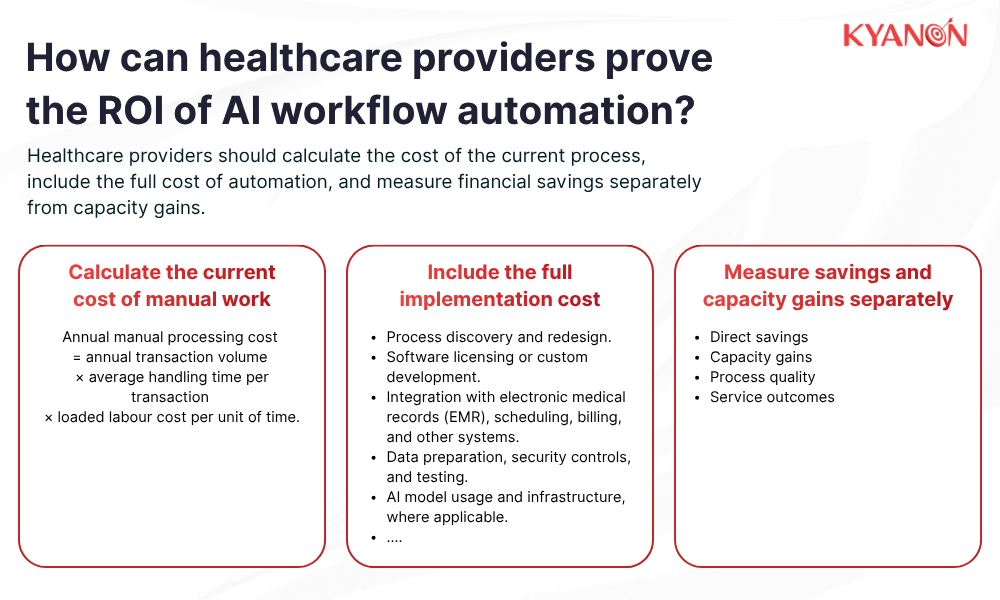
Calculate the current cost of manual work
Record transaction volumes, average handling time, staff costs, overtime, outsourcing, error rates, and rework. Identify which steps are genuinely repetitive and which require professional judgement. A useful baseline is:
Annual manual processing cost = annual transaction volume × average handling time per transaction × loaded labour cost per unit of time.
Use consistent assumptions and avoid counting the same labour savings twice.
Include the full implementation cost
A realistic business case should account for:
- Process discovery and redesign.
- Software licensing or custom development.
- Integration with electronic medical records (EMR), scheduling, billing, and other systems.
- Data preparation, security controls, and testing.
- AI model usage and infrastructure, where applicable.
- Staff training, change management, exception review, and ongoing maintenance.
A low-cost prototype may not represent the cost of a production-ready workflow. Integration complexity, data quality, and operational controls can change the economics substantially.
Measure savings and capacity gains separately
|
Value category |
What to measure | How to interpret it |
| Direct savings | Avoided outsourcing, overtime, or expenditure |
Count only costs actually avoided |
|
Capacity gains |
Staff hours released from repetitive work | Track how the hours are redeployed |
| Process quality | Error rates, rework, and processing time |
Confirm that speed does not reduce accuracy |
|
Service outcomes |
Response time and completion rates |
Check whether the improvement matters to patients and staff |
For example, releasing 100 staff hours does not automatically create cash savings. The benefit may instead be greater capacity to handle demand without proportionally increasing administrative workload. Set a pilot baseline, define a target with the process owner, and agree on a review period before implementation. Scale only when the evidence supports the investment.
Automation rates alone are not a reliable measure of financial success. A workflow may automate a large percentage of tasks while still requiring substantial manual review. Kyanon Digital’s recommended evaluation approach should therefore connect automation performance to actual cost per transaction, staff capacity released, and the total cost of operating the solution.
How should Singapore healthcare providers choose a workflow automation company?
Choose a partner based on the complexity of the workflow, the systems involved, and the level of risk, rather than the sophistication of its AI demonstration. Three approaches are worth comparing:
|
Approach |
Best fit | Main trade-off |
| RPA or rules-based automation | Stable, repetitive tasks with structured inputs |
Brittle when interfaces or process rules change |
|
AI-enabled workflow automation |
Variable documents, unstructured requests, classification, and exception handling | Requires stronger validation, monitoring, and human oversight |
| Workflow platform or existing-system configuration | Processes already supported by a healthcare or enterprise platform |
May not cover cross-system gaps or specialised requirements |
These options can also be combined. A workflow might use AI to classify an incoming document, deterministic rules to validate required fields, and RPA or APIs to update another system.
Before selecting a partner, ask:
- Integration: Can it work with existing EMR, billing, scheduling, and document systems without unnecessary replacement?
- Governance: Can it enforce access controls, maintain appropriate audit records, and route uncertain cases to staff?
- Measurement: Will it establish baseline metrics and define acceptance criteria before deployment?
- Operations: Who will maintain integrations, update workflow rules, monitor failures, and manage exceptions after launch?
Singapore providers must also assess applicable privacy and healthcare requirements. The Ministry of Health’s August 2026 parliamentary response on AI data security confirms that relevant security requirements apply to AI tools processing patient data, whether hosted in third-party cloud environments or on-premises.
How can Kyanon Digital help healthcare providers identify and implement high-value automation opportunities?
Kyanon Digital’s published healthcare case illustrates how an organisation can automate routine service work while retaining human ownership of complex requests.
Challenges
- A private healthcare provider in Singapore faced growing enquiries about appointments, services, locations, operating hours, and administrative procedures.
- Staff capacity was being consumed by repetitive requests, while fragmented service information made consistent responses more difficult.
- The provider needed to expand self-service without allowing routine automation to take over medical or sensitive enquiries.
Solution from Kyanon Digital
- Implemented a non-clinical AI customer-service chatbot using Azure OpenAI, Azure AI Search, and retrieval-augmented generation (RAG) to ground responses in approved organisational knowledge.
- Connected the chatbot to customer-service workflows through APIs and automation to classify enquiries, trigger relevant workflows, and route complex requests to appropriate teams.
- Established escalation rules and monitoring so medical, sensitive, or unsupported enquiries remained under human oversight.
Results and Impact
According to Kyanon Digital’s published case study:
- 38% reduction in routine manual enquiries.
- 32% faster response times.
- 28% of eligible enquiries resolved through self-service.
- 24% reduction in repetitive agent workload.
Explore the full case study here: Scaling Customer Service with an AI Chatbot for Healthcare.
The decision lesson is that automation value comes from matching a clearly defined task to the right technology, connecting it to the operating process, and establishing boundaries for human intervention. Providers considering broader intelligent workflow automation should assess each workflow independently rather than extrapolating customer-service results.
Conclusion: Start with a measurable workflow, not a technology purchase
AI workflow automation is most defensible when a healthcare provider can identify a costly manual process, access the information it needs, and demonstrate improvement without increasing operational or compliance risk.
Start with one workflow, establish its baseline cost and performance, and agree on measurable pilot outcomes. Expand only when the results justify the additional integration and operating costs.
Planning an automation initiative? Contact Kyanon Digital to identify suitable pilot opportunities, assess integration requirements, and define the evidence needed to make a scale-up decision.
References
- Citizen Developer Showcase 2025: Where RPA Meets GenAI – SingHealth
- Data security requirements apply to AI tools that process patient data – Ministry of Health, Singapore
- Scaling Customer Service with an AI Chatbot for Healthcare – Kyanon Digital
- Enterprise Development Grant – Enterprise Singapore





 Create project brief with AI