

Implementing AI in Singapore healthcare requires selecting a high-value use case, validating AI models, complying with Ministry of Health (MOH) and Health Sciences Authority (HSA) requirements, protecting patient data, and integrating AI into existing healthcare workflows with appropriate human oversight.
Healthcare providers should first determine whether their AI applications support administrative operations, patient engagement, or clinical decision-making, as each use case involves different regulatory and implementation requirements. Establishing secure data pipelines, assessing software classification, and validating AI performance before deployment can help minimize compliance risks and disruption to patient care.
This guide explains how healthcare organizations in Singapore can implement AI effectively, from selecting suitable use cases and navigating regulatory requirements to protecting patient data, integrating AI with existing systems, and evaluating available government support schemes.
Key Takeaways
- Administrative AI fast-tracks time-to-value because non-diagnostic operational tools avoid lengthy Health Sciences Authority (HSA) medical device registration.
- Clinical decision tools require HSA Software as a Medical Device (SaMD) registration and strict compliance with joint MOH-HSA AIHGle 2.0 guidelines before clinical deployment.
- Zero-Data Retention (ZDR) architecture protects patient privacy by removing Patient Identifiable Information (PII) before data reaches external AI models.
- Human-in-the-Loop workflows mitigate liability by mandating clinician review and explicit sign-off on AI-generated documentation before updating electronic medical records.
- Kyanon Digital prepares grant-eligible technical documentation that helps healthcare organizations qualify for Enterprise Singapore funding through the Enterprise Development Grant (EDG).
Does your clinic’s AI tool require HSA approval as a medical device?
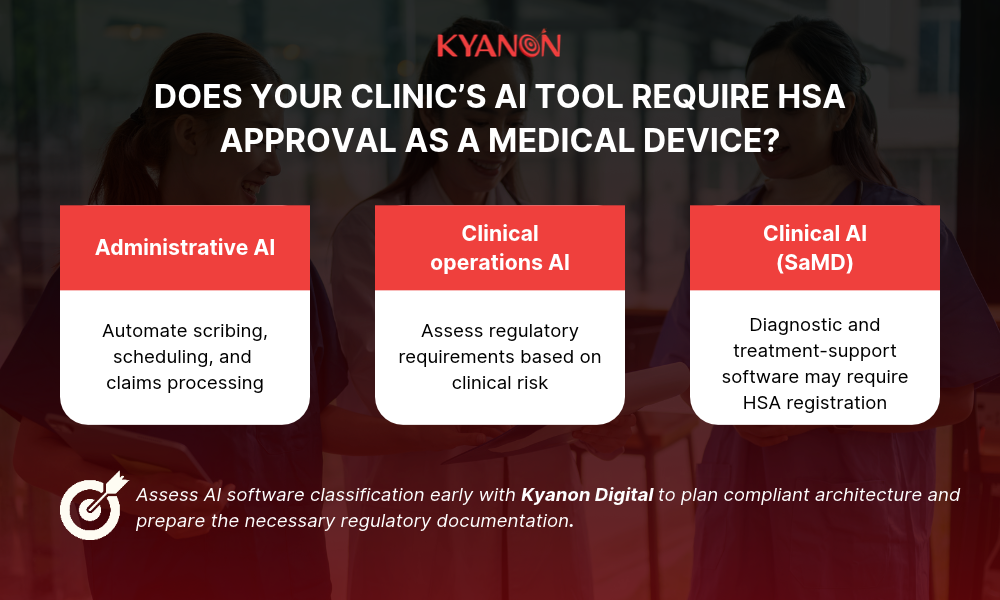
Determining your regulatory pathway depends on whether the software performs a clinical function or handles back-office administration. In Singapore, software that analyzes patient data to diagnose, treat, prevent, or predict medical conditions is regulated as Software as a Medical Device (SaMD) by the Health Sciences Authority (HSA). Conversely, software designed strictly to automate operational tasks, such as voice-to-text medical scribing, appointment scheduling, or claims processing, falls outside medical device regulation.
The joint Ministry of Health (MOH) and HSA Artificial Intelligence in Healthcare Guidelines (AIHGle 2.0) define clear regulatory categories for deployers and developers:
AI categories and regulatory pathways in Singapore healthcare
| AI Category | Core Function | HSA SaMD Registration Required? | Typical Deployment Timeline |
| Administrative AI | Automated scribing, staff scheduling, claims processing, intake chatbots | No | Immediate / Weeks |
| Clinical Operations AI | Triage queue prioritization, bed allocation, resource management | Evaluated on clinical risk | Months |
| Clinical AI (SaMD) | Diagnostic radiology evaluation, risk scoring, automated therapy guidance | Yes (Pre-market registration required) | 6 to 12+ Months |
Administrative tools allow clinic groups to capture fast operational ROI without submitting to multi-year clinical trials. However, if an administrative tool is updated to include risk stratification scores or automated diagnostic suggestions, it crosses into clinical territory, triggering mandatory HSA pre-market registration.
Healthcare providers can work with Kyanon Digital to assess AI software classification before development begins. By separating clinical decision logic from general workflow modules, teams can deploy non-regulated administrative features while preparing the required Health Sciences Authority (HSA) documentation, including the Common Submission Dossier Template (CSDT), for applicable clinical AI features.

How can you ensure your healthcare AI architecture is 100% PDPA-compliant?
Handling Sensitive Personal Data (SND) in Singapore carries heavy statutory responsibility. Under the Personal Data Protection Act (PDPA), the Personal Data Protection Commission (PDPC) can issue financial penalties of up to S$1 million or 10% of an organization’s annual turnover in Singapore (whichever is higher) for data breaches.
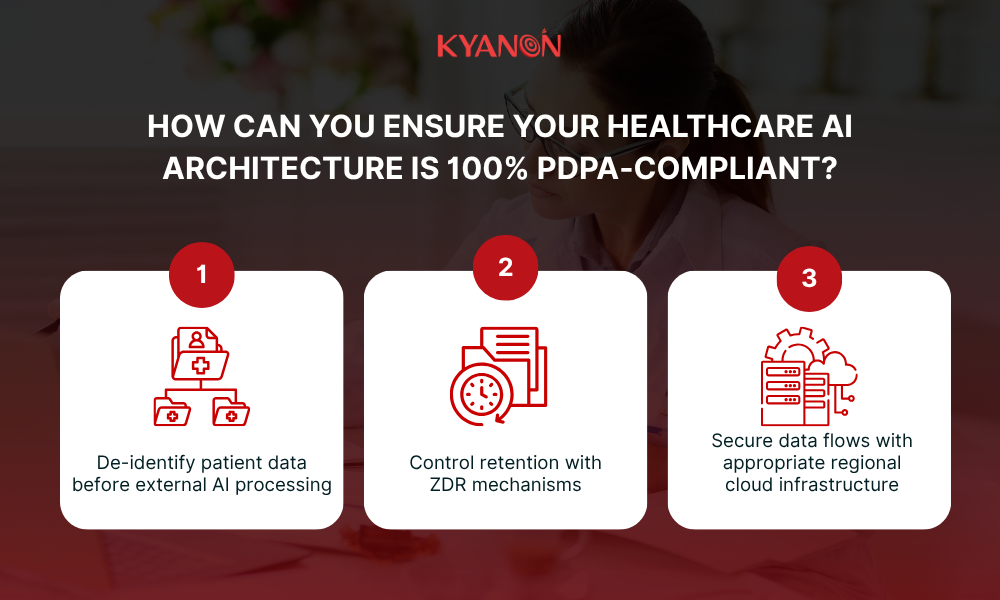
To mitigate data exposure when connecting Large Language Models (LLMs) or cloud AI APIs, healthcare architectures must implement Zero-Data Retention (ZDR) mechanics paired with automated de-identification middleware.
The middleware layer automatically strips Patient Identifiable Information (PII), including NRIC numbers, names, addresses, and phone numbers, before the request is routed to external model providers. Additionally, data pipelines must leverage local cloud infrastructure (such as AWS or Azure Singapore regions) to satisfy local data residency requirements and pass cybersecurity audits.
When current systems lack native de-identification pipelines or isolated regional routing, engaging specialist engineers through Kyanon Digital’s data consulting services ensures your technical architecture meets strict PDPA compliance standards without sacrificing model performance.
How do you integrate AI into legacy EMR systems without causing clinic downtime?
Connecting new software into existing Clinic Management Systems (CMS) or Electronic Medical Record (EMR) databases often raises concerns regarding system lockups, corrupted records, or operational downtime. Legacy CMS applications are rarely designed for direct, real-time machine learning interaction, making direct database modifications high-risk.
Modern integrations eliminate downtime by communicating through standardized HL7 / FHIR (Fast Healthcare Interoperability Resources) protocols and custom API adapters. Operating as an isolated microservice, the AI engine fetches necessary context, performs inference offsite, and returns structured outputs back to the primary user interface.
To address clinical liability and prevent automation bias, systems should enforce a Human-in-the-Loop UI/UX design. Under this model, AI-generated summaries or draft notes appear within a distinct review panel. The software restricts direct database writeback until the attending physician explicitly checks and clicks “Sign-off,” keeping legal accountability firmly with the human practitioner.
What is the shortest path to build and fund a healthcare AI MVP in Singapore?
A structured 12-week MVP roadmap enables healthcare providers to quickly validate AI use cases, secure EDG grant funding, and minimize deployment risks.
Multi-year enterprise deployments frequently encounter scope creep and regulatory friction. The most reliable approach to adopting healthcare AI is executing a focused, 12-week Minimum Viable Product (MVP) targeting high-volume administrative bottlenecks, such as AI-assisted clinical documentation.
A structured 12-week MVP roadmap follows four clear development phases:
- Weeks 1–3: Regulatory & architecture audit: Map data flows, verify HSA SaMD boundaries, and configure PII anonymization middleware.
- Weeks 4–7: API integration & model tuning: Connect HL7/FHIR adapters to clinic systems and fine-tune models on localized data.
- Weeks 8–10: Human-in-the-loop UI & pilot: Deploy a sandbox interface for frontline staff testing and feedback.
- Weeks 11–12: Security hardening & go-live: Perform penetration testing, verify PDPA compliance, and deploy to production.
Healthcare institutions seeking to offset development costs can explore government grant programs, such as Enterprise Singapore’s Enterprise Development Grant (EDG), which provides grant support for eligible capability development and automation projects. Qualifying requires detailed technical blueprints, clear project deliverables, and verified data protection measures. Kyanon Digital assists healthcare clients by preparing the technical documentation and system architecture specifications required during the grant application process.
Conclusion
Deploying enterprise AI in Singapore’s healthcare sector requires balancing technological innovation with strict regulatory compliance. By distinguishing non-regulated administrative tools from regulated clinical devices, stripping PII via secure middleware, and implementing secure Human-in-the-Loop workflows, clinic groups can capture immediate operational efficiencies while maintaining regulatory compliance.
Stop guessing how to bridge the gap between AI innovation and Singapore regulations. Speak with Kyanon Digital’s healthcare software consultants to review your technical architecture, HSA classification, and grant-eligible development roadmap.
References
Updated MOH Artificial Intelligence in Healthcare Guidelines (AIHGle 2.0) — Ministry of Health Singapore & Health Sciences Authority, 2026.
Singapore: MOH and HSA Launch Refreshed AI in Healthcare Guidelines — Baker McKenzie, 2026.
AIHGle 2.0: Singapore’s New Rules for AI in Healthcare — Jonda Health, 2026.
Singapore HSA SaMD Registration: 2026 Lifecycle Guide — Trusted Trace Med, 2026.


 Create project brief with AI