

AI development in Singapore healthcare typically costs from about US$6,000 for a basic chatbot to over US$1 million for hospital-wide systems (S$8,000 to S$1.5 million+). Cost rises with clinical risk, not just features: data preparation, PDPA and HSA compliance, and integration with patient systems often decide the final budget.
Key takeaways
- Exposes how backend compliance and legacy EHR integration consume up to 40% of upfront budgets in medical software engineering practice, particularly when expanding beyond simple administrative tools into clinical workflows.
- Demonstrates how a hybrid talent model significantly lowers engineering expenditure, in the experience of our team at Kyanon Digital, provided local leaders manage compliance while offshore hubs handle technical execution.
- Warns against deploying advanced diagnostic AI or predictive models before establishing robust data pipelines and post-launch MLOps, as clinical accuracy quickly degrades without ongoing auditing infrastructure.
- Recommends a phased adoption roadmap to de-risk capital investment, as drawn from client delivery experience at Kyanon Digital, provided organizations validate administrative ROI before committing to hospital-wide systems.
What is the real cost of healthcare AI development in Singapore?
AI development in Singapore healthcare typically costs from about US$6,000 for a basic chatbot to over US$1 million for hospital-wide systems ($8,000 to $1.5 million+). Cost rises with clinical risk, not just features: data preparation, PDPA compliance, and legacy system integration often dictate the final budget.
Unlike generic enterprise software, healthcare AI cannot be deployed out of the box. Medical solutions carry high stakes, demanding custom integration with legacy Electronic Health Record (EHR) or Clinic Management Software (CMS) systems. When hospital administrators and clinic directors budget for artificial intelligence, they often underestimate the backend engineering required to make these tools safe, legal, and truly effective.
From the expert perspective of Kyanon Digital, a leading digital production house and AI-native software development firm operating in Singapore, evaluating the “real cost” of healthcare AI requires shifting from a generic price tag to an architectural and delivery-model framework.
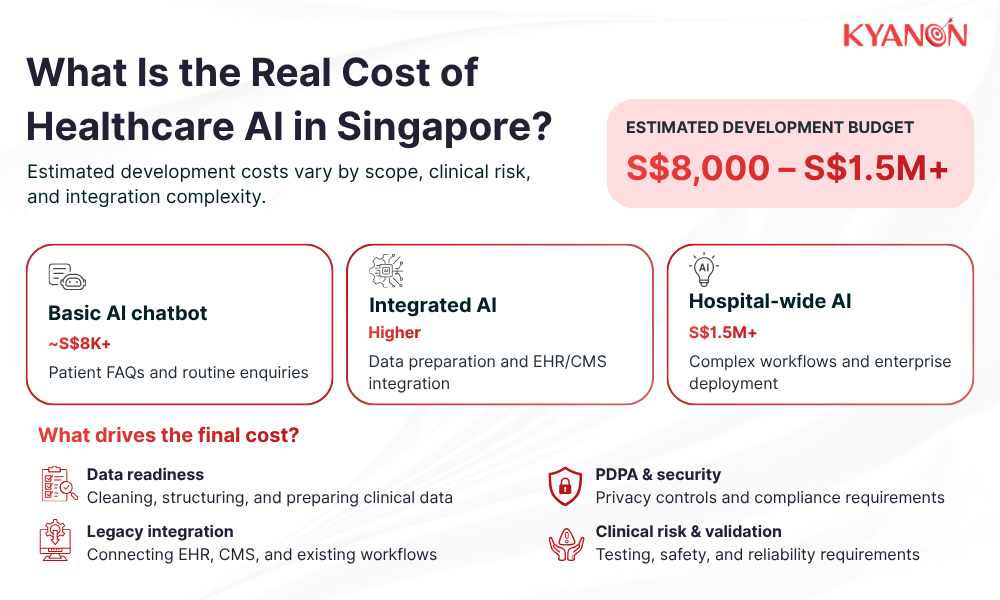
Healthcare AI development costs by solution tier
On average, the cost of AI development depends heavily on project complexity, data volume, and clinical risk. Simple administrative automation provides fast ROI, while clinical diagnostic tools require rigorous compliance checks and significantly longer timelines.
|
AI Solution Tier |
Indicative Budget (USD) | Typical Use Case | Primary ROI Metric |
| Tier 1: Administrative Agents | $6,000 – $25,000 | 24/7 AI Receptionist, patient intake bots, appointment triaging via WhatsApp. |
30% reduction in front-desk dropped calls. |
|
Tier 2: Clinical Productivity |
$30,000 – $110,000 | Ambient AI Medical Scribes, automatic SOAP note generation, multilingual consultation translation. | Reclaims ~2 hours per physician daily. |
| Tier 3: Operational Analytics | $60,000 – $135,000 | Predictive patient flow modeling, hospital bed optimization, chronic disease risk scoring. |
20% increase in clinic throughput. |
|
Tier 4: Diagnostic Engineering |
$110,000 – $370,000+ | Custom Computer Vision models for X-ray/MRI imaging analysis, pathology diagnostics. | Instant secondary clinical verification. |
| Tier 5: Enterprise Transformation | $260,000 – $1.1M+ | System-wide clinical data platforms, genomic data processing, predictive self-healing operations. |
Organization-wide digital maturity. |
Disclaimer: The pricing information in this table is for reference purposes only. Actual costs may vary depending on project requirements, scope, complexity, and the service provider. Please contact the respective providers for the most accurate and up-to-date pricing.
Hidden and ongoing costs
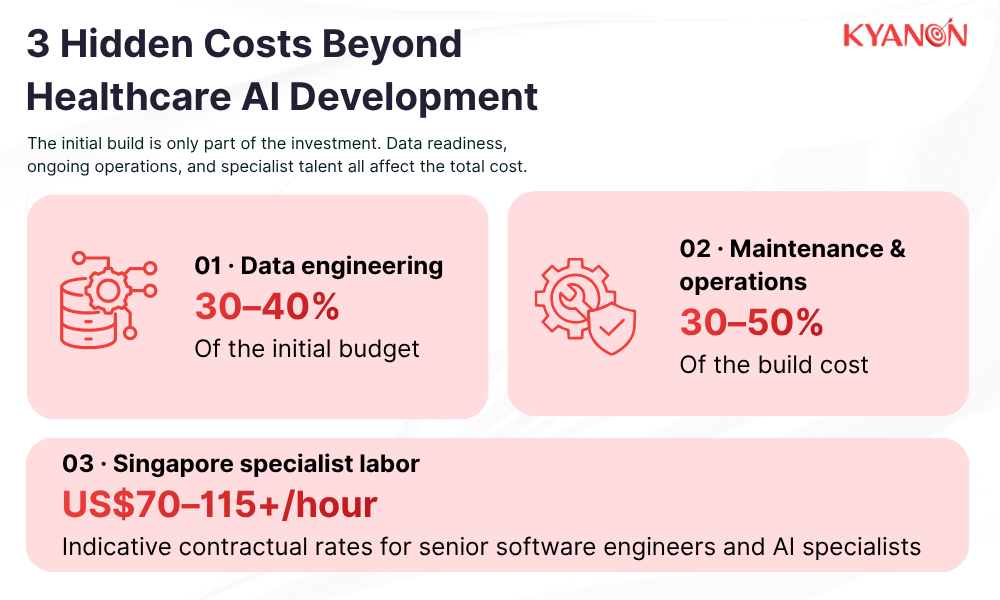
- Data engineering (30%–40% of initial budget): This remains the largest hidden upfront cost. For an AI diagnostic tool, this equates to roughly USD $35,000 to USD $115,000+ solely dedicated to medical data cleansing, structuring, anonymization, and labeling.
- Maintenance & operations (30%–50% of the build cost): Over the first two years, expect to spend an additional USD $35,000 to USD $150,000+ on continuous model retraining, cloud inference fees, software updates, and workflow integration.
- Singapore labor rates: Hiring local senior software engineers or AI specialists ranges from USD $70 to USD $115+ per hour for contractual work. (Pearson Carter)

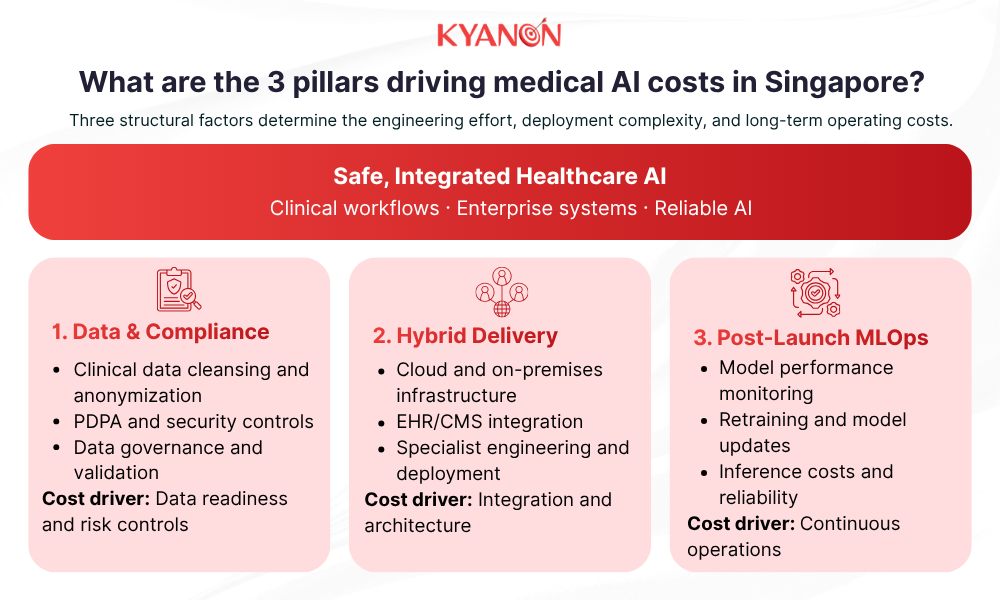
What are the 3 pillars driving medical AI costs in Singapore?
From the perspective of specialized software engineers like Kyanon Digital, the real cost of medical AI in Singapore is not determined by the lines of code written, but by three structural pillars. Here is an in-depth exploration of how Data & Compliance, Hybrid Delivery, and Post-Launch MLOps dictate the final price tag.
Pillar 1: Data engineering & heavy regulatory compliance
Getting clinical data “AI-ready” while meeting Singapore’s strict legal frameworks is the single largest upfront cost. This phase consistently consumes 30% to 40% of the total project budget.
- The Local Compliance Standard: Developers must engineer pipelines that strictly comply with the PDPA (Personal Data Protection Act) and the Ministry of Health’s (MOH) healthcare frameworks. This requires building complex, automated data anonymization layers.
- Legacy EHR Integration: Interfacing securely with tightly guarded Electronic Health Record (EHR) systems commands high-security engineering hours.
- The Financial Impact: Beyond model training, medical AI requires investment in data quality, clinical system integration, data security, and regulatory compliance. Costs depend on data readiness, system complexity, and clinical risk. Singapore’s MOH highlights data quality, integrated infrastructure, and governance as key enablers of healthcare AI.
Pillar 2: The local-offshore hybrid talent sourcing model
Because local tech talent in Singapore commands massive premiums, building an entirely local engineering team quickly becomes cost-prohibitive. Firms mitigate this by utilizing a hybrid delivery framework:
|
Development Layer |
Location | Role & Cost Focus |
| Consulting, PM & Governance | Local (Singapore) |
Manages high-security compliance, clinic stakeholder alignment, and regulatory navigation. |
|
Core Engineering & QA |
Offshore (e.g., Vietnam Hubs) |
Executes data pipelines, core model training, and heavy quality assurance. |
The Financial Impact: Senior local AI architects can lead clinical architecture and compliance oversight, while offshore engineers support implementation. Kyanon Digital reports 1.5–2.5× cost savings compared with in-house development. Actual savings depend on project scope, team composition, and governance requirements.
Pillar 3: Post-launch MLOps & continuous clinical auditing
Medical AI models suffer from data drift, their accuracy degrades over time as clinical behaviors, medical guidelines, or patient demographics shift. A system cannot simply be built and left alone.
- Continuous Retraining (MLOps): Providers must fund a permanent infrastructure to monitor model outputs, flag drops in clinical accuracy, and safely retrain the model.
- The Maintenance Multiplier: Medical AI requires ongoing investment in cloud infrastructure, security updates, model monitoring, and clinical validation. These recurring costs vary with system complexity, usage volume, and clinical risk, making lifecycle budgeting essential for sustainable deployment.
- The Financial Impact: Healthcare AI requires ongoing investment in cloud infrastructure, security updates, model monitoring, and clinical validation. Costs vary with system complexity and risk, while Singapore’s MOH guidelines emphasize continued safety assessment and responsible deployment.
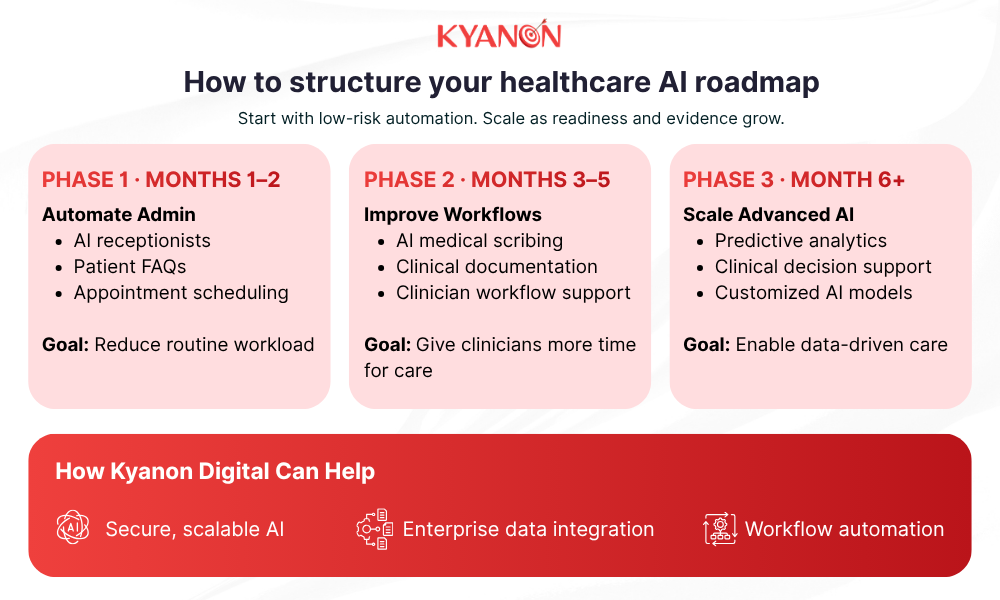
How to structure your healthcare AI roadmap
Healthcare institutions can reduce implementation risk and validate ROI through a phased AI adoption roadmap:
- Phase 1 (Months 1–2): Automate Administrative Tasks. Deploy AI receptionists and chatbots to handle appointment scheduling, FAQs, and routine patient inquiries.
- Phase 2 (Months 3–5): Improve Clinical Workflows. Introduce AI medical scribing to reduce documentation workloads and give clinicians more time for patient care.
- Phase 3 (Month 6+): Integrate Advanced AI. Invest in predictive analytics, clinical decision support, and customized AI models as data readiness and governance mature.
How Kyanon Digital can help: Kyanon Digital supports healthcare enterprises in building secure, scalable AI solutions, integrating enterprise data, and automating workflows. Start with a focused use case, measure business outcomes, and scale AI investment based on proven results.
Case study: Scaling Customer Service with an AI Chatbot for Healthcare
Kyanon Digital helped a healthcare provider improve customer service through an AI-powered chatbot that automates routine enquiries, retrieves approved healthcare service information, and routes complex requests to human staff.
Key challenges
- Growing customer-service workload: Routine inquiries about appointments, locations, services, operating hours, and administrative procedures consumed significant agent capacity.
- Fragmented service knowledge: Information was distributed across documents, systems, and teams, making fast and consistent responses difficult.
- Limited self-service: Many straightforward questions still required direct staff assistance.
- Manual request routing: Agents had to classify and redirect inquiries to the appropriate teams.
- Inconsistent responses: Customers could receive different information depending on the agent or channel.
- Rising cost-to-serve: Higher enquiry volumes risked requiring proportional increases in customer-service headcount.
- Need for responsible AI controls: Medical, sensitive, or unsupported questions require clear human-escalation rules
Results & business impact
- 38% reduction in routine manual inquiries: Automated common customer-service questions, freeing agents to focus on interactions requiring greater judgment or coordination.
- 32% faster response times: Gave customers quicker access to routine service and administrative information.
- 28% of eligible enquiries resolved through self-service: Reduced dependency on direct agent support for straightforward requests.
- 24% reduction in repetitive agent workload: Increased capacity for customer-service teams to handle more complex cases.
Explore the full case study here: Scaling Customer Service with an AI Chatbot for Healthcare
Partnering with the right Singapore AI developer
Healthcare AI requires more than software development. The right partner should understand clinical workflows, healthcare data interoperability, patient data security, and Singapore’s regulatory requirements.
Kyanon Digital helps healthcare enterprises build secure, scalable AI solutions, from workflow automation and AI assistants to enterprise data integration. Our team aligns implementation with your operational needs, data governance requirements, and long-term AI roadmap.
Ready to explore AI opportunities for your healthcare organization? Contact Kyanon Digital for a consultation to assess your workflows, identify high-impact use cases, and define a practical implementation roadmap with a clear project scope and cost estimate.
References
- Emerging Regulatory Policy Issues: Artificial Intelligence in Healthcare – Ministry of Health (MOH), Singapore, 2026.
- Overview of the Health Information Act – Singapore Health Information Act, 2026.
- Cybersecurity and Data Security – Singapore Health Information Act, 2026.
- Singapore Digital Economy Report 2025 – Infocomm Media Development Authority (IMDA), 2025.
- Enterprise Development Grant (EDG) – Enterprise Singapore, accessed 2026.
- Monitoring Deployed AI Systems in Health Care – arXiv, 2025; indexed in PubMed Central, 2026.
- HL7 FHIR: Fast Healthcare Interoperability Resources – Office of the National Coordinator for Health Information Technology, 2026.
- Software Development Outsourcing Services – Kyanon Digital
- Systematic Review of Cost Effectiveness and Budget Impact of AI in Healthcare — npj Digital Medicine, 2025.
- Scoping Review on the Economic Aspects of Machine Learning Applications in Healthcare — International Journal of Medical Informatics, 2025.
- Data & AI Salary Guide 2026 — Pearson Carter, 2026.
- Singapore Ai In Healthcare Market Size & Outlook, 2026-2033 – Grand View Horizon



 Create project brief with AI