

To hire AI developers effectively, manufacturers should first define their specific use cases to match the necessary AI, data, OT/IT, and deployment capabilities. Comparative sourcing models, scenario-based assessments with industrial data, and dedicated or offshore teams allow companies to gain specialized skills without building every role internally.
Drawing from Kyanon Digital’s enterprise experience, this guide explains how to recruit dedicated AI developers for manufacturing, from sourcing models to practical vetting. Kyanon Digital also supplies dedicated AI teams across development, data, integration, and deployment to support scaling.
Key takeaways
- Clarifies why most logistics AI projects stall at the integration phase. In Kyanon Digital’s experience, models fail if developers do not understand how goods actually move through legacy WMS or ERP workflows.
- Debunks the idea that high laboratory accuracy guarantees a successful rollout. Real-world deployments show that an AI solution only survives if developers can first master messy, real-time sensor data and sudden operational shifts.
- Warns against choosing a sourcing model before mapping internal capability gaps. The Kyanon Digital team applies this sequencing rule because scaling only pays off when the engagement matches your long-term delivery requirements.
- Explains how to restructure candidate vetting to prioritize system architecture and MLOps. Enterprise standards dictate that developers must prove they can manage data drift before they are granted access to live supply chain operations.
Further reading:
- Logistics Data at Source: Why Input Quality Matters
- Logistics Automation with AI: What Works in 2026
- Digital Platform Transformation in the Maritime & Logistics Sector
Why hiring AI developers for logistics isn’t a standard dev hire
Hiring AI developers for logistics is different from hiring for a typical software project. The solution needs to work with existing ERP, WMS, and TMS systems while fitting into real operational processes. This means developers need to understand not only how to build AI models, but also how logistics teams move goods, manage inventory, plan routes, and respond to operational changes.
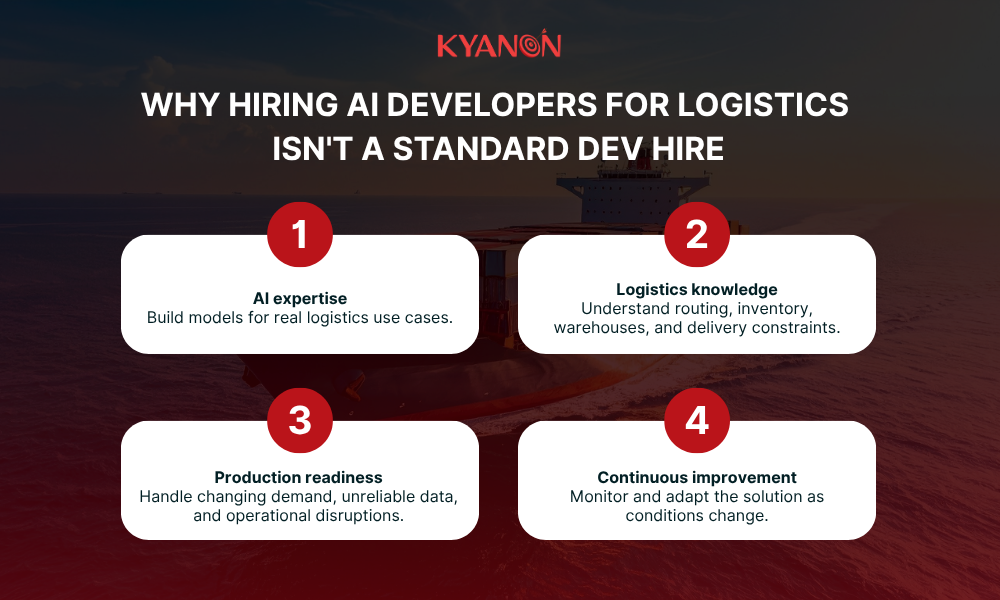
Successful logistics AI bridges AI models, operational workflows, and continuous production support. The biggest risk is an AI solution that performs well in testing but struggles after go-live. Changing demand, inaccurate tracking data, delivery disruptions, and system differences can quickly affect results.
Enterprise hiring should therefore assess four areas: AI capability, logistics understanding, integration skills, and production readiness.

Enterprise sourcing models for AI logistics talent: Quick comparison
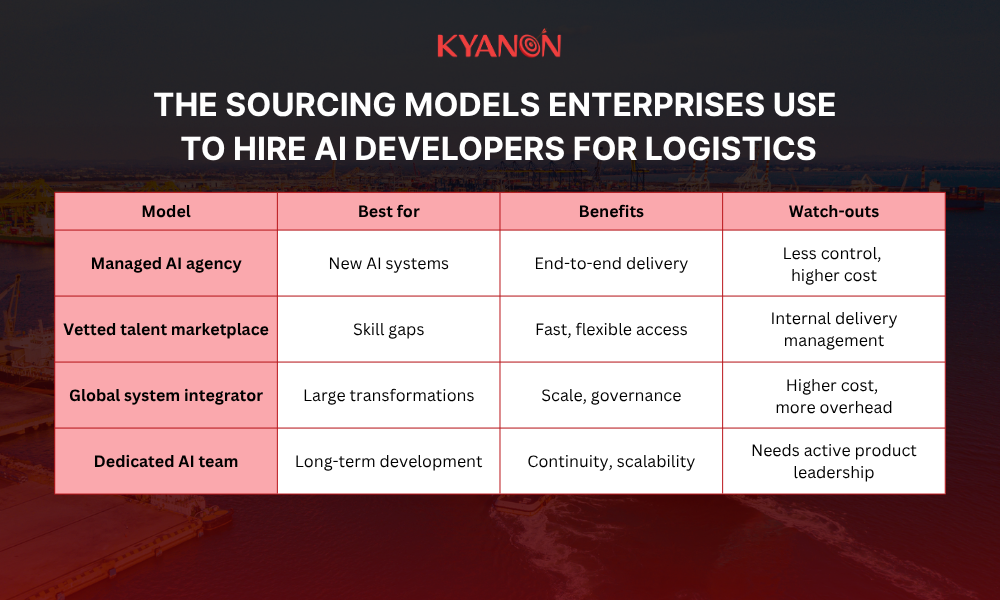
Enterprises can use four main sourcing models when hiring AI developers for logistics transformation. The right choice depends on the project scope, how quickly the business needs to move, and how much delivery responsibility the internal team wants to retain.
Comparison of enterprise sourcing models for AI logistics talent
Sourcing model | Best for | Speed to start | Cost profile | What you get | Watch-outs |
| Managed AI agency | Large system changes, custom AI solutions, predictive capabilities | Shorter than large-scale transformations | Higher, project-based | End-to-end team and delivery | Less day-to-day control; vendor dependency |
Vetted talent marketplace | Adding specialist AI skills to an existing team | Fast, depending on talent availability | Flexible, per specialist | Pre-vetted individual specialists | Internal team manages direction and integration |
| Global system integrator (GSI) | Large-scale ERP and multi-region transformations | Longer, enterprise-scale engagement | Higher enterprise-level cost | Enterprise delivery, governance, and change management | Higher process overhead; less suitable for focused projects |
Dedicated AI team | Long-term AI product development and continuous scaling | Faster to scale than building internally | Predictable, team-based | Dedicated team aligned with the roadmap | Requires clear goals and an engaged product owner |
No model is universally better. GSIs may add unnecessary processes to a focused pilot, while individual specialists may not provide enough coordination for a complex transformation.
The right choice depends on project scope, internal capability, business priorities, and the level of ownership the enterprise wants to retain.
Not sure which delivery model fits your logistics AI initiative?
Kyanon Digital can help assess your scope, internal capabilities, and team requirements. Contact us today!
Which AI specialists do logistics enterprises need?
The right team depends on the use case. Enterprises may need different combinations of AI, data, integration, MLOps, and logistics skills rather than a single “AI developer” profile.
Core specialist roles for logistics use cases
| Logistics use case | Core specialist roles |
Route optimization & ETA prediction | ML Engineer, Data Scientist, Optimization Specialist |
| Demand & inventory forecasting | Data Scientist, ML Engineer, Data Engineer |
Warehouse automation | AI/ML Engineer, Computer Vision Engineer, Robotics Engineer |
| Shipment & fleet monitoring | ML Engineer, Data Engineer, IoT Engineer |
AI-powered document processing | AI Engineer, NLP/LLM Engineer, Data Engineer |
| Supply chain planning & decision support | Data Scientist, ML Engineer, Supply Chain Specialist |
AI agents & logistics copilots | AI Engineer, LLM/Agent Engineer, Integration Engineer |
| Enterprise AI deployment & operations | MLOps Engineer, Cloud Engineer, Integration Engineer |
Enterprises rarely need one AI profile for an entire logistics program. Define the team around the use case, then combine AI, data, integration, MLOps, and logistics capabilities as needed.
The sourcing models enterprises use to hire AI developers for logistics
Enterprises typically choose between managed delivery, specialist augmentation, GSIs, and dedicated AI teams. The right model depends on internal capability, project scope, time-to-market, and desired control.
Managed AI agencies: Best for net-new systems without an internal AI team
Managed AI agencies take responsibility for the AI build, from planning and development through deployment and integration.
Best for:
- New AI capabilities
- Custom generative AI tools
- Predictive analytics built from scratch
When evaluating an agency, look for production experience, logistics integration, data and MLOps capabilities, and clear post-launch ownership.
Pros:
- End-to-end delivery accountability
- Faster access to specialized expertise
- No need to build an internal AI team
Cons:
- Less day-to-day control
- Higher project costs
- Potential vendor dependency
Verdict: Best when you need a new AI capability without an internal team to deliver it.
Talent marketplaces: Best for rapid team augmentation
Vetted talent marketplaces provide quick access to individual AI specialists. They work best when the enterprise already has delivery leadership but needs additional expertise.
Best for: Adding 2–3 senior ML specialists to an existing project.
Platforms such as Toptal, Turing, and Arc.dev provide pre-vetted specialists and flexible contracts. The enterprise retains responsibility for priorities, integration, and delivery quality.
Pros:
- Fast access to specialists
- Flexible engagement
- Greater control over resource allocation
Cons:
- Internal team retains delivery responsibility
- Less coordination than a dedicated team
Verdict: Best when an established team needs specialist support to close specific skill gaps.
Global system integrators: Best for multi-continent ERP transformations
Global System Integrators (GSIs) fit large programs where AI is part of a broader ERP, technology, or operating-model transformation.
Best for: Multi-country programs requiring enterprise governance, security, and change management.
Organizations such as Accenture, Capgemini, Infosys, and Wipro provide enterprise-scale delivery, governance, security, and change management.
The trade-off is scale. For a focused AI use case or regional pilot, the additional governance may make delivery slower and more expensive.
Pros:
- Strong enterprise governance
- Global delivery scale
- Structured risk and change management
Cons:
- Higher overall costs
- Longer decision and delivery cycles
- More process overhead
Verdict: Best for large, board-level transformations where scale and governance are critical.
Dedicated AI development teams: Best for a committed, scalable build partner
A dedicated AI team works continuously on an enterprise’s roadmap, offering higher continuity than individual specialists while preserving internal product ownership.
Best for: Long-term logistics AI development requiring evolving team capacity.
Composed of AI, data, MLOps, and software specialists alongside a project lead, the team builds deep context over time around operations, workflows, and enterprise systems.
Pros:
- Predictable, flexible cost
- Stronger continuity and business context
- Scalability as priorities change
- Internal product ownership
Cons:
- Requires a clear roadmap and engaged product owner
- Needs ongoing business-partner alignment
Verdict: Ideal for building a committed team that scales while keeping direction in-house.
How to hire AI developers for logistics: An enterprise roadmap
Choosing a sourcing model is only the beginning. Enterprises also need to define the capabilities to hire and validate them against the AI initiative.
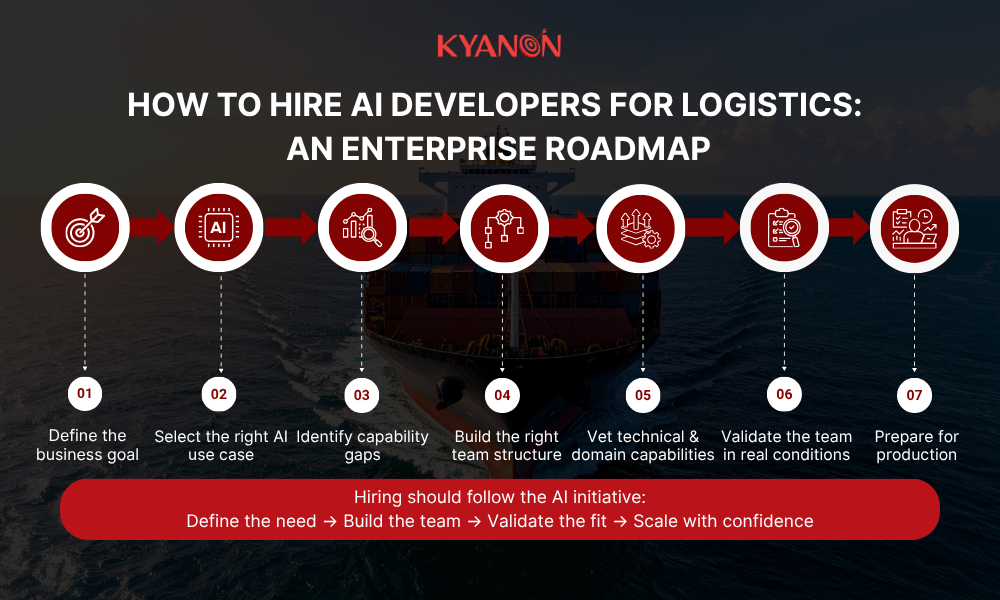
Gartner’s 2026 AI roadmap outlines sequencing initiatives from business alignment to scaling. For logistics enterprises, it offers a framework to align hiring directly with the AI strategy rather than as a standalone task.
Sourcing models comparison
Roadmap stage | What it means for hiring AI developers | Key output |
| 1. Align with business goals | Define the logistics problem AI needs to solve and the business outcome expected | Clear AI objective |
2. Prioritize the use case | Assess potential value, feasibility, data readiness, and operational impact | Prioritized use case |
| 3. Assess capability gaps | Compare existing internal capabilities with the skills needed to deliver the use case | Capability gap assessment |
4. Plan talent and resourcing | Define the required AI, data, engineering, MLOps, and logistics roles and determine what should be sourced externally | Team and resourcing plan |
| 5. Evaluate candidates or teams | Assess shortlisted developers or delivery teams against technical, domain, integration, and production requirements | Qualified shortlist |
6. Pilot and validate | Use a controlled PoC to test the proposed team and solution against representative logistics conditions | Validated business and technical fit |
| 7. Prepare to scale | Establish governance, engineering, data, and operating requirements before expanding the solution | Production-ready AI capability |
The hiring decision should follow the initiative’s requirements: define the outcome, identify capability gaps, choose the team structure, then validate candidates through a controlled pilot.
How enterprises vet AI developers: The technical screening matrix
Enterprise logistics hiring should assess more than model-building ability. Leaders need to know whether developers can work with operational data, existing systems, and changing conditions.
Shift the hiring benchmark from laboratory model accuracy to production readiness, focusing on system integration, MLOps, and real-world operational reliability.
A practical vetting process can be split into two phases: technical screening first, followed by system architecture and production-readiness review.
Technical screening matrix for enterprise logistics projects
Evaluation phase | Focus area | Assessment methods | What to look for |
| Phase 1: Technical screening | Data and algorithms | Portfolio review; practical coding; model-building exercise | Strong data handling, clear problem-solving, practical model development |
Phase 2: System architecture | Deployment and integration | Enterprise deployment and integration scenarios | Scalable deployment, reliable integrations, manageable operating requirements |
| Phase 3: MLOps and governance | Model health and data drift | Monitoring and retraining scenarios | Ability to detect performance changes and maintain reliability after launch |
Live coding and algorithmic screening
Focus on how candidates solve realistic business problems rather than generic coding tests. For logistics use cases, candidates can work with shipment, inventory, location, traffic, or other operational data and explain how they would turn it into a working AI solution.
The goal is to identify developers who can work with production-grade data, not simply perform well on clean test datasets.
System architecture and MLOps review
The next phase examines what happens after the model is built. Candidates should explain how the solution would fit existing systems, scale with business volume, and remain reliable after launch.
Assess cloud deployment, system integration, scalability, monitoring, data drift, and retraining approaches.
The key question is not which technology a candidate uses, but whether the solution can support operations without creating new reliability, cost, or maintenance issues.
Production readiness matters more than laboratory accuracy
A model that performs well in testing may still fail in production if it cannot integrate with existing operations, handle changing data, scale with demand, or be monitored after launch.
For enterprise leaders, production readiness should be the real hiring benchmark.
Need to vet AI developers for real-world logistics requirements?
Discuss your WMS, TMS, ERP, data, and MLOps needs with Kyanon Digital. Contact us today!
Testing for logistics domain expertise (not just AI skill)
Strong AI skills do not automatically translate into strong logistics outcomes. Enterprise interviews should therefore test how candidates approach real supply chain problems, not just how well they build models.
Effective technical vetting must test domain-specific capabilities like route optimization, legacy WMS integration, and the processing of messy, real-time sensor data.
Test 1: Dynamic route optimization
Ask candidates to optimize routes for around 500 trucks while accounting for traffic, weather, driver hours, vehicle capacity, and delivery windows.
The goal is not simply to find the shortest route. Candidates should explain how they would balance delivery time, operating costs, customer commitments, and changing conditions.
Test 2: Legacy WMS integration
Ask candidates how they would work with an older, on-premise WMS or ERP without disrupting daily operations.
A strong candidate should explain how operational data can be connected to the AI solution while keeping existing warehouse processes running.
Test 3: Messy IoT and sensor data
Logistics AI may use GPS, cold-chain sensors, or RFID data. These streams can be incomplete, delayed, duplicated, or inaccurate.
Candidates should explain how they would identify and manage unreliable data before it affects shipment visibility, inventory decisions, or predictive models.
Why these tests matter
These tests expose three common logistics AI risks: unrealistic recommendations, disruption to existing operations, and unreliable data.
Candidates who can connect AI decisions to routes, warehouse operations, and real-world data are more likely to build solutions that work beyond the testing environment.
Compliance and onboarding: How enterprises de-risk AI in supply chains
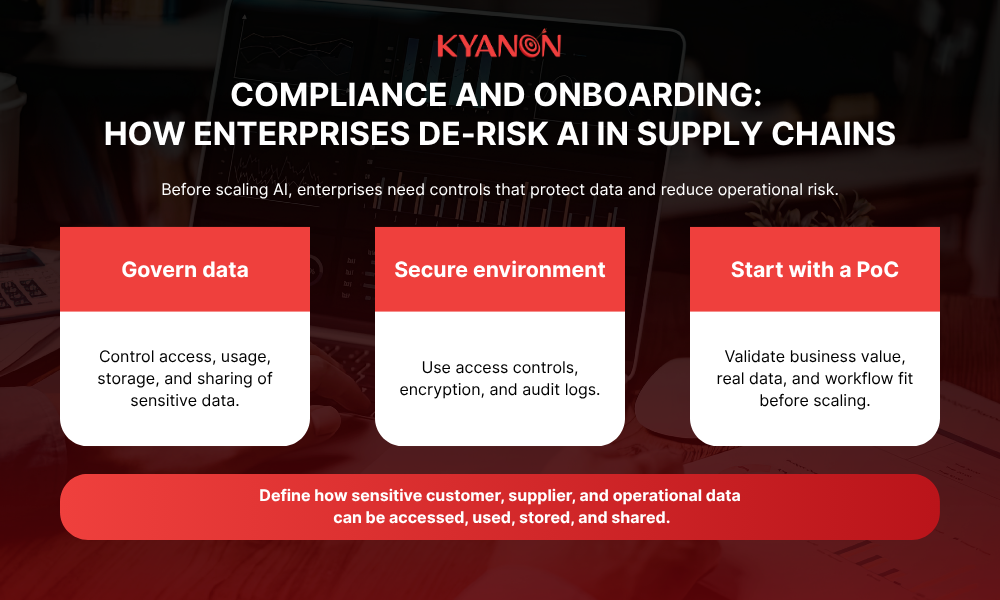
AI projects can involve sensitive customer, supplier, and operational data. Enterprises need clear controls before external developers or partners access production environments, along with a rollout strategy that proves value before wider deployment.
Data governance and security standards
Supply chain AI involves sensitive customer, commercial, and operational data. Before external developers or partners access it, enterprises must establish clear governance rules for access, usage, storage, and sharing.
Key requirements include compliance standards like GDPR or CCPA, robust access controls, encryption, and audit logs to protect data and prevent privacy, security, or compliance risks.
Phased rollout strategy: Proof of concept to scale
Enterprises rarely deploy a new logistics AI solution across every region at once. A safer approach is to start with a Proof of Concept (PoC) in one warehouse or shipping corridor, using clear operational and financial targets to measure its value.
The PoC can show whether the solution works with real data, fits existing workflows, and delivers the expected business results. It also gives the enterprise an opportunity to evaluate the development team or partner before making a larger commitment.
Once the PoC meets agreed success criteria, the solution can be expanded gradually across more warehouses, routes, or regions. This approach helps enterprises control investment, manage operational risk, and build confidence before scaling AI across the wider supply chain.
Planning a logistics AI PoC?
Kyanon Digital can help define the use case, success criteria, data, and integration requirements. Contact us today!
How to choose the right way to hire AI developers for logistics
There is no single hiring model that works for every logistics AI project. The right choice depends on what the business can manage internally, how complex the initiative is, and how much control leaders want to retain.
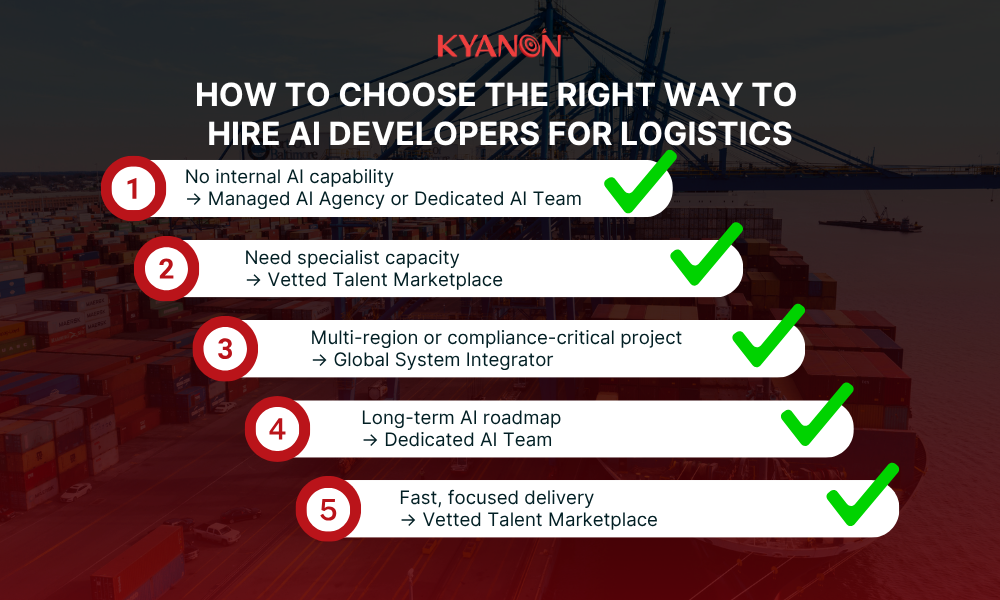
Whatever model you choose, use a scoped PoC to test whether the team can work with your data, understand your operations, and deliver measurable results.
A successful PoC provides evidence before a larger commitment and helps reduce delivery risk as the solution moves toward production.
Case study: How Kyanon Digital implemented intelligent AI automation for enterprise supply chain operations
Intelligent automation can drive significant operational efficiency by integrating AI with existing enterprise infrastructure like ERP and POS systems.
Kyanon Digital partnered with a leading Singapore-based retail enterprise to modernize supply chain and finance operations across retail stores, eCommerce, and B2B wholesale channels. The solution integrated AI-powered automation with the client’s existing SAP, POS, and omnichannel infrastructure.
The challenge:
Handling thousands of daily transactions manually across fragmented systems caused reconciliation bottlenecks, fulfillment gaps, and poor supply chain visibility for the retailer.
The solution:
Kyanon Digital implemented an intelligent supply chain automation platform featuring:
- Extracted supplier, invoice, purchase order, and delivery data from various formats and routed it into SAP.
- Used bots to match invoices, goods receipts, and ERP records, flagging discrepancies for review.
- Synced SAP, POS, eCommerce, and B2B systems for accurate cross-channel inventory visibility.
- Standardized integrations to onboard new suppliers and channels without extra manual overhead.
The impact:
- 90% reduction in manual data entry.
- Reduced supplier invoice processing time from days to under 30 minutes.
- Reduced omnichannel inventory discrepancy incidents by over 80%.
- Enabled supply chain processes to handle growing supplier and channel complexity without proportional increases in headcount.
Read more: Scaling Singapore Retail Operations with Intelligent Supply Chain Automation
Trends shaping how enterprises hire AI talent for logistics
AI adoption is changing what enterprises expect from logistics talent. In 2026, hiring decisions increasingly emphasize production readiness, operational integration, and safe scaling.
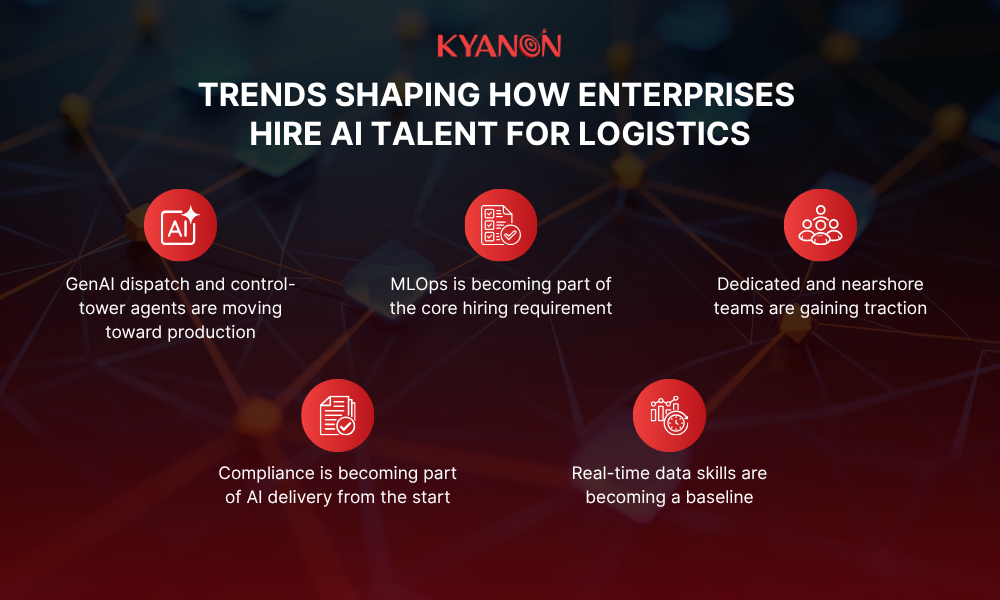
Emerging priorities include production-ready GenAI, MLOps, real-time data, and compliance-first delivery.
- GenAI and agentic solutions are moving toward production: Enterprises are exploring AI for dispatch, planning, and operational decision support, increasing demand for developers who understand both traditional ML and GenAI.
- MLOps is becoming a core requirement: Developers need to monitor performance, manage changing data, and maintain reliability after go-live.
- Dedicated and nearshore teams are gaining traction: For mid-size transformations, these models can provide specialist talent, team continuity, and more predictable delivery costs than some larger GSI engagements.
- Compliance is becoming part of AI delivery: Privacy, governance, and data sovereignty increasingly influence how enterprises evaluate external AI teams.
- Real-time data skills are becoming more important: Logistics AI depends on constantly changing information from vehicles, warehouses, and connected devices.
Final thoughts
For enterprise logistics teams, hiring the right AI developers is about more than technical skills. The team must understand logistics operations, work with existing enterprise systems, manage real-world data, and support AI after go-live.
The key question is simple: Can this team turn AI capability into reliable operational outcomes?
Before scaling, enterprises should validate the sourcing model, team structure, technical capabilities, integration requirements, and PoC scope against the intended business outcome.
Planning a logistics AI initiative but unsure what team or delivery model you need?
Contact Kyanon Digital to get help mapping your use case to the right AI capabilities, team structure, integration requirements, and PoC approach before you commit to a larger engagement.




 Create project brief with AI